Relevance in 2026 and Beyond
Ancient Trade Wisdom for Modern Supply Chains
How the teachings of the Silk Road and Central Asian trade apply to modern life, from supply chain resilience to cultural exchange in a globalized world.
The Silk Road Never Ended
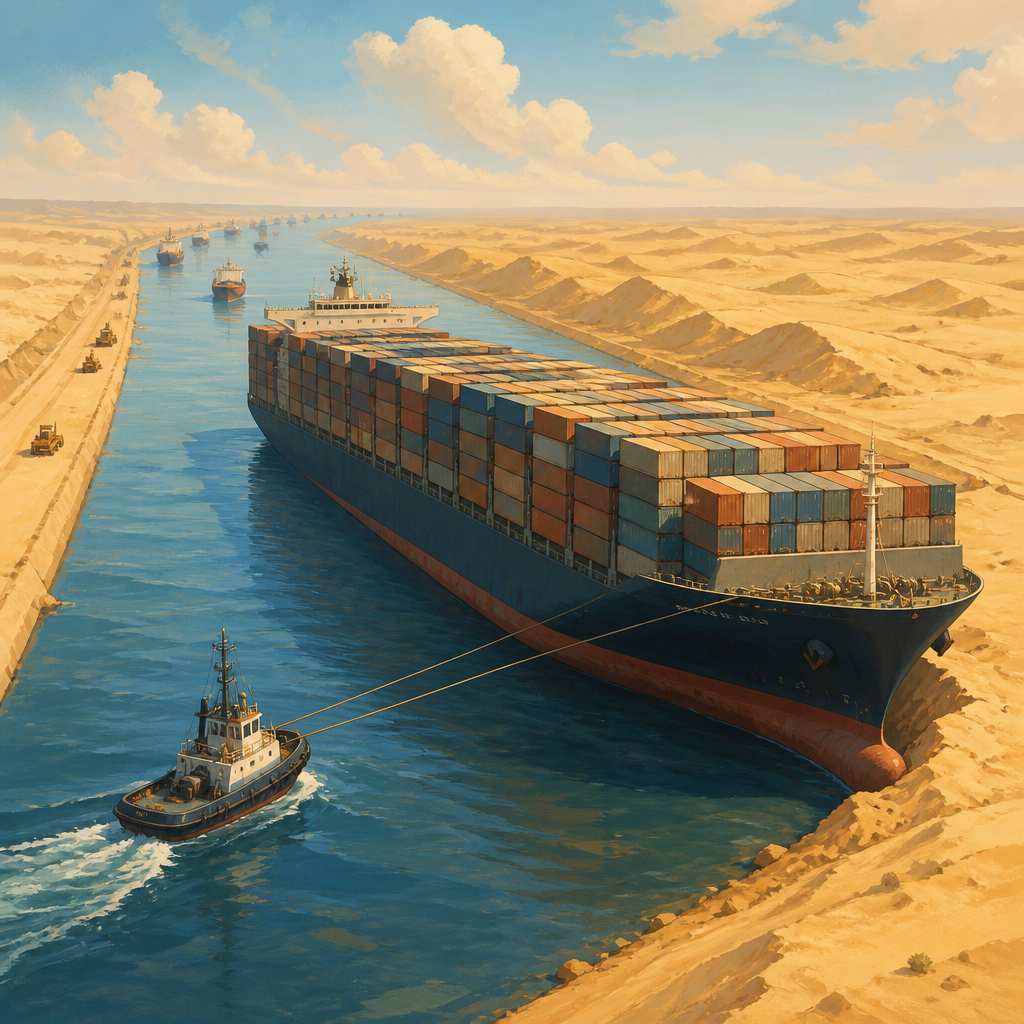
In March 2021, a single container ship, the Ever Given, ran aground in the Suez Canal. For six days, global trade froze. An estimated $9.6 billion worth of goods sat waiting each day. Supply chains across the world stumbled. Suddenly, the ancient question echoed with modern urgency: How do you move goods safely across vast distances?
The executives scrambling for solutions faced challenges their ancestors would have recognized: route dependencies, choke-point vulnerabilities, the need for alternatives. The Silk Road's lessons hadn't become irrelevant, they'd become invisible, embedded in systems so complex we'd forgotten their foundations.
This chapter has traced the Silk Road and Central Asian trade from ancient caravans to modern corridors. Now we bring these teachings home: What do these ancient patterns mean for you, in 2026 and beyond?
Five Enduring Principles
Across six lessons, we've uncovered principles that transcend eras:
1. Create Irreplaceable Value
Ancient India dominated Silk Road trade because it produced goods no one else could, pepper, muslin, wootz steel. Rome bled gold because it couldn't replicate Indian excellence.
Modern Application: In a world of commoditization and AI automation, irreplaceable value becomes more important, not less. The skills and offerings that can be easily copied or automated will be. The question for every professional: What can you do that others cannot easily replicate?
Your Action: Identify and cultivate your comparative advantage. It might be a skill combination (technical plus communication), domain expertise (deep knowledge of specific industries), or relationship access (trusted connections others lack). Protect and develop what makes you irreplaceable.
2. Position Yourself at Junctions
The Kushan Empire prospered by controlling where trade routes converged. Takshashila thrived where roads, ideas, and commerce intersected.
Modern Application: In a networked economy, junction positions command disproportionate value. Platform companies (Amazon, Uber, Google) capture value by positioning at convergence points. So do individuals, the people who bridge departments, connect industries, or translate between domains.
Your Action: Map the junctions in your professional field. Where do information flows converge? Where do decisions get made? Who bridges different communities? Position yourself at these nodes through building connections, developing relevant expertise, and being useful to those who control access.
3. Build Trust Infrastructure
Silk Road commerce depended on trust infrastructure, guilds that vouched for members, sarayas that protected goods, customs systems that created predictability.
Modern Application: Every transaction requires trust. Digital trust infrastructure (reviews, ratings, blockchain verification, regulatory compliance) serves the same function as ancient guilds. Your personal trust infrastructure, credentials, track record, references, determines which opportunities open to you.
Your Action: Invest in your trust infrastructure. Build credentials that signal competence. Maintain reputation by delivering consistently. Cultivate relationships with people who will vouch for you. Document achievements so trust is portable across contexts.
4. Ideas Travel on Commercial Infrastructure
Buddhism spread along Silk Road trade routes. Indian mathematics reached Arabia through merchant contacts. Commerce and culture intertwined inseparably.
Modern Application: Your ideas will spread through your networks. The quality of your insights matters less than the reach of your connections. Great work in isolation stays isolated. Mediocre work with great distribution often wins.
Your Action: Develop your "distribution infrastructure." This might mean building online presence, joining professional communities, attending conferences, or cultivating relationships with well-connected people. Create content that travels. Be generous in sharing what you know.
5. Alternatives Create Freedom
When one Silk Road branch became dangerous or expensive, merchants developed alternatives. IMEC exists because BRI monopoly would constrain choices. Options create power.
Modern Application: Dependence on single employers, single clients, single skills, or single income sources creates vulnerability. Professionals with alternatives negotiate from strength; those without accept what they're given.
Your Action: Deliberately build optionality. Develop multiple skill sets. Cultivate relationships outside your current organization. Maintain financial reserves that let you walk away. Always know your next-best alternative.
The New Trade Routes: Where to Position
As you consider your career and investments through 2026 and beyond, several structural shifts deserve attention:
Supply Chain Reorganization
COVID-19 exposed over-dependence on single suppliers. Companies are diversifying, the "China Plus One" strategy. This creates opportunity in:
- India's manufacturing sector: PLI schemes attracting electronics, textiles, pharma manufacturing
- Logistics and warehousing: Delhivery, other logistics startups building infrastructure
- Professional services: Legal, consulting, finance supporting foreign investment
IMEC and Connectivity Projects

IMEC's completion (projected 2030s) will reshape India-Europe trade. Early positioning matters:
- Port cities: Mumbai, Mundra, Kandla will see increased traffic
- Manufacturing corridors: Gujarat, Maharashtra, Karnataka along connectivity routes
- Skills: Trade finance, customs/compliance, logistics technology
The Digital Silk Road
Alongside physical infrastructure, digital connectivity creates new trade routes:
- IT services exports: Already $227 billion (FY2023), growing rapidly
- Digital platforms: UPI, IndiaStack creating infrastructure others will use
- Knowledge services: Design, research, consulting following manufacturing
Personal Practice: Your Silk Road Strategy
Take 30 minutes to work through this strategic exercise:
Step 1: Map Your Comparative Advantage
- What can you do that few others can?
- What do people consistently come to you for?
- Where do your skills/knowledge/access exceed market rates?
Step 2: Identify Your Junctions
- What communities/groups do you bridge?
- What information flows through you?
- Where in organizational decision-making do you sit?
Step 3: Audit Your Trust Infrastructure
- What credentials signal your competence?
- Who would vouch for you? How readily?
- How portable is your reputation?
Step 4: Assess Your Distribution
- How do your ideas/work reach others?
- Who amplifies what you create?
- What platforms carry your expertise?
Step 5: Count Your Alternatives
- If you left your current role, what would you do?
- How many income sources do you have?
- How many months could you survive without current income?
For each dimension, rate yourself 1-10 and identify one specific action to improve.
Case Study: The Modern Sarthavaha

Rajesh graduated from a tier-2 engineering college in 2015. He took a job at a small IT services firm in Pune, earning Rs 25,000/month. Unremarkable beginning.
But Rajesh applied Silk Road principles deliberately:
Irreplaceable Value: He noticed that clients struggled to bridge Indian development teams and American business stakeholders. He developed both technical skills AND business communication, a combination rare in India's IT industry.
Junction Position: Rather than choosing pure development or pure management, he positioned himself as the translator between them, attending both engineering reviews and client meetings.
Trust Infrastructure: He documented every project outcome, built LinkedIn presence around his niche, and systematically collected recommendations from American clients who valued his bridging role.
Distribution: He wrote medium posts about cross-cultural technology management that reached potential clients before they knew they needed him.
Alternatives: He maintained consulting relationships with former clients even while employed, building a parallel income stream.
By 2024, Rajesh runs a 50-person consultancy specializing in US-India technology partnerships, earning more in a month than he made in his first year of work.
Rajesh isn't uniquely talented. He applied ancient principles to modern contexts.
India's Civilizational Opportunity
At the civilizational level, India stands at a historical inflection point. For the first time in 500 years, the country has both:
- Scale: 1.4 billion people, youngest major population, rising middle class
- Connectivity: IMEC, Gati Shakti, digital infrastructure creating global links
- Capability: Manufacturing potential, IT excellence, educational depth
The Silk Road era saw India as the world's manufacturing hub, the source of goods everyone wanted, the junction through which ideas flowed. That position is attainable again, but not guaranteed.
The difference between the India of 2050 being a prosperous, influential civilization and being a disappointed also-ran lies in decisions being made now: investments in infrastructure, education, manufacturing capability, and institutional quality.
As individuals, we can position ourselves for either outcome. As citizens, we can advocate for the policies that maximize India's opportunity. As inheritors of a trading civilization, we can draw on millennia of wisdom about how prosperity is built.
Your Next Steps
Complete the Personal Practice exercise above. Identify one weakness and one action to address it.
Share one insight from this chapter with someone in your professional network. Ideas spread through networks; be a node that spreads valuable knowledge.
Apply one principle from the chapter in your work this week. Small experiments compound into major changes.
Research one IMEC/connectivity-related opportunity relevant to your field. Early awareness creates positioning advantage.
Reflect on your ancestors' trading heritage. Whether merchant caste or not, every Indian family has some connection to the trade networks that built civilization. Consider how that heritage might guide your modern choices.
Closing: The Road Continues
The Roman Senator who complained about gold flowing to India, the Kushan emperor collecting tolls at the junction, the sarthavaha approaching the saraya at dusk, the Buddhist monk carrying sutras to China, all faced challenges that echo in your life today.
How do you create value that others cannot replicate? How do you position yourself at junctions where opportunity flows? How do you build trust that opens doors? How do you spread your ideas through networks? How do you maintain the freedom that comes from alternatives?
These questions connected the ancient Silk Road to your modern career. The answers have always been the same: provide genuine value, position strategically, build trust carefully, share generously, and maintain independence fiercely.
The Silk Road never ended. It just changed form. The caravans became container ships; the sarayas became logistics hubs; the guilds became LinkedIn profiles; the shulka became GST. But the principles endure, because they're not really about trade routes at all. They're about how humans cooperate across distance and difference to create mutual prosperity.
That's the heritage you inherit. That's the wisdom you can apply. The road stretches before you. Where will you walk?