Shrivijaya-Vijaya: Controlling the Malacca Straits

Administering Maritime Empire

Winning wars is one thing; administering conquered territories is another. How the Cholas transformed military victory into lasting commercial dominance, replacing Srivijaya's extraction model with a trade-enabling system that Tamil merchants dominated for decades.

After the Victory
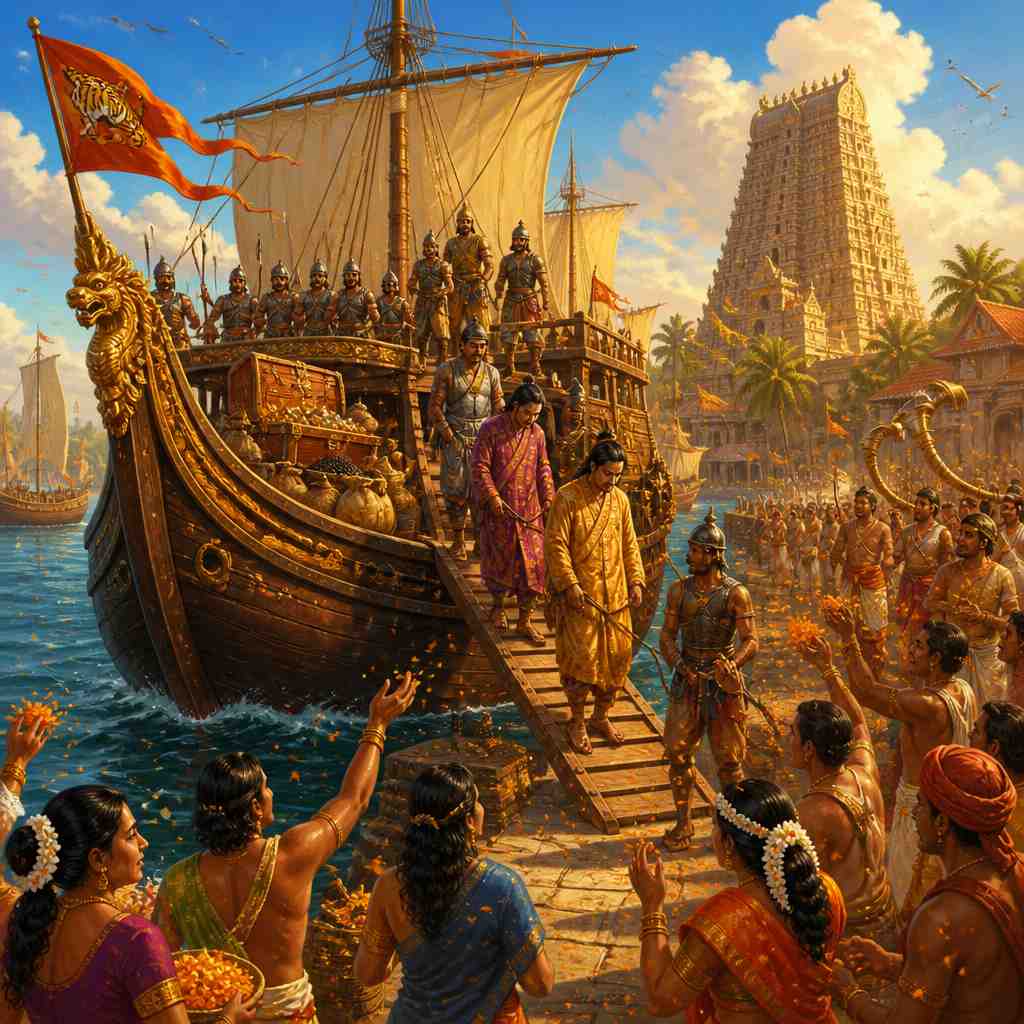
Chola fleet returning triumphant to Nagapattinam

The Chola fleet returned to Nagapattinam in late 1025 CE with captured Srivijayan princes, treasure ships, and control of fourteen Southeast Asian ports. Rajendra Chola I had won the war. But a question remained: how do you govern territory 2,500 kilometers from your capital?

The challenge was unprecedented. The Cholas had conquered land empires before, the Pandyas, the Cheras, Sri Lanka. But those could be governed through familiar mechanisms: appointed governors, garrisoned troops, regular tribute collection. The Malacca territories were different. They were too far for direct administration, too valuable to abandon, and too complex to rule by force alone.

Rajendra's answer would prove as strategic as his naval campaign: govern through commerce, not conquest.

The Srivijayan System: What the Cholas Replaced

To understand what the Cholas built, we must first understand what they dismantled.

Srivijaya had controlled the Malacca Straits for three centuries (7th-10th century CE) through a simple model:

Element Srivijayan Approach
Revenue 40% transit tolls on all cargo
Enforcement Naval patrols; confiscation of non-compliant ships
Local rulers Subordinated through military threat
Merchant communities Taxed heavily; no representation
Infrastructure Minimal; ports as extraction points

This model was profitable but brittle. Srivijayan merchants had no stake in the system, they were subjects, not partners. Local Malay rulers chafed under foreign domination. And the high tolls encouraged smuggling and alternative routes.

When the Chola fleet appeared, Srivijaya discovered it had no allies. Local rulers defected. Merchant communities welcomed the invaders. The empire collapsed in weeks, not because the Cholas were invincible, but because Srivijaya had built extraction without loyalty.

The Chola Alternative: The Manigramam Model
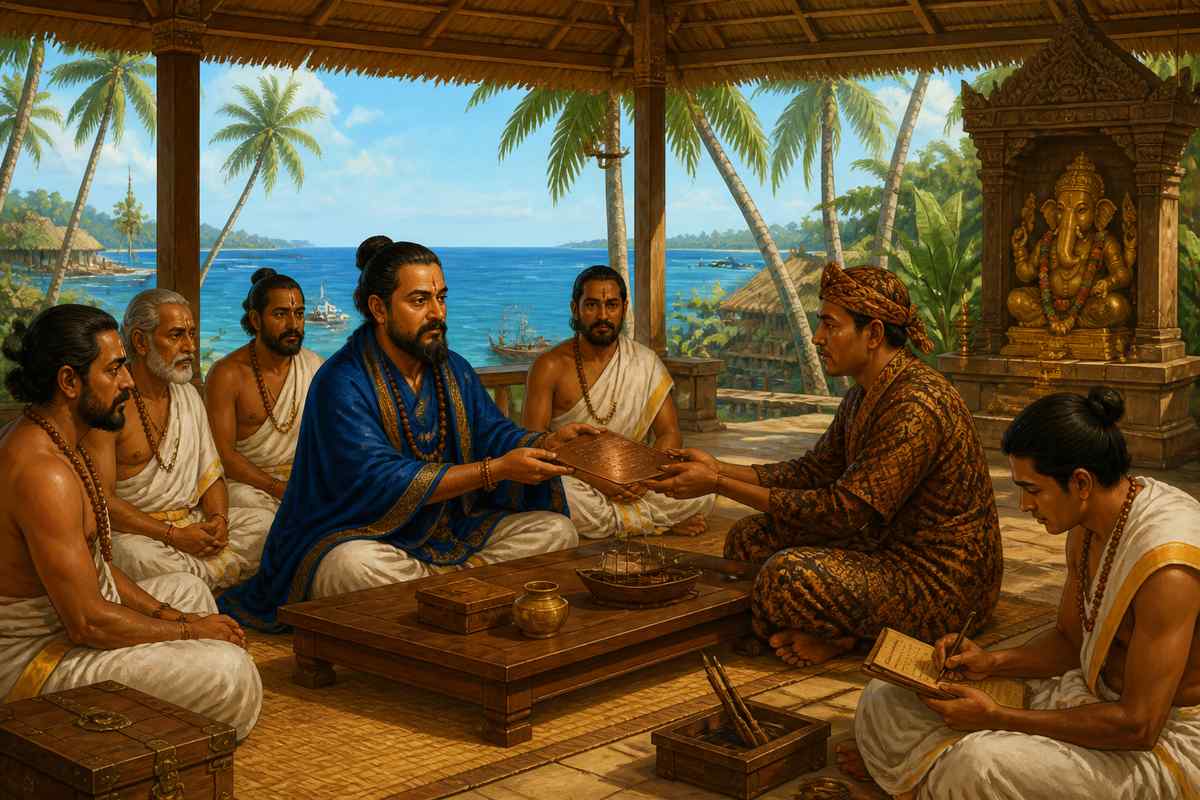
Tamil Manigramam guild meeting on the Sumatran coast

The Cholas replaced Srivijaya's extractive system with something far more sophisticated: merchant guild governance.

The Manigramam and Ayyavole were Tamil merchant guilds with centuries of trading experience. Instead of appointing governors, Rajendra empowered these guilds to administer conquered ports. The system worked as follows:

1. Reduced Tolls, Increased Volume Chola-administered ports charged 5-10% tolls instead of Srivijaya's 40%. This made trade profitable again, attracting more ships, which generated more total revenue despite the lower rate.

2. Guild Self-Governance Merchant guilds handled day-to-day port administration: warehouse allocation, dispute resolution, quality standards, weights and measures. This reduced the need for expensive bureaucracy from Tamil Nadu.

3. Local Partnership Instead of subjugating Malay rulers, the Cholas incorporated them as junior partners. Local chiefs retained authority over their populations; in exchange, they provided port security and upheld Chola commercial interests.

4. Permanent Trading Colonies Tamil merchants established permanent settlements (pattanam) at key ports. These weren't just trading posts, they were communities with temples, schools, and families. Merchants had stakes in long-term stability.

"Vanikku ilam vazhi vendum", The merchant needs a safe path. , Tamil trading proverb

Inscriptional Evidence: The Neusu Stone

The most remarkable evidence of Chola commercial governance comes from the Neusu (Lobu Tua) inscription from Sumatra, dated to 1088 CE, over sixty years after the original conquest:

The inscription, in Tamil and local script, records a merchant guild's donation to a local temple. It lists:

This inscription proves that Chola commercial presence persisted for generations after the military campaign. The Tamil merchant colonies weren't temporary expeditions, they were permanent features of Southeast Asian commerce.

Western Perspectives: Commercial Governance Models

The Chola merchant guild system anticipated what European powers would attempt centuries later, with mixed success.

The Dutch East India Company (VOC, 1602-1799) tried to combine commerce and governance in Southeast Asia. But the VOC was fundamentally extractive, prioritizing shareholder returns over local development. Its monopolistic practices eventually generated the same resentment that had undermined Srivijaya.

The British East India Company (1600-1874) similarly began as a trading organization before becoming a colonial administration. Unlike the Chola guilds, the Company answered to distant shareholders, not to merchants living in the territories they governed.

Model Key Difference from Chola Guilds
Srivijaya Pure extraction; 40% tolls; no local partnership
Dutch VOC Shareholder-driven; monopolistic; extraction-focused
British EIC Distant control; eventual colonial administration
Chola Guilds Merchant-governed; resident communities; profit-aligned with local prosperity

Fernand Braudel, the French historian, noted that pre-modern Asian trading networks were often more sophisticated than European systems. The Chola guilds embodied this, they were self-governing, self-regulating, and aligned merchant profit with local stability.

The Satavahana Precedent

The Cholas weren't inventing from scratch. They inherited a tradition of Indian maritime commercial governance stretching back a millennium.

Gautamiputra Satakarni (c. 78-102 CE), the great Satavahana emperor, had established similar patterns centuries earlier:

The Cholas were the culmination of an Indian maritime tradition, not an exception to it. From Satavahanas to Pallavas to Cholas, Indian rulers understood that commercial dominance required enabling trade, not merely taxing it.

The Decline: Why Chola Dominance Ended

Chola maritime supremacy lasted approximately 70 years after the Srivijaya expedition (1025-1095 CE). The decline came not from military defeat but from internal succession crises and shifting trade patterns:

1. Succession Instability After Kulottunga Chola I (1070-1122 CE), the empire faced contested successions that diverted attention from maritime affairs.

2. Rise of New Powers The Khmer Empire and various Malay sultanates gradually reasserted control over Southeast Asian ports. Without continuous naval presence, Chola influence waned.

3. Song China's Maritime Turn As Chinese merchants became more active in Southeast Asian trade (12th century onwards), the intermediary role Tamil merchants had played became less valuable.

4. Distance Costs Maintaining commercial presence 2,500 km from home required constant reinvestment. As domestic priorities shifted, maritime infrastructure decayed.

The lesson: commercial empires require continuous cultivation, not one-time conquest.

Singapore's container port at night

Modern Resonance: India's FTA Strategy

Modern India cannot conquer Southeast Asia. But it can build commercial presence through institutional agreements, Free Trade Agreements, Comprehensive Economic Partnership Agreements, and multilateral frameworks like RCEP (which India notably declined to join).

External Affairs Minister S. Jaishankar frames this as "engagement without entanglement": building commercial relationships that create mutual benefit without the obligations of formal alliance.

India's FTA network includes:

Agreement Partner Focus
CECA Singapore (2005) Services, investment
CEPA South Korea (2010) Goods, services
CECA Malaysia (2011) Goods, manufacturing
Trade Agreement ASEAN (2010) Goods, regional integration
ECTA Australia (2022) Resources, education
TEPA EFTA (2024) Technology, investment

The philosophy echoes Chola guild governance: create institutional frameworks that enable commerce rather than extract from it. India's FTA strategy aims to build what the Chola merchant colonies achieved, permanent, beneficial commercial presence in partner economies.

Your Turn

The Cholas proved that military victory is the beginning, not the end, of commercial dominance. They replaced Srivijaya's extraction with a system that aligned merchant profit with local prosperity.

As India negotiates trade agreements across the Indo-Pacific, from the UAE to the UK, from Australia to the EU, the Chola lesson remains relevant: sustainable commercial presence requires partnership, not extraction.

What institutional frameworks is India building today that might, like the Manigramam guilds, outlast any particular government or policy? And what would it mean to govern through commerce in the 21st century?

The next lesson explores the technology that made all this possible: Chola shipbuilding and the indigenous naval technology that crossed oceans.

Enabling vs. extractive governance; aligned incentives; sustainable commercial presence

Modern development economics distinguishes 'inclusive' from 'extractive' institutions (Acemoglu & Robinson). The Cholas built inclusive commercial institutions centuries before Europeans codified the concept.

The Chola merchant guilds were resident communities, not distant shareholders. Their prosperity depended on local stability. This aligned incentives in ways European trading companies never achieved.

Chola-controlled ports maintained commercial viability for 70+ years; VOC monopoly ports collapsed within 200 years as extraction bred resistance.

Institutional economics; path dependency; transaction cost reduction through stable frameworks

Douglass North won the Nobel Prize for demonstrating that institutions, stable rules of the game, determine economic performance. The Cholas understood this intuitively: guild governance reduced transaction costs and enabled sustained trade.

Key terms

Manigramam
Major Tamil merchant guild; literally 'jewel community'
Ayyavole
Itinerant merchant guild; 'Lords of Five Hundred'
Shreni
Guild; professional association; trade union
Vanikpatha
Trade route; merchant's path; commercial highway

Key figures

Kulottunga Chola I

Chola Emperor who sustained Southeast Asian commercial presence

Gautamiputra Satakarni

Satavahana Emperor; pioneer of Indian maritime commercial governance

Jan Pieterszoon Coen

Architect of Dutch commercial-colonial system in Southeast Asia

Case studies

India's FTA Strategy: Building Commercial Presence Through Institutions

Since 2005, India has signed Free Trade Agreements and Comprehensive Economic Partnership Agreements with Singapore, South Korea, Malaysia, ASEAN, Japan, UAE, Australia, and EFTA (European Free Trade Association). Critics argue these agreements expose Indian industry to foreign competition. Supporters contend they build institutional commercial presence in key markets, the modern equivalent of Chola merchant guild expansion.

The Chola approach would prioritize institutional presence over short-term protection. The Manigramam guilds accepted competitive pressures because permanent presence in lucrative markets outweighed the costs of competition. Modern FTAs similarly trade short-term adjustment for long-term market access. The key question, which the Cholas answered correctly, is whether the institutional framework enables or extracts. FTAs that open markets while protecting strategic industries follow the Chola model; those that simply expose without enabling replicate Srivijayan extraction in reverse.

India's bilateral trade with FTA partners has grown significantly: UAE trade increased 68% in two years post-CEPA (2022-2024). The Australia ECTA opened resources and education sectors. The EFTA agreement promises $100 billion in FDI over 15 years. However, India declined to join RCEP (Regional Comprehensive Economic Partnership) in 2019, judging that its terms didn't meet the 'enabling, not extracting' standard.

Commercial presence requires institutional frameworks. The Cholas built guild networks; modern India builds FTA networks. Both strategies prioritize long-term presence over short-term protection. But framework quality matters, only agreements that enable trade, not just expose markets, follow the Chola model.

India's FTA strategy mirrors how ASEAN nations used trade agreements to embed themselves in global supply chains. The lesson for any developing economy: institutional trade frameworks compound over decades, converting initial market exposure into deep commercial integration.

India-UAE bilateral trade: $84 billion (2023-24), up from $52 billion (2020-21). The CEPA institutional framework enabled growth that neither country could have achieved through ad-hoc commerce.

Singapore: The Modern Malacca Model

Singapore sits exactly where Srivijaya once extracted 40% tolls. Today, it handles 20% of global container transshipment and 25% of global sea trade. Unlike Srivijaya, Singapore charges minimal port fees, among the world's lowest. How did a city-state with no natural resources become the world's most successful commercial hub?

Singapore followed the Chola playbook, not the Srivijayan one. Like the Cholas, Singapore reduced extraction to enable volume: port fees are minimal, trade facilitation is world-class, and institutional frameworks (rule of law, efficient customs, low corruption) attract merchants. The city-state understood what Rajendra Chola understood: a thriving passage generates more revenue than an extracted one. Singapore's per-capita GDP ($65,000) proves the Chola principle, enabling commerce enriches the enabler.

Singapore's port is the world's second-busiest. Its economy depends on being the passage, not the destination. The Changi Airport and PSA terminals are the modern equivalents of Chola-administered pattanams, infrastructure that enables rather than extracts.

The Chola model works across millennia. Reduce extraction, enable trade, build institutional frameworks, and commercial dominance follows. Singapore validated what the Cholas demonstrated: the straits' controller prospers most when traders prosper.

Singapore's success as a low-extraction trade hub is now the explicit model for Vizhinjam, Colombo, and Chabahar. Globally, ports that compete on efficiency and fairness consistently outperform those that rely on geographic monopoly alone.

Singapore's average port dwell time: 1.5 days. Indian ports average: 3.5 days. This efficiency gap is why Singapore handles transshipment that could flow through Indian ports, a reminder of what Chola-style administration achieved.

Historical context

Chola Maritime Administration (1025-1100 CE)

The Chola period represents the height of Indian institutional sophistication in maritime commerce. Merchant guilds like the Manigramam and Ayyavole operated with legal autonomy, maintained armed escorts, and functioned almost like trading nations within the Chola imperial framework.

Contemporary European commerce remained largely feudal, merchants were subjects of local lords without guild autonomy. The Venetian and Genoese trading networks that would later dominate Mediterranean commerce were just emerging. Chola commercial governance was centuries ahead.

The Ayyavole guild's inscriptions appear from Karnataka to Cambodia, a commercial network spanning 6,000+ kilometers, operating across multiple kingdoms with consistent institutional frameworks.

The Chola system demonstrates that commercial empires can be built and maintained through institutional governance, not just military conquest. This lesson remains relevant for India's economic diplomacy today.

Living traditions

Indian industry associations (FICCI, CII, ASSOCHAM) operate on guild principles: self-governance, industry representation, interface with government. The tradition of merchant community organization stretches unbroken from Manigramam to modern chambers of commerce.

Reflection

More in Chola Maritime Empire: The Original Indo-Pacific

All lessons in Chola Maritime Empire: The Original Indo-Pacific · Trade Routes of Ancient Bharat course