Nau-Nirmana: Chola Shipbuilding Excellence

Mamallapuram to Nagapattinam

Technology requires infrastructure. How the Cholas organized their shipyards, trained their workforce, supplied their fleets, and built an industrial ecosystem stretching from Mamallapuram to Nagapattinam, the port network that made naval power possible.

The Port Network That Built an Empire
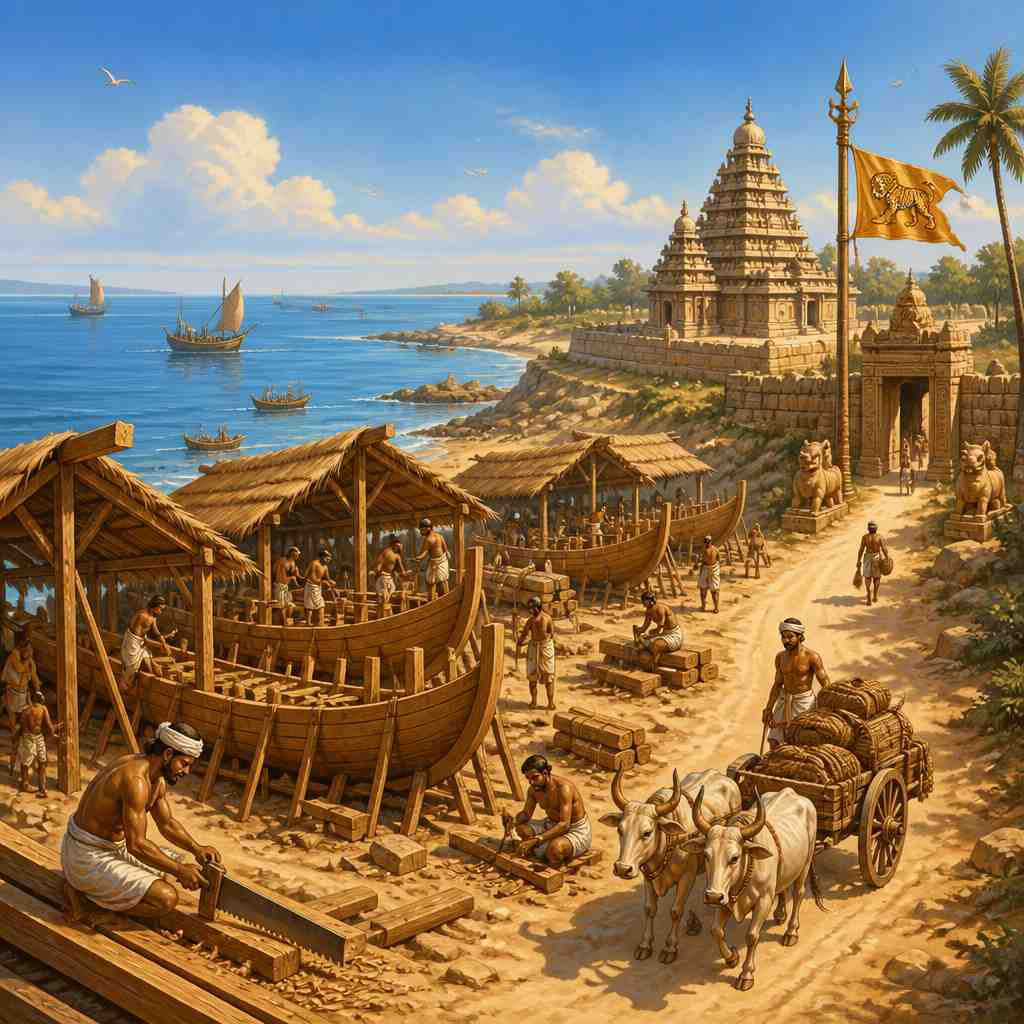
Mamallapuram port with the Pallava Shore Temple

A visitor to the Coromandel Coast in 1015 CE would have witnessed something remarkable: a 400-kilometer industrial corridor stretching from Mamallapuram in the north to Nagapattinam in the south. At every major river mouth, smoke rose from shipyard forges. Timber barges moved south from the Western Ghats. Coir rope caravans arrived from Kerala. Iron ingots came overland from Karnataka.

This wasn't accidental, it was industrial planning on an imperial scale. The Cholas had created what modern economists call an "industrial ecosystem": interconnected facilities where specialized activities supported a larger strategic goal.

The goal: build and maintain the largest navy the medieval world had ever seen.

The Port Hierarchy

Not all Chola ports were equal. They operated in a sophisticated hierarchy:

Port Function Special Capability
Nagapattinam Primary naval base Large warship construction; fleet headquarters
Kaveripattinam Commercial hub International trade; merchant guild headquarters
Mamallapuram Secondary shipyard Smaller vessels; repair facilities
Poompuhar Timber processing Wood treatment; mast production
Arikamedu Specialty goods Bead manufacturing; luxury trade

Each port specialized. Nagapattinam didn't try to do everything, it focused on large warship construction and naval operations. Commercial trade flowed through Kaveripattinam, where the Manigramam guild maintained its headquarters. Mamallapuram handled smaller vessels and repairs.

This specialization was strategic. A port that tries to do everything does nothing well. The Cholas understood comparative advantage centuries before David Ricardo theorized it.

The Supply Chain Network

Building a 30-meter warship required inputs from across South India:
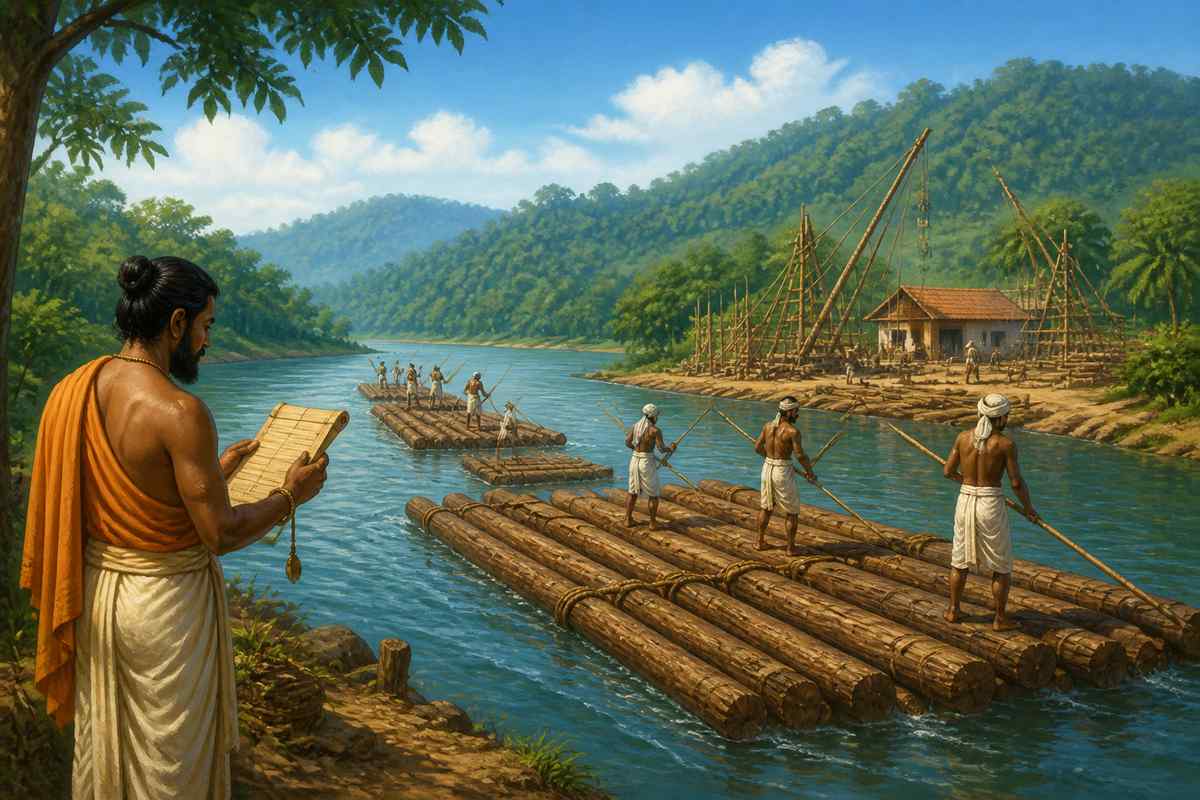
Teak rafts drifting down the Kaveri to shipyards

Timber

Teak from the Western Ghats, the finest shipbuilding wood in the world, came down the Cauvery and Vaigai rivers to coastal shipyards. The Arthashastra specifies timber types:

"For the keel, teak or sissoo. For the hull, sal or teak. For the mast, deodar from the mountains. For oars, light woods that float."

Chola timber procurement officers (vanyadhyaksha) maintained reserved forests, ensuring sustainable supply. The British would later exploit these same forests unsustainably.

Coir Rope

Coconut fiber rope from Kerala was essential for the sewn-plank technique. The Cholas maintained trade agreements with Kerala rulers ensuring steady supply. A single large vessel might require kilometers of rope.

Iron Fittings

Karnataka's iron-smelting regions produced anchors, chain, and fittings. The Cholas didn't just buy iron, they contracted with specific guilds for naval-grade production.

Sailcloth

Cotton from the Coromandel interior was woven into sail fabric. Specialized weaving guilds produced canvas strong enough for oceanic voyages.

The Shipyard Organization

Chola shipyards operated as integrated manufacturing facilities. The Nagapattinam yard included:

Dry Docks: Stone-lined basins where ships were built. Water could be drained for construction and flooded to launch completed vessels.

Rope Walks: Long covered areas where coir rope was twisted. The length of the walk determined the maximum rope length, some extended over 300 meters.

Forges: Ironworking facilities producing anchors, fittings, and weapons. Master smiths specialized in marine-grade metalwork resistant to salt corrosion.

Timber Yards: Storage and treatment areas where wood was seasoned and shaped. Fresh timber couldn't be used immediately, it required months of curing.

Training Areas: Where young sailors learned navigation, ship handling, and combat. The navy recruited from fishing communities but trained them to naval standards.

Guild Governance of Industrial Activity

The Cholas didn't directly manage shipyard operations, they delegated to guilds.

The Naukashilpi Sangha (Shipbuilders' Guild) managed:

This guild system had profound advantages:

Aspect Guild Management Direct State Management
Expertise Deep craft knowledge Bureaucratic generalists
Flexibility Adapts to demand Rigid procedures
Innovation Craftsmen improve methods Top-down directives
Cost Self-regulating efficiency Administrative overhead
Quality Reputation-based accountability Rule-based compliance

The Chola state set requirements ("We need 50 warships by monsoon") and the guilds figured out how to deliver. This was outcome-based governance, specifying ends, not means.

Western Perspectives: Industrial Ecosystems

Modern industrial economists would recognize the Chola port network as a cluster, geographic concentrations of interconnected companies and institutions in a particular field.

Michael Porter, Harvard Business School professor, famously analyzed clusters like Silicon Valley and Hollywood. His core insight: clusters create competitive advantage through:

The Chola Coromandel Coast had all of these 900 years before Porter theorized them:

Porter's Element Chola Implementation
Specialized suppliers Rope makers, timber merchants, iron smiths
Skilled labor pools Hereditary shipbuilding families, trained navigators
Knowledge spillovers Guild training, apprenticeship systems
Supporting institutions Merchant guilds, temple-based education

The Port of Rotterdam, Europe's largest port, exemplifies modern cluster thinking. CEO Allard Castelein has noted: "A port is not just a dock, it's an ecosystem. Shipping, logistics, manufacturing, services, they all reinforce each other." The Cholas understood this a millennium ago.

Vizhinjam transshipment port at dawn

Modern Resonance: India's Port Renaissance

India's Sagarmala project explicitly aims to recreate the Chola model: port-led industrial development.

The philosophy: don't just build ports, build ecosystems around ports. Manufacturing clusters, logistics corridors, skill development centers, and supporting infrastructure that make ports engines of economic growth, not just transit points.

Key Sagarmala principles that echo Chola approaches:

Chola Practice Sagarmala Implementation
Port specialization Vizhinjam (transshipment), Mundra (containers), Paradip (bulk)
Industrial clusters Coastal Economic Zones around major ports
Supply chain integration Multimodal logistics parks connecting ports to hinterland
Skill development Maritime training institutes at port locations

Your Turn

The Cholas didn't build ships, they built the system that built ships. Shipyards, supply chains, training programs, maintenance infrastructure, and guild governance all worked together as an integrated whole.

As India rebuilds maritime capability today, through Sagarmala, defense shipyards, and port modernization, the Chola lesson is clear: ecosystems beat facilities. A port without an industrial cluster is just a dock. A shipyard without supply chains is just a building. And technology without trained people is just machinery.

What infrastructure, physical, institutional, human, would you need to build to create lasting capability in your field? And are you building facilities or ecosystems?

The next lesson examines how Chola maritime strategy applies to India's contemporary security challenges: the QUAD and Indo-Pacific strategy.

Industrial clusters; ecosystem economics; network effects

Michael Porter's cluster theory explains why some regions dominate industries, specialized suppliers, skilled labor pools, knowledge spillovers, and supporting institutions all reinforce each other. The Chola Coromandel Coast was a naval industrial cluster.

The Chola guild system created natural clusters, hereditary trades concentrated expertise geographically while guild networks spread it institutionally. Modern India can leverage similar community-based knowledge networks.

Rotterdam's port ecosystem generates 6.2% of Dutch GDP; Singapore's 7% of GDP. Ports with industrial clusters generate 3-5x the economic impact of pure cargo-handling facilities.

Infrastructure investment; supply-leading vs. demand-following development

Economists distinguish 'supply-leading' infrastructure (built before demand) from 'demand-following' (built after need emerges). Supply-leading is riskier but creates greater development impact. The US Interstate Highway System was supply-leading; most developing country roads are demand-following.

Key terms

Nau-Nirmana
Shipbuilding; naval construction
Pattina-udaiyan
Port master; harbor administrator (Tamil)
Vanyadhyaksha
Forest Superintendent; timber supply officer
Shala
School; training institution; workshop

Key figures

Pattina-udaiyan (Chola Port Master)

Administrator responsible for all port operations and development

Sanjay Sethi

Head of India's largest container port

Allard Castelein

Head of Europe's largest port

Case studies

Vizhinjam: India's Transshipment Pivot

India's largest container ships can't dock at Indian ports, they're too shallow. So cargo bound for India is first unloaded at Colombo or Singapore, then transferred to smaller ships. India loses Rs 1,500 crore annually in transshipment fees. The Vizhinjam International Seaport, under construction in Kerala, aims to change this. Located on the main East-West shipping lane with natural deep water (18+ meters), it will handle the world's largest container ships. But the project has faced years of delays, protests from fishing communities, and funding challenges.

The Cholas would recognize Vizhinjam's strategic importance, natural deep water near major trade routes is exactly what made Nagapattinam valuable. But they would also recognize the challenge: infrastructure development creates winners and losers. The Chola guild system integrated affected communities as stakeholders, not obstacles. Vizhinjam's fishing community conflicts reflect a failure to apply this principle, infrastructure that displaces rather than incorporates generates resistance.

Vizhinjam is now 80% complete (2024), with first phase operations expected in 2025. The project has incorporated some fishing community demands, dedicated fishing harbor, compensation packages, though tensions remain. If successful, Vizhinjam will capture transshipment traffic currently going to Colombo, positioning India as an Indian Ocean logistics hub.

Strategic infrastructure requires community integration. The Cholas built guild systems that made local communities stakeholders in port success. Modern infrastructure development that displaces communities without incorporation generates resistance that delays projects for years. Vizhinjam's delays reflect the cost of ignoring this principle.

Vizhinjam addresses a problem shared by most South Asian and African ports: insufficient depth for modern mega-container ships. As vessel sizes continue growing, ports that invest in deep-water capability now will capture transshipment traffic for decades, while shallow-water ports lose relevance.

India's transshipment leakage: Rs 1,500 crore annually to Colombo and Singapore. Vizhinjam's projected capacity: 1 million TEUs (Phase 1) to 6.4 million TEUs (full build). Expected recapture: 30-40% of transshipment traffic.

Adani Ports: Private Ecosystem Building

In 1998, Gujarat's Mundra was a fishing village. Today, it's India's largest commercial port, handling 150 million tonnes annually. Adani Ports and SEZ built not just a terminal but an ecosystem: Special Economic Zone, power plants, refineries, logistics parks, and rail connectivity. The private sector created what the Cholas created with guild governance, an integrated industrial cluster around a port.

Adani's Mundra development mirrors Chola ecosystem thinking: infrastructure is not just the port but everything that makes the port valuable. The SEZ creates demand; the logistics park moves cargo; the rail link connects to hinterland; the power plants ensure operations. This integrated approach creates competitive advantage that isolated port terminals cannot match. However, the concentration of infrastructure in private hands raises questions the Cholas answered differently, their guild system created distributed stakeholders, not centralized control.

Mundra became India's largest port by 2020. Adani Ports now operates 13 ports across India, handling 25% of national cargo. The company's market cap exceeds Rs 3 lakh crore. The model demonstrates that port-led development works, but raises questions about market concentration and regulatory oversight.

Ecosystem thinking works whether implemented by state (Cholas), guilds (medieval), or private sector (Adani). The key is integration, ensuring that port, industry, logistics, and connectivity develop together. The question is governance: who captures the value, and how are externalities managed?

Adani Ports' ecosystem approach at Mundra is replicated by DP World in Jebel Ali and PSA in Singapore. Modern port competitiveness depends on integrated logistics ecosystems, not standalone terminals. The winners build complete supply chain solutions around their berths.

Mundra Port capacity: 210 MTPA (2024). Growth rate: 10x in 20 years. Adani Ports' share of India's port capacity: 25%+. Employment in Mundra SEZ: 200,000+ direct and indirect.

Historical context

Chola Port Development (950-1150 CE)

The Coromandel Coast under the Cholas was the most developed port network in the medieval Indian Ocean. From Mamallapuram to Nagapattinam, specialized facilities supported trade, shipbuilding, and naval operations. This infrastructure made the Cholas the dominant maritime power.

Contemporary European ports, Venice, Genoa, Bruges, were significant but operated at smaller scale. The Hanseatic League was just emerging. Chinese ports under the Song Dynasty were large but didn't support equivalent naval projection. The Chola port network was uniquely integrated for both commerce and military power.

The Chola Coromandel port network processed an estimated 200,000 tonnes of cargo annually, more than any contemporary European port complex.

Port infrastructure is not just about moving cargo, it's about creating economic ecosystems. The Chola model shows that integrated development (ports + industry + logistics + training) creates more value than isolated facilities. This lesson directly informs Sagarmala and modern port development strategy.

Living traditions

Sagarmala explicitly cites historical port-led development as inspiration. The Rs 8.5 lakh crore investment aims to create what the Cholas built: integrated maritime ecosystems where ports drive industrial development, not just cargo handling.

Reflection

More in Chola Maritime Empire: The Original Indo-Pacific

All lessons in Chola Maritime Empire: The Original Indo-Pacific · Trade Routes of Ancient Bharat course