Hindu Sagara: The Indian Ocean as 'Hindu Lake'

Naval Technology Excellence

How indigenous maritime technology, shipbuilding techniques, navigation methods, and naval engineering, made the Chola expeditions possible. The story of technology sovereignty that transformed the Indian Ocean into 'Hindu Sagara' for centuries.

The Ships That Crossed Oceans
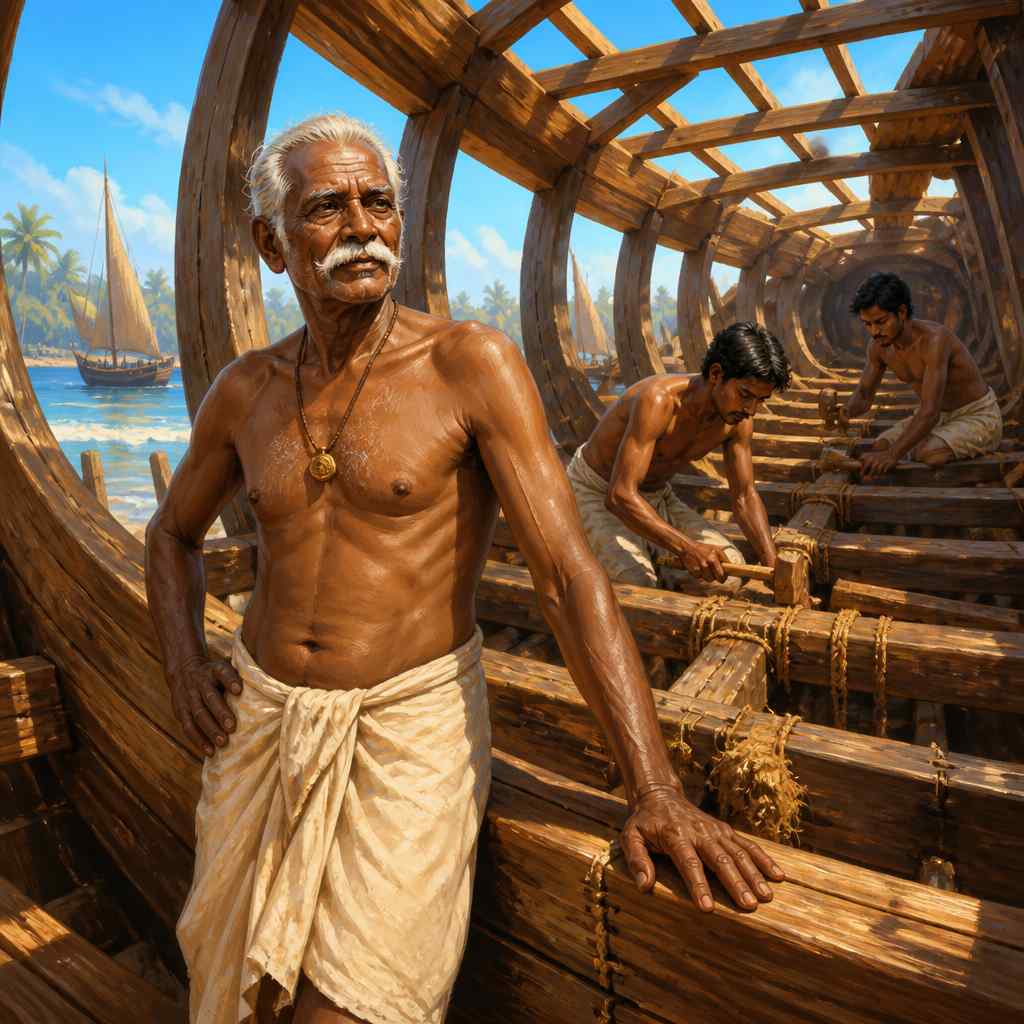
Master shipwright Karunakaran inside a warship hull

In the Nagapattinam shipyards of 1020 CE, master shipwright Karunakaran walked the length of a hull unlike anything his grandfather would have recognized. Thirty meters from bow to stern. Beam wide enough for elephant stalls. A double hull with watertight compartments. This wasn't a coastal trader, it was an ocean-crossing warship, designed to carry 500 soldiers across 2,500 kilometers of open sea.

The European vessels of the era couldn't match it. The Viking longships, fearsome in the North Sea, were single-hulled craft unsuited for tropical storms. Arab dhows were excellent traders but lacked the capacity for amphibious warfare. Chinese junks were large but primarily coastal. Only the Cholas had developed blue-water naval technology, ships designed not just to cross oceans but to fight when they arrived.

How did a South Indian kingdom achieve what no other medieval civilization could?

The Indigenous Innovation Stack

Chola naval technology wasn't borrowed, it was built on centuries of Indian maritime innovation:

1. The Sewn-Plank Technique
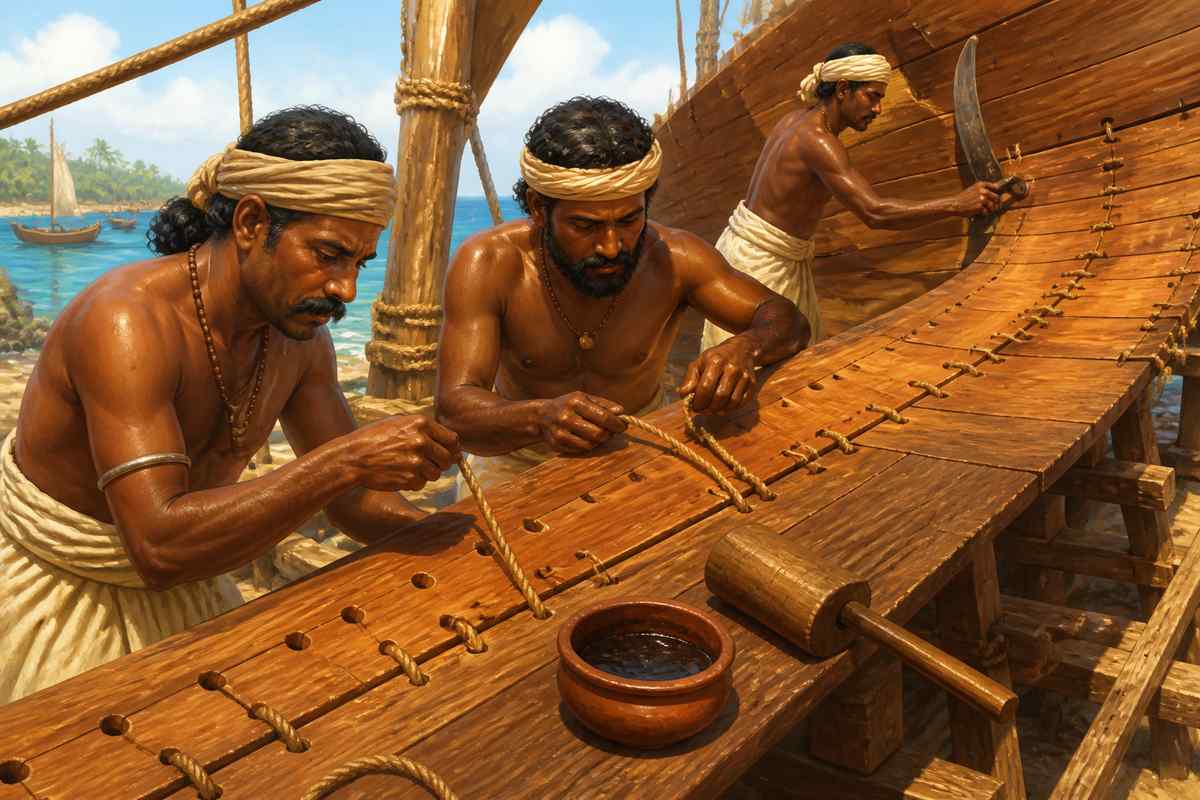
Indian shipwrights using sewn-plank technique on a hull

Indian shipbuilders didn't nail planks together; they stitched them using coir rope threaded through holes. This technique, documented in the Periplus of the Erythraean Sea (1st century CE), created flexible hulls that could absorb wave impact without cracking.

Technique Advantage Origin
Sewn planks Flexibility; storm resistance Coromandel Coast
Iron nails Rigidity; faster construction Mediterranean
Dowel joints Compromise strength/flex Arab shipyards

European visitors were astonished. Marco Polo, visiting India in the 13th century, described Indian ships stitched with "thread made from the husk of the Indian nut [coconut]" and noted they carried more cargo than any Mediterranean vessel.

2. Watertight Compartmentalization

Chola warships had multiple watertight compartments. If one section flooded, the ship stayed afloat. This technology wouldn't appear in European vessels until the 19th century, 800 years later.

The Yuktikalpataru, a Sanskrit text on shipbuilding, describes the design principles:

"The ship shall be divided by cross-beams into sections, each sealed with wadding and pitch, so that damage to one part does not sink the whole."

3. Navigation Without Instruments

Chola navigators crossed the Bay of Bengal without compass, sextant, or chronometer. They used:

Arab traders called Indian navigators malim, the "knowing ones." The Portuguese, arriving in 1498, were guided across the Arabian Sea by an Indian pilot, Ahmad ibn Majid, whose knowledge exceeded anything European navigation could offer.

The Arthashastra's Technical Standards

Kautilya's Arthashastra, written over a millennium before the Chola expeditions, established state standards for shipbuilding:

"The Superintendent of Ships shall ensure vessels are built of suitable timber, with proper proportions of length to beam, and fitted for their intended purpose, whether river, coastal, or oceanic travel." , Arthashastra, Book 2, Chapter 28

This wasn't just advice, it was state-mandated quality control. The Arthashastra specified:

The Cholas inherited this tradition of standardized naval engineering, technology treated not as craft secrets but as state infrastructure.

Western Perspectives: The Technology Gap

When Europeans arrived in the Indian Ocean in the late 15th century, they encountered technological peers, not primitives.

James Watt (1736-1819), the Scottish inventor whose steam engine would transform maritime power, studied historical ship designs. He noted that Indian vessels demonstrated "principles of buoyancy and compartmentalization that European shipwrights are only now beginning to understand."

Vasco da Gama's 1498 expedition reached India only because an Indian pilot guided them across the Arabian Sea. The Portuguese had no independent capability to navigate these waters. Their advantage was gunnery, not seamanship, European ships carried more cannons, not better hulls.

Technology India (1000 CE) Europe (1000 CE) Europe (1500 CE)
Watertight compartments Yes No No
Ocean-crossing capacity Yes Limited Yes
Accurate navigation Traditional Magnetic compass (later) Still limited
Gunpowder weapons No No Yes

The European advantage was military technology transferred from China (gunpowder, cannons), not indigenous innovation. In shipbuilding and navigation, Indian methods remained superior until the steam age.

The Decline of Indigenous Shipbuilding

Indian maritime technology didn't disappear through obsolescence, it was deliberately destroyed.

The British Navigation Acts (1651 onwards) systematically dismantled Indian shipbuilding:

British shipping interests couldn't compete with Indian quality and cost; they legislated Indian shipbuilding out of existence. The HMS Asia, a 74-gun ship of the line built in Bombay in 1824, was considered among the finest vessels in the Royal Navy, proof that Indian shipbuilding remained world-class until deliberately suppressed.

Modern Resonance: Technology Sovereignty Returns

INS Vikrant under construction at Cochin Shipyard

In 2022, when INS Vikrant was commissioned at Cochin Shipyard, it represented something more than a naval platform. It was the return of indigenous maritime technology after two centuries of imposed dependency.

Vice Admiral G.M. Hiranandani, India's foremost naval historian, has documented this arc: "From the Cholas who built fleets no other civilization could match, to the colonial era when we were forbidden from building ships, to today when we build aircraft carriers. The thread is technology sovereignty, the refusal to remain dependent."

The statistics tell the story:

Year Indigenous Naval Capability
1025 1,000+ ocean-going warships
1830 Traditional shipyards closed by British
1947 Zero indigenous warship capability
1961 INS Delhi (first locally built frigate)
2022 INS Vikrant (indigenous aircraft carrier)

The 192 years between 1830 and 2022 represent India's "technology gap", the period when indigenous maritime capability was destroyed and then painstakingly rebuilt.

Your Turn

The Cholas didn't import their fleet. They built it, generations of accumulated knowledge in materials, design, and navigation crystallized in shipyards at Nagapattinam and Mamallapuram.

Today, India faces similar choices across critical technologies: semiconductors, AI, space systems, advanced materials. The Chola lesson is clear: strategic capability requires indigenous foundation. You can import systems; you cannot import the capacity to innovate and improve.

As India pursues Atma Nirbharta in defense manufacturing, from fighter jets to submarines to aircraft carriers, the Chola shipyards offer a template: invest in technology for generations, protect strategic knowledge, and never depend on others for what your security requires.

The next lesson examines the physical infrastructure of Chola maritime power: the ports from Mamallapuram to Nagapattinam that made the fleet possible.

Technology sovereignty; strategic autonomy; critical infrastructure

Modern economists distinguish 'tradable' from 'non-tradable' goods. Defense capability is non-tradable, you cannot rely on imports for what you need in conflict. The US CHIPS Act (2022) reflects this: some technologies are too critical to outsource.

The Chola approach created a technology ecosystem, shipyards, timber cultivation, coir rope production, navigator training, that couldn't be replicated by simply buying ships. Modern India's defense indigenization follows this model.

INS Vikrant: 76% indigenous content. INS Vikramaditya (imported): under 20%. Indigenous construction costs more initially but creates capability that can't be sanctioned, embargoed, or delayed by foreign suppliers.

Technology transfer and adaptation; absorptive capacity; indigenous innovation

Japan's post-WWII industrial strategy exemplified this, importing foreign technology, adapting it, then improving it until Japanese products exceeded originals. Korea followed similarly. Both adapted rather than merely imitated.

Key terms

Matsya Yantra
Fish-shaped navigation instrument; star guide
Naukashilpi
Shipbuilder; naval architect; master craftsman of ships
Sarvatobhadra
Multi-purpose vessel; literally 'auspicious on all sides'
Jalayana
Watercraft; vessel; any vehicle that moves on water

Key figures

Thirupadai Thalaivar (Chola Fleet Admiral)

Supreme commander of Chola naval forces

Vice Admiral Gulab Mohanlal Hiranandani

India's foremost naval historian; author of comprehensive Indian naval history

James Watt

Inventor whose steam engine would transform maritime technology

Case studies

Cochin Shipyard: Rebuilding Indigenous Naval Capability

Cochin Shipyard Limited (CSL), established in 1972, was tasked with an impossible mission: build India's first aircraft carrier from scratch. No Indian yard had ever constructed a vessel of this complexity, 45,000 tonnes, capable of operating fighter jets, with hundreds of compartments and integrated weapons systems. Critics argued India should simply buy a carrier from Russia or the US. The project took 17 years and faced repeated cost overruns and delays.

The Chola approach would recognize the hidden value in apparent inefficiency. Yes, buying a carrier would be faster and initially cheaper. But the Cholas never bought ships, they built shipyards. The value isn't the vessel; it's the capability to build vessels. CSL's 17-year journey created an ecosystem of 550+ vendors, trained thousands of engineers, and established processes that will make the second carrier faster and cheaper. This is the Chola logic: invest in capability, not just capacity.

INS Vikrant was commissioned in September 2022 with 76% indigenous content. The second indigenous carrier (IAC-2) is now under construction with lessons learned. CSL has become one of Asia's largest shipyards, competing for international orders. The initial 'inefficiency' created a self-sustaining ecosystem.

Technology sovereignty is an investment, not an expense. The Chola shipyards of Nagapattinam took generations to develop; CSL took 50 years. Both chose temporary inefficiency for permanent capability. Strategic assets cannot be purchased, they must be built.

Cochin Shipyard's journey from basic construction to aircraft carrier delivery parallels how South Korea's Hyundai Heavy Industries grew from building simple cargo vessels to dominating global LNG carrier construction. Both prove that shipbuilding capability compounds through increasingly complex projects.

CSL workforce: 2,500 direct employees, 5,000+ contract workers. Vendor ecosystem: 550+ Indian companies now produce carrier-grade components. Technology transfer: zero, this was built from Indian knowledge and adapted foreign concepts.

Mazagon Dock: Submarine Sovereignty

In 2005, India signed a $3.75 billion contract with France's DCNS (now Naval Group) to build six Scorpene-class submarines at Mazagon Dock Shipbuilders Limited (MDL), Mumbai. The project was called 'Project 75.' It wasn't just about acquiring submarines, it was about acquiring the capability to build submarines. By 2023, all six submarines had been delivered, but more importantly, MDL had developed the skills to design the next generation independently.

This is the Chola principle of adaptation over imitation in action. India didn't simply buy submarines, it bought a process. French designs were adapted to Indian requirements: indigenous sonar systems, locally-sourced steel, Indian combat management systems. The first submarine took 12 years; the sixth took 3 years. The gap represents learned capability. Unlike buying finished products, buying processes creates permanent value.

Project 75 delivered six submarines, but more importantly: MDL can now build submarines without foreign assistance. Project 75(I), six more advanced submarines, will have even higher indigenous content. The long-term goal: Project 76 nuclear attack submarines, designed and built entirely in India.

Strategic technology acquisition isn't buying products, it's buying knowledge. The Cholas didn't import ships; they learned shipbuilding. MDL didn't just buy submarines; it learned submarine construction. The difference between product and process is the difference between dependency and sovereignty.

Mazagon Dock's rising indigenous content in submarine construction reflects a pattern seen across defense industries worldwide. France, Japan, and Australia all learned that buying military platforms without acquiring production knowledge creates permanent dependency. Technology transfer, not product purchase, builds sovereignty.

First Scorpene (INS Kalvari) construction time: 12 years. Sixth Scorpene (INS Vagsheer): 3 years. Indigenous content: increased from 30% to 45%. Future submarines (P-75I): targeted 60%+ indigenous.

Historical context

Chola Naval Technology Peak (950-1100 CE)

India was the center of Indian Ocean maritime technology. Ships built on the Coromandel and Malabar coasts were considered the finest in the medieval world. Arab, Persian, and Southeast Asian traders preferred Indian-built vessels for long-distance voyages.

Viking longships (800-1100 CE) were impressive for North Atlantic conditions but couldn't match Indian vessels for tropical ocean crossings. Chinese junks were large but primarily coastal. Only Indian ships had the combination of size, durability, and navigational capability for trans-oceanic warfare.

The largest Chola warships carried 500+ soldiers with supplies for months-long voyages. Contemporary European vessels rarely exceeded 100 crew for ocean crossings.

Understanding Chola maritime technology reveals that Indian 'backwardness' in naval power is a colonial-era creation, not an inherent condition. India was the global leader in maritime technology for centuries, a position now being rebuilt.

Living traditions

India's defense shipbuilding ecosystem, Cochin Shipyard, Mazagon Dock, GRSE, L&T, represents the institutional successors to Chola naval yards. The Atma Nirbharta policy explicitly connects to historical precedent: India was a maritime technology leader and can be again.

Reflection

More in Chola Maritime Empire: The Original Indo-Pacific

All lessons in Chola Maritime Empire: The Original Indo-Pacific · Trade Routes of Ancient Bharat course