QUAD and Indo-Pacific Strategy: Chola Lessons
Ancient Alliance Principles for Modern Maritime Security
The Cholas mastered the art of strategic maritime partnerships, forging alliances, establishing forward bases, and creating networked security architectures across the Indian Ocean. Today's QUAD (Quadrilateral Security Dialogue) between India, USA, Japan, and Australia represents a remarkably similar strategic logic. This lesson examines how Chola principles of Mitra-Mandala (circle of allies), Madhyama (buffer partnerships), and Udasina (strategic neutrality management) illuminate modern Indo-Pacific strategy, revealing that successful maritime security has always required the same fundamental elements: shared interests, complementary capabilities, and coordinated presence across critical chokepoints.
Sangama: The Confluence of Ancient and Modern Strategy
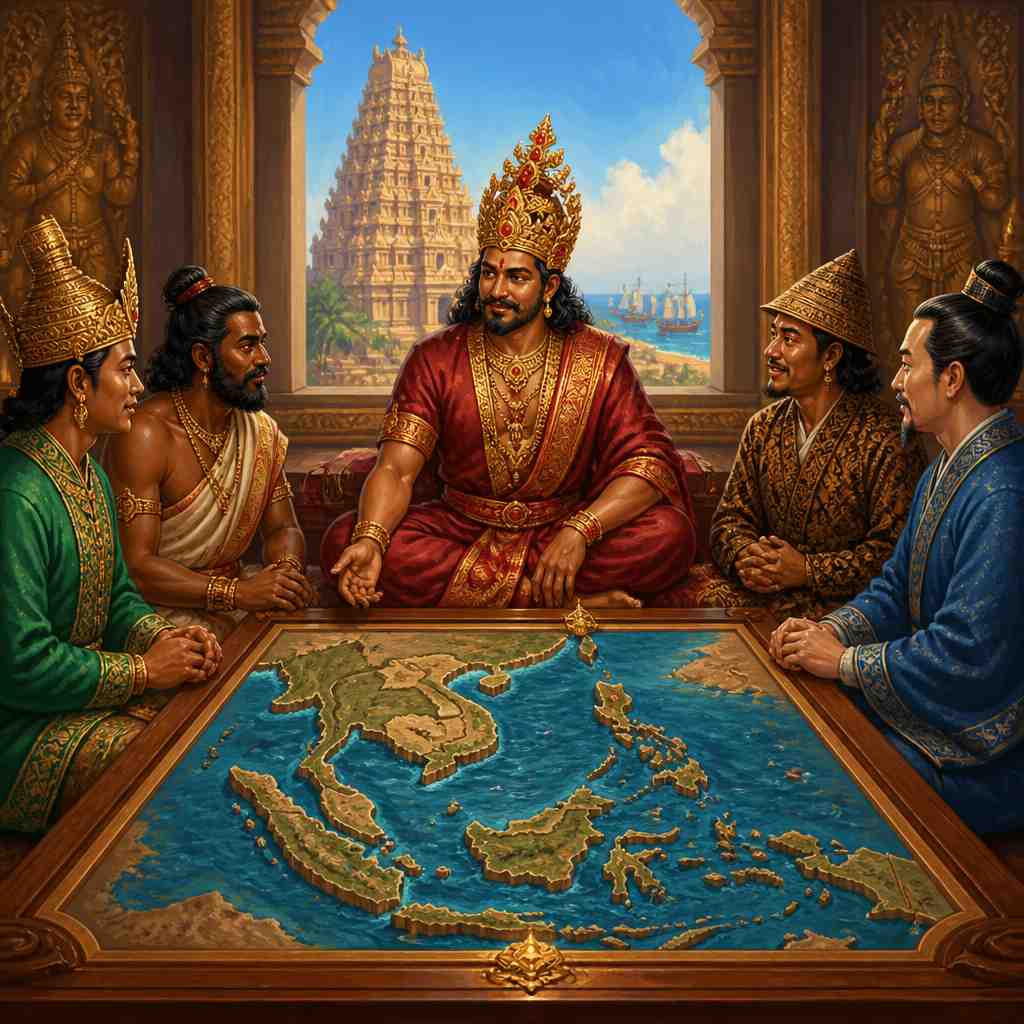
In 1025 CE, when Rajendra Chola launched his naval expedition to Southeast Asia, he did not sail alone. His fleet carried not just warriors but diplomats, merchants, and priests, a comprehensive deployment designed to create lasting partnerships, not merely military victories. The Chola approach to maritime security was inherently multilateral, recognizing that no single power, however mighty, could secure the vast Indian Ocean alone.
A thousand years later, in 2017, four nations, India, the United States, Japan, and Australia, revived the Quadrilateral Security Dialogue, commonly known as QUAD. The strategic logic was strikingly familiar: securing freedom of navigation, ensuring open sea lanes, and countering coercive behavior by establishing a network of like-minded maritime powers. The Cholas would have recognized this strategy immediately, it was their own Mitra-Mandala (circle of friends) adapted for the 21st century.
Vistara: The Geography of Partnership
The Chola maritime network was not randomly constructed but strategically designed around geographic realities. They established Nagapattinam as their primary naval base on the Coromandel Coast, then extended influence through a chain of allied ports: Tamralipti in Bengal, Kataha (Kedah) in the Malay Peninsula, and relationships extending to Champa (Vietnam) and Song China. Each node served multiple purposes, trade facilitation, intelligence gathering, forward staging, and denial of rival access.
The modern Indo-Pacific strategy follows remarkably similar geographic logic. The QUAD nations' combined geography creates an arc of presence from the Pacific through Southeast Asia to the Indian Ocean. India's Andaman and Nicobar Islands mirror the Chola forward base at Nagapattinam, positioned at the Malacca Strait chokepoint. Japan's engagement with ASEAN nations resembles Chola cultivation of Southeast Asian relationships. Australia's northern coast serves as the southern anchor, much as Chola relationships with Sri Lankan ports secured their southern flank.
The Cholas understood Sthana-Pradhanya, the primacy of position. They knew that controlling the Malacca Strait allowed them to regulate trade between the Indian Ocean and the Pacific, extracting both economic benefits and strategic leverage. Today's competition for influence in the same waters, whether through port development, military access agreements, or maritime domain awareness networks, reflects identical geographic imperatives.
Niti: The Principles of Alliance Management
Kautilya's Arthashastra, written centuries before the Cholas, provided the theoretical framework for their alliance strategy. The concept of Mitra (ally) was nuanced, distinguishing between Sahaja-Mitra (natural allies sharing common interests), Kritima-Mitra (cultivated allies requiring ongoing maintenance), and Mitra-Ari (allies of adversaries requiring careful management).
The Cholas applied this framework systematically. The Srivijaya Empire was initially a Sahaja-Mitra, both powers benefited from secure maritime trade. But when Srivijaya began restricting Chola merchant access, the relationship transformed. Rajendra's 1025 expedition was not mere conquest but strategic realignment, replacing an unreliable partner with direct control and more dependable local allies.
The QUAD embodies similar Mitra-dynamics. India and Japan represent something approaching Sahaja-Mitra status, both are democratic nations with shared concerns about Chinese assertiveness, no territorial disputes between them, and complementary economic interests. The Indo-US relationship has evolved from Ari (adversary during Cold War non-alignment) to increasingly Sahaja status through decades of cultivation.
The Chola concept of Madhyama, intermediate powers whose alignment could tip regional balance, finds modern expression in QUAD's engagement with Southeast Asian nations. Countries like Vietnam, Indonesia, and the Philippines occupy Madhyama positions, courted by both QUAD nations and China. Chola strategy toward such powers emphasized Sama (conciliation) and Dana (inducements) over Danda (force), building genuine partnerships rather than coercing subordination. India's Act East policy and Japan's FOIP (Free and Open Indo-Pacific) initiative reflect identical wisdom.
Vyuha: The Architecture of Coordinated Presence
Chola naval strategy employed sophisticated force coordination. Their fleet operated not as a single armada but as distributed squadrons, some protecting merchant convoys, others conducting diplomatic missions, still others maintaining presence at forward bases. This Mandala-Vyuha (networked deployment) allowed the Cholas to project power across vast distances while maintaining local superiority at critical points.

Modern QUAD coordination exhibits similar architecture. The Malabar naval exercises, which began as bilateral Indo-US drills and now include Japan and Australia, develop interoperability for coordinated operations. Each nation contributes distinctive capabilities: American carrier strike groups provide unmatched firepower, Japanese submarine expertise offers underwater domain awareness, Australian expeditionary capabilities enable distant power projection, and Indian Ocean geographic centrality provides positional advantage.
The Chola concept of Akasha-Samudra-Prithvi integration, coordinating naval, land, and (in modern terms) air/space assets, anticipated today's multi-domain operations. Chola expeditions combined naval superiority with amphibious capability, merchant shipping, and administrative infrastructure. QUAD similarly integrates maritime security with space cooperation (tracking ships via satellite), cyber coordination (protecting maritime communications), and economic initiatives (countering coercive economic practices).
Artha: The Economic Foundation of Security
The Cholas never separated economic prosperity from military capability, their Nau-Sainya served both functions simultaneously. Merchant vessels could be requisitioned as troop transports. Port revenues funded naval construction. Trade relationships created the stakes that made alliance worthwhile.
This Artha-Sainya (economic-military) integration distinguishes QUAD from purely military alliances. The Indo-Pacific Economic Framework (IPEF), supply chain resilience initiatives, and infrastructure investment programs complement security cooperation. Japan's Partnership for Quality Infrastructure explicitly competes with China's Belt and Road by offering alternative financing for ports, railways, and digital networks.
The Cholas understood that lasting influence required what we might call Samyak-Vikasa, balanced development creating mutual benefit rather than dependency. Their Southeast Asian relationships thrived because Chola presence brought prosperity, not exploitation. Port cities under Chola influence flourished as trade increased. This model informs India's current approach to Indian Ocean island nations and Southeast Asian partners, offering development partnership rather than debt traps.
Kala-Chakra: The Wheel of Strategic Competition
Chola strategists recognized that maritime security is not static but cyclical. Periods of dominance attract challengers; successful strategies are eventually countered; allies' interests evolve. The Kala-Chakra demanded continuous adaptation.
The 1025 Srivijaya expedition exemplified adaptive response to changed circumstances. For decades, Srivijaya had been a tolerable partner. When that relationship soured, Rajendra recalculated and acted decisively. The expedition succeeded not merely militarily but strategically, establishing Chola supremacy while avoiding the overextension that doomed earlier maritime powers.
QUAD's evolution reflects similar adaptive dynamics. Dormant from 2008 to 2017, the grouping revived as Chinese assertiveness in the South China Sea, the Indian Ocean, and the global economy created new convergent interests. The addition of summit-level meetings, working groups on technology and vaccines, and expanded military exercises represent calibrated escalation, enough to signal resolve without triggering unwanted conflict.
The Chola principle of Sama-Dama-Dana-Bheda-Danda prescribed graduated responses, from conciliation through inducements to, only as last resort, force. QUAD nations apply similar graduation: diplomatic démarches, economic diversification away from China, enhanced military presence, and ultimately defensive capability improvements, while maintaining dialogue and avoiding unnecessary provocation.
Sampradaya: The Living Tradition
The Chola maritime legacy lives not in museums but in ongoing strategic culture. The Indian Navy's motto, Sham No Varunah (May the Lord of Water be auspicious unto us), invokes the same divine protection Chola admirals sought. More substantively, Indian strategic thinking increasingly embraces what the late strategist K. Subrahmanyam called the "maritime renaissance", recognition that India's security and prosperity depend on the same oceanic spaces the Cholas mastered.
Japan's transformation from defeated continental power to maritime democracy offers parallel lessons. The Meiji-era recognition that Japan's destiny lay on the seas mirrors Rajaraja Chola's strategic awakening. Both nations learned that island and peninsular powers thrive through oceanic engagement, not continental isolation.
The QUAD represents not novelty but restoration, the recreation of partnership networks that characterized Asian maritime order for millennia before European colonialism disrupted indigenous systems. The Cholas traded with Song China while maintaining strategic autonomy. QUAD nations seek similar balance, economic engagement with all nations combined with security architectures protecting freedom of action.
India's post-independence non-alignment served continental security logic but inadequately addressed maritime realities. The maritime domain rewards cooperation: shared domain awareness multiplies surveillance capability; interoperability enables coordinated operations; distributed presence deters aggression across wider areas. QUAD represents India's belated recognition of Chola wisdom, that maritime security requires partnership architectures, not splendid isolation. Business leaders similarly benefit from strategic alliances that extend reach without requiring resources for independent global presence.
QUAD's measured evolution demonstrates similar strategic patience. Rather than rushing to formal alliance or military confrontation, the grouping has escalated gradually, from dialogue to working groups to summit meetings to enhanced exercises, maintaining flexibility while building substance. This approach preserves options, allows course correction, and avoids triggering the very conflict it seeks to prevent. In business and personal strategy alike, graduated response preserves relationships and options that premature escalation would foreclose.
Key terms
- Mitra-Mandala
- Circle of allies, the strategic concept from Kautilya's Arthashastra describing the network of friendly states surrounding a kingdom, forming concentric rings of partnership. The Cholas applied this to maritime space, creating an oceanic Mitra-Mandala extending from the Bay of Bengal to the Malacca Strait.
- Madhyama
- Intermediate or middle power, states whose alignment can tip regional balance. In Chola strategy, Southeast Asian kingdoms occupied Madhyama status. In modern context, ASEAN nations represent Madhyama powers whose partnership both QUAD and China actively court.
- Vyuha
- Strategic formation or deployment architecture, the systematic arrangement of forces for maximum effect. Chola naval Vyuha involved distributed squadrons with coordinated missions. Modern parallels include QUAD's networked presence combining each nation's distinctive capabilities.
- Artha-Sainya
- Economic-military integration, the Chola principle that commercial prosperity and military capability reinforce each other. Trade revenues funded naval power; naval power secured trade routes. QUAD's combination of security cooperation and economic initiatives reflects identical logic.
Key figures
Rajendra Chola I
Rajendra perfected the art of maritime alliance management, combining military expeditions with diplomatic cultivation to create a network of partnerships spanning the Indian Ocean to Southeast Asia. His Srivijaya campaign demonstrated calculated recalibration when existing partnerships failed, replacing unreliable allies with direct control and more dependable local partners while avoiding imperial overextension.
Shinzo Abe
Abe articulated the 'Free and Open Indo-Pacific' (FOIP) vision that became QUAD's strategic framework. His 2007 speech to India's Parliament, invoking 'Confluence of the Two Seas,' revived the dormant Quadrilateral concept. Abe transformed Japan from a passive security consumer to an active Indo-Pacific stakeholder, championing quality infrastructure investment as strategic tool.
Alfred Thayer Mahan
Mahan's 'The Influence of Sea Power upon History' (1890) established the theoretical foundation for modern naval strategy. His emphasis on controlling chokepoints, establishing overseas bases, and maintaining a navy capable of projecting power globally shaped American, British, and Japanese strategic thinking throughout the 20th century.
Case studies
Malabar Exercises: Building Interoperability Brick by Brick
The Malabar naval exercises began in 1992 as bilateral Indo-US drills focused on basic interoperability. Japan joined permanently in 2015, Australia in 2020, transforming Malabar into QUAD's primary military cooperation platform. The 2023 exercises conducted off Sydney featured anti-submarine warfare, air defense, and maritime strike scenarios of unprecedented complexity. The evolution demonstrates Chola-like Mandala-Vyuha construction, with each exercise building on previous cooperation, gradually developing the coordinated capabilities that networked security requires.
The Chola navy operated through Mandala-Vyuha, a networked deployment where distributed squadrons trained and operated together across the Indian Ocean. Rajendra Chola's fleet did not sail as a single armada but as coordinated groups, each familiar with the others' capabilities through years of joint patrols and campaigns. The Malabar exercises mirror this pattern precisely. Building interoperability through repeated joint operations is the modern equivalent of Chola squadron coordination, where trust and tactical fluency were earned through practice, not assumed through treaties.
Malabar has grown from simple passing exercises to the Indo-Pacific's most advanced multilateral naval drill. The 2024 exercises included coordinated anti-submarine warfare, live-fire drills, and carrier strike group operations. All four QUAD navies now share tactical data links and standardized communication protocols. India's participation has accelerated its own naval modernization, with lessons from Malabar directly influencing Indian Navy doctrine on multi-domain operations.
Effective alliance capabilities cannot be improvised during crisis. They require years of systematic development. The Cholas maintained standing relationships with allied powers precisely so coordinated action would be possible when needed. Malabar's patient evolution from basic maneuvers to complex operations exemplifies this wisdom. Business partnerships similarly require cultivation before they can deliver value in critical moments.
Military interoperability exercises like Malabar have direct commercial parallels. Joint ventures, technology partnerships, and supply chain integrations all require years of trust-building before they deliver results. Companies that invest in relationship infrastructure before they need it consistently outperform those that seek partners only during crises.
Malabar exercises: 30+ years of evolution (1992-2024). Participants grew from 2 navies to 4. Exercise complexity increased from basic passing exercises to carrier strike group coordination. The 2023 iteration involved 20+ warships, submarines, and maritime patrol aircraft operating across three ocean zones simultaneously.
India-Japan 2+2 Dialogue: Comprehensive Partnership Architecture
Initiated in 2019, the India-Japan 2+2 (Foreign and Defense Ministers) dialogue represents the deepest bilateral security relationship India maintains with any nation except the United States. The partnership spans military logistics agreements (ACSA), intelligence sharing, defense technology cooperation (US-2 amphibian aircraft negotiations), space situational awareness, and critical mineral supply chains. Japan has committed $42 billion to India's infrastructure development, explicitly framed as strategic investment in a key Indo-Pacific partner.
Kautilya's Arthashastra classified allies into categories. Sahaja-Mitra, the natural ally, shares common interests without coercion. The Cholas cultivated such relationships with the Chera kingdom and Southeast Asian port states by weaving together trade, cultural exchange, and military coordination into a single fabric. The India-Japan 2+2 follows this model exactly. Neither nation pressures the other into alignment. Instead, convergent interests in maritime security, technology supply chains, and balancing regional power create a partnership that strengthens naturally across multiple domains.
By 2024, the India-Japan partnership had expanded to include joint military exercises (Dharma Guardian, JIMEX, Shinyuu Maitri), a civil nuclear agreement, bullet train cooperation (Mumbai-Ahmedabad corridor), and Japan's largest-ever bilateral infrastructure commitment. Defense technology transfers have moved from discussion to implementation, with India acquiring Japanese surveillance systems. The relationship now serves as a template for how two Asian democracies can build comprehensive security partnerships without formal military alliance.
The Cholas would recognize the India-Japan partnership as exemplary Sahaja-Mitra cultivation, natural allies deepening cooperation across multiple domains. The comprehensiveness matters: purely military alliances lack resilience when interests diverge. Partnerships embedding economic, technological, and strategic cooperation create dense interdependencies that sustain alignment through political changes. Modern professionals building partnerships should similarly aim for multi-dimensional engagement rather than single-issue relationships.
The India-Japan partnership model, spanning defense, infrastructure, and technology, is increasingly cited as a template for 'comprehensive strategic partnerships' that resist disruption from political changes. Deep multi-domain partnerships are more resilient than single-issue alliances, in both geopolitics and business.
Japan's $42 billion infrastructure commitment to India is the largest bilateral development package Japan has extended to any single country. Bilateral trade: $22 billion (2023). Japanese FDI in India: $38 billion cumulative. Joint military exercises: 3 annual series across army, navy, and air force.
Living traditions
QUAD, IPOI, IORA, and IFC-IOR embody recognition that Indian Ocean security requires the networked, multilateral approach Chola strategists pioneered. India's foreign policy establishment explicitly studies Chola precedents when developing Indo-Pacific strategy.
- Indo-Pacific Oceans Initiative (IPOI): Proposed by Prime Minister Modi in 2019, IPOI explicitly aims to create a 'networked' security architecture, essentially a modern Mitra-Mandala bringing together nations around shared maritime interests.
- SAGAR Island Diplomacy: India's SAGAR doctrine (Security and Growth for All in the Region) applied to Maldives, Sri Lanka, Mauritius, Seychelles, and Madagascar, reconstructing Chola-era hub-and-spoke relationships through development partnership.
- Andaman and Nicobar Command: India's only tri-service command, positioned at the Malacca Strait's western approach, the same geographic position Chola forces valued for Indian Ocean control.
- QUAD Summit Locations: Rotating QUAD summits represent the modern equivalent of Chola diplomatic gatherings that coordinated strategy among allied powers.
- Brihadeeswara Temple, Thanjavur: Built by Rajaraja Chola I, this temple's inscriptions detail diplomatic relationships with Southeast Asian powers. The temple symbolizes the integration of soft power (cultural prestige) with hard power (military capability) that characterized Chola foreign policy.
- Rajarajeswaram Temple (Gangaikonda Cholapuram): Built by Rajendra Chola I to celebrate his victories and diplomatic achievements. The temple's inscriptions document relationships with powers from the Ganges to Southeast Asia, the medieval equivalent of QUAD-style alliance building.
Reflection
- The Cholas recalibrated their Srivijaya relationship when partnership no longer served mutual interests, ultimately launching military intervention. What indicators should guide modern nations in deciding when strategic partnerships require fundamental restructuring, and how can the costs of such transitions be managed?
- Chola alliance success depended on offering genuine value to partners, trade prosperity, security, cultural prestige, not merely demanding loyalty. What distinctive value does India bring to QUAD partnerships, and how might this value proposition be strengthened to attract Madhyama powers currently hedging between QUAD and China?