Rajendra Chola: Conqueror of the Seas
Chokepoint Strategy
Why Rajendra Chola targeted the Malacca Straits specifically, the narrow passage where geography becomes destiny. Understanding chokepoints reveals why the same strategic logic that drove the 1025 CE expedition drives India's Chabahar port and IMEC corridor today.
The 40-Kilometer Bottleneck
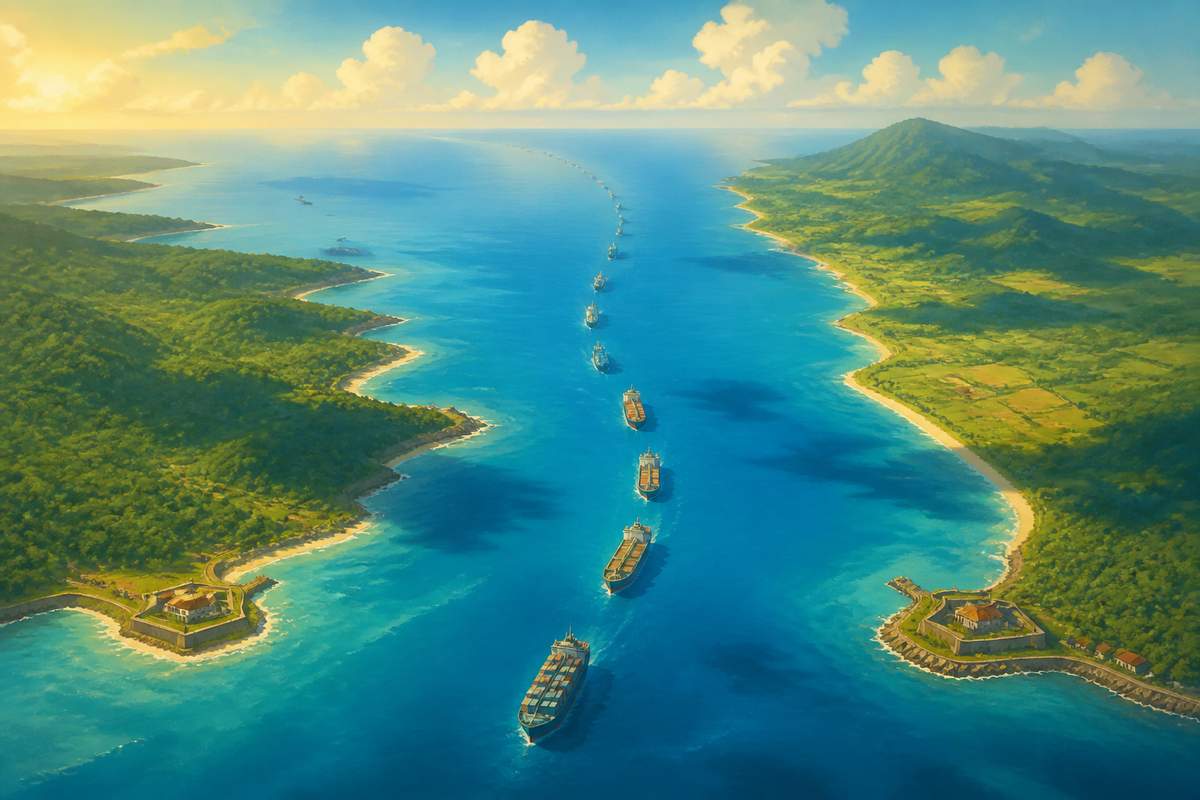
Every merchant in 11th-century Asia knew the math: the Malacca Straits were just 40 kilometers wide at their narrowest point, yet 90% of all trade between India and China, silk, spices, gems, textiles worth millions in gold, flowed through this single passage. Control Malacca, control Asia.
Srivijaya understood this. For three centuries, their empire had grown fat on transit tolls, charging 40% on every cargo that passed through waters they patrolled. Tamilian pepper merchants, Arab traders carrying Indian textiles, Chinese junks laden with silk, all paid tribute to Srivijaya or faced confiscation.
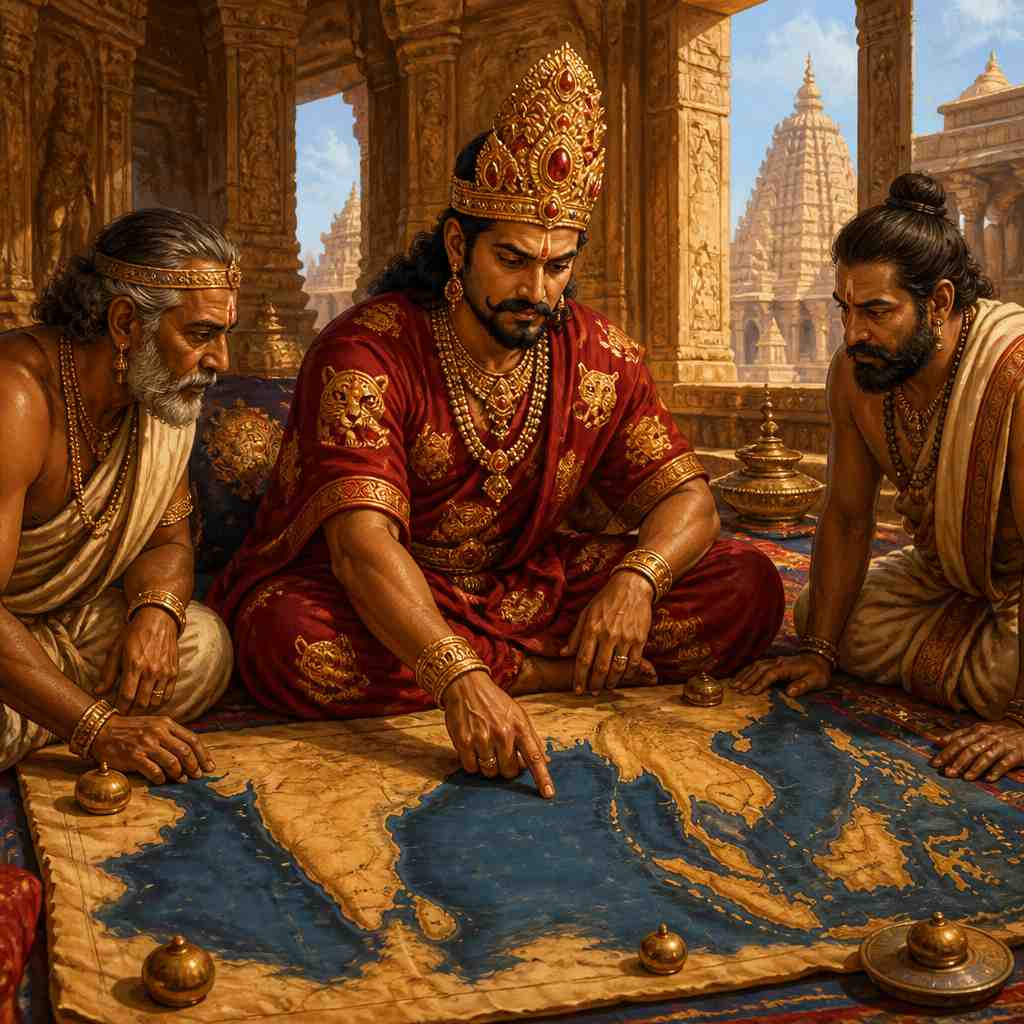
Rajendra Chola I studied the maps. He traced the routes his merchants complained about. And in his war council at Thanjavur, he asked the question that would reshape the Indian Ocean: Why do we pay others to use the sea?
The Geometry of Power
Chokepoints are where geography becomes destiny. A chokepoint is any narrow passage through which trade must flow, and whoever controls it can tax, block, or redirect that flow at will.
The medieval world had five critical maritime chokepoints:
| Chokepoint | Width | Trade Controlled | Who Held It (1000 CE) |
|---|---|---|---|
| Malacca Straits | 40 km | India-China trade | Srivijaya |
| Strait of Hormuz | 55 km | Persian Gulf trade | Abbasid Caliphate |
| Bab el-Mandeb | 30 km | Red Sea-Indian Ocean | Fatimid Egypt |
| Palk Strait | 50 km | Bay of Bengal internal | Chola Empire |
| Sunda Strait | 24 km | Alternative to Malacca | Srivijaya |
Rajendra's genius was recognizing that Srivijaya's control of both Malacca and Sunda gave them a stranglehold on Indian maritime commerce. There was no alternative route. Tamil merchants either paid Srivijaya's tolls or didn't trade with China at all.
"He who controls the straits controls the wealth of kingdoms beyond." , Attributed to Rajendra Chola I, Thanjavur court records
This wasn't abstract philosophy. It was economic warfare by geography.
The Arthashastra on Strategic Geography
Kautilya had anticipated this logic a thousand years earlier. The Arthashastra devotes extensive attention to what modern strategists call "terrain analysis":
"A king should know the routes through which his enemies can advance and through which his own forces can retreat or attack. Rivers, mountains, forests, and narrow passes, these are the features that determine victory." , Arthashastra, Book 7, Chapter 12
The principle applies equally to sea and land. Kautilya understood that narrow passages concentrate power. An army spread across open plains is vulnerable everywhere; an army defending a mountain pass is strong everywhere. The same logic governs maritime strategy.
Rajendra applied this to the sea. Malacca was a "mountain pass" on water, and Srivijaya had been defending it for too long.
Western Perspectives on Chokepoint Geopolitics
Nine centuries after Rajendra's expedition, American political scientist Nicholas Spykman (1893-1943) would articulate the strategic significance of what he called the "Rimland", the coastal regions surrounding Eurasia where sea and land power meet.
Spykman argued in his 1942 work America's Strategy in World Politics: "Who controls the Rimland rules Eurasia; who rules Eurasia controls the destinies of the world." The Rimland includes precisely the chokepoints the Cholas contested, Malacca, the Indian Ocean littoral, the straits connecting oceans.
Halford Mackinder (1861-1947), British geographer, had earlier proposed the "Heartland" theory, that control of Central Asia determined global power. Spykman countered that the edges matter more than the center, because trade and naval power flow through coastal chokepoints.
| Theorist | Key Insight | Chola Parallel |
|---|---|---|
| Spykman | Rimland (coastal edges) determines power | Cholas controlled Indian Ocean rim |
| Mackinder | Heartland (interior) determines power | Rajendra also conquered to the Ganges |
| Mahan | Sea lanes determine commerce | Cholas secured trade routes |
Ibn Khaldun (1332-1406), the great Arab historian, observed that maritime powers rise and fall based on their control of "narrow seas." Writing three centuries after the Chola expeditions, he noted that Indian Ocean trade had been reshaped by "the Tamil kings who seized the eastern passages."
The Cholas were not borrowing Western theory, they were practicing what the West would only theorize centuries later.
The 1025 Campaign: Surgical Strike on Geography
Rajendra's Srivijaya expedition wasn't indiscriminate conquest. It was surgical geographic warfare, targeting the specific points that controlled trade flows:
Phase 1: Kadaram (Kedah) The first objective was Kedah on the Malay Peninsula, the western approach to Malacca. Capturing Kedah meant controlling ships entering the straits from India.
Phase 2: Srivijaya Capital (Palembang) The second target was Srivijaya's capital on Sumatra. This wasn't about destroying a city; it was about decapitating the toll collection system. Without central coordination, Srivijayan patrol ships couldn't enforce tribute.
Phase 3: Eastern Approaches Finally, the Cholas secured ports on the eastern exit of Malacca, ensuring Chinese-bound ships could proceed without harassment.
The strategic result: Tamil merchants now controlled both entrances and exits of the Malacca Straits. Srivijaya's geographic advantage had been neutralized.
The Economics of Chokepoint Control
What did this mean in practice? Consider the numbers:
Before 1025:
- Transit toll at Malacca: 40% of cargo value
- A shipment of pepper worth 1,000 gold coins lost 400 to Srivijaya
- Tamil merchants' profit margins: compressed
- Incentive to trade: reduced
After 1025:
- Chola administration charged 5-10% (to their own treasury)
- Same pepper shipment now lost only 50-100 gold coins
- Tamil merchants' profit margins: expanded dramatically
- Trade volume: increased as lower costs made more voyages profitable
The Cholas understood Laffer Curve economics eight centuries before Arthur Laffer. Lower toll rates increased total trade, which increased total revenue despite the lower rate. Srivijaya had been killing the golden goose; the Cholas fed it.

Modern Resonance: India's Chokepoint Strategy Today
In January 2024, Houthi militants in Yemen began attacking commercial shipping in the Red Sea, disrupting the Bab el-Mandeb chokepoint. Within weeks, shipping costs for India-Europe trade increased by 300%. The lesson Rajendra Chola learned in 1025 CE suddenly felt very current: geography hasn't changed.
External Affairs Minister S. Jaishankar has articulated India's response to chokepoint vulnerability with characteristic directness: "India cannot be a major power if it remains dependent on passages others control. We must have alternatives."
This thinking drives three major Indian initiatives:
- Chabahar Port (Iran) - Bypasses Pakistan entirely, giving India land access to Afghanistan and Central Asia
- IMEC (India-Middle East-Europe Corridor) - Alternative to Suez, reducing dependency on a single chokepoint
- Andaman & Nicobar militarization - Controlling India's own "Malacca", the approaches to the Bay of Bengal
The Chola solution to Srivijaya was military conquest. India's modern solution is infrastructure diplomacy, building alternative routes that reduce any single chokepoint's leverage.
Your Turn
Pull up a map. Trace the route from Mumbai to Rotterdam. Count the chokepoints: Bab el-Mandeb, Suez Canal, Strait of Gibraltar. Each narrow passage is a vulnerability, a point where hostile actors, natural disasters, or political crises can disrupt your trade.
Now trace the IMEC route: India to UAE, rail across Saudi Arabia, ship from the Mediterranean. Fewer chokepoints. More resilience.
Rajendra Chola would have approved. He understood that strategic autonomy requires geographic alternatives. A millennium later, we're learning the same lesson.
The next lesson examines what happened after Rajendra's victory, how the Cholas maintained dominance over the straits for decades, and why their system eventually collapsed.
Chokepoint economics; geographic monopoly; natural barriers to entry
Spykman's Rimland theory and Mahan's sea power doctrine both emphasize chokepoint control. In business, this parallels platform economics, control the narrow point (app store, payment rail, data pipeline) and extract value from all who pass through.
The Cholas' insight was that chokepoint control should enable trade, not strangle it. They reduced tolls rather than maximizing extraction, understanding that a thriving passage generates more long-term revenue than a taxed-to-death one.
Srivijaya's 40% toll rate generated less total revenue than the Cholas' 5-10% rate because the lower rate dramatically increased trade volume.
Diversification; supply chain resilience; optionality
Modern supply chain theory emphasizes 'multi-sourcing' and 'alternative routing' to reduce single points of failure. The 2021 Suez blockage and 2024 Red Sea crisis proved this wisdom, companies with alternatives suffered less.
Key terms
- Sankata
- Narrow passage; chokepoint; crisis point
- Jalapatha
- Sea route; water-path; maritime passage
- Svayatta
- Under one's own control; autonomous; self-governed
- Shulka
- Customs duty; transit toll; tariff
Key figures
Rajendra Chola I
Emperor and geopolitical strategist
Dr. S. Jaishankar
India's chief diplomat and architect of multi-alignment strategy
Nicholas Spykman
Geopolitical theorist; author of 'Rimland' theory
Case studies
Chabahar: India's Chokepoint Bypass
India has no land route to Afghanistan or Central Asia that doesn't pass through Pakistan, a hostile chokepoint. Since Partition, this geographic fact has constrained India's connectivity options. In 2016, India signed a deal to develop Iran's Chabahar port, 72 kilometers from Pakistan's Gwadar (developed by China). The project faced US sanctions pressure, funding challenges, and regional instability. Many questioned whether India should invest billions in a port in sanctions-hit Iran.
Rajendra Chola would recognize the strategic logic immediately: Pakistan is India's 'Srivijaya', a geographic obstacle controlling access to regions beyond. Chabahar is the 'alternative strait', a passage that bypasses the obstacle entirely. The Arthashastra's principle of sva-shakti (self-power) demands that a state not remain dependent on hostile passages. Short-term costs (sanctions complications, construction delays) are acceptable for long-term strategic autonomy.
By 2024, Chabahar is operational. India has shipped wheat to Afghanistan, established transit routes to Central Asia, and created leverage in regional diplomacy. The port provides an alternative to Pakistan's CPEC route, reducing China's geographic advantage. When the US granted India a sanctions waiver in 2023, it acknowledged Chabahar's strategic importance to the region.
Geographic constraints demand geographic solutions. The Cholas conquered Malacca; India built Chabahar. The method differs, but the strategic logic is identical: bypass the hostile chokepoint, create alternatives, achieve autonomy.
Chabahar demonstrates that infrastructure bypasses are often more cost-effective than diplomatic resolution of hostile chokepoints. Modern supply chain strategists apply this same logic when they build redundant logistics paths to avoid single points of failure.
India-Central Asia trade via Chabahar is 60% faster and 25% cheaper than any route through Pakistan. The port's capacity will reach 8.5 million tonnes by 2026.
Red Sea Crisis 2024: Chokepoints Strike Back
In January 2024, Yemen's Houthi militants began attacking commercial shipping in the Red Sea and Bab el-Mandeb strait, responding to Israel's Gaza operations. Within weeks, major shipping companies rerouted around Africa's Cape of Good Hope, adding 10-14 days and $1 million per voyage. India-Europe shipping costs tripled. Container availability collapsed. Indian exporters faced delayed payments and broken supply chains.
The Red Sea crisis validates everything the Cholas understood about chokepoints. Bab el-Mandeb is 30 kilometers wide, narrower than Malacca. A non-state actor with simple weapons effectively closed a passage handling 15% of global trade. India, dependent on this single route for 40% of its European trade, was caught without alternatives. The Arthashastra warns: 'A king dependent on a single path is vulnerable to those who control it.' Modern India learned this lesson expensively.
The crisis accelerated IMEC discussions. Indian companies began exploring rail-sea combinations through the Gulf. The government fast-tracked alternative route planning. Meanwhile, companies with diversified supply chains, those who had already reduced Red Sea dependency, weathered the crisis better than those with single-route exposure.
Chokepoints remain decisive in 2024 as they were in 1025. The Cholas responded to Srivijaya's stranglehold by capturing Malacca. Modern India must respond to Red Sea vulnerability by building alternatives like IMEC. The lesson of 1025 CE could not be more current.
The 2024 Red Sea disruption forced companies globally to recalculate the cost of chokepoint dependency. Insurance premiums for Red Sea shipping tripled within weeks, proving that ancient maritime risks persist in the container age. Diversified routing is now a boardroom priority, not just a geopolitical concern.
The Red Sea handles $1 trillion in annual trade. The 2024 disruption cost the global economy an estimated $100 billion in the first three months alone. India's tea exports to Europe fell 30% in Q1 2024 due to shipping disruptions.
Historical context
Medieval Chola Empire (1000-1044 CE)
The Chola Empire controlled the Coromandel Coast, Sri Lanka, and now the Malacca approaches. This made them the dominant power in Indian Ocean trade at a time when India represented 25-30% of world GDP. Their geographic control translated directly into economic primacy.
Contemporary European powers were largely land-focused. Venice and Genoa were emerging maritime powers in the Mediterranean, but their scale was fraction of Chola operations. The Chinese Song Dynasty had massive merchant fleets but didn't project naval power for territorial control the way Cholas did.
The Malacca Straits in 1025 CE handled an estimated 40% of global maritime trade, comparable to the Strait of Hormuz's share of oil trade today (21% of global petroleum).
Understanding chokepoint strategy explains not just ancient history but current geopolitics: why India invests in Chabahar, why China built Gwadar, why the US maintains bases at Hormuz and Malacca, and why the Red Sea crisis disrupted global trade.
Living traditions
Every Indian naval strategist studies the Chola expeditions. The Navy's Maritime Capability Perspective Plan explicitly references historical Indian Ocean dominance. Politicians from multiple parties cite Chola maritime heritage when discussing Indo-Pacific strategy.
- Maritime Domain Awareness (MDA): India operates the Information Fusion Centre - Indian Ocean Region (IFC-IOR) in Gurugram, monitoring all shipping in the Indian Ocean. This institutional descendant of Chola maritime intelligence tracks vessels across the same waters Rajendra's admirals patrolled.
- Necklace of Diamonds Strategy: India's response to China's 'String of Pearls', developing strategic relationships and base access across the Indian Ocean rim: Mauritius, Seychelles, Madagascar, Oman, Iran. A modern version of Chola forward basing.
- Andaman and Nicobar Command
- Vizhinjam International Seaport
- INS Kadamba
- Shore Temple, Mahabalipuram: This Pallava temple complex, expanded under Chola influence, served as a landmark for maritime navigation. The temple's position on the shore made it visible to ships, serving both spiritual and practical navigation functions.
- Nataraja Temple, Chidambaram: One of the most sacred Chola temples, patronized extensively by rulers who derived wealth from maritime trade. The temple's prosperity directly correlated with the success of Chola naval and commercial ventures.
Reflection
- The Cholas understood that controlling narrow passages meant controlling trade. In the digital age, what are the new 'chokepoints', app stores, payment rails, undersea cables, cloud providers? Who controls them, and what does that mean for sovereignty in the 21st century?
- Identify one 'chokepoint' in your own life, a single point of failure that, if disrupted, would seriously impact you (a single income source, one skill, one relationship, one supplier). What alternative could you build to reduce this vulnerability? How might you start this week?