Chola Nausena: Building Naval Supremacy
Projecting Power Across Seas
How the Chola Empire built history's first blue-water navy, culminating in the audacious 1025 CE expedition across 2,500 kilometers of open ocean to control the Malacca Straits, a feat unmatched until the European Age of Exploration.
The Fleet That Changed History
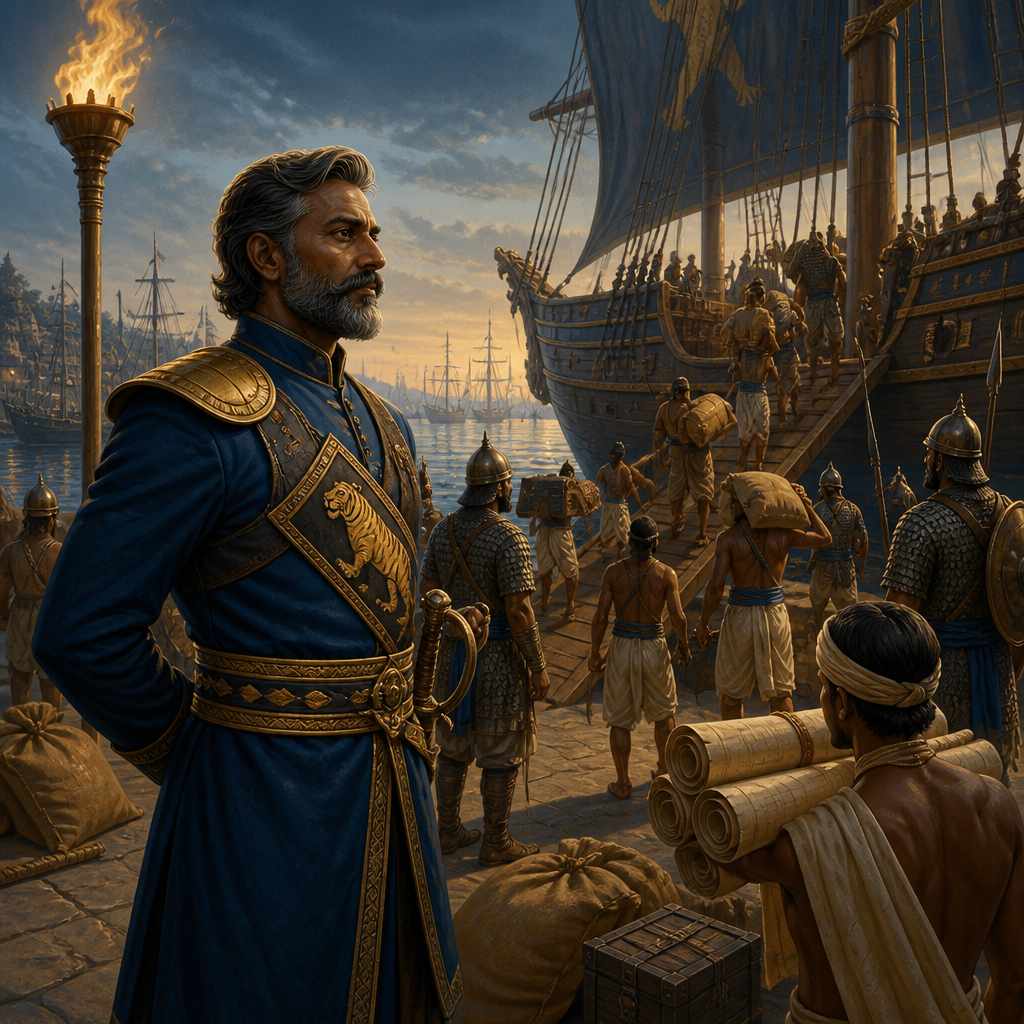
In the pre-dawn darkness of 1025 CE, Admiral Virarajendra stood on the deck of the Karavali, watching over a thousand ships slip their moorings at Nagapattinam. No European power would launch an armada this size for another five centuries. The fleet carried 100,000 soldiers, sailors, and marines, more troops than William the Conqueror would use to take England forty years later.
Their destination: the Srivijaya Empire, 2,500 kilometers across the Bay of Bengal. Their mission: to break the stranglehold that Srivijaya held over the Malacca Straits, the narrow passage through which all trade between India and China flowed.
"Samudra eva shakti," Rajendra Chola I had declared to his court. The sea itself is power.
Building the Blue-Water Navy
The 1025 expedition didn't emerge from nothing. It was the culmination of a century of deliberate naval development that transformed the Cholas from a regional land power into history's first true blue-water empire.
Raja Raja Chola I (985-1014 CE) had laid the foundation. He understood what many rulers before him missed: controlling land meant controlling peasants, but controlling the sea meant controlling the wealth of nations. Under his reign, the Chola kingdom invested systematically in what we would today call "naval infrastructure":
- Shipyards at Nagapattinam, Kaveripattinam, and Mamallapuram capable of building vessels up to 30 meters in length
- A permanent standing navy with full-time sailors rather than conscripted fishermen
- Naval academies training officers in navigation, ship-to-ship combat, and amphibious operations
- Harbor fortifications protecting the fleet from monsoon and enemy alike
This wasn't improvisation, it was grand strategy. The Cholas spent three generations building capability before deploying it.
The Arthashastra's Maritime Vision
Kautilya's Arthashastra, written over a millennium before Rajendra's expedition, had already laid out the principles the Cholas would master:
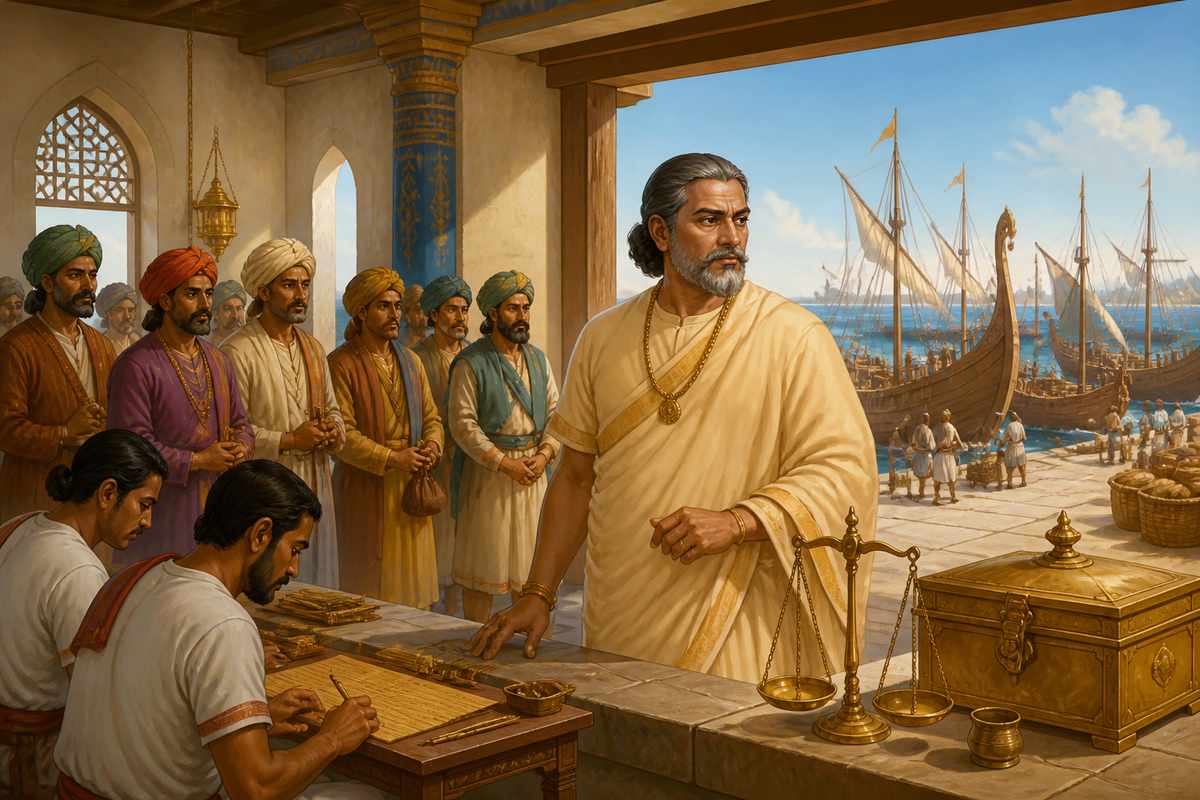
"Nava-adhyaksha shall supervise the building of boats, their maintenance, the protection of trade routes, and the collection of tolls at ferries and ports." , Arthashastra, Book 2, Chapter 28
The Nava-adhyaksha (Superintendent of Ships) wasn't merely a bureaucrat, he was a strategic asset. Kautilya understood that maritime power required integrated thinking: shipbuilding, trade protection, revenue collection, and military projection were not separate functions but facets of a single strategy.
The Cholas took this further. Their naval organization included:
| Role | Sanskrit Term | Function |
|---|---|---|
| Fleet Admiral | Thirupadai Thalaivar | Overall command |
| Ship Captain | Marakkalam-udaiyan | Individual vessel command |
| Naval Infantry | Kadal Padai | Amphibious assault troops |
| Harbor Master | Pattinam-udaiyan | Port operations |
Western Perspectives on Sea Power
Eight centuries after Rajendra Chola's expedition, American naval officer Alfred Thayer Mahan (1840-1914) would articulate principles that the Cholas had already demonstrated.
In his influential 1890 work The Influence of Sea Power upon History, Mahan argued that national greatness depended on maritime commerce and the naval power to protect it. His core principles:
- Control of strategic chokepoints determines global trade
- A strong navy requires industrial base for shipbuilding
- Forward bases extend power projection
- Trade protection is a state function
| Mahan's Principle | Chola Implementation |
|---|---|
| Chokepoint control | Captured Malacca Straits |
| Industrial base | Shipyards at Nagapattinam |
| Forward bases | Ports in Sri Lanka, Lakshadweep, Andamans |
| Trade protection | Permanent naval patrols |
Sir John Knox Laughton, British naval historian, noted in 1898 that medieval Indian fleets "anticipated by centuries the strategic doctrines Europeans thought they had invented."
Zheng He, the Chinese admiral whose famous voyages (1405-1433 CE) are celebrated as showing Chinese maritime capability, was sailing waters the Cholas had dominated four centuries earlier, and he did so without conquering territory or establishing permanent naval supremacy.
The 1025 Expedition: Execution
The Srivijaya expedition wasn't a raid, it was a planned conquest. The fleet departed in early 1025, timing their voyage to catch the northeast monsoon. They carried:
- War elephants for land campaigns after amphibious landing
- Siege equipment for fortified ports
- Gold and trade goods to immediately resume commerce under Chola flags
Within months, Rajendra's forces had captured:
- Kadaram (Kedah) - modern Malaysia
- Srivijaya's capital on Sumatra
- 14 major ports across the Malay Peninsula and Sumatra
The strategic result: Indian merchants could now trade directly with China without paying Srivijayan tolls. The Cholas didn't just win a war, they restructured the entire Indian Ocean economy.
Modern Resonance: India's Return to the Seas

In September 2022, Prime Minister Narendra Modi commissioned INS Vikrant, India's first indigenously designed and built aircraft carrier. Standing on its flight deck at Cochin Shipyard, he invoked an ancient legacy: "When India grows, the world grows. When India reforms, the world transforms."
The 45,000-ton carrier represents exactly what Rajendra Chola understood a millennium ago: true sovereignty requires indigenous capability. INS Vikrant was built entirely in India, with 76% indigenous content, from the steel to the propulsion systems.
Admiral Karambir Singh, then Chief of Naval Staff, framed it explicitly: "The Indian Ocean has been, and will again be, Hind Mahasagar, India's ocean. But only if we build the capability to make it so."
The Sagarmala Project, launched in 2015, echoes the Chola strategy of port-led development. With investments of ₹8.5 lakh crore ($110 billion), it aims to:
- Modernize 12 major ports
- Develop 1,500 islands for strategic and economic use
- Create 140 coastal economic zones
- Reduce logistics costs by ₹35,000 crore annually
The Cholas would recognize this playbook.
Your Turn
The Cholas succeeded because they thought in decades while their rivals thought in years. They invested in capability before they needed it, built infrastructure before campaigns, and understood that sea power was not about ships alone but about the entire ecosystem, shipyards, sailors, harbors, and trade networks.
As you watch India's naval buildup, from the second indigenous carrier now under construction to the Chabahar port project in Iran, ask yourself: Are we thinking like Rajendra Chola? Are we building for the challenges of 2050, or merely reacting to the challenges of today?
The next lesson explores the man behind the vision: Rajendra Chola I, the Gangaikonda Cholan who conquered not just the Malacca Straits but the very river Ganges.
Infrastructure investment with long-term returns; capability building vs. capacity building
Mahan argued that naval capability requires industrial base, which takes decades to develop. Modern defense economists call this 'strategic latency', having capabilities ready before crises emerge.
The Chola approach was explicitly dharmic, rulers accepted they were building for successors, not just themselves. Raja Raja I invested knowing Rajendra I would reap the strategic benefits.
The Chola naval buildup took approximately 40 years (985-1025 CE) before the Srivijaya expedition. Modern aircraft carrier programs take 15-20 years from design to deployment.
Public goods provision; security as enabler of commerce
Adam Smith argued that defense is the primary duty of the sovereign. Modern international relations theory frames sea lane security as a 'global public good' often provided by hegemonic powers.
Key terms
- Nausena
- Navy; literally 'ship-army'
- Navadhyaksha
- Superintendent of Ships; Director of Naval Affairs
- Pattanam
- Port city; commercial harbor
- Kadal Padai
- Naval infantry; marines (Tamil)
Key figures
Rajendra Chola I
Emperor and Naval Strategist
Admiral Karambir Singh
Former Chief of Naval Staff (2019-2021)
Alfred Thayer Mahan
Naval strategist and author of 'The Influence of Sea Power upon History'
Case studies
INS Vikrant: Building Strategic Independence
In September 2022, Prime Minister Modi commissioned INS Vikrant at Cochin Shipyard, India's first indigenously designed and built aircraft carrier. The 45,000-ton vessel took 17 years to build, employed over 2,000 companies, and achieved 76% indigenous content. The project faced repeated delays, cost overruns, and skepticism about India's ability to build such a complex platform. Many argued it would be cheaper and faster to buy a carrier from Russia or the United States.
The Chola approach would prioritize indigenous capability over immediate efficiency. Raja Raja I could have hired foreign shipbuilders, Mediterranean and Arab shipwrights were available, but chose to build domestic capability even though it took decades. The Arthashastra's principle of strategic autonomy (sva-shakti) teaches that dependence on foreign suppliers for critical defense assets creates fundamental vulnerability. Short-term cost savings create long-term strategic weakness.
INS Vikrant created an ecosystem: 550+ Indian firms now supply carrier-grade steel, electronics, propulsion systems. This industrial base enables the second indigenous carrier (IAC-2) now under construction to be built faster and cheaper. More importantly, India can now sustain, repair, and upgrade its carriers without foreign permission, true strategic autonomy.
Strategic patience in capability building beats short-term efficiency. The Cholas built for 40 years before the Srivijaya expedition; India built for 17 years before Vikrant. Both chose temporary inefficiency for permanent capability.
India's indigenous carrier program mirrors how Brazil, Turkey, and South Korea have built defense industries through decades of patient capability investment. The pattern is consistent: countries that accept short-term inefficiency in defense production gain long-term strategic autonomy and industrial depth.
INS Vikrant's indigenous content: 76%. INS Vikramaditya (purchased from Russia): under 20% indigenous content. Long-term maintenance costs for Vikrant are 40% lower because India controls the supply chain.
Sagarmala: The Chola Playbook Returns
Launched in 2015, Sagarmala is India's Rs 8.5 lakh crore ($110 billion) port-led development initiative. The project aims to modernize 12 major ports, develop coastal economic zones, and reduce logistics costs by Rs 35,000 crore annually. But Sagarmala isn't just about ports, it's about recreating the integrated maritime ecosystem the Cholas built: shipyards, coastal roads, industrial clusters, and fishing harbors all connected in a single strategic vision.
The Cholas understood that a port is not just a dock, it's a node in a network. Their pattanams (port cities) integrated shipbuilding, warehousing, merchant housing, customs collection, and naval facilities. Sagarmala explicitly follows this model, creating 'port-based industrialization' where manufacturing clusters around ports reduce the 14-18% logistics costs that make Indian exports uncompetitive.
By 2024, Sagarmala has operationalized 142 projects worth Rs 1.1 lakh crore. Port capacity has increased from 1.5 billion tonnes (2015) to 2.5 billion tonnes (2024). Turnaround time at major ports has fallen from 4.5 days to 2.5 days. New deep-water ports at Vizhinjam and Vadhavan will handle the largest container ships, positioning India as a transshipment hub, a status it lost to Colombo and Singapore.
Maritime power requires integrated thinking, ships, ports, industry, and infrastructure must develop together. The Cholas built their empire on this integration; Sagarmala attempts to recreate it.
Sagarmala's integrated port-industry-logistics approach is being replicated in Indonesia's 'Global Maritime Fulcrum' and Nigeria's 'Deep Blue' maritime strategy. The insight that maritime power requires system-level thinking, not isolated port construction, is spreading across the developing world.
India's share of global shipping: 1.2% (2015) vs 1.8% (2024). Target for 2047: 5%, which would make India the world's third-largest shipping nation after China and Greece.
Historical context
Medieval Chola Empire (985-1070 CE)
India represented approximately 25% of world GDP, with the Tamil Coast as the commercial hub connecting the Mediterranean, Middle East, Southeast Asia, and China. The Chola Empire at its height controlled trade routes from the Red Sea to the South China Sea.
No European power would launch a comparable transoceanic naval expedition until Vasco da Gama (1497-1499), nearly 500 years later, and da Gama's fleet of 4 ships carrying 170 men was a fraction of the Chola armada.
The Chola navy of 1025 CE: ~1,000 ships, 100,000 troops. The Spanish Armada of 1588 (history's 'largest' fleet until modern era): 130 ships, 30,000 men.
The Chola naval campaigns demonstrate that India was not a passive recipient of foreign maritime influence but an active shaper of Indian Ocean commerce and politics, a capability and confidence we are only now rebuilding.
Living traditions
The Indian Navy explicitly invokes Chola heritage. INS Rajendra (a Cauvery-class submarine) and the Southern Naval Command's adoption of the Chola emblem reflect institutional consciousness of this legacy. The Sagarmala Project's focus on Tamil Nadu ports follows Chola precedents.
- Irula and Paravar fishing communities: These coastal communities have maintained traditional boat-building and navigation techniques for over a millennium. Their kattumarams (catamarans) use design principles unchanged since Chola times.
- Valluvan and Vaniyar trading traditions: Merchant communities who trace their trading practices to Chola-era maritime commerce. Their business ethics and partnership structures reflect medieval guild practices.
- Nagapattinam
- Gangaikonda Cholapuram
- Mamallapuram (Mahabalipuram)
- Brihadeeswara Temple, Thanjavur: Built by Rajaraja Chola I, this temple's construction was funded by maritime trade revenues. Its inscriptions detail the administrative and economic systems that supported Chola naval power.
- Gangaikonda Cholapuram Temple: Built by Rajendra Chola I to commemorate his victories, including the naval expedition to Southeast Asia. The temple symbolizes the connection between maritime power and imperial glory.
Reflection
- The Cholas spent three generations building capability before using it. In our era of quarterly results and instant gratification, what does 'strategic patience' mean for a nation, a company, or an individual? What are you building today that you may not benefit from personally, but that future generations will?
- India's logistics costs are 14-18% of GDP compared to 8-10% in developed nations. Pick one supply chain you interact with daily, food, products, fuel, and trace how better port infrastructure (like Sagarmala envisions) would reduce costs and improve your life. What would change if Indian ports were as efficient as Singapore's?