The Composers' Court
Purandara Dasa, Tyagaraja, and how Carnatic music carried Venkateswara across the South with no patron and no press
A rich moneylender walks out of his fortune carrying a stringed instrument. A composer in Thanjavur answers a king's treasury with a song asking whether wealth ever made anyone happy. Neither held a temple post; neither kept a patron; neither had printing, radio, or copyright. Their songs of Venkateswara conquered the entire South anyway, traveling on the only distribution channel no power controls: quality. This closing lesson of the bhakta chapter is about work so good it markets itself.
The Miser's Last Transaction
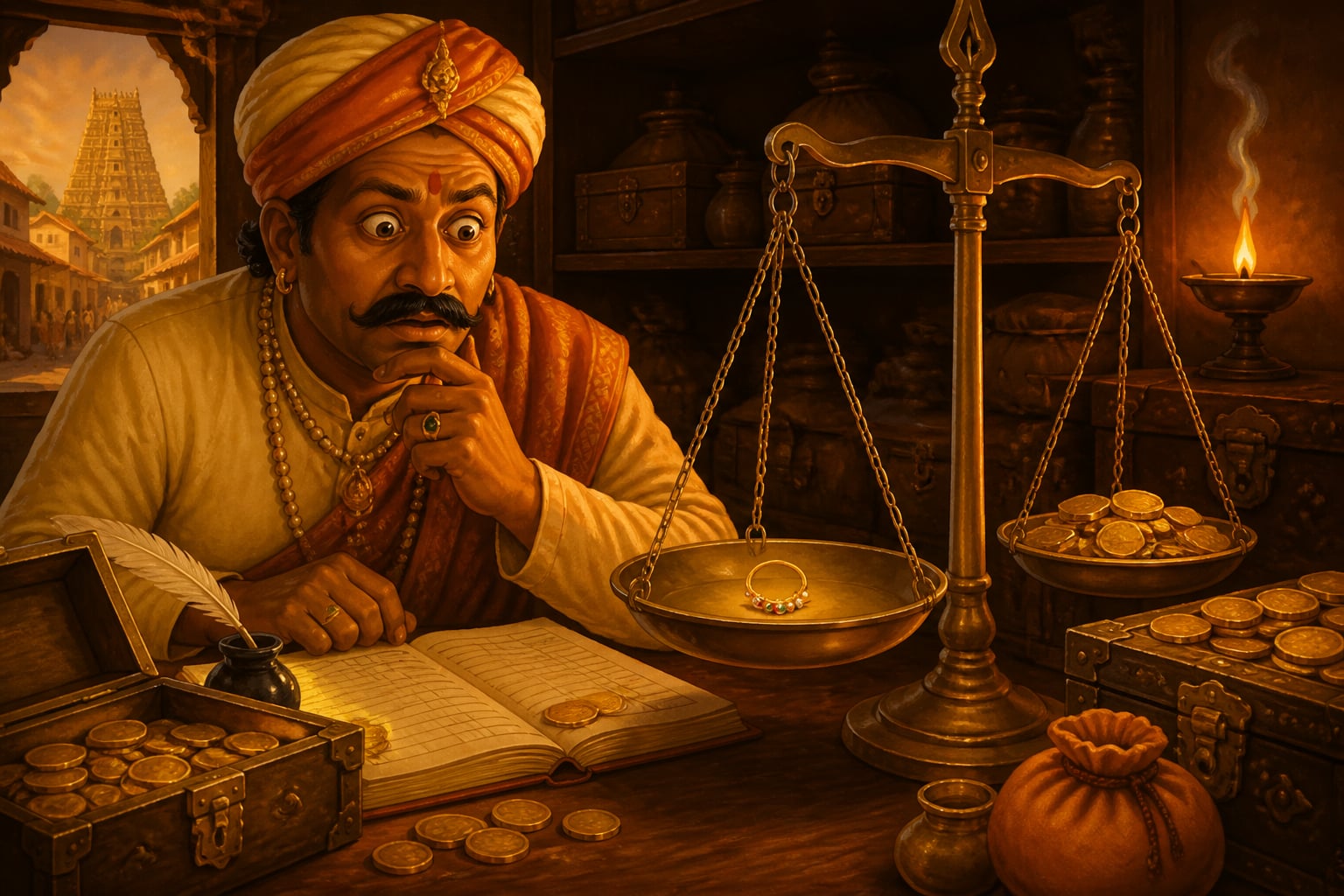
The story his tradition tells begins in a counting house in Karnataka, around the year 1525. Srinivasa Nayaka is one of the richest gem merchants and moneylenders of his region, and one of the stingiest. Coins move through his fingers all day; nothing leaves his hand for free. Then, the story goes, a poor Brahmin comes asking help for a ceremony, and the merchant, to be rid of him, takes months to give a handful of worthless coins. The Brahmin then approaches the merchant's wife, who, having nothing else of her own, gives him her nose ring.
The Brahmin promptly offers the nose ring to the merchant himself, as security for a loan. Srinivasa Nayaka recognizes it instantly. Locks it in his strongbox. Goes home to question his wife, who, cornered, prays and then reaches for the jewelry box to prove the ring is still there. It is there. The merchant opens his strongbox: the pledged ring is gone.
The tradition says he sat down where he stood and did the arithmetic of his whole life. He was around thirty. He gave away everything, the business, the gems, the ledgers, took up the tambura, the four-stringed drone instrument of wandering singers, and walked out of the merchant class forever. Enjoy the miracle as the tradition tells it; keep the documented ending, because it is bigger than the legend. That merchant became Purandara Dasa, and Carnatic music, the classical music of all South India, calls him its grandfather.
This chapter has asked what art is for, what to do when gatekeepers refuse you, and what earns an outsider a place inside. Its last lesson is the working artist's hardest question. You have no temple post, no patron you can keep, no press, no platform. How does the work travel?
The Grandfather of Carnatic Music
Purandara Dasa joined the haridasa movement, the wandering singer-saints of Kannada country, and studied under Vyasatirtha, the great scholar who was also royal preceptor to emperor Krishnadevaraya, the same emperor whose gilded gifts you saw two lessons of history ago. The hill's story keeps folding back on itself.
What the former merchant did next was systematic in a way only a former businessman could be. He composed relentlessly, in Kannada, the people's language of his region, tradition credits him with hundreds of thousands of songs, a loving exaggeration; about a thousand survive. But he also did something no pure poet thinks to do: he standardized the teaching. He designed the graded exercises, the beginner's scale patterns and drills, through which the music itself is learned.
Five centuries later, every single student of Carnatic music, in Chennai or in California, still begins with the exercises Purandara Dasa designed. Not his songs first: his curriculum. He did for South Indian music roughly what Panini did for Sanskrit grammar, turned an art into a teachable system, and the system became the distribution network. Every teacher who used his method taught students who became teachers who used his method. He never held a post. He built a pipeline.
And through that pipeline flowed, among everything else, the lord of the hills. One of his best-loved kritis is sung to this day:
वेङ्कटाचल निलयं वैकुण्ठपुरवासं । पङ्कजनेत्रं परम पवित्रं शङ्खचक्रधर चिन्मयरूपं ॥
veṅkaṭācala nilayaṃ vaikuṇṭha-pura-vāsaṃ paṅkaja-netraṃ parama-pavitraṃ śaṅkha-cakra-dhara cinmaya-rūpaṃ
He who dwells on the Venkata hill, resident of Vaikuntha, lotus-eyed, supremely pure, bearer of conch and discus, whose form is pure consciousness.
Purandara Dasa, Venkatachala Nilayam
A Kannada saint, singing in the Vijayanagara age, put the god of a Telugu-Tamil border hill into the permanent repertoire of the whole South. No temple committee commissioned it. It was simply too good to stay home.
The Song That Refused a Treasury
Two and a half centuries later, in the Tamil town of Tiruvaiyaru near Thanjavur, lived the greatest of all Carnatic composers: Tyagaraja, born 1767 into a Telugu-speaking family, devotee of Rama, and a man so committed to music-as-worship that he treated every alternative use of it as a kind of theft.
The test came, as it came for Annamacharya, from a palace. The Maratha king of Thanjavur, Serfoji II, a genuine patron of the arts, invited Tyagaraja to court: sing before the throne, receive land and gold. Court musicians would have crawled over each other for the invitation. Tyagaraja's answer has been sung for two hundred years, because his answer was a kriti:

నిధి చాల సుఖమా రాముని సన్నిధి సేవ సుఖమా । నిజముగ పల్కు మనసా ॥
nidhi cāla sukhamā rāmuni sannidhi sēva sukhamā nijamuga palku manasā
Is wealth the greater happiness, or service in Rama's presence? Answer truly, O mind.
Tyagaraja, Nidhi Chala Sukhama
Notice the form of the refusal. Not a lecture to the king; a question addressed to his own mind, sung in public. Annamacharya refused his king in the 1400s and was chained for it. Tyagaraja refused his king in the 1800s and was celebrated for it, partly because three centuries of bhakta composers had, by then, taught the South whose side such stories are on. The chapter's first lesson and its last close the same loop: the artist who will not sell the core keeps the core's power.
The Curtain
Tyagaraja's devotion belonged to Rama, but the tradition records his pilgrimage to Tirumala, and the visit produced one of the most loved stories in Carnatic lore. Be careful with it, and honest, the way this course has been with every legend.
What is certain: Tyagaraja composed a kriti addressed to Venkateswara of Tirupati, Tera Teeyagarada, and it survives in the standard repertoire. Its words ask the lord: won't you remove the curtain? And, in the very same breath, the song names the real curtain: not cloth, but matsara, the envy and pride standing between the singer's mind and his god.

What is tradition: the story that when Tyagaraja arrived at the sanctum, the priests had drawn the curtain closed, and as he sang this kriti, the curtain fell aside of its own accord. The miracle is hagiography, told with love, impossible to document. But read the kriti's own words and you see the miracle story is almost a distraction. The composer built the meaning into the song itself: every obstacle between you and what you seek has an outer form and an inner one, and the inner curtain is the one only you can remove. The song works whether or not the cloth ever moved.
No Patron, No Press
Now step back and look at what this chapter's four lives have in common, as media history, because it is stranger than any single legend.
Annamacharya's songs reached the future through copper and a family school. Purandara Dasa's traveled down a teaching lineage he engineered himself. Tyagaraja never printed a note; his disciples memorized the kritis, taught their own students, and the songs radiated outward through the guru-shishya chain, singer to singer, for a century before anyone systematically wrote them down. No copyright, no publisher, no advertising, no algorithm. The filter at every link of the chain was a single question: is this song good enough to spend my life teaching?
Most songs failed that filter and vanished. What passed it has now outlived every empire, court, and currency of its era. The same mechanism carried the dohas of Kabir, the weaver-poet of Varanasi, across five centuries and into the scripture of another religion entirely, on pure memorability. Quality is a slow algorithm, the slowest there is, but it is the only one that has never once been bought.
The mechanism has not retired. In 1963, a singer from Madurai named M.S. Subbulakshmi recorded the Venkateswara Suprabhatam, the dawn hymns of the hill. No marketing plan imagined what followed: her recording became the morning sound of the entire South, playing at first light in millions of homes to this day. The court of the composers never closed. It just changed instruments.
The Bhaktas' Four Answers
The chapter set out four dilemmas every creator still faces. Its four portraits answered:
| The bhakta | The dilemma | The answer |
|---|---|---|
| Annamacharya | Is your art for sale? | The skill, yes; the core, never |
| Vengamamba | The gatekeepers reject you | Outlast them; outproduce them |
| Hathiram Bhavaji | No credentials, only conviction | Conviction, demonstrated for years, wins |
| The composers | No distribution but the work | Make it too good to stay home |
Four lives, one common structure underneath: each treated the work as an offering, aimed past every earthly audience, and each discovered the paradox that this chapter has circled from its first page. Work aimed at the market obeys the market's fashions and dies with them. Work aimed beyond the market somehow ends up owning it.
So far this course has watched the hill from the outside: its stories, its builders, its singers. It is time to walk in. The next chapter enters the temple itself, and it begins with the strangest fact in the whole tradition: at the center of the world's most-visited shrine stands an image that, the tradition insists, no human hand ever carved, an image whose very identity was once the subject of the hill's greatest dispute, settled not by a war but by a procedure.
Case studies
Kabir: Five Centuries on Pure Memorability
Kabir was a fifteenth-century weaver in Varanasi: low-caste, unlettered by the standards of the schools, with no royal patron, no institution, and no script of his own. He composed dohas, two-line couplets in the plainest street Hindi of his day, about God beyond temple and mosque, about hypocrisy, about death sitting on every shoulder. He wrote nothing down. The couplets traveled mouth to mouth: weavers to boatmen, wandering sadhus to village grandmothers, each carrier keeping only what refused to be forgotten.
Kabir is the composers' mechanism stripped to its bare physics. Annamacharya had copper plates; Purandara Dasa had a curriculum; Tyagaraja had disciplined disciples. Kabir had nothing but compression: truth packed so tight into fourteen words that human memory itself became his publisher. The filter the lesson describes, is this worth teaching to my student?, operated on him in its rawest form: is this worth repeating to my neighbor? Five centuries of neighbors said yes.
His couplets survived five hundred years with no institution dedicated to preserving them, entered the Guru Granth Sahib, the scripture of Sikhism, where hundreds of his verses are enshrined, spawned the Kabir Panth community, and remain so current that Hindi speakers quote him daily, often without knowing the line is his. A weaver with no press achieved distribution most empires never managed.
Distribution can be owned, rented, or earned. Owned and rented channels die with their owners; the earned channel, work people voluntarily carry, is the only one that compounds across centuries.
Every era's platforms promise reach and take a toll for it. Kabir's dohas mark the toll-free road: make the unit of work small, true, and impossible to forget, and your audience becomes your infrastructure.
The Guru Granth Sahib, compiled in 1604, includes several hundred of Kabir's compositions: a Muslim-born Hindu-mystic weaver's verses canonized in a third faith's scripture within about a century of his death, entirely through their own circulation.
The Newsletter That Grew in Forwards
Aparna, a sruti-box repairer's daughter turned software product manager in Bengaluru, starts a small weekly email called Ear Training, explaining one piece of Indian classical music at a time to complete beginners: why a raga feels like rain, what to listen for in a ten-minute alapana, one recording with timestamps. She refuses the standard growth menu: no social media clips, no collaborations, no paid promotion, no clickbait subject lines. Her one rule is craft: every issue must be good enough that at least one reader forwards it to one friend without being asked. For a year, growth is humiliating: forty subscribers, then ninety. Her friends gently suggest reels.
Aparna has chosen the sampradaya model in a broadcast age. Each forwarded email is a guru-shishya link in miniature: a human staking a little personal credibility to say, this is worth your attention. Like the kritis, her issues pass or fail one filter, is this worth carrying?, and like the composers she has bet everything on the slow algorithm: quality compounding through voluntary human chains rather than rented reach.
The compounding is invisible until it isn't. In year two, a Carnatic vocalist forwards an issue to her entire student list; a Chennai music critic quotes another in a festival piece; each spike brings readers who forward in turn. By year four the list is forty thousand, with an open rate the industry considers a misprint, and concert organizers ask her to write program notes, because her readers, having been trusted with one good thing at a time, trust her completely. Rivals with ten times her output and paid promotion churn through audiences she never loses.
Growth bought with attention tricks rents an audience; growth earned through forwarding builds a congregation. The difference appears in the second year and becomes unbeatable by the fourth.
In every creator economy, the fork Aparna faced is permanent: optimize for the platform's algorithm or for the human chain. The composers' court is the five-century evidence file for the second choice, and it holds whether the work travels by disciple, doha, or email.
Living traditions
The composers' court set South India's permanent template for artistic integrity: the artist as devotee first, professional second, refusing the durbar and trusting the chain. Their transmission model, quality filtered through voluntary human carriers, now doubles as a case study quoted by educators and creators alike, and their songs remain the proof: no empire that patronized, ignored, or tested these musicians survives, and every one of their refusals is still being sung.
- The Carnatic Concert Repertoire: Venkatachala Nilayam, Tera Teeyagarada, and dozens of other compositions about the lord of the hill remain standard concert pieces, performed in the great December music season of Chennai, at temple festivals, and on diaspora stages, keeping Venkateswara in the living songbook of the South.
- The Dawn Suprabhatam: The morning hymn waking the deity is broadcast, streamed, and played from home speakers across the South at first light, most often in M. S. Subbulakshmi's 1963 recording, synchronizing millions of households with the temple's ritual clock.
- Music in the Temple's Daily Life: The temple administration maintains musical service traditions and cultural programs where the compositions of Annamacharya, Purandara Dasa, and Tyagaraja are performed, the three streams of this chapter flowing through one sanctum's daily life.
Reflection
- The tambura plays no melody; it holds one steady note beneath the song. Purandara Dasa traded a fortune for one. What is the single steady note under your life's music, and when did you last actually listen for it?
- Tyagaraja asked his mind, truthfully, whether wealth or meaningful service was the greater happiness. Put his exact question to yourself about your current work, and answer as honestly as he demanded: nijamuga, truly.
- The disciple chain filtered songs by asking 'is this worth a life of teaching?' Modern algorithms filter by asking 'will this hold attention for eight more seconds?' What kind of culture does each filter build, and which one is building yours?