Talapatram

Tarigonda Vengamamba

The woman poet who out-stubborned the temple establishment, and whose lamp still closes the god's day

In the 1700s, a widowed woman insisted on a poet's life the establishment said she could not have. She refused the rules of widowhood, wrote when they mocked her, wrote when they exiled her to a forest cave, and wrote until her shelf of books outweighed every man who had blocked her. Today the temple that once threw her out ends every single night with a lamp offered in her name. This lesson is for everyone the gatekeepers have said no to.

The Woman They Threw Out

Picture a morning on the hill, sometime in the mid-1700s. In the lamplit corridor of the Tirumala temple, a woman stands with a harathi plate in her hands, the camphor flame trembling as she circles it before the deity. She is a widow. And she is wearing what widows of her time were forbidden to wear: kumkuma bright on her forehead, flowers in her unshaved hair.

Around her, the guardians of custom have had enough. Who is this woman from Tarigonda village who dresses as if her husband were alive, argues with scholars, writes poetry as if she had a right to, and now performs harathi to the lord as if the temple were her own house? The order comes down: she is to stop. When she does not stop, she is driven out, first from the shrine, then from the temple town itself.
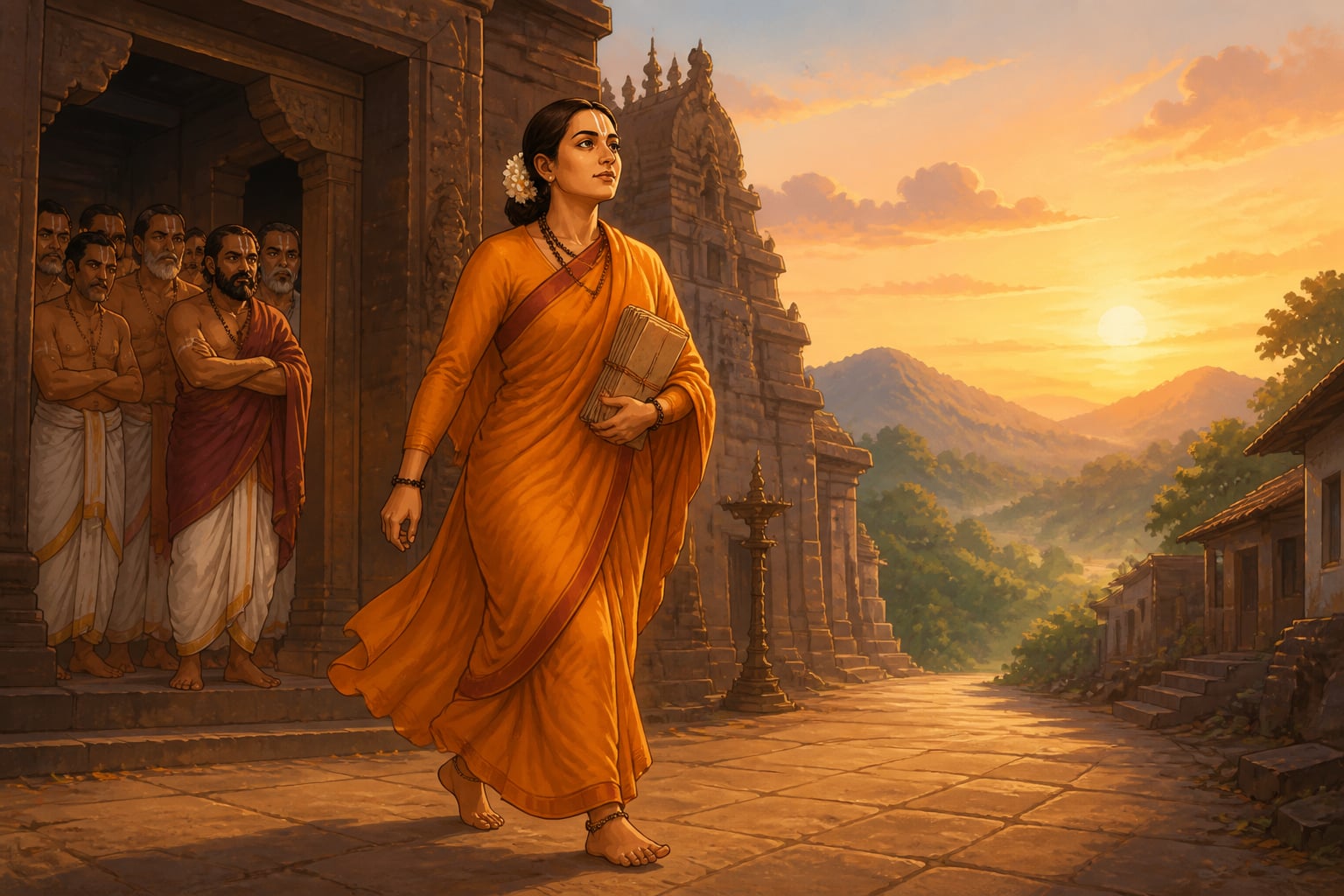
Vengamamba walking out of the temple town unbowed

She does not argue her case. She picks up her pen and her god and walks out, into the forest.

The men who exiled her believed they had ended her story. Hold that belief up against one fact from our own time: the Tirumala temple now ends every single night with a lamp offered in her name. The last ritual of the god's day, after the crowds are gone, carries the name of the woman the establishment threw out. This lesson is about the road from that morning to this one, and it belongs to everyone whose gatekeepers have said: not you.

A Girl from Tarigonda

Vengamamba was born in 1730 in Tarigonda, a village in the Chittoor region, in the same Telugu country that had produced Annamacharya three centuries earlier. Her father was a pious Brahmin who let his daughter do something unusual: learn. The village deity, Lakshmi Narasimha, became her first audience. As a girl she composed a satakam, a hundred-verse Telugu poem, in his praise, and took the village's name into her own. She would sign herself, all her life, as Tarigonda Vengamamba.

Her family did the normal thing and married her off as a child. Her husband died while she was still young. And here her life turned on a single refusal.

Custom demanded that a widow be visibly erased: head shaved, ornaments gone, kumkuma wiped away, a life of silence at the edge of the household. Vengamamba refused all of it. Her answer, as the tradition records it, was theological and unanswerable: her true husband was the lord himself, and he was not dead. She kept the kumkuma. She kept her hair. She kept writing.

To modern ears this may sound like a small domestic matter. In the 1700s it was open rebellion. A widow who would not perform her own erasure was an insult to every authority in the room, and the authorities responded accordingly: mockery first, then harassment, then the exile from Tirumala, where she had gone to live near her chosen lord.

The Cave Years

Driven from the temple town, Vengamamba went into the forested folds of the hills and settled in a cave near Tumburu Kona, a waterfall gorge a day's trek from the shrine. She lived there for years, in silence and discipline, practicing the yoga she would later write about with a specialist's precision.

The tradition tells a story about those years, and it should be enjoyed as tradition tells it. Each night, the story goes, the priests would close the sanctum and each morning find the evidence of worship already fresh inside: the lord, they concluded, was going to her, since she could not come to him. The legend is the tradition's way of recording a verdict: the exile had failed. You can bar a devotee from a building. Nobody has yet found a way to bar the devotion.

Vengamamba writing by an unflickering lamp in her cave

What is not legend is what she did with the solitude. She wrote. She wrote through the mockery, through the exile, through years when no establishment would touch her work.

यथा दीपो निवातस्थो नेङ्गते सोपमा स्मृता । योगिनो यतचित्तस्य युञ्जतो योगमात्मनः ॥

yathā dīpo nivāta-stho neṅgate sopamā smṛtā yogino yata-cittasya yuñjato yogam ātmanaḥ

As a lamp in a windless place does not flicker, such is the disciplined mind of a yogi absorbed in the self.

Bhagavad Gita 6.19

The Gita's image of the unflickering lamp could be her portrait. The wind, in her case, had names and titles. The lamp did not go out.

The Shelf of Books

Count what the woman they called unqualified actually produced. Her surviving corpus runs to well over a dozen major works, across nearly every form Telugu literature had:

Notice the range: devotion, drama, philosophy, technical instruction. The scholars who mocked her had one argument, that a woman with no formal Sanskrit schooling could not be a real author. She answered the way builders answer, not with a rebuttal but with a body of work too large and too good to dismiss. There is an old rule visible here, one this hill keeps teaching: gatekeepers control the gate, not the road. The work finds its own way around.

India's history keeps producing people who prove it. A century after her, a clerk in Madras named Srinivasa Ramanujan, twice failed out of college, his letters returned unread by famous mathematicians, kept filling notebooks with theorems until one professor finally read past the first page. The gatekeepers were not defeated in argument. They were simply out-produced.

The Return and the Pearls

The pearl arati offered by the returned Vengamamba

The establishment's resistance wore out before her patience did. In time, the authorities relented; she returned to Tirumala and lived there, honored at last, until her death in 1817 at a great age. Her samadhi, her memorial, stands in Tirumala to this day.

But the tradition kept a better memorial than stone. Vengamamba used to offer the deity a muthyala harathi, a lamp ceremony with pearls, at the close of the day, singing verses of her own composition. The temple absorbed her offering into its eternal routine. Every night, in the Ekanta Seva, the day's final ritual, when the god is sung to rest with lullabies, a harathi associated with her name is offered in the sanctum. The establishment of her century tried to remove her from the temple. The temple instead made her part of its clock.

The modern administration went further. Its vast free-kitchen complex, which feeds lakhs of pilgrims, is named Matrusri Tarigonda Vengamamba Annaprasadam Bhavanam: the exiled widow's name now stands over the largest act of hospitality on the hill, feeding every pilgrim regardless of caste, wealth, or sex. History has a long memory and, occasionally, a sense of justice.

Outlasting the Gatekeepers

Set her story beside the chapter's question: what does a creator do when the gatekeepers say no?

She shows the full method, in order. She did not comply: the kumkuma stayed. She did not quit: the pen stayed. She did not waste her strength on the gate: no petitions, no career spent fighting the men who blocked her. She moved to where the work could continue, a cave, if that was what was available, and let the work pile up until the world had to reorganize itself around it.

Note what her stubbornness was made of. Not thick skin, but a settled certainty about whom the work was for. Like Annamacharya's songs, her books were offerings; the establishment was never their intended reader. You cannot be gatekept out of an offering. The judges she answered to, her lord and her own standard, had already said yes.

Every creator who has been told 'not you' owns a share in her story: wrong caste, wrong sex, wrong degree, wrong accent, wrong age. Her advice, written in the shape of her life, is plain. Keep the kumkuma on. Keep writing. Outlast them.

She was not the only outsider this hill would reorganize itself around. In roughly the same era, a wandering sadhu from the north arrived at Tirumala: no lineage the South recognized, no Sanskrit, no standing, nothing but a devotion so direct that the stories say the god would sit with him at night and play dice. The establishment dismissed him too. His mutt ended up running the entire temple for ninety years.

Case studies

Ramanujan: The Letters They Returned

Srinivasa Ramanujan failed out of college twice, undone by every subject that was not mathematics, and by 1912 was a clerk at the Madras Port Trust, filling cheap notebooks with theorems in the margins of a poor man's life. The gatekeepers had spoken clearly: no degree, no position, no entry. He wrote to eminent mathematicians in England; his letters came back or went unanswered. In January 1913 he tried once more, mailing nine pages of raw results to a Cambridge professor named Hardy, who came within a whisker of discarding them as a crank's scribbles before the strangeness of the formulas pulled him back.

Ramanujan is Vengamamba's pattern in mathematics. Both were ruled unqualified by every measure the institutions could check, degree and sex, schooling and status, and both kept producing through the years of rejection, because the work was not addressed to the gatekeepers in the first place. Ramanujan famously credited his family goddess Namagiri for his formulas: like her books, his notebooks were offerings first, and the institutions were late arrivals to work that had never depended on their permission.

Hardy brought him to Cambridge in 1914. Within five years the clerk with no degree was a Fellow of the Royal Society, among the youngest in its history. He died at thirty-two, and his notebooks have fed mathematics for a century since: a lost notebook, rediscovered in 1976, was still yielding new results generations after his death.

Rejection by gatekeepers is information about the gate, not about the work. The only response that has ever reliably worked is the one Vengamamba and Ramanujan shared: keep producing until the pile is undeniable.

Every field still runs on proxies, degrees, brand-name employers, the right city, the right accent, and every field therefore still returns its Ramanujan letters unread. The lesson cuts both ways: keep producing if you are the outsider, and read past page one if you are the gate.

Before Hardy, at least two other Cambridge mathematicians received Ramanujan's letters and returned or ignored them: the difference between a port clerk and a Fellow of the Royal Society was one reader who read past page one.

The Engineer They Kept Overlooking

Sindhu is a backend engineer at a mid-sized Pune software company, the only woman on an infrastructure team of eleven. Her code reviews come back with a different flavor than her colleagues': more 'are you sure you understand this system?', more nitpicks, fewer approvals. In meetings her warnings get restated ten minutes later by someone else, to nods. Two promotion cycles pass her over with the same vague note: needs more visible impact. Her mentor advises the standard menu: complain to HR, switch companies, or grow a thicker skin. Sindhu picks a fourth option. There is a chronic problem everyone has learned to live with, a deployment system that fails roughly one release in ten and costs the company weekends. Quietly, in the gaps of her sprint work, she starts fixing it: one failure mode at a time, each fix documented, each result measured.

Sindhu's fourth option is the Vengamamba method. She does not comply (accepting the verdict that she is not senior material), does not quit the work (only the argument), and does not spend her strength on the gate (the review-comment wars, the meeting battles). She relocates her effort to where no gatekeeper controls the outcome, a broken system and a measurable result, and lets the work accumulate. Her cave is a neglected codebase. The discipline is the same tapas: sustained effort past the point where recognition is fueling it.

Fourteen months later the deployment failure rate is near zero, and the metric is public: dashboards do not restate her points in someone else's voice. When a release crisis hits a sister team, hers is the system held up as the standard, and the question 'who built this?' has only one answer. The promotion arrives with an apology attached. Two of the reviewers who doubted her become her advocates, not because they were argued down, but because they were out-produced.

When judgment about you is biased, move the contest to ground where judgment is irrelevant: shipped work, measured results, problems visibly solved. Bias can survive any argument; it survives evidence much less well.

This is not advice that the bias is acceptable, and organizations that force their Vengamambas to take the cave route lose most of them. It is advice about power: the one lever always in the builder's hand is the pile of undeniable work, and it is the lever gatekeepers have never found a way to take away.

Living traditions

Vengamamba has grown from a suppressed footnote into one of the hill's officially celebrated figures: her name on the great free kitchen, her ritual in the temple's nightly worship, her plays performed at temple festivals, and her life retold in Telugu books, television, and film. For modern readers she stands in the same row as the era's other unlettered-by-decree women authors, proof that the corpus outlives the committee.

  • The Nightly Muthyala Harathi: During the Ekanta Seva, the final service of the temple day, the deity is sung to rest and a pearl-lamp offering associated with Vengamamba's name is made in the sanctum. Her devotional verses live inside the temple's daily round of song.
  • Pilgrimage to Tumburu Kona: The waterfall gorge where tradition places her exile years remains a trekking pilgrimage in the Tirumala forests, reachable on foot in season. Pilgrims visit the cave area associated with her tapas along with the sacred cascade.
  • Her samadhi at Tirumala: Vengamamba's memorial shrine stands in Tirumala, where she spent her final decades after the establishment relented. Pilgrims who know her story stop there; the temple's guides increasingly tell it.

Reflection

  • The men who exiled Vengamamba are nameless now, while her lamp closes every day on the hill. When you imagine the people whose approval you currently work for, how many of them will matter to your story in thirty years?
  • Vengamamba kept the kumkuma on. What is the equivalent in your life, the marker of who you are that some authority or custom is quietly pressuring you to remove?
  • The temple that exiled her now honors her nightly. Did the institution correct itself, or did it simply absorb a rebel it could no longer ignore, and is there a difference?

More in The Bhaktas: The People Who Made Tirumala Immortal

All lessons in The Bhaktas: The People Who Made Tirumala Immortal · Tirupati Balaji ebook course