Talapatram

Annamacharya: 32,000 Songs

The composer who refused a king and the copper plates that slept in a temple vault for four hundred years

At sixteen, a village boy climbed the hill of Tirumala and made a vow: one new song for the lord, every day, for the rest of his life. He kept it for nearly eighty years. He sang caste equality in the 1400s, refused to sing for a king and paid for it, and his 32,000 songs were engraved on copper plates, sealed in a stone room, and forgotten for four centuries. This lesson is about the oldest question in every creator's life: who is your work actually for?

The Room of Sleeping Songs
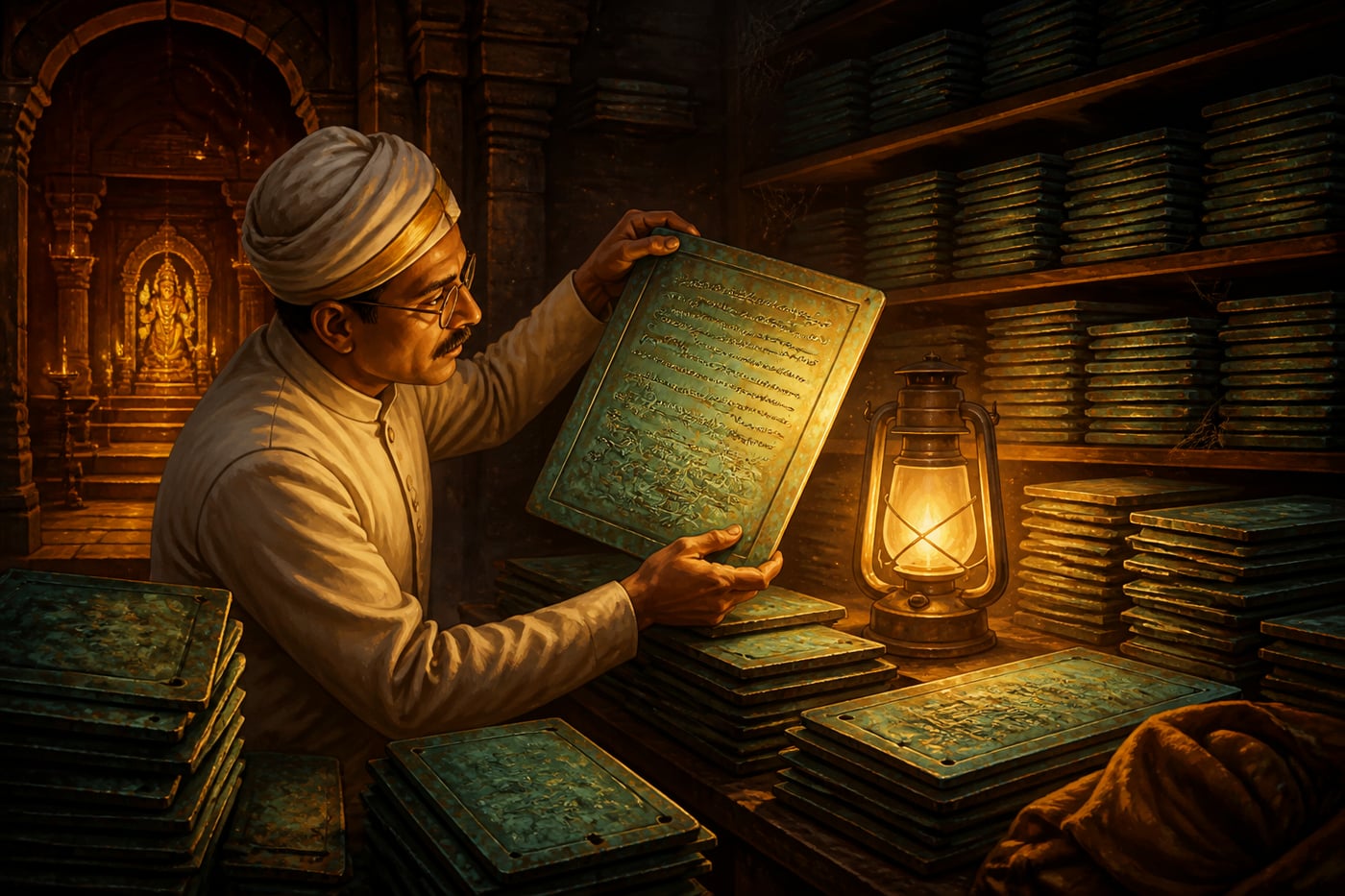
Copper plates of sleeping songs found in the vault

Early in the twentieth century, inside the Tirumala temple, the administration turned its attention to a small stone room that stands just opposite the hundi, the great pot where pilgrims drop their offerings. The room had long been used as a store. When lamps were brought in, the light fell on stacks of copper plates, about 2,500 of them, dark green with age, each one engraved on both sides with neat rows of Telugu letters.

The temple's scholars of inscriptions, the same kind of patient readers you met in the last lesson, began to work through them plate by plate. What they found was not deeds or accounts. It was songs. Thousands and thousands of songs, and most of them signed, near the closing lines, with marks of the same author: Annamacharya.

Almost no one alive had heard even one of them sung. The songs had been asleep in that room for roughly four hundred years.

This lesson is the story of the man who wrote them. The last chapter belonged to the builders: poets, a reformer, an emperor, a queen. This chapter belongs to the bhaktas, the devotees, four creators whose only real tool was their devotion and their craft. It opens with the question every creator still wakes up to: who is your work actually for?

The Boy Who Climbed

Annamacharya was born in 1408 in Tallapaka, a small village in the Kadapa region of today's Andhra Pradesh. The stories of his childhood are loving legend, told by his own grandson in a biography written after his death. But the outline is steady: at about sixteen, the boy left home without permission and walked to Tirumala, joining the pilgrim paths up the hill.
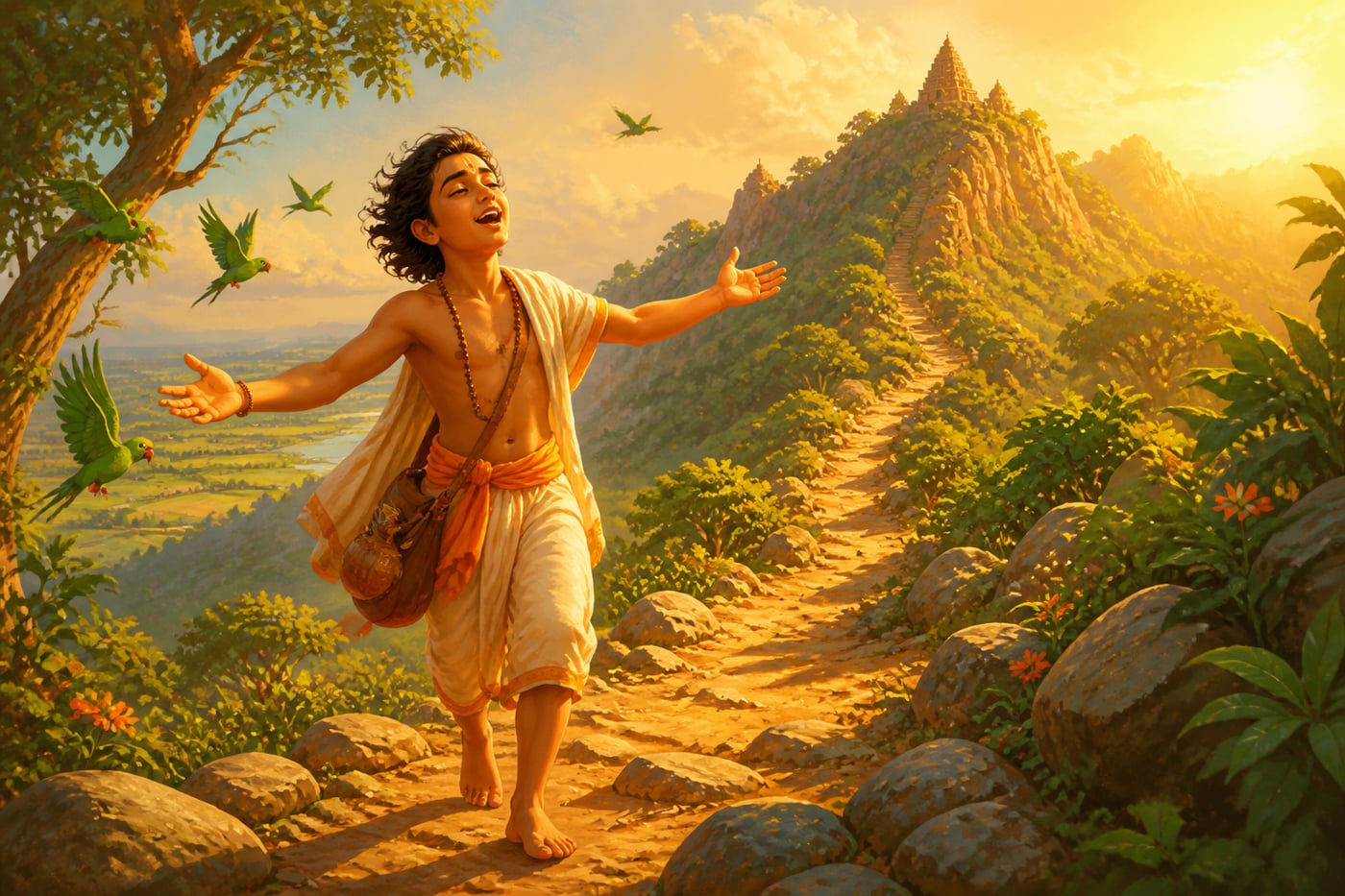
Young Annamacharya singing on his first climb

Tradition says he composed his first verses on that first climb, in praise of the hill itself, before he had even seen the deity. And it says he made a vow that sounds impossible: one new song for Venkateswara, every day, for the rest of his life.

He lived to be ninety-five. The family's own count, recorded by his grandson, is 32,000 songs. Even the twelve thousand or so that survive make him one of the most productive songwriters in recorded history. Do the arithmetic on the vow and the number stops being a boast and becomes a work ethic: it is simply what one song a day adds up to, if you never stop.

He wrote almost all of them in Telugu, the language of his people, with some in Sanskrit. Like the Alvars seven centuries before him, he chose the mother tongue over the scholar's tongue, and for the same reason: songs are for singing, and people sing in the language of their kitchens. Telugu literature remembers him as the Pada Kavita Pitamaha, the grandfather of the pada, the short song-poem form his hands perfected.

His songs flow in two rivers:

Adhyatma (spiritual) songs Sringara (love) songs
Speak directly of God, the self, and freedom Sing the love of the lord and the goddess Alamelu Manga
The voice of a philosopher The voice of a poet
"The supreme spirit is one" The soul approaches God as a lover approaches the beloved

The Song That Flattened the World

Remember the century he lived in. In the 1400s, caste ruled who you could touch, where you could stand, whose shadow could fall on whose food. Into that world, from inside the temple tradition itself, Annamacharya sang his most famous lines:

బ్రహ్మమొక్కటే పరబ్రహ్ févrммొక్కటే నిండార రాజు నిద్రించు నిద్ర ఒకటే అండనే బంటు నిద్ర అది ఒకటే

brahmamokkaṭe parabrahmamokkaṭe niṇḍāra rāju nidrincu nidra okaṭē aṇḍanē baṇṭu nidra adi okaṭē

The supreme spirit is one, only one. The sleep a king sleeps and the sleep his servant sleeps, it is one and the same sleep.

Annamacharya, Brahmam Okate

The song goes on, verse after verse: the ground a Brahmin walks and the ground an outcaste stands on are the same ground; hunger is one; the god inside all is one. He was not writing a protest pamphlet. He was stating, in plain Telugu that a farm worker could sing, what his philosophy actually implied if you took it seriously. Five and a half centuries later, the song is still sung, and it has lost none of its edge.

His home was full of music. His wife Timmakka wrote a long poem called Subhadra Kalyanam and is widely regarded as the first woman poet of Telugu literature. Two of his sons became composers and scholars. The vow had become a family trade.

The Day He Said No

The most powerful man in the region was Saluva Narasimha, the warlord who ruled from Chandragiri fort at the foot of the hills, and who would later seize the Vijayanagara throne itself. He was a devotee of Venkateswara and an admirer of the poet. For years the two rose together, the general funding the temple, the poet filling it with music.

Then came the request. The tradition tells it plainly: the king, who loved Annamacharya's sringara songs, asked him to compose that kind of song about the king himself. Sing of me the way you sing of the lord.

To the king it must have seemed a small ask, even an honor. Court poets everywhere lived on exactly such commissions. Annamacharya refused. The answer preserved in tradition is itself a song: the tongue that has sung of the lord of the hill will not bend to praise a mortal.

Annamacharya in chains refusing the king

The king, humiliated in front of his own court, had the poet chained. The legend says the chains fell away when Annamacharya sang to his god from the cell. Behind the legend sits a harder, more believable fact: the poet lost the favor of the most powerful patron he would ever have, and he accepted the loss as the price of the line he had drawn.

Understand what he was and was not refusing. He was not refusing work, or money, or patrons. Temple singers were professionals; he trained his family in the craft and its economics. He was refusing one specific thing: the core of the work was not for hire. His skill could serve many; his praise belonged to one. Every serious creator ends up drawing this line somewhere. The shehnai master Bismillah Khan drew it in our own time, turning down wealth and a home abroad because his music, he said, could not leave the Ganga it was made beside. The line costs something every time. It is also, usually, the exact place where the work's power comes from.

The Copper Plates

Annamacharya died in 1503, singing, the tradition says, to the end. And here the story turns from the artist to something this course keeps meeting: the keeping.

Songs on palm leaf rot in a century. His son Pedda Tirumalacharya and grandson organized something far more expensive and far more permanent: the songs were engraved on copper plates, the same technology kings used for land grants, and stored in that stone room by the hundi. The plates even record the raga, the melodic frame, assigned to each song.

Then history did what it does. The family line faded. The room stopped being opened. Memory of what it held dissolved. For about four hundred years, one of the largest bodies of devotional art ever created sat in the dark, a few feet from millions of passing pilgrims.

The rediscovery in the early twentieth century gave scholars back the words, but not the sound: the plates name each raga, yet the original tunes were never written down and are lost. So in 1978 the temple administration launched the Annamacharya Project, commissioning musicians to set the words to new melodies and carry them back to the people. It worked beyond anyone's plan. Today his songs play on temple loudspeakers and concert stages and in film recordings, and Telugu mothers still sing his lullaby, Jo Achyutananda, to babies who will never know the author's name.

The Vault and the Vow

The stone room is called the Sankirtana Bhandagaram, the treasury of songs. Stand in front of what it means for a moment. A man kept a daily vow for nearly eighty years, said no to a king for the sake of it, and his life's work still almost vanished. What saved it was everything this course has studied so far: the family that recorded, the temple that kept, and above all the quality of the songs themselves, good enough that when they finally woke up, four centuries late, people wanted to sing them.

Annamacharya answered the creator's question with his whole life: the work was not for the king, and not even for the audience. It was an offering, made daily, whether or not anyone was listening. The audience came anyway. It usually does, eventually, though he never promised you it would come in your lifetime.

Two generations after his death, in the same Telugu country, a girl would be born who wanted what he had: a life of composing for the lord of the hill. But she was a woman, and the establishment that now ran the temple's culture would mock her, block her, and finally throw her out. She refused to stop writing. Her name was Tarigonda Vengamamba, and she out-stubborned them all.

Case studies

Bismillah Khan: The Man Who Would Not Leave the River

Ustad Bismillah Khan, the shehnai master who played from the Red Fort as India woke to independence in August 1947, spent his whole life in a modest house in the lanes of Varanasi, practicing beside the Ganga and playing at the Balaji temple there, where his family had served as temple musicians for generations. As his fame went global, the offers came: concerts he accepted, but also invitations to settle abroad with wealth and honors, including, as he loved to recount, a student's offer to recreate his whole atmosphere in America. His reported reply became famous: you can bring everything, but can you bring the Ganga? He stayed, played, and taught in the same lanes until his death in 2006.

A Muslim master whose shehnai served a temple, Bismillah Khan drew exactly Annamacharya's line: the skill could travel anywhere and serve anyone, but the source of the music was not transferable and therefore not for sale. Both men treated their art as an offering with a fixed recipient, and both discovered that refusing to relocate the offering is what kept its power intact.

He received the Bharat Ratna, India's highest civilian honor, in 2001, the third classical musician ever to get it. More telling than the award: the shehnai, once a modest ceremonial instrument, became a concert instrument worldwide, entirely because of a man who refused to leave one riverbank.

Saying no to the biggest offer is not the end of a career; it is often the reason the career means something. The line you refuse to cross becomes the signature of the work.

Every creator with a following now faces weekly versions of the king's request: lend your voice to this, endorse that, relocate the work to where the money is. His answer, and Annamacharya's, is the same test: is this an offering or a transaction, and if it is an offering, to whom?

Bismillah Khan played at the Red Fort on 15 August 1947 at Nehru's personal request, and his shehnai opened Independence Day broadcasts for decades: a temple musician's sound chosen as the sound of the republic.

The Designer Who Kept Her Name

Lavanya is a freelance illustrator in Hyderabad whose hand-drawn style, built over eight years of daily sketching, has become recognizable enough that clients ask for her by name. A fast-growing lending app offers her the biggest contract of her life: a full brand campaign, at nearly a year's income for six weeks of work. Then she reads the brief closely. The illustrations must make instant loans feel like festival gifts, aimed at first-time borrowers in small towns, with the interest terms nowhere in the visual language. Her style, warm and trustworthy, is precisely what they want to borrow. She thinks about her cousin, who is still paying off one of these apps.

The king did not ask Annamacharya to stop singing about the god; he asked the poet to point the same beloved style at a new subject, himself. That is exactly what the lending app is buying: not Lavanya's hours but her credibility, the trust her style has earned, redirected at something she believes causes harm. The tradition's distinction is precise: skill is for hire, the offering is not. Her style IS her offering, the thing her daily practice was building all along.

She declines, and writes one honest line to the agency: this brief needs my style to say something I do not believe, so you would be buying a forgery. The agency is annoyed; two people at the agency remember. Eight months later one of them, now at a children's publisher, brings her a book series at lower pay and full credit. The series runs for years and becomes the work she is known by. The lending app found another illustrator in a week, and that campaign is remembered by no one.

When a client wants your credibility more than your labor, the fee is never the real price. You are being paid to spend trust, and trust does not refill at any salary.

Influencer endorsements, expert testimony, a senior engineer's name on a shaky launch: the modern economy constantly offers to rent earned trust. The refusal that costs a year's income in the moment is usually the cheapest protection a body of work can buy.

Living traditions

Annamacharya's rediscovered corpus reshaped South Indian devotional music: his padas are concert staples, film composers borrow his lines, and Brahmam Okate is quoted in speeches and classrooms as a fifteenth-century argument for equality. He has become the standard proof, cited far beyond music, that a daily practice sustained for a lifetime can outweigh entire eras of talent.

  • The Annamacharya Project: Since 1978, the temple administration has run a dedicated project to set Annamacharya's rediscovered lyrics to music, record them with leading classical and film musicians, teach them in classes, and publish the corpus. It is institutional resurrection: an organization deliberately giving a dead archive back its voice.
  • Sankirtana in Daily Worship: Annamacharya's compositions are sung daily on the hill: in temple programs, on the loudspeakers along the pilgrim paths, and by pilgrims climbing the footpath steps, for whom songs like Kondalalo Nelakonna describe the exact landscape they are walking through.
  • The Sankirtana Bhandagaram: The stone cell where the copper plates slept for four centuries still stands where pilgrims file past the offering pot. The plates themselves are preserved by the temple administration, and selections are displayed in the temple museum.

Reflection

  • Annamacharya composed daily for decades knowing most of the songs might never be heard beyond the hill. Could you keep making your best work if you knew the audience might arrive only after your death, or never?
  • The king asked for one song, and the poet's whole life turned on the answer. What is the request you are most afraid someone powerful will someday make of you, and do you already know your answer?
  • The plates preserved the words but the melodies died, and modern musicians composed new ones. Are the songs sung today still Annamacharya's work, or a collaboration across five centuries, and does the difference matter?

More in The Bhaktas: The People Who Made Tirumala Immortal

All lessons in The Bhaktas: The People Who Made Tirumala Immortal · Tirupati Balaji ebook course