Tirtha: Vidura's Pilgrimage
Meeting Uddhava and Maitreya
Vidura, the wise uncle of the Pandavas, embarks on a sacred pilgrimage after the Kurukshetra war. He encounters Uddhava, who shares Krishna's final message, and the sage Maitreya, who becomes his spiritual guide. This journey sets the stage for profound creation narratives.
The Departure of a Righteous Soul
In the aftermath of the great Kurukshetra war, when the battlefield still echoed with the grief of widows and the land lay soaked in the blood of millions, a wise man walked away from it all. Vidura, the uncle of both the Pandavas and Kauravas, left the palace of Hastinapura with nothing but the clothes on his back and an unquenchable thirst for spiritual truth.
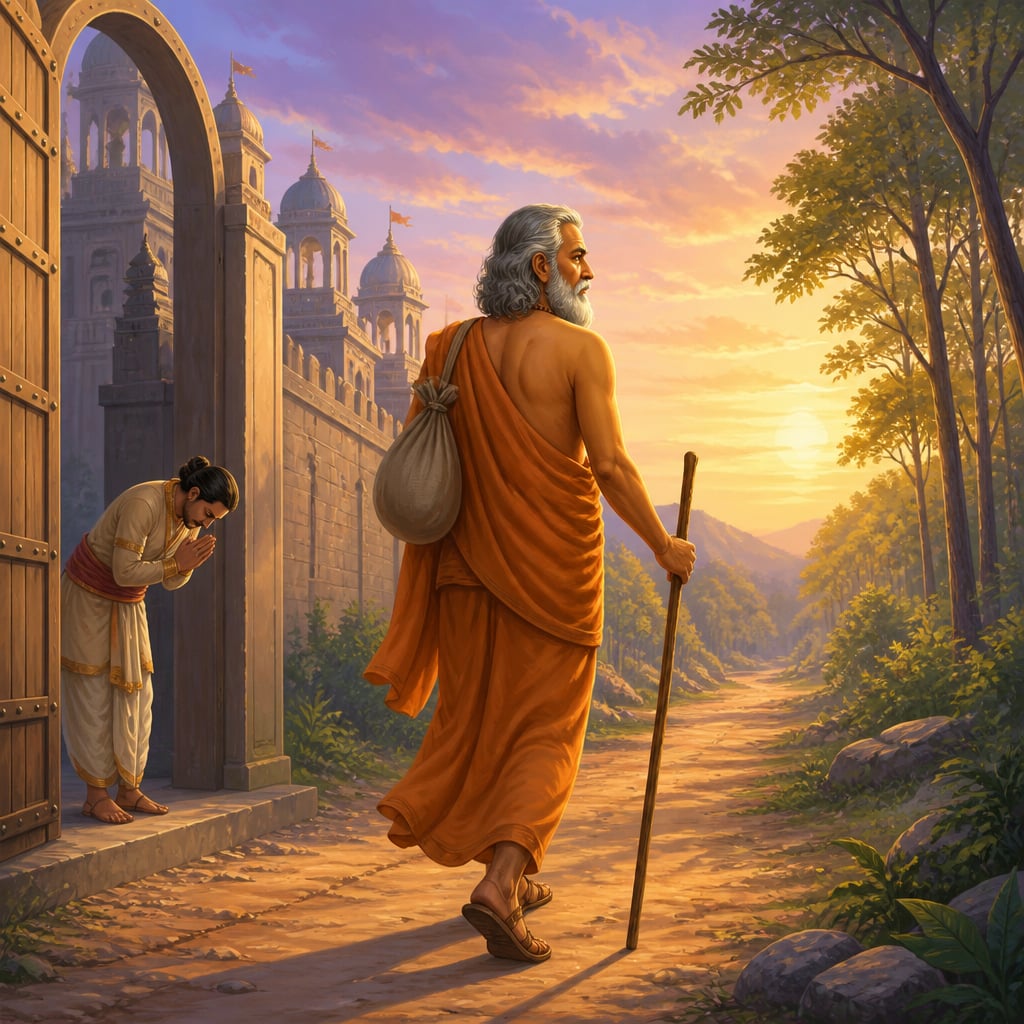
Vidura was no ordinary man. Born of the sage Vyasa and a palace maidservant, he carried the consciousness of Yamaraja himself - the god of death and dharma - who had been cursed to take human birth. Throughout his life, Vidura had been the voice of righteousness in a court drowning in adharma. He had warned Dhritarashtra countless times about the wickedness of Duryodhana. He had protested when Draupadi was humiliated. He had counseled peace when war clouds gathered.
But his words fell on deaf ears.
"One who speaks truth in a court of the blind becomes invisible himself."
Now, with the Kauravas destroyed and the Pandavas ruling a kingdom built on ashes, Vidura felt no attachment to worldly affairs. His heart yearned for something deeper - direct knowledge of the Supreme Lord and the mysteries of creation.
The Sacred Sites of Bharata
Vidura's pilgrimage took him across the length and breadth of sacred Bharatavarsha. He bathed in holy rivers - the Ganga, Yamuna, Saraswati, and countless tributaries blessed by the touch of sages. He visited tirthas (sacred fords) where heaven and earth were said to meet, where the veil between the material and spiritual grew thin.
At each site, Vidura performed the prescribed rituals:
- Snana (sacred bathing) at dawn
- Dana (charitable giving) to brahmanas and the poor
- Puja (worship) at ancient temples
- Shraddha (ancestral rites) for the departed
But more than rituals, Vidura sought satsanga - the company of saints. He knew that true spiritual progress came not merely from visiting places, but from encountering realized souls who could transmit the living flame of knowledge.
The Meeting with Uddhava

It was at a sacred site called Prabhasa - the very place where Lord Krishna would later depart from the mortal world - that Vidura encountered a figure walking toward him. The man's face bore the marks of recent grief, yet his eyes shone with an inner light that spoke of transcendent wisdom.
This was Uddhava, Krishna's dearest friend and confidant.
The two men recognized each other immediately. They had both been present in the courts of kings, witnesses to the great drama of the Mahabharata. But more importantly, both were devotees of the same Lord.
"Uddhava!" Vidura exclaimed, embracing him. "What news from Dwaraka? How fares Lord Krishna?"
Uddhava's face clouded with sorrow. "Noble Vidura, I am the bearer of heavy tidings. The Lord... the Lord has returned to His eternal abode. The Yadava dynasty has perished through an internal curse. Dwaraka itself has been swallowed by the sea."
Vidura stood stunned. Though he knew intellectually that Krishna was the Supreme Lord who transcends birth and death, the news struck like a thunderbolt. The anchor of the age had departed.
Uddhava's Message
Seeing Vidura's distress, Uddhava shared what Krishna had taught him in their final conversation - the famous Uddhava Gita, which we will explore in detail in Skanda 11. The essence was this:
"The Lord is never truly absent. He exists eternally in the hearts of His devotees and in the sacred narratives about His pastimes. Hearing and chanting His glories is equal to His personal presence."
Uddhava was on his way to Badrikashrama in the Himalayas, where he would spend the remainder of his days in meditation. Before parting, he advised Vidura:
"Go to the sage Maitreya, who resides near the source of the Ganga. He was a disciple of Lord Krishna's own teacher, and he has received divine knowledge directly from the Lord. He will answer the questions burning in your heart."
The two devotees embraced one final time, their paths diverging but their hearts united in love for Krishna.
The Arrival at Maitreya's Ashram

Vidura journeyed north, through forests of sal and deodar, past villages where simple folk still practiced the ancient dharma, climbing ever higher toward the snow-capped peaks. At last, he reached the ashram of Maitreya near Haridwar, where the holy Ganga bursts forth from the mountains onto the plains.
Maitreya received Vidura with great respect. The sage recognized this visitor as no ordinary pilgrim. Here was a soul ripe for the highest knowledge - one who had renounced everything, whose only desire was to understand the truth of existence.
"Welcome, O descendant of the Kurus," Maitreya said. "I have been expecting you. The Lord Himself informed me that you would come seeking knowledge. Ask freely, and I shall reveal what was taught to me by my guru, the great Parashara, and later confirmed by Lord Krishna Himself."
Vidura's Questions
Vidura's heart overflowed with questions - questions that had been forming through years of contemplation:
On Creation: "O sage, how did this universe come into being? What was before creation? What is the relationship between the Supreme Lord and this material world?"
On the Soul: "What is the nature of the individual soul? How does it become bound to this material existence? What is the path to liberation?"
On the Lord: "I have heard that the Lord takes many incarnations. Why does He descend? What are His eternal activities? How can we understand One who is beyond all understanding?"
On Dharma: "In this age of Kali, dharma seems to decline with each passing year. How can righteous people maintain their path? Where can we find refuge?"
Maitreya smiled. These were not casual questions but the profound inquiries of a genuine seeker. He began to speak, and what followed would become the third skandha of the Srimad Bhagavatam - a comprehensive account of creation, the descent of avatars, the science of yoga, and the path of devotion.
The Setting for Profound Teachings
The Ganga flowed nearby, her waters carrying the blessings of countless sages. The Himalayan peaks stood as silent witnesses, their eternal snows reflecting the unchanging truth Maitreya was about to reveal. In this sacred setting, with a perfect teacher and a perfect student, the transmission of divine knowledge began.
Maitreya would speak of:
- How Brahma emerged from the cosmic lotus
- The curse of the Kumaras and the fall of Jaya-Vijaya
- The Varaha avatar rescuing the Earth
- The sage Kardama and his divine son Kapila
- The profound teachings of Sankhya philosophy
Each of these narratives would unfold like petals of a cosmic flower, revealing layer after layer of meaning. And at the heart of it all was a single truth: the Supreme Lord, out of His infinite compassion, creates, maintains, and dissolves the universe for the ultimate benefit of all souls.
The Purpose of This Pilgrimage
Vidura's journey teaches us something essential about spiritual seeking. He did not set out merely to collect experiences or tick off pilgrimage sites from a list. He went in search of truth, and he was willing to go wherever that search led him.
When he met Uddhava, he received the news of Krishna's departure - devastating, yet liberating. When he found Maitreya, he discovered that the Lord's absence creates a space for even deeper connection through knowledge and devotion.
This is the beginning of Skanda 3 - not with cosmic fireworks or divine battles, but with a simple scene: a seeker sitting at the feet of a sage, ready to listen. From this humble setting, the entire mystery of creation will unfold.
Living traditions
The tirtha-yatra tradition continues to thrive in modern India. Millions of pilgrims annually visit the sites Vidura traveled to - from Haridwar to Prabhasa. The IRCTC (Indian Railways) runs special pilgrimage trains, and tour operators offer organized yatras. The desire to combine spiritual seeking with sacred geography remains deeply embedded in Indian culture.
- Char Dham Yatra: The pilgrimage to four sacred sites in the Himalayas - Yamunotri, Gangotri, Kedarnath, and Badrinath - following the ancient tirtha tradition exemplified by Vidura
- Guru Purnima: Annual celebration honoring spiritual teachers, commemorating the guru-shishya relationship exemplified by Maitreya and Vidura
- Haridwar: Where the Ganga enters the plains; the region where Maitreya's ashram was located. One of the seven most sacred cities in India.
- Somnath (Prabhasa): The site where Vidura met Uddhava; also where Krishna departed from the mortal world. Home to the famous Somnath Jyotirlinga temple.
- Somnath Temple: One of the twelve Jyotirlingas, this temple has been destroyed and rebuilt multiple times, symbolizing the resilience of dharma. Located at the very site where Vidura met Uddhava.
Reflection
- Vidura walked away from power and position to seek spiritual truth. What attachments in your own life might be holding you back from deeper spiritual seeking?
- Vidura's pilgrimage was transformed by meeting Uddhava and Maitreya. Who in your life serves as a source of spiritual wisdom? If no one comes to mind, where might you find such guidance?
- What are the deepest questions you carry about existence, meaning, and your place in the cosmos? When did you last sit with these questions seriously?