Sankhya: Kapila's Teachings (Part 1)

The 24 elements explained

Lord Kapila, an incarnation of Vishnu, instructs His mother Devahuti in the Sankhya philosophy. He explains the twenty-four elements of material nature, how the soul becomes entangled, and how one can distinguish spirit from matter. The foundation of liberation begins with knowledge.

The Mother Becomes the Student

In a unique reversal of the natural order, Devahuti approached her son not as a mother seeking care, but as a disciple seeking liberation. Lord Kapila, though her child in appearance, was the Supreme Lord in essence - the very source of all knowledge.

"O Lord," Devahuti said with folded hands, "my heart is overwhelmed by material attachments. I do not know the true nature of my self. Please teach me - what is this material nature that binds the soul? How does consciousness become entangled? And most importantly, how can I become free?"

These were not casual questions but the sincere inquiries of a prepared heart. Devahuti's years of service to Kardama, her purity of character, her devotion to dharma - all had prepared her to receive the highest knowledge.

Kapila smiled. This was why He had incarnated - to deliver just such teachings through the vehicle of mother-son love.
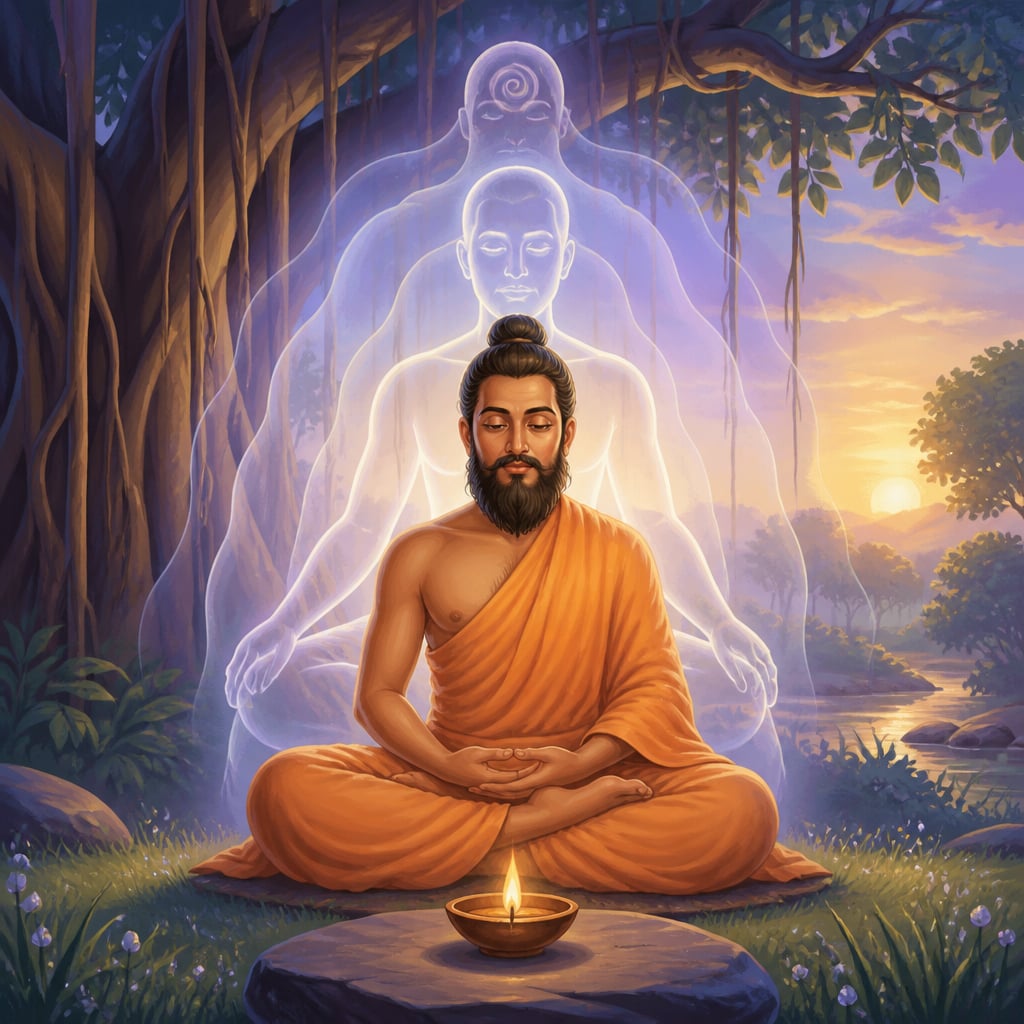
A seated yogi meditates in a forest clearing as the inner witness.

Introduction to Sankhya

Sankhya literally means "enumeration" or "counting." It is one of the six orthodox schools of Hindu philosophy, and Kapila is traditionally credited as its founder. But the Sankhya of the Bhagavatam differs from the later atheistic versions - Kapila's Sankhya is theistic, with Vishnu as the ultimate source.

The purpose of Sankhya is practical: to distinguish Purusha (consciousness, spirit) from Prakriti (matter, nature). Only by clearly seeing this distinction can the soul understand its true nature and achieve liberation.

"Mother, the soul suffers in this world because it has identified with matter. It thinks: 'I am this body, I am this mind, I am these emotions.' But the soul is none of these. When this misidentification is removed through knowledge, liberation naturally follows."

The 24 Elements of Material Nature

Kapila enumerated the components of material existence - the famous 24 tattvas (elements or principles) of Sankhya:

The Causal Elements (3)

Element Sanskrit Description
Prakriti प्रकृति Primordial matter; the unmanifest source of all material elements
Mahat महत् The cosmic intelligence; first transformation of prakriti
Ahankara अहङ्कार Ego; the principle of individuation that creates "I" and "mine"

The Subtle Elements (5 Tanmatras)

Element Sanskrit Description
Shabda शब्द Sound; subtle element of ether
Sparsha स्पर्श Touch; subtle element of air
Rupa रूप Form; subtle element of fire
Rasa रस Taste; subtle element of water
Gandha गन्ध Smell; subtle element of earth

The Gross Elements (5 Mahabhutas)

Element Sanskrit Description
Akasha आकाश Ether/space; the most subtle physical element
Vayu वायु Air; the element of movement
Tejas तेजस् Fire; the element of transformation
Jala जल Water; the element of cohesion
Prithvi पृथ्वी Earth; the most gross physical element

The Sense Organs (10 Indriyas)

5 Jnanendriyas (Knowledge-gathering):

5 Karmendriyas (Action-performing):

The Mind (1)

Element Sanskrit Description
Manas मनस् Mind; the instrument of thought and emotion

These 24 elements constitute the entirety of material existence. Everything we perceive, think, or experience in the material world is some combination of these principles.

The 25th Element: Purusha

But Kapila emphasized the crucial 25th element: Purusha - the conscious self that is distinct from all material elements.

"Mother, the soul is not any of these 24 elements. The soul is the witness, the knower, the experiencer - but not the experience itself. Just as the sun illuminates objects but remains separate from them, consciousness illuminates the mind and body but is not made of them."

This distinction is fundamental:

Prakriti (Matter) Purusha (Spirit)
Unconscious Conscious
Changing Unchanging
Compound (made of parts) Simple (partless)
Object of experience Subject who experiences
Can be known The knower
Bound by time Eternal

How the Soul Becomes Bound

If the soul is distinct from matter, how does it become entangled? Kapila explained this through the concept of misidentification:

When prakriti begins to transform, it creates mahat (cosmic intelligence), then ahankara (ego). The ego creates the sense of "I" - but this "I" is false. It is the material ego claiming to be the self.

The soul, witnessing this process, makes a fateful error: it identifies with the ego. It begins to think:

This misidentification is called avidya (ignorance) - not ignorance of external facts but ignorance of one's true nature.

"Mother, the soul is like a person who has fallen asleep and is dreaming. In the dream, terrible things may happen - being chased, falling, suffering. The dreamer experiences all this as real. But upon waking, he realizes: 'I was always safe in my bed. The dream had no power to actually harm me.'"

The Three Gunas

The three gunas embodied as figures walking a forest path

Prakriti operates through three fundamental modes called gunas:

Sattva (Goodness)

Rajas (Passion)

Tamas (Ignorance)

Every material thing, thought, and action is characterized by some combination of these three gunas. Even spiritual seekers can be bound by sattva if they become attached to the peace and knowledge it brings.

"Mother, all three gunas are binding. Sattva binds with golden chains, rajas with iron chains, tamas with rusted chains. But chains are chains. True freedom is to rise above all three."

Practical Observation

Kapila didn't present these ideas as mere philosophy. He taught Devahuti to observe directly:

Observe the body: Watch it change from childhood to youth to age. Who is the observer who notices these changes? That observer is not the body.

Observe the mind: Watch thoughts arise and disappear. Who is aware that thoughts come and go? That awareness is not a thought.

Observe emotions: Watch happiness and sadness alternate. Who notices these changing states? That witness is beyond both happiness and sadness.

Observe sleep: In deep sleep, mind and body are inactive, yet something continues. Upon waking, you know "I slept well." Who was present during sleep to know this?

Through such observation, the distinction between witness (purusha) and witnessed (prakriti) becomes experientially clear - not just intellectual understanding but direct recognition.

The Goal of Sankhya Knowledge

Why enumerate all these elements? The goal is viveka - discrimination between the real and unreal, the permanent and impermanent, the self and not-self.

With viveka:

"Mother, the soul was never actually bound. Bondage is like the snake seen in a rope - upon examination, it disappears. The soul imagined itself to be matter and suffered accordingly. With knowledge, the imagination dissolves, and freedom is recognized as ever-present."

The Limitation of Sankhya Alone

But Kapila would go further than classical Sankhya. In the next lesson, He would reveal that knowledge alone, while valuable, is not the complete path. Something more is needed - bhakti, loving devotion to the Supreme.

For now, however, He wanted Devahuti to understand the landscape of material existence - to see clearly what she was seeking liberation from. Only with this understanding could she appreciate the power of devotion.

For the Spiritual Seeker

Kapila's analysis remains relevant for anyone seeking self-understanding:

The body is not you: Modern culture obsesses over body image, health, and physical sensation. Sankhya reminds us that while we should care for the body, we should not identify with it.

The mind is not you: Our thoughts, opinions, and emotional patterns feel so personal - but they too are material phenomena observed by the conscious self.

Ego is the key trap: The sense of "I" and "mine" is the fundamental misidentification. Question it. Who is this "I" that claims ownership?

Direct observation is key: These aren't beliefs to accept on faith but hypotheses to test through careful attention. Meditate. Observe. See for yourself whether you are the body, mind, or the awareness that knows both.

Living traditions

Sankhya's influence pervades modern yoga. When yoga teachers speak of prakriti and purusha, the three gunas, or the distinction between body-mind and consciousness, they're using Sankhya terminology. The system has also attracted attention from Western philosophers interested in consciousness studies, with some finding parallels to phenomenology and dual-aspect theories of mind.

Reflection

More in Skanda 3: Status Quo

All lessons in Skanda 3: Status Quo · Srimad Bhagavatham course