Kardama: The Sage and Devahuti
A divine marriage and promise
The sage Kardama performs severe penance at Lake Bindu Sarovar. Lord Vishnu appears and promises that He Himself will be born as Kardama's son. The princess Devahuti becomes his devoted wife, and together they await the arrival of Lord Kapila.
The Sage at the Sacred Lake
Not all of Skanda 3 is filled with cosmic battles and demon slaying. The narrative now shifts to a tender story of devotion, marriage, and divine promise - the story of Kardama Muni and Devahuti.
Kardama was one of the Prajapatis - the progenitors created by Brahma to populate the universe. Unlike some who immediately set about their creative duties, Kardama chose a different path. Before engaging in worldly activity, he wanted to perfect his spiritual realization.
He retired to the banks of Bindu Sarovar - a sacred lake in what is now Gujarat - and began performing severe tapas (austerities). For ten thousand years by the demigods' calculation, Kardama stood in meditation, his mind fixed on Lord Vishnu.
"O Lord, grant me the vision of Your divine form. Let me see that face which devotees yearn for, that smile which dispels all darkness, that glance which liberates."
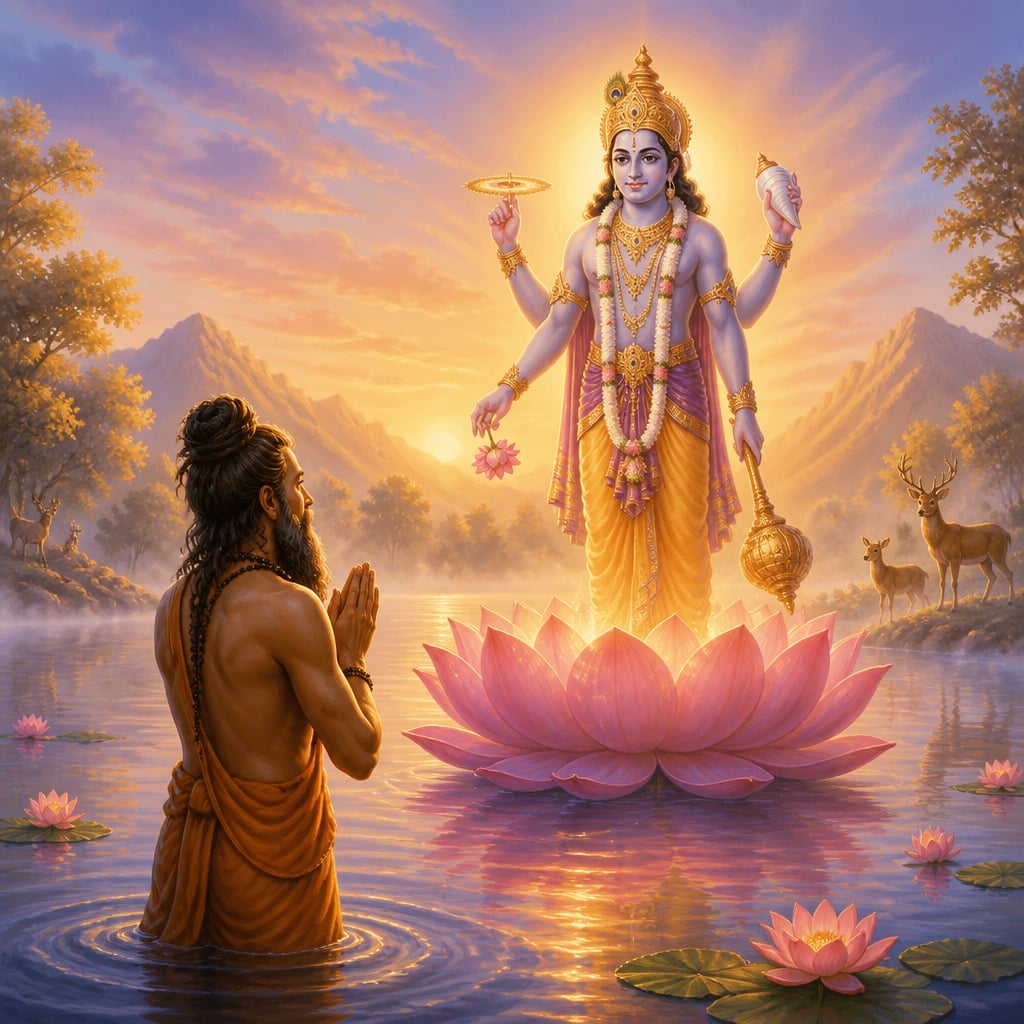
The description of Kardama's tapas reveals the standard of practice expected of serious seekers in that age:
| Austerity | Description |
|---|---|
| Physical stillness | Standing in one place for thousands of years |
| Mental control | Mind fixed single-pointedly on the Lord |
| Sense restraint | No distraction from heat, cold, hunger, or thirst |
| Devotional focus | Heart filled with love for Vishnu |
The Divine Vision
At last, Lord Vishnu appeared before Kardama. The sage beheld the four-armed form of the Lord - holding conch, discus, mace, and lotus - riding upon Garuda. The very vision he had yearned for through ten thousand years of practice now stood before him.
Kardama fell prostrate in devotion. But what he said next surprised even the Lord:
"O Lord, I have seen You. My spiritual desire is fulfilled. But one duty remains. Brahma ordered me to help populate the creation. I must marry and have children. Yet my heart yearns only for liberation. How can I reconcile these two paths?"
This is the eternal dilemma faced by spiritually-inclined householders: How does one fulfill worldly duties while maintaining spiritual focus? Kardama was articulating a question that resonates through the ages.
The Lord's Promise
Lord Vishnu's response was extraordinary. He didn't tell Kardama to abandon either path. Instead, He offered a solution that would fulfill both:
"O Kardama, Emperor Svayambhuva Manu has a daughter named Devahuti - beautiful, virtuous, and devoted. She is destined to be your wife. Marry her, fulfill your duty as a Prajapati, and produce children.
"And hear this secret: I Myself shall appear as your son. I will take birth through Devahuti, and as your child, I shall teach the world the science of liberation - the Sankhya philosophy that distinguishes spirit from matter.
"After this divine son is born and your duty is complete, you may take sannyasa. Your path to liberation is guaranteed."
This promise was unprecedented. The Supreme Lord was offering to become Kardama's child - not as an avatar descending from heaven, but literally being born as a baby in their household. The creator of the universe would call Kardama "father" and Devahuti "mother."
The Marriage
Svayambhuva Manu - the first law-giver and ancestor of humanity - arrived at Bindu Sarovar with his daughter Devahuti. He had heard of Kardama's greatness and knew this sage was destined for his daughter.
Devahuti was no ordinary princess. Though raised in royal luxury, her heart inclined toward spiritual life. She had heard of Kardama's devotion and secretly hoped to serve such a realized soul. When she saw the sage - radiant from his tapas, gentle despite his power - her heart was captured.
The marriage was performed according to Vedic rites. Manu gave his beloved daughter to Kardama, blessing the union:
"This daughter is my heart. I give her to you, knowing you will cherish her as your own self. May your union be blessed with divine children."
Cardama accepted Devahuti's hand, promising to care for her with honor and affection. But he made one condition clear: "I will remain a householder only until we have children. After that, I will renounce the world for final liberation."
Devahuti accepted this condition joyfully. To serve even temporarily such a great soul was more than she could have hoped for.
Devahuti's Service
What followed was a remarkable example of pativrata dharma - a wife's devoted service to her husband. But this was not subservience born of oppression; it was loving service offered to a spiritual master who happened also to be her husband.
Devahuti served Kardama for many years:
- She attended to his daily needs with care
- She maintained the ashram with diligence
- She studied spiritual subjects from his teachings
- She practiced her own tapas while serving him
But the years of austerity took their toll. The princess who had known royal comforts now wore rough bark cloth. Her body grew thin from fasting and spiritual practice. Her hair became matted, her limbs weak.
Kardama noticed none of this for many years, absorbed as he was in his meditation. But when he finally saw what his wife had become, compassion flooded his heart.
The Aerial Palace
Kardama's yogic powers were immense. Seeing his devoted wife's condition, he decided to reward her service before their time together ended.
Using his mystic abilities, Kardama created an aerial palace of extraordinary beauty:
- Chambers filled with every luxury imaginable
- Gardens with celestial flowers that never wilted
- Lakes of crystal-clear water where divine maidens waited to serve
- Flying ability - the entire palace could travel anywhere in the three worlds
He then transformed Devahuti herself. Through yogic power, he restored her youth and beauty. She became more radiant than before - adorned with divine ornaments, dressed in celestial silks, attended by handmaidens.
"My dear wife," Kardama said, "for years you have served me without complaint. Now, before I must leave for the forest, let us enjoy some time together. Let me repay even a fraction of your devotion."
The Celestial Journey

In their aerial palace, Kardama and Devahuti traveled across the three worlds. They visited celestial realms where the demigods entertained them. They saw wonders that mortal eyes never behold.
But for Devahuti, the greatest joy was simply being with her husband. The palaces and gardens meant nothing compared to his presence. She knew their time was limited - soon he would renounce everything - and she treasured each moment.
During this period, they conceived their children. Devahuti gave birth to nine daughters, each of whom would marry great sages and become mothers of significant lineages:
| Daughter | Married To | Significance |
|---|---|---|
| Kala | Marichi | Ancestor of the solar dynasty |
| Anasuya | Atri | Mother of Dattatreya |
| Shraddha | Angiras | Matriarch of many sages |
| Havirbhu | Pulastya | Ancestor of Ravana's lineage |
| Gati | Pulaha | Linked to various dharmic families |
| Kriya | Kratu | Mother of great sacrificers |
| Khyati | Bhrigu | Mother of Lakshmi's incarnation |
| Arundhati | Vashishtha | Model of wifely devotion |
| Shanti | Atharva | Linked to the Atharva Veda |
Through these nine daughters, much of humanity would descend. The Prajapati's duty was being fulfilled.
The Promised Son
But the greatest blessing was yet to come. After the nine daughters, Devahuti became pregnant one final time. This child was different - she could feel the divine presence within her womb.

When the baby was born, he was unlike any ordinary infant. Though appearing as a newborn, his eyes held ancient wisdom. His complexion was the color of lotus petals. His form was perfect in every way.
This was Kapila - an incarnation of Lord Vishnu Himself, come to fulfill the promise made to Kardama years ago.
The demigods showered flowers from the heavens. Celestial music filled the air. Brahma himself came to see the divine child, recognizing immediately the Supreme Lord in infant form.
Kardama's Departure
With the divine son born, Kardama knew his householder duties were complete. He approached Lord Kapila - strange to think of approaching one's own newborn son as the Supreme Lord, yet this was the reality:
"O Lord, You have fulfilled Your promise. You have appeared as my son. Now I beg permission to renounce this world and seek final liberation."
Kapila, though still an infant in body, spoke with divine authority:
"Father, go in peace. Your tapas, your devotion, your service to creation - all have been perfect. You have nothing more to achieve. Liberation awaits you.
"But do not worry about my mother. I will remain here and teach her the highest knowledge. Through Me, she too will attain liberation."
Kardama circumambulated his divine son, touched his feet in reverence, and departed for the forest. He would never be seen in the world again, having achieved the goal of all existence - permanent residence in the spiritual realm.
Devahuti Alone with God
Devahuti now found herself in an extraordinary situation. Her husband had left for the forest. Her daughters were married and gone. She was alone with her son - except her son was the Supreme Lord.
At first, she performed a mother's duties - nursing the infant, singing to him, watching over him. But as Kapila grew, she began to understand her true fortune. She had given birth to her own guru.
One day, when Kapila had grown to young manhood, Devahuti approached him with folded hands:
"O Lord, You promised to teach the path of liberation. Though You are my son, I know You are the Supreme. Please instruct me. How can I free myself from this material bondage?"
This question - a mother asking her son for spiritual instruction - sets up the remarkable teachings that follow in the next lessons.
The Model of Grihastha Dharma
The story of Kardama and Devahuti offers a complete model for spiritual householder life:
For seekers who must marry: Kardama shows that marriage need not obstruct liberation. When undertaken with spiritual consciousness, when a spouse is viewed as a partner in dharma, when children are seen as gifts from God - householder life becomes a path, not an obstacle.
For wives: Devahuti shows devoted service that is neither degrading nor passive. She served from love and received rewards beyond imagination - not just the aerial palace, but the privilege of giving birth to God and receiving His personal instruction.
For husbands: Kardama shows the responsibility to honor and care for the wife who serves. His creation of the aerial palace wasn't romantic fantasy but acknowledgment of true merit.
For parents: Both showed the ultimate gift to a child - surrounding the birth with so much spiritual merit that God Himself chose to appear in their family.
For the Spiritual Seeker
What do we take from this story today?
Most of us are not sages who can perform ten thousand years of tapas. But we can bring the same consciousness to our relationships. Can we see our families as opportunities for spiritual growth? Can we serve our partners with the devotion Devahuti showed? Can we maintain our spiritual focus while fulfilling worldly duties?
The promise Vishnu made to Kardama is, in essence, made to all sincere seekers: If you do your duty with devotion, the Lord Himself will come to you - perhaps not as a child, but certainly as the guru within the heart who leads all souls to liberation.
Living traditions
The Kardama-Devahuti story continues to influence Hindu marriage ideals and family relationships. It is often cited in wedding ceremonies and in discussions about balancing spiritual and material life. The Siddhpur tradition of honoring mothers remains vibrant, with thousands of devotees visiting annually to perform matru shraddha. Kapila's teachings, which form the next lessons, have influenced both Hindu philosophy and yoga traditions worldwide.
- Matru Shraddha at Siddhpur: The practice of performing mother's last rites specifically at Siddhpur, based on the Kapila-Devahuti connection
- Vivaha Samskara: The Vedic marriage ceremony, following principles established in stories like Kardama-Devahuti's wedding
- Bindu Sarovar: The sacred lake where Kardama performed his ten-thousand-year penance and where Lord Vishnu appeared to him. The water is considered highly purifying.
- Kapileshwar Mahadev Temple: An ancient temple at the site where Lord Kapila taught Devahuti. The temple houses deities of both Kapila and Devahuti.
- Kapil Muni Temple at Gangasagar: Built where the Ganga meets the sea, this temple honors Kapila's connection to the Ganga's descent story (Kapila's hermitage was where the sons of Sagara were reduced to ash)
Reflection
- Kardama balanced his duty to create progeny with his aspiration for liberation. How do you balance worldly responsibilities with spiritual growth? Do you see them as conflicting or complementary?
- Devahuti received divine teaching from her own son. Have you ever learned profound lessons from someone younger than you, or from an unexpected source? What did this teach you about wisdom and ego?
- Kardama created an aerial palace and restored Devahuti's youth through yogic power, honoring her service. How do you honor and acknowledge those who serve you? Do you take their service for granted?