Brahma: Creation from the Lotus
The creator's divine origin
From Lord Vishnu's navel, a magnificent lotus sprouts, and upon it sits Brahma, bewildered in the cosmic waters. Through penance and the Lord's grace, Brahma receives the knowledge to create the universe. Witness the origin of the creator himself.
Before the Beginning
What existed before creation? This question has haunted philosophers across all ages and civilizations. The Srimad Bhagavatam's answer is both simple and profound: only the Supreme Lord existed, reclining in yogic sleep upon the cosmic waters.
Maitreya began his narration to Vidura by painting this primordial scene. Before there was space or time, before atoms or elements, before even the concept of existence itself - there was Maha-Vishnu, the source of all sources.
"At the end of the previous creation, when all beings had merged back into the Lord, He alone remained - self-luminous, infinite, beyond description. The cosmic waters of the Karana Ocean surrounded Him, and upon the serpent Ananta Shesha, He reclined in divine rest."
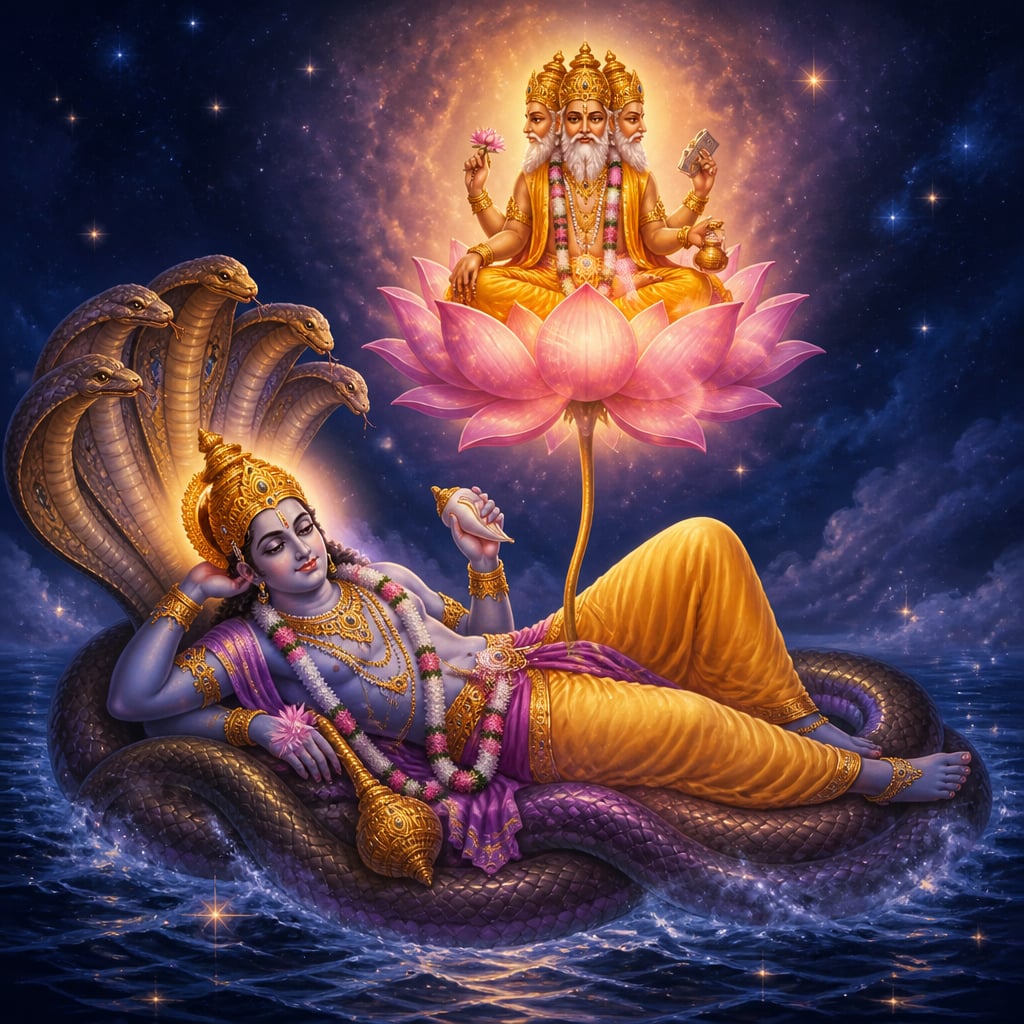
This is not the sleep of exhaustion but the yoga-nidra - the meditative slumber in which infinite potencies lie dormant, awaiting the next cycle of manifestation.
The Cosmic Serpent Ananta
Ananta Shesha - the infinite serpent - served as the Lord's resting place. This divine serpent has a thousand hoods, each adorned with a brilliant gem whose light illuminates the cosmic darkness. Ananta means 'endless,' for this serpent represents the infinite support that underlies all existence.
Ananta Shesha is not merely a divine creature - He is an expansion of the Supreme Lord Himself, the sankarshana aspect that sustains all worlds. In iconography, Vishnu is always shown reclining upon this serpent, teaching us that the foundation of existence is the Lord's own divine energy.
The characteristics of Ananta Shesha reveal profound truths:
| Attribute | Symbolic Meaning |
|---|---|
| Thousand hoods | Infinite awareness and protection |
| Supporting Vishnu | Divine energy as the basis of all existence |
| Coiled body | Time as cyclic, not linear |
| Jeweled hoods | Wisdom illuminating darkness |
The Lotus Emerges
As the time for creation approached, a remarkable phenomenon occurred. From the navel of Lord Vishnu, a golden lotus began to emerge. Like a stem rising through water toward light, this cosmic lotus grew from the Lord's body, carrying within it the seed of the entire universe.
The symbolism is exquisite. The lotus is associated with purity - it grows from muddy waters yet remains unstained. Similarly, creation emerges from the transcendent Lord yet does not affect His purity. The navel represents the center - the universe emerges from the very core of divine being.
This lotus was no ordinary flower. Its brilliance rivaled a thousand suns. Its petals contained the essence of all future worlds, all future beings, all future possibilities. And seated upon its golden whorl, blinking into awareness, was Brahma - the first created being, destined to become the creator of all that would follow.
Brahma's Bewilderment
Imagine awakening to find yourself alone in infinite darkness, sitting upon a lotus floating in endless waters. You have no memory of how you came to be. You see nothing, hear nothing, know nothing except your own mysterious existence.
This was Brahma's situation.
"Who am I? Where did I come from? What is this lotus upon which I sit? What lies beneath these waters?"
Brahma looked around in all directions - above, below, to the sides - but saw only darkness and water. He tried to trace the lotus stem downward but could not find its source despite searching for a hundred celestial years. He was, in the truest sense, lost.
This bewilderment of Brahma carries a profound teaching. Even the creator of the universe began in a state of ignorance. Even the highest being within creation must seek knowledge from beyond creation. Self-knowledge is not automatic - it must be discovered.
The Divine Sound

As Brahma sat in confusion, exhausted from his futile search, he decided to turn inward. He began to meditate, focusing his nascent consciousness in the hope of receiving guidance.
Then came the revelation.
From the cosmic depths, a sound reached Brahma's ears - two syllables that would become the seed mantra of all Vedic wisdom: "Ta-Pa" (तप).
Tapa means austerity, penance, concentrated spiritual practice. The Lord was instructing Brahma: before you can create, you must perform tapas. Before you can manifest externally, you must develop internally.
Brahma understood. He closed his eyes and began to meditate - not for days or years, but for a thousand celestial years (which equals millions of human years). His concentration was so intense that even the cosmic waters around him grew still.
The Vision of Vaikuntha

At the culmination of his penance, Brahma was granted a vision that would forever transform his understanding. The waters receded, and before him appeared Vaikuntha - the eternal spiritual realm beyond material creation.
In Vaikuntha, Brahma beheld:
- Lord Vishnu in His full glory, no longer sleeping but seated in magnificent splendor
- Lakshmi, the goddess of fortune, serving the Lord with devotion
- Countless liberated souls, their forms made of pure consciousness, absorbed in loving service
- A realm of pure spiritual substance where decay and death have no meaning
Most importantly, Brahma understood his own position. He was not the supreme creator but a secondary creator - a divine architect working with materials provided by the Supreme Lord. Just as a potter needs clay before he can make pots, Brahma would need the ingredients of creation from Vishnu.
The Chatuh-Shloki Bhagavatam
In this transcendent vision, Lord Vishnu spoke to Brahma. The Lord compressed the entire essence of the Bhagavatam into just four verses - the famous Chatuh-Shloki Bhagavatam (four-verse Bhagavatam). These four verses contain all spiritual knowledge in seed form:
The Four Essential Truths:
The Lord existed before creation - "I alone existed before creation. Nothing else, whether existent or non-existent, was there. What you see now as the cosmos is also Me. What remains after dissolution is again only Me."
Creation is the Lord's energy - "All that appears to be separate from Me is actually My illusory energy. Like the reflection of the sun in water, creation appears real but is a transformation of My potency."
The Lord pervades everything - "I exist within everything, and everything exists within Me. The wise see Me everywhere and see everything in Me."
Knowledge comes through devotion - "One who seeks Me with single-minded devotion attains true understanding. This knowledge cannot be grasped through mere logic or scholarship."
These four verses became the foundation upon which Brahma would later expand the full Bhagavatam through Narada, Vyasa, and Shukadeva.
Brahma Receives Creative Power
With knowledge came power. Lord Vishnu blessed Brahma with the ability to create. He revealed to Brahma the material elements - earth, water, fire, air, and ether - along with the subtler elements of mind, intelligence, and ego. He showed how these could be combined to produce the infinite variety of manifest existence.
Brahma also received the Vedas - the repository of all knowledge needed for creation and for guiding created beings back to their source. These eternal sounds had existed within the Lord and were now transmitted to the first created being.
Armed with knowledge, power, and divine instruction, Brahma was ready to begin his cosmic work. But first, he needed to create helpers - beings who would assist in the vast project of manifestation.
The Beginning of Creation
From his meditation, Brahma began the process of creation. His first creations emerged from his mind itself:
- The four Kumaras - eternally youthful sages who refused to participate in material creation
- Rudra (Shiva) - who emerged from Brahma's anger and was assigned destruction
- The ten Prajapatis - progenitors who would populate the various worlds
- Manu and Shatarupa - the first human couple
Each creation had its own story, its own purpose, its own relationship to the grand design. The universe was being populated not randomly but according to divine plan.
The Lotus as Symbol
The image of Brahma emerging from Vishnu's navel lotus is one of the most powerful symbols in Hindu iconography. It appears in countless temples, paintings, and sculptures across South and Southeast Asia.
What does this symbol teach?
- Dependence: Brahma, despite his cosmic powers, is dependent on Vishnu. The creator is himself created.
- Emergence from transcendence: Material creation emerges from spiritual reality, not vice versa.
- Purity within complexity: Like the lotus unstained by muddy waters, spirit remains pure despite manifesting matter.
- The navel center: Creation emerges from the Lord's core, His very essence.
This teaching refutes both the notion that the universe is without cause and the idea that some material principle is the ultimate reality. The source of everything is conscious, is personal, is divine.
For the Spiritual Seeker
Brahma's journey from bewilderment to enlightenment mirrors the journey of every sincere seeker. Like Brahma, we awaken to find ourselves in a confusing world, unsure of our origin or purpose. Like Brahma, we may search externally for answers but find only more questions.
The turning point comes when, like Brahma, we hear the inner command: Tapa - turn inward, practice, meditate, develop yourself spiritually. And like Brahma, sincere practice leads to revelation - not through our own effort alone, but through divine grace responding to sincere seeking.
The creation of the universe begins with the creation of the creator. And the creation of the creator begins with receiving divine knowledge. This is the profound teaching of the cosmic lotus and the bewildered Brahma who learned to see.
Living traditions
The image of Vishnu reclining on Ananta with the lotus emerging has become one of the most recognizable Hindu symbols globally. It appears on temple walls from Cambodia's Angkor Wat to ISKCON centers worldwide. The yoga-nidra concept has been adapted into modern relaxation techniques practiced in yoga studios globally, introducing millions to this ancient cosmological meditation.
- Brahma Muhurta Practice: The auspicious period roughly 1.5 hours before sunrise, named after Brahma, considered ideal for meditation and spiritual practice
- Satyanarayan Puja: A popular worship ritual celebrating Lord Vishnu as Satya Narayana, often performed during auspicious occasions
- Brahma Temple, Pushkar: One of the very few temples dedicated to Lord Brahma; features a red spire and silver turtle on the floor. The holy Pushkar lake is associated with a lotus dropped by Brahma.
- Padmanabhaswamy Temple: Houses the famous reclining Vishnu deity (Padmanabha) in yoga-nidra pose on Ananta Shesha. The deity is so large it can only be viewed through three doors.
- Ranganathaswamy Temple, Srirangam: The largest functioning Hindu temple complex in the world, featuring the reclining Ranganatha (Vishnu) on Ananta Shesha - the same cosmic scene from which Brahma emerged
Reflection
- Brahma awoke alone and bewildered, not knowing who he was or why he existed. Have you experienced moments of deep existential questioning? What did those moments teach you?
- The instruction 'Tapa' told Brahma to develop internally before creating externally. In your own life, how much time do you invest in inner development versus outer productivity?
- The image of the cosmic lotus emerging from Vishnu suggests that creation is an expression of the divine, not separate from it. How might seeing the world as a divine expression change your relationship with daily life?