Srishti: Additional Creation Narratives
Brahma's manifold creations
Maitreya continues narrating the detailed process of creation to Vidura. From Brahma's mind emerge the Prajapatis, the Manus, and all classes of beings. The origins of time, the demigods, and the various species are explained in this comprehensive account of cosmic manifestation.
Return to the Frame Narrative
With the profound teachings of Kapila to Devahuti concluded, the narrative of Skanda 3 returns to its frame story: Maitreya instructing Vidura. This return reminds us that the Kapila-Devahuti dialogue was itself a teaching within a teaching, sacred knowledge transmitted through multiple generations of speakers and listeners.
Vidura, absorbed in hearing about Kapila's liberation of his mother, now receives further instruction about the process of creation. Maitreya, drawing from the wisdom passed down through the sages, unfolds the detailed cosmogony of the Bhagavatam.
The Manifestation of Time
Before any creation could proceed, Kala (Time) had to manifest. Time in Vedic cosmology is not merely a measurement but a divine force, indeed, another form of the Supreme Lord Himself. As Kala, the Lord ensures that creation, maintenance, and dissolution proceed according to cosmic law.
Time operates as the great equalizer and the ultimate transformer:
- Nothing in the material realm is exempt from its influence
- It enables growth and change, making creation dynamic rather than static
- It ensures that all conditional beings eventually return to their source
The Bhagavatam presents time not as an abstract concept but as a manifestation of divine will, directing the flow of all events toward their ultimate purpose.
Brahma's Mental Creations
From Brahma's mind emerged various categories of beings, each manifesting from particular aspects of his consciousness:
The Four Kumaras
First to emerge were the Sanatkumaras, Sanaka, Sanandana, Sanatana, and Sanatkumara. These eternal children, perpetually five years old in appearance, possessed perfect knowledge from birth and chose the path of complete renunciation, refusing to participate in creation.
The Ten Prajapatis
Brahma then produced ten mind-born sons known as the Prajapatis (Lords of Progeny), who would become the progenitors of all species:
- Marichi - Father of Kashyapa, through whom came demigods and demons
- Atri - Father of Dattatreya and Soma (the Moon)
- Angiras - Progenitor of the Angirasa lineage of sages
- Pulastya - Ancestor of Rakshasas through Vishrava
- Pulaha - Progenitor of various animal species
- Kratu - Connected to sacrificial traditions
- Bhrigu - Founder of the Bhargava lineage
- Vasishtha - The greatest of priest-sages
- Daksha - Father of many daughters who became mothers of species
- Narada - The celestial sage and devotee of Vishnu
Rudra and His Expansions
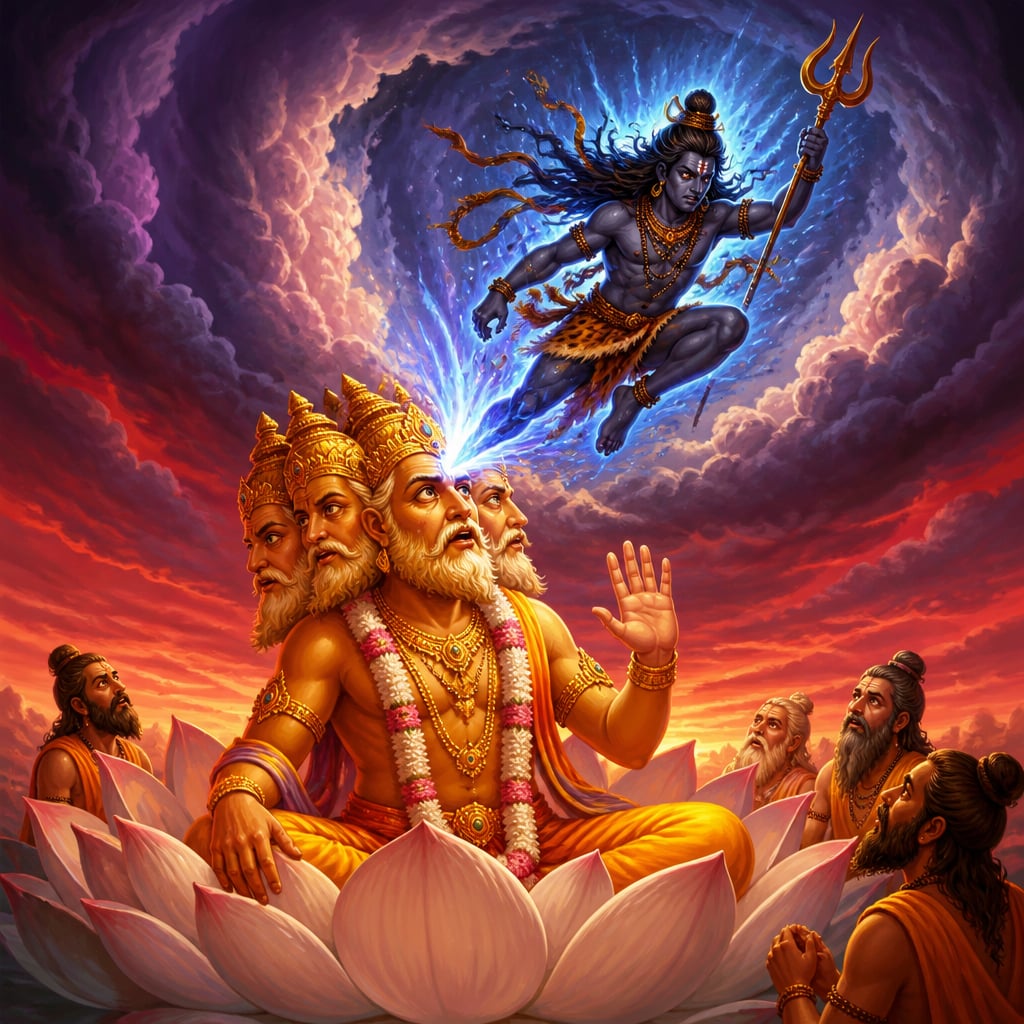
From Brahma's anger emerged Rudra (Shiva), who himself expanded into eleven forms with eleven consorts. These Rudras represent the destructive aspect of cosmic function, balancing creation with dissolution.
The Origin of Species
The Bhagavatam presents a systematic account of how different species came into being, each emerging from specific cosmic sources:

From Brahma's body:
- From his mouth emerged the Brahmanas and the Vedas
- From his arms came the Kshatriyas (warriors)
- From his thighs manifested the Vaishyas (merchants)
- From his feet appeared the Shudras (service providers)
From Daksha's daughters:
- Aditi became the mother of the twelve Adityas (solar deities)
- Diti bore the Daityas (demons)
- Danu gave birth to the Danavas (another class of demons)
- Other daughters produced various species including animals, birds, and serpents
The Manus and Their Ages
Critical to understanding Vedic cosmology is the concept of Manvantaras, cosmic ages each presided over by a Manu. Each Manu serves as the progenitor and lawgiver for humanity during their era.
The current cosmic day of Brahma (kalpa) contains fourteen Manus:
- Svayambhuva - The first Manu, father of Dhruva and Uttanapada
- Svarochisha - The second Manu
- Uttama - The third Manu
- Tamasa - The fourth Manu
- Raivata - The fifth Manu
- Chakshusha - The sixth Manu
- Vaivasvata - The current (seventh) Manu, also known as Shraddhadeva 8-14. Seven future Manus whose reigns are yet to come
We currently live in the age of Vaivasvata Manu, descended from Vivasvan (the Sun god).
The Demigods and Their Functions
The Bhagavatam details how different demigods received specific cosmic portfolios:
Indra - King of heaven, lord of rain and warfare Agni - Fire deity, carrier of offerings to other gods Vayu - Wind god, vital breath of the universe Varuna - Lord of waters and cosmic order Yama - Lord of death and righteous judgment Kubera - Treasurer of the gods, lord of wealth Soma - Moon god, lord of plants and medicines Surya - Sun god, sustainer of all life
These demigods function as administrators within the cosmic government, each maintaining their sphere under the ultimate sovereignty of the Supreme Lord.
The Fourteen Worlds
The creation accounts describe the fourteen lokas (worlds) that constitute the cosmic egg:
Seven Upper Worlds (ascending):
- Bhu-loka (Earth)
- Bhuvar-loka (Atmospheric realm)
- Svar-loka (Heaven, Indra's realm)
- Mahar-loka (Abode of saints)
- Jana-loka (Realm of Brahma's sons)
- Tapo-loka (Realm of austerities)
- Satya-loka (Brahma's abode, also called Brahma-loka)
Seven Lower Worlds (descending):
- Atala
- Vitala
- Sutala
- Talatala
- Mahatala
- Rasatala
- Patala
Below these lies Naraka (hell realms), and the entire structure rests on the thousand-headed serpent Ananta Shesha.
Purpose of Detailed Creation Accounts
Why does the Bhagavatam spend such effort on creation narratives? Several purposes emerge:
Demonstrating Divine Order - Nothing in existence is random; all beings and realms emerge according to divine purpose and cosmic law.
Establishing Interconnection - All species share common origins; the creation accounts reveal the family relationships binding all existence.
Providing Context for Avatars - Many avatars appear during specific Manvantaras or to specific Manus; understanding the cosmic timeline contextualizes their appearances.
Inspiring Wonder - The sheer scale and intricacy of creation inspires awe and reverence for the divine intelligence behind it.
The Symbolic Dimension
Beyond the literal account, the creation narratives carry symbolic meanings:
Brahma's meditation represents the focused consciousness required for any creative act.
The emergence from different body parts symbolizes how consciousness manifests through different modes and qualities.
The fourteen worlds can be understood as states of consciousness, from gross to subtle, that exist within every being.
Time as a divine form teaches that even the passage of moments is sacred and purposeful.
Creation as Ongoing Process
Importantly, the Bhagavatam views creation not as a one-time event but as an ongoing process. Brahma continues to create, maintain, and eventually withdraws creation in an endless cycle. At the cosmic dawn of each kalpa, creation reappears; at cosmic night, it dissolves.
This cyclical view distinguishes Vedic cosmology from linear creation models. There is no ultimate beginning or final end, only an eternal dance of manifestation and dissolution, presence and absence, day and night of Brahma.
Vidura's Receptivity
Throughout these teachings, Vidura remains the ideal student, attentive, questioning appropriately, and allowing the knowledge to sink deep. His receptivity mirrors Devahuti's in the Kapila narrative, demonstrating that creation knowledge, like liberation knowledge, requires a prepared and humble recipient.
The parallelism between Vidura hearing from Maitreya and Devahuti hearing from Kapila unifies the Skanda: both seekers receive transformative wisdom from realized teachers, both demonstrate the proper attitude for receiving sacred knowledge.
Living traditions
The Bhagavatam's creation cosmology continues to inspire artists, architects, and thinkers. Modern Hindu temples often incorporate cosmic imagery based on these accounts, and creation themes appear in contemporary Hindu art and literature.
- Brahma Temple
- Prabhasa Tirtha
Reflection
- The creation accounts show everything emerging from consciousness (Brahma's mind). How does this change your view of the material world?
- Different species emerged from different cosmic sources yet share common ancestry. How should this interconnection influence our treatment of other beings?
- The demigods have specific portfolios (rain, fire, wind, etc.). Do you sense any ordering principle behind natural phenomena in your experience?