Sankhya: Kapila's Teachings (Part 2)

Bhakti as the supreme path

Kapila reveals that while Sankhya provides knowledge, bhakti is the supreme path to liberation. He describes the characteristics of a true devotee, the process of meditation, and how devotion surpasses even liberation. Knowledge and devotion unite in the Lord's teachings.

From Knowledge to Devotion

In the previous lesson, Kapila illuminated the analytical framework of Sankhya, the twenty-four elements, the distinction between purusha and prakriti, and the interplay of the three gunas. Devahuti had absorbed this profound cosmological knowledge with the attentiveness of a sincere student. Yet knowledge alone, however complete, remained insufficient.

A devotee sits in deep meditation before a small home altar at dusk.

Now Kapila reveals the crowning jewel of his teachings: bhakti-yoga, the path of loving devotion that transcends mere intellectual understanding and leads directly to the Supreme. This is the unique contribution of Kapila's theistic Sankhya, the integration of analytical knowledge with heartfelt devotion.

The Limitations of Dry Knowledge

Kapila explains to his mother that pure philosophical speculation, while valuable, has inherent limitations. One may understand the distinction between spirit and matter intellectually, yet remain bound by material attachments. The mind may assent to truth while the heart remains unchanged.

"Knowledge without devotion is like a sword without a handle, it may be sharp, but one cannot wield it effectively."

Many learned scholars throughout history have possessed encyclopedic knowledge of scriptures yet failed to attain liberation because their knowledge remained theoretical. The missing element was bhakti, that transformative love which alone can dissolve the subtle bonds of ego and desire.

The Nine Forms of Bhakti
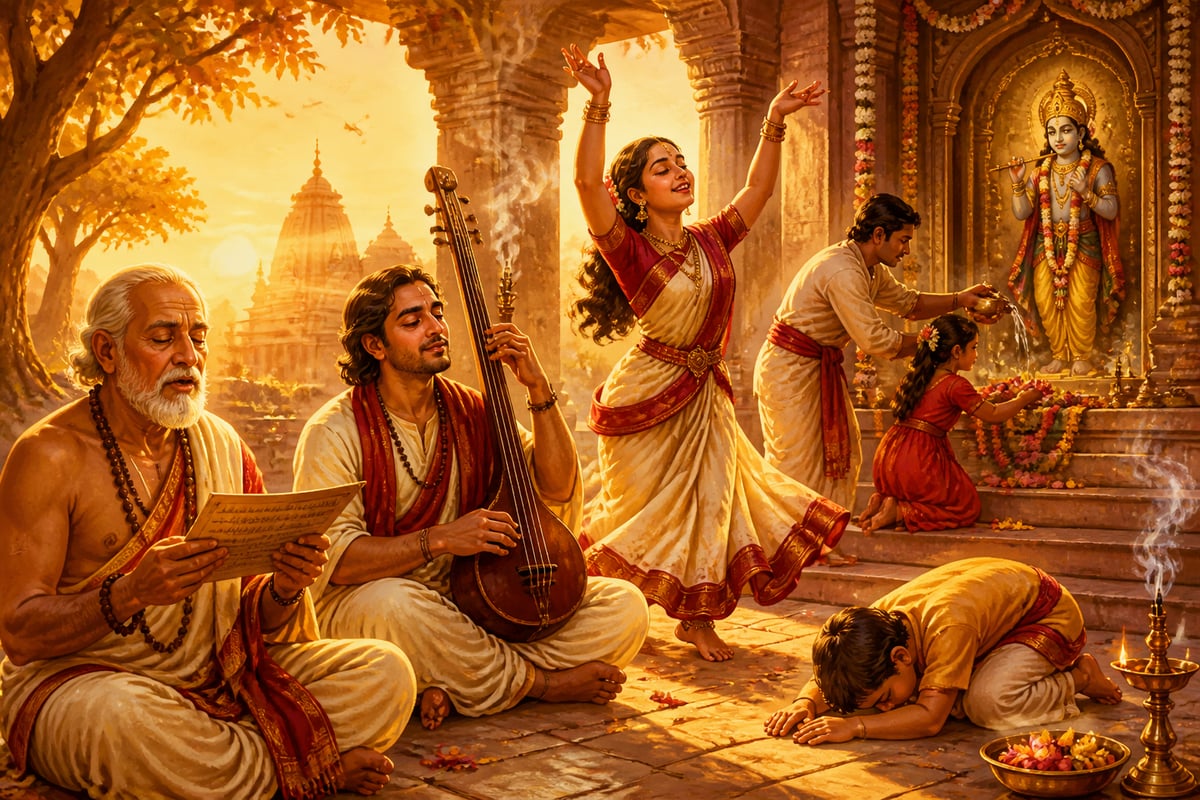
Devotees expressing different forms of bhakti in a temple courtyard

Kapila describes the comprehensive path of devotion through its ninefold expression:

  1. Shravana (Hearing) - Listening to the names, qualities, and pastimes of the Lord
  2. Kirtana (Chanting) - Glorifying the Lord through song and recitation
  3. Smarana (Remembering) - Constant meditation on the divine form and qualities
  4. Pada-sevana (Serving the lotus feet) - Humble service to the Lord and His devotees
  5. Archana (Worship) - Ritualistic worship with offerings and mantras
  6. Vandana (Prayer) - Offering heartfelt prayers and prostrations
  7. Dasya (Servitude) - Considering oneself the servant of the Lord
  8. Sakhya (Friendship) - Relating to the Lord as an intimate friend
  9. Atma-nivedana (Self-surrender) - Complete offering of oneself to the divine will

Each form of devotion is complete in itself, and a devotee may excel in any one or combine several according to their nature and inclination.

Characteristics of a True Devotee

Kapila describes the qualities that naturally manifest in one who has cultivated genuine devotion:

Equanimity (sama) - The devotee remains balanced in success and failure, honor and dishonor, because their happiness depends not on external circumstances but on their relationship with the Lord.

Compassion (karuna) - True devotees feel the suffering of others as their own. They cannot bear to see any being in distress and actively work for the welfare of all.

Humility (namrata) - Despite spiritual advancement, the devotee considers themselves the most fallen, attributing all good qualities to the Lord's grace rather than personal merit.

Freedom from possessiveness (aparigraha) - The devotee uses material things as needed for service but remains internally detached, knowing that everything belongs to the Lord.

Cleanliness (shaucha) - Both external purity of body and environment, and internal purity of thoughts and intentions characterize the devotee.

Meditation on the Divine Form

Kapila provides his mother with a detailed process for meditation (dhyana), beginning with the Lord's lotus feet and ascending through the entire divine form:

"Starting from the lotus feet adorned with auspicious marks, let the mind rise to the shining ankles, then to the knees strong as thunderbolts. Contemplate the yellow silk garments, the waist adorned with a golden belt, the navel from which the universe emerged..."

This systematic meditation serves multiple purposes:

The meditation culminates in the Lord's smiling face, merciful eyes, and the crown that represents His supreme sovereignty. Kapila emphasizes that this meditation should be performed with love, not merely as a mental exercise.

Bhakti Surpasses Liberation

In one of the most revolutionary statements of the Bhagavatam, Kapila declares that pure devotees do not even desire liberation (mukti). The four types of liberation, residing in the Lord's abode, possessing divine powers, having a form like the Lord's, or merging into the Absolute, hold no attraction for them.

Why? Because these devotees find complete satisfaction in loving service itself. The very act of devotion is their reward. They would rather serve the Lord eternally than merge into undifferentiated oneness and lose the capacity for relationship.

This teaching distinguishes Vaishnava philosophy from schools that view liberation as the dissolution of individuality. For Kapila, the soul's individuality is eternal, and the highest attainment is not cessation of existence but eternal, blissful service in full consciousness.

The Three Types of Devotion

Kapila categorizes devotion according to the motivation of the practitioner:

Sattvika Bhakti - Devotion in the mode of goodness, performed for purification and spiritual advancement

Rajasika Bhakti - Devotion in the mode of passion, performed to gain material benefits or fame

Tamasika Bhakti - Devotion in the mode of ignorance, performed with violent intentions or to harm enemies

Beyond these three is Nirguna Bhakti, pure devotion that transcends all material modes. This causeless, motiveless love seeks nothing but the Lord's pleasure. It is compared to the Ganga flowing naturally toward the ocean, it needs no external impetus.

Time as the Lord's Instrument

Kapila reminds Devahuti of time's role in creation and dissolution. Material nature, guided by the Lord's glance and impelled by time, undergoes constant transformation. Empires rise and fall, bodies are born and perish, yet the soul remains unchanged.

Understanding time's relentless movement should inspire urgency in spiritual practice. The human form is rare and temporary, it must be utilized for its highest purpose before the opportunity passes.

Unity of Jnana and Bhakti

Kapila's teaching represents the perfect synthesis of knowledge and devotion. Neither alone is complete:

Together, they form the complete path. Sankhya provides the philosophical foundation, understanding what we are and what the world is. Bhakti provides the practical method and the ultimate goal, loving union with the Supreme Person.

This integrated approach ensures that the devotee's practice is both intellectually satisfying and emotionally transformative.

Devahuti's Deepening Understanding

As Kapila's teachings unfold, Devahuti's transformation becomes evident. The mother who initially asked questions from a position of worldly attachment now listens with the ears of a sincere seeker. Her mind, purified by proximity to her divine son and by the nectar of his words, becomes fit for the highest realization.

The relationship between teacher and student, already sanctified by the bond of mother and son, becomes the vehicle for the transmission of sacred knowledge. Devahuti's humility in learning from her own child exemplifies the attitude every spiritual seeker must cultivate.

Living traditions

Kapila's integration of philosophical analysis with devotional practice influences contemporary approaches to spirituality that seek both intellectual rigor and heartfelt practice. The nine forms of bhakti provide a practical framework used by millions worldwide.

Reflection

More in Skanda 3: Status Quo

All lessons in Skanda 3: Status Quo ยท Srimad Bhagavatham course