Moksha: Devahuti's Liberation

A mother attains the Supreme

After receiving complete instruction from her divine son Kapila, Devahuti dedicates herself to spiritual practice. Through unwavering devotion, she attains liberation. The sacred site of her realization becomes known as Siddhapada, and the river Saraswati flows through her ashram.

The Culmination of Teaching

Having transmitted the complete philosophy of Sankhya united with bhakti-yoga, Lord Kapila prepared to take leave of his mother. The instruction that began with Devahuti's heartfelt questions had blossomed into the most comprehensive spiritual teaching, a complete manual for liberation that future generations would study and cherish.

Devahuti, transformed by her son's wisdom, was no longer the same woman who had approached him in spiritual distress. Her mind, purified by divine knowledge and kindled with devotion, was ready to traverse the final journey.

Devahuti sits in samadhi on a woven mat by the banks of the Saraswati.

Kapila's Departure

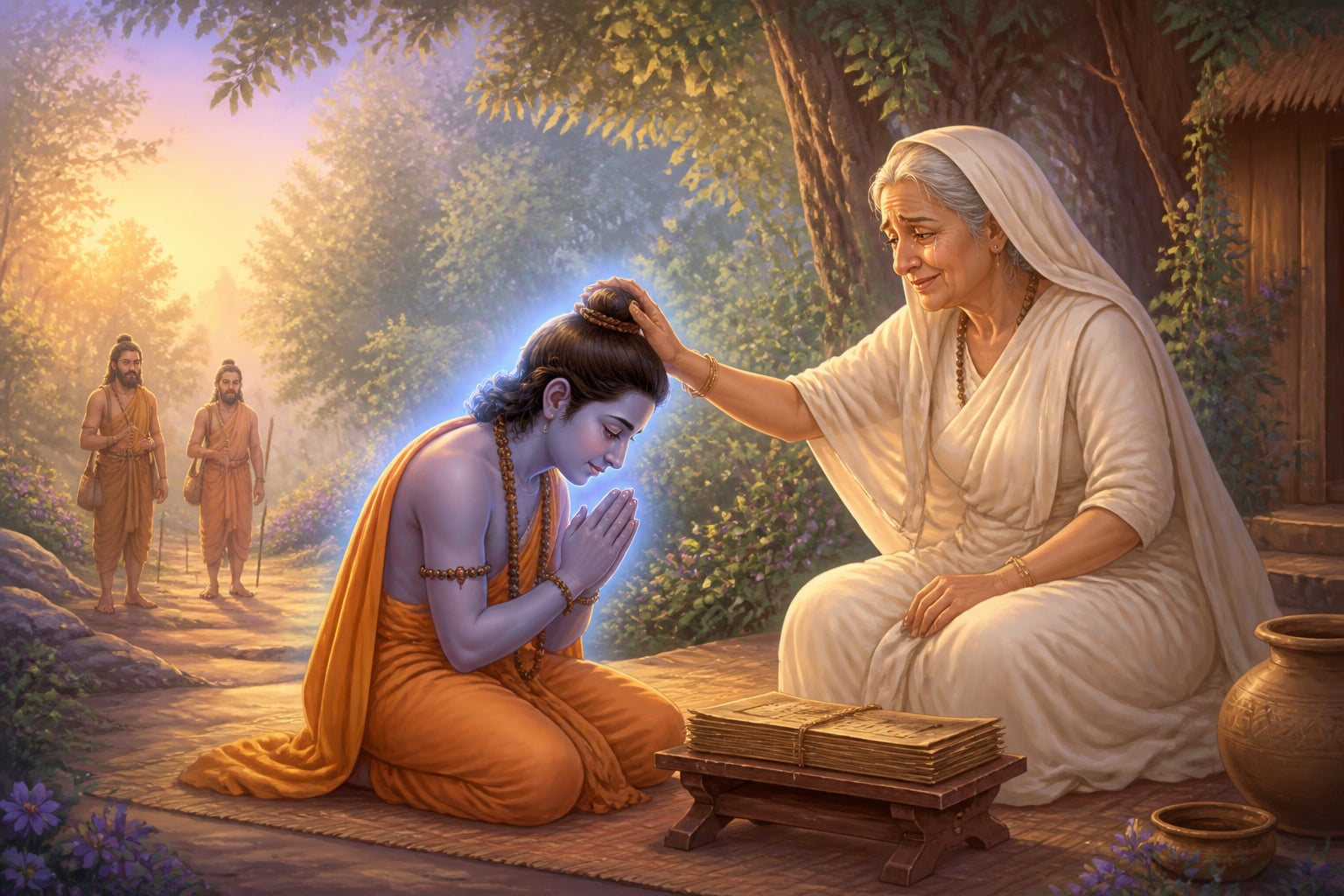
Kapila taking leave of his mother Devahuti

With his mother firmly established in spiritual understanding, Kapila departed to pursue his own divine mission. He traveled northeast toward the ocean, where he would establish his ashram and become celebrated as the great sage of Sankhya philosophy.

This departure marks an important moment in the narrative. Kapila had appeared specifically to enlighten his mother and, through her, all future seekers. His mission accomplished, he withdrew to the solitude befitting a realized soul, yet his presence would continue through the teachings he left behind.

"A true teacher gives the student wings to fly, then steps back to let them soar."

Devahuti's Spiritual Practice

Alone in her ashram by the Saraswati River, Devahuti dedicated herself entirely to the path her son had illuminated. Her practice encompassed all the elements Kapila had taught:

Meditation - She fixed her mind on the divine form, systematically contemplating from the lotus feet upward as instructed. The form of Vishnu became her constant companion, replacing all worldly attachments.

Renunciation - The princess who had once lived in celestial palaces now resided simply, her needs reduced to the minimum required for maintaining the body.

Devotion - Her heart flowed naturally toward the Lord like the Ganga toward the ocean. No force was required, only the removal of obstacles that had blocked this inherent tendency.

Knowledge - The analytical understanding of Sankhya served as the foundation, ensuring her practice was grounded in wisdom rather than blind sentiment.

The Transformation of Body and Mind

As Devahuti's practice deepened, remarkable transformations occurred. The texts describe how her body, once the epitome of womanly beauty, became withered through intense austerity. Her hair matted, her limbs thin, yet these external changes reflected internal purification.

The body that had been a source of pride and later of attachment was now recognized for what it truly was: a temporary vehicle, a chariot for the soul's journey. By treating it with the same detachment one shows toward a worn garment, Devahuti demonstrated the practical application of Sankhya wisdom.

Yet this asceticism was not mere mortification. Unlike practices driven by hatred of the body, Devahuti's renunciation emerged from love of the Supreme. She was not running from matter but running toward Spirit.

The State of Samadhi

Through sustained practice, Devahuti attained samadhi, the state of complete absorption in divine consciousness. In this exalted condition, the distinctions that ordinarily dominate awareness dissolved:

This was not unconsciousness or trance, but the highest wakefulness, consciousness aware of its own infinite nature and its eternal relationship with the Supreme.

The Moment of Liberation

Devahuti's liberation did not come as a dramatic event but as the natural culmination of her practice. Like a ripe fruit that falls from the tree without effort, her soul separated from material bondage when the last traces of attachment dissolved.

The Bhagavatam describes her attaining kaivalya, the state of absolute freedom. Yet because her path was bhakti, this liberation took the form of eternal service rather than impersonal merging. She attained the Lord's abode, where loving relationship continues forever.

Her abandoned body did not decay or require the usual cremation rites. Transformed by years of spiritual practice, it dissolved into the elements from which it came, the earth returned to earth, water to water, fire to fire. The site where this occurred became sacred.

Siddhapada: The Place of Perfection

Siddhapada and the surfacing Saraswati at dawn

The ashram where Devahuti attained perfection came to be known as Siddhapada, the place of the Siddha, the perfected one. This sacred site, sanctified by her realization, became a pilgrimage destination for seekers.

The Saraswati River, already holy, gained additional sanctity from flowing through the place where such supreme devotion had been practiced. Pilgrims who bathed in its waters at Siddhapada were said to receive special blessings.

The Power of a Mother's Devotion

Devahuti's story carries profound significance as the liberation of a mother through her son's teaching. In the usual order, children learn from parents. Here, the divine reversed this pattern, the son became the guru, the mother the disciple.

This reversal teaches that in spiritual matters, conventional hierarchies do not apply. The only relevant distinction is between the knower and the seeker, regardless of age, gender, or familial relationship.

Yet Devahuti's liberation was possible precisely because of her role as mother. Her maternal love for Kapila, transmuted into devotion to the Lord within him, became the vehicle for her spiritual transformation. The same capacity for selfless love that defines motherhood became the foundation for bhakti.

Lessons from Devahuti's Journey

Devahuti's path offers instruction for all seekers:

From royalty to renunciation - Her journey from princess to ascetic shows that worldly position is neither help nor hindrance to liberation. What matters is the direction of the heart.

From enjoyment to enlightenment - Her early life of pleasure with Kardama, though a apparent detour, was actually part of the divine plan. Even her material desires were orchestrated to lead ultimately to spiritual fulfillment.

From question to realization - Her courageous questioning of Kapila demonstrates that sincere inquiry, driven by genuine spiritual hunger, opens the door to highest knowledge.

From instruction to practice - Unlike many who hear but do not act, Devahuti immediately applied what she learned. Theory became sadhana; sadhana became siddhi.

The Continuing Blessing

According to tradition, the site of Devahuti's liberation continues to bestow spiritual benefits on sincere seekers. The concentrated spiritual energy of her practice, accumulated over years of devoted sadhana, remains present as a blessing field.

This concept, that places become sacred through the practice of great souls, is central to the tradition of tirtha-yatra (pilgrimage). The earth itself remembers and radiates the vibrations of those who have sanctified it through their realization.

Legacy in the Bhagavatam

Devahuti's story within the Bhagavatam serves multiple narrative functions:

  1. It provides the frame story for the crucial Kapila Gita teachings
  2. It demonstrates the possibility of liberation for women and householders
  3. It shows the transformation from worldly attachment to spiritual freedom
  4. It establishes the primacy of devotion as the culmination of philosophy

Her liberation also connects to the larger Bhagavatam narrative. As the mother of an avatara and a liberated soul in her own right, Devahuti represents the highest feminine spiritual achievement in the text.

The River Saraswati's Testimony

The Bhagavatam mentions that the Saraswati River, though flowing underground in many places, surfaces at Siddhapada. This emergence of the hidden river at the place of liberation carries symbolic meaning:

Just as the Saraswati flows hidden beneath the earth before emerging at sacred sites, spiritual truth flows hidden in the heart before emerging into conscious realization. Devahuti's liberation represents such an emergence, the surfacing of eternal truths that had always been present but were hidden by ignorance.

The association of the Saraswati (goddess of knowledge) with Devahuti's liberation site reinforces the theme that true knowledge and devotion lead to the same goal.

Living traditions

Devahuti's story has inspired women's spiritual movements and organizations that emphasize the equal capacity of women for highest spiritual attainment. Her journey validates the path of the householder-turned-renunciate and the possibility of liberation in any life stage.

Reflection

More in Skanda 3: Status Quo

All lessons in Skanda 3: Status Quo ยท Srimad Bhagavatham course