Uddhava Gita: Paths of Realization (Part 1)
Krishna's final discourse begins
As the Yadavas prepare for destruction, Krishna's beloved friend Uddhava cannot bear to be separated. Krishna begins His final and most confidential teachings - the Uddhava Gita. He explains the various paths of spiritual realization and their relative merits.
The Setting: Twilight of an Era
The curse had been spoken. The iron mace had been ground to powder and cast into the sea. The Yadavas knew that their time was limited, though most tried not to think about it. Festivals continued in Dwaraka, merchants conducted business, children played in the streets - life went on as if nothing had changed.
But one person could not pretend. Uddhava, Krishna's cousin, childhood friend, minister, and most intimate devotee, felt the approaching end like a physical weight pressing on his heart. Unlike others who might take comfort in denial or distraction, Uddhava understood exactly what the curse meant - the Lord would soon depart from this world.
For over a hundred years, Uddhava had lived in Krishna's presence. He had been with Krishna since their boyhood in Vrindavan. He had served as a messenger between Krishna and the Gopis. He had witnessed Krishna's battles, His court, His family life, His teachings. Now all of this was ending.
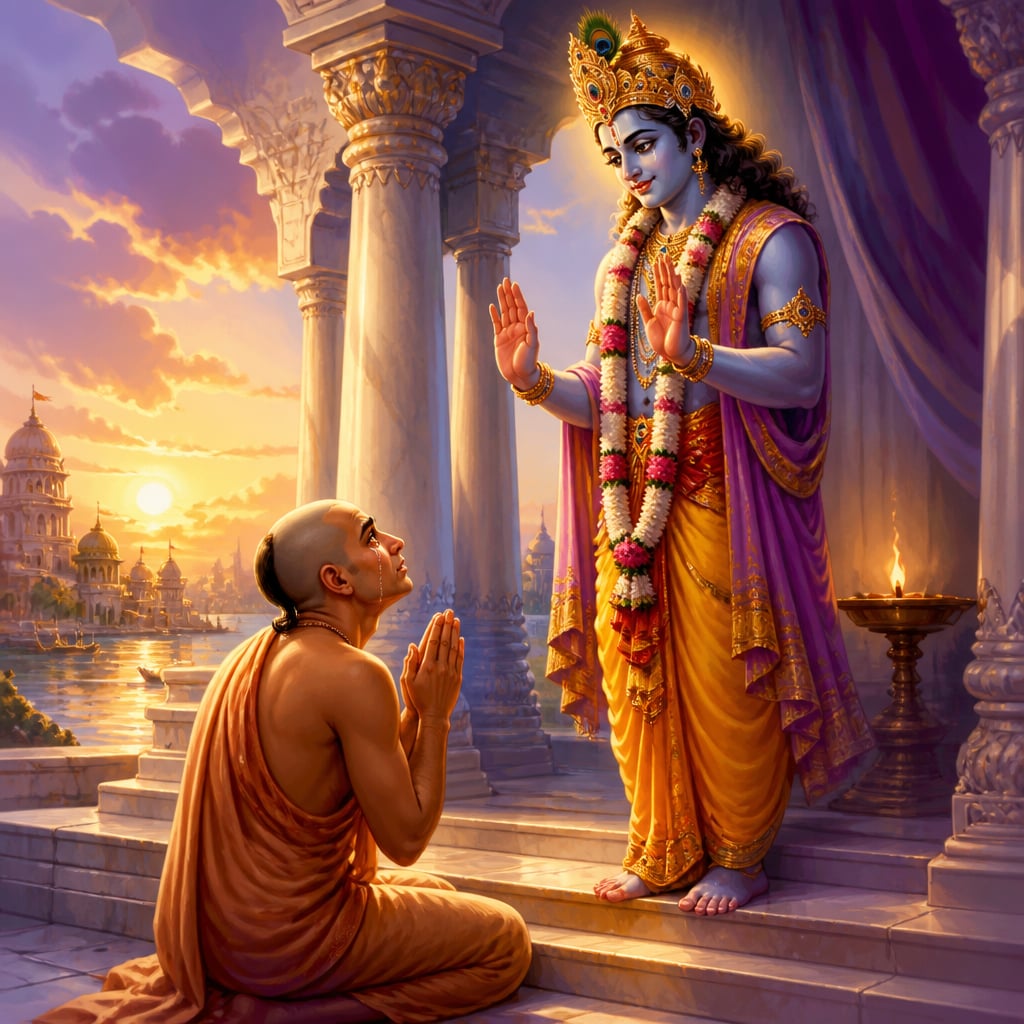
"O Krishna," Uddhava approached his Lord with tear-filled eyes, "how can I live in a world without You? The very sun seems to draw its light from Your presence. When You depart, what will remain? Take me with You, or give me teachings so profound that they will sustain me through the darkness to come."
Krishna's Response
Krishna looked at His devotee with infinite compassion. Of all the beings who loved Him, Uddhava's love was perhaps the most balanced - neither the fierce maternal love of Yashoda, nor the passionate longing of the Gopis, nor the respectful devotion of the Pandavas. Uddhava's love combined friendship, service, knowledge, and surrender. He was the perfect recipient for Krishna's final and most comprehensive teaching.
"Dear Uddhava," Krishna replied, "what you ask is what I most wish to give. The time has come for Me to speak truths that I have held in reserve - teachings even more complete than what I gave Arjuna on the battlefield of Kurukshetra."
This statement is significant. The Bhagavad Gita, spoken to Arjuna, is itself one of the world's most revered scriptures. Yet here Krishna indicates that the Uddhava Gita would be even more comprehensive. The Bhagavad Gita was spoken in the crisis of war, to a warrior paralyzed by moral confusion. The Uddhava Gita would be spoken in peace, to a devotee already established in knowledge, capable of receiving the deepest truths.
The Three Paths Compared
Krishna began by addressing a question that had puzzled seekers throughout time: Which path leads to liberation? Different teachers prescribed different methods:
| Path | Primary Practice | Goal | Who it Suits |
|---|---|---|---|
| Karma Yoga | Selfless action | Purification | Active temperaments |
| Jnana Yoga | Self-inquiry | Knowledge of Self | Contemplative minds |
| Bhakti Yoga | Loving devotion | Union with God | Emotional natures |
Krishna explained that these paths are not contradictory but complementary. They are like different roads ascending the same mountain - each has its own scenery, challenges, and character, but all lead to the summit.
Karma Yoga: The Path of Action
"For those whose minds are attached to action," Krishna taught, "the path of karma yoga is prescribed. By offering all actions to Me, by renouncing the fruits of work, the heart becomes purified. Through pure action, the way to knowledge opens."

Karma Yoga does not mean merely being busy or productive. It means performing actions:
- Without attachment to results
- As offerings to the Divine
- With awareness of the larger order (dharma)
- Without claiming personal doership
The karma yogi acts vigorously in the world but remains inwardly detached. Success and failure are received equally because the action itself has been surrendered to a higher purpose.
Jnana Yoga: The Path of Knowledge
"For those whose minds have been purified through action or by grace," Krishna continued, "the path of jnana becomes accessible. Through discrimination (viveka), one separates the eternal Self from the temporary body-mind. Through renunciation (vairagya), one withdraws attention from the unreal."
Jnana Yoga is the path of inquiry and discernment. The jnana yogi asks:
- Who am I beyond this body?
- What remains when thoughts cease?
- What is real and what is merely appearing?
This path requires a sharp intellect, intense focus, and the ability to sit with paradox. The jnana yogi seeks to know the Self not through emotion or action but through direct insight.
Bhakti Yoga: The Path of Devotion
"But for those who cannot bear separation from Me," Krishna said, His voice softening, "there is the path of bhakti - loving devotion. This path surpasses all others because it requires no qualification other than a loving heart. The unlearned and the scholarly, the sinful and the pure - all can walk this path."

Bhakti Yoga transforms the natural human capacity for love into a spiritual practice. Instead of loving objects that perish, the bhakta loves the Imperishable. Instead of seeking love from those who are limited, the bhakta receives love from the Unlimited.
Krishna declared bhakti supreme not because the other paths are inferior, but because:
- Bhakti purifies automatically (accomplishing what karma yoga seeks)
- Bhakti reveals the Self naturally (accomplishing what jnana yoga seeks)
- Bhakti adds something neither path provides - a relationship with the Divine
The Integration of Paths
Krishna then explained something crucial: in practice, these paths are rarely separate. The mature seeker integrates all three:
"Act in this world with detachment - this is karma yoga. Know yourself as distinct from the body - this is jnana yoga. Offer all actions and knowledge to Me with love - this is bhakti yoga. The complete path includes all three."
This integration prevents the distortions that can arise from pursuing any single path exclusively:
| Exclusive Path | Potential Distortion | Integration Corrects |
|---|---|---|
| Karma alone | Busyness without depth | Jnana adds discrimination |
| Jnana alone | Dry intellectualism | Bhakti adds heart |
| Bhakti alone | Emotional instability | Karma grounds in action |
The Yoga of the Senses
Krishna also taught about the role of the senses in spiritual life. The senses are neither evil nor obstacles - they are instruments that can be directed toward bondage or liberation.
"The tongue that tastes food offered to Me purifies the entire body. The ears that hear My names and stories become doorways to liberation. The eyes that see My form and My devotees behold the sacred. Use your senses as offerings, not as means of exploitation."
This teaching addresses a common confusion. Some spiritual paths demand suppression of the senses. Others allow unrestrained sensory engagement. Krishna prescribes neither suppression nor indulgence but transformation - using the senses for spiritual rather than material purposes.
The Importance of Association
Krishna emphasized that no path can be walked alone:
"Association with My devotees is the most powerful means of advancement. Even brief contact with a genuine devotee can transform a life. But association with those opposed to devotion can destroy even firm determination."
The principle is simple: we become like those we spend time with. The company we keep shapes our thoughts, which shape our character, which shapes our destiny. Therefore, the seeker must choose associations consciously.
Why Multiple Paths Exist
Uddhava asked why the Lord had prescribed multiple paths instead of a single universal method. Krishna's answer reveals the depth of His compassion:
"Not all minds are the same. Some are predominantly active, others contemplative, others emotional. To insist on one path for all would be like prescribing the same medicine for all diseases. I have provided multiple approaches so that no sincere seeker is excluded."
This pluralism of paths is a hallmark of Sanatan Dharma. Unlike religious systems that claim monopoly on truth, the Bhagavatam recognizes that divine wisdom adapts to human diversity.
The Promise
As this first portion of the Uddhava Gita concluded, Krishna made a promise that would sustain His devotee through all that was to come:
"These teachings are not mere philosophy, Uddhava. They are seeds of liberation. Plant them in your heart, water them with practice, and they will grow into the tree of realization. I am never separate from My words. When you contemplate these teachings, you contemplate Me."
This promise transforms the Uddhava Gita from ancient scripture into living presence. The teachings are not merely about Krishna - they are a form of Krishna. To study them with devotion is to be in Krishna's company.
With this foundation laid, Krishna would proceed to elaborate on each path in greater detail. The Uddhava Gita had begun - the Lord's final gift to humanity before His departure from the world.
Living traditions
The Uddhava Gita has influenced many modern teachers. Swami Chinmayananda gave extensive commentaries. The text's emphasis on bhakti as accessible to all influenced social reform movements. The integration of the three yogas appears in Sri Aurobindo's Integral Yoga and Swami Sivananda's teachings on the synthesis of yogas.
- Uddhava Gita Parayana: The practice of systematic reading and contemplation of the Uddhava Gita chapters, often done over a period of days or weeks
- Tri-yoga Sadhana: The integrated practice of karma, jnana, and bhakti yoga as taught by Krishna - service, inquiry, and devotion combined
- Badrinath: The destination Krishna instructed Uddhava to go to. According to tradition, Uddhava meditated here on Krishna's teachings for thousands of years. One of the four Char Dham sites.
- Badrinath Temple: One of the most sacred Vishnu temples, where Uddhava is believed to reside. The black stone deity of Vishnu here is said to be self-manifested (svayambhu).
Reflection
- Krishna taught three paths: karma (action), jnana (knowledge), and bhakti (devotion). Which path naturally resonates with your temperament? Why do you think that is?
- Krishna says bhakti can purify 'even those born in the lowest circumstances.' What does this say about the relationship between social status and spiritual attainment? How might this change how you view yourself and others?
- Uddhava was in despair at the prospect of separation from Krishna. Have you experienced separation from something or someone you considered divine or sacred? How did you cope? What did that separation teach you?