Uddhava Gita: Jnana and Maya (Part 4)
Knowledge and illusion
The nature of true knowledge (jnana) and illusion (maya) is explained. Krishna describes how the soul becomes entangled in matter through identification with the body. Self-realization comes through understanding the distinction between the knower and the known.
The Veil of Illusion
The Uddhava Gita now enters its most philosophical territory. Uddhava, having received teachings on bhakti, yoga, and social duty, seeks to understand the fundamental nature of bondage itself. Why does the eternal soul, inherently free and blissful, become trapped in the cycles of birth and death? Krishna's answer unveils the mysterious workings of maya, the divine illusion, and points the way to liberating knowledge.
The Anatomy of Ignorance
Krishna begins by explaining that the soul's bondage is not real in the ultimate sense, it is a case of mistaken identity. The atman, the true self, is eternal, unchanging, and beyond all suffering. But through association with the material energy (prakriti), a strange forgetfulness occurs. The soul begins to identify with what it is not.
"As fire covered by smoke, a mirror by dust, or an embryo by the womb," Krishna explains, "so is knowledge covered by different degrees of conditioning."
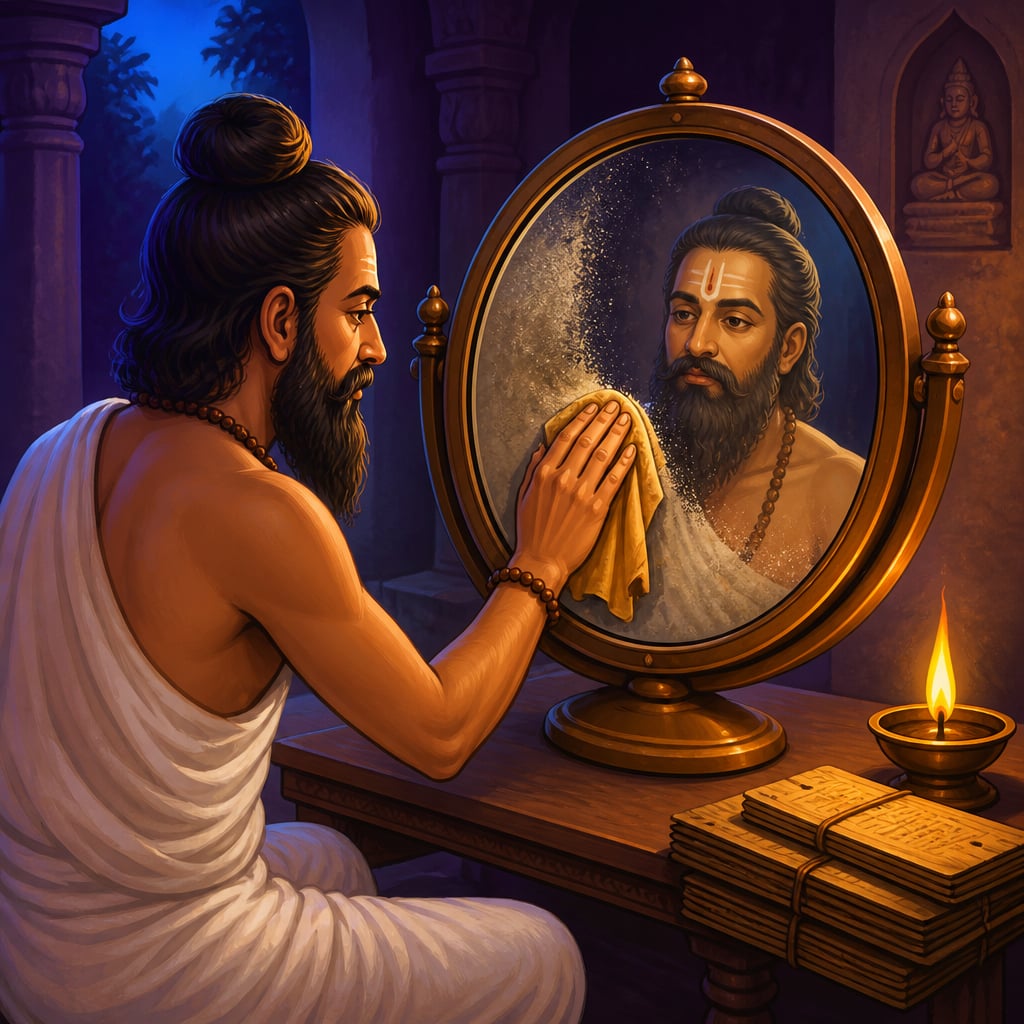
This covering is not destruction of knowledge but obscuration. The sun exists whether clouds cover it or not; similarly, the soul's pure awareness exists even when hidden by layers of false identification. The work of spiritual practice is not to create something new but to remove what shouldn't be there.
The Three Bodies
Krishna describes the soul's entanglement through three bodies:
The Gross Body (Sthula Sharira): Made of the five elements, earth, water, fire, air, and space. This physical form is born, grows, changes, and eventually dies. Yet fools imagine this temporary vehicle to be the self.
The Subtle Body (Sukshma Sharira): Comprising the mind, intelligence, ego, and the ten senses. This body carries impressions (samskaras) from life to life, determining future births. Even those who recognize they are not the physical body often mistake themselves for the subtle body, their thoughts, emotions, and personality.
The Causal Body (Karana Sharira): The deepest level of ignorance, the seed form of the other bodies. This primordial covering contains all potentialities in dormant form, waiting to manifest.
Liberation means transcending all three bodies to realize the pure atman, which is none of them.
The Workings of Maya
Maya, Krishna reveals, is His own divine energy, mysterious, beginningless, and beyond logic. She operates through three modes:
Sattva (Goodness): Manifests as wisdom, peace, and the desire for knowledge. Though the highest mode, even sattva can bind the soul through attachment to happiness and knowledge itself.
Rajas (Passion): Creates desire, ambition, and restless activity. The rajasic person is constantly doing, acquiring, becoming, never at peace.
Tamas (Ignorance): Produces laziness, delusion, sleep, and negligence. The tamasic person is covered in the thickest darkness, barely aware of their predicament.
All three modes are binding. Even golden chains are chains. The liberated soul transcends all gunas, dwelling in the pure consciousness beyond their influence.
The Spider and Its Web
Krishna offers a striking analogy. Maya is like a spider's web, spun from the spider's own body, yet capable of trapping insects that enter it. The Lord projects maya from Himself, yet remains untouched by it. Souls who enter this web become entangled, forgetting they were ever free.

"I am the spider," Krishna says, "and this universe is My web. But unlike the spider, I am fully conscious of the web's illusory nature, while those caught in it take it to be real."
The web is not created to trap souls but to provide a field for experience, growth, and eventual liberation. Maya is not enemy but teacher, through suffering in illusion, the soul eventually seeks truth.
Jnana: The Light of Knowledge
If maya is darkness, jnana is light. True knowledge is not mere information but direct seeing, the recognition of what one actually is. Krishna describes the characteristics of liberating knowledge:
Discrimination (Viveka): The ability to distinguish between the eternal and the temporary, the real and the unreal, the self and the not-self.
Dispassion (Vairagya): Natural detachment arising from seeing the limitations of material pursuits. Not forced renunciation but effortless letting go.
Six Treasures (Shat-Sampatti): Tranquility, self-control, withdrawal of senses, forbearance, faith, and one-pointedness.
Intense Longing (Mumukshutva): The burning desire for liberation that makes spiritual practice not a duty but a necessity.
These four qualifications together constitute the preparation for receiving knowledge. Without them, even hearing the highest truth brings no transformation.
The Witness Consciousness
Krishna points Uddhava to the key insight: there is that which never changes while everything else changes. The body transforms from infant to elder; the mind fluctuates between happiness and sorrow; thoughts arise and dissolve like waves. But behind all this flux is the unchanging witness, pure awareness itself.

"You are not the seer of sights but that by which seeing is possible," Krishna teaches. "You are not the thinker of thoughts but that in which thoughts appear and disappear. You are the eternal witness, untouched by what is witnessed."
This is not a concept to be believed but a recognition to be lived. In deep meditation, when thoughts settle, the witnessing awareness reveals itself, always present, always peaceful, always free.
The Sunrise of Self-Knowledge
Uddhava asks how one abiding in such knowledge would behave in the world. Krishna responds that the jnani, one established in knowledge, acts without ego, sees the same Self in all beings, and remains undisturbed by praise or blame, gain or loss.
Such a person may appear ordinary from outside but is inwardly free. They engage with the world as an actor plays a role, fully participating yet knowing it is a play. The body continues its destined actions; the mind continues its habitual patterns; but the identification with these has been severed.
"The knot of the heart is cut," Krishna declares, "all doubts are destroyed, and all karma is exhausted when one sees Me everywhere."
Maya as Divine Play
In closing, Krishna reveals the highest understanding: maya is not merely illusion to be escaped but divine play (lila) to be understood and transcended. The Lord creates, sustains, and dissolves the universe through maya, not out of necessity but out of joy.
For the devotee established in jnana, even maya becomes beautiful. They see the Lord's artistic hand in every form, His consciousness in every being, His play in every event. The universe transforms from prison to temple, from bondage to celebration.
This is the culmination of knowledge: not cold detachment from a meaningless world but warm appreciation of a world infused with divine presence. The maya that once trapped now delights, and the soul that once feared now dances.
Living traditions
- Atma Vichara (Self-Inquiry): The practice of constantly asking 'Who am I?' and tracing thoughts back to their source, the witness consciousness described in this lesson
Reflection
- In quiet moments, can you sense the unchanging awareness behind your changing thoughts and feelings? What would it mean to identify with that awareness rather than with the fluctuations?
- Krishna compares one who studies scripture without realization to someone maintaining a cow that gives no milk. How can you ensure your spiritual learning leads to actual transformation?
- The teaching suggests that even happiness can be a binding force through sattva guna. How might your attachments to 'positive' experiences be limiting your freedom?