Avadhuta: The Brahmana's 24 Gurus

Learning from all creation

A wandering avadhuta (renunciate) describes his twenty-four gurus to King Yadu - including earth, air, sky, water, fire, moon, sun, pigeon, python, ocean, moth, bee, elephant, deer, fish, and more. Each teaches a profound spiritual lesson. This becomes a famous teaching in the Bhagavatam tradition.

The Encounter with the Wandering Sage

Before Krishna began His final teachings to Uddhava, He recounted an ancient story that had been passed down through generations - the story of an Avadhuta Brahmana who learned wisdom from the most unexpected sources. This teaching is so profound that it has become one of the most quoted passages in the entire Bhagavatam.

Long ago, King Yadu - the ancestor of the Yadava dynasty and one of the great kings of ancient India - was traveling through a forest when he encountered an extraordinary sight. A young brahmana wandered through the woods, radiating peace and contentment despite having no possessions, no home, and no apparent worldly support.

The king was struck by the sage's serene demeanor. Most people who renounced everything appeared haggard, anxious, or at least detached. But this man seemed genuinely blissful, as if he had discovered some secret treasure that others could not see.

"O learned one," King Yadu addressed the wanderer, "you appear neither a householder nor a renunciate in the conventional sense. You have no occupation, yet you seem perfectly content. From whom have you learned this art of living? Who is your guru?"

The Avadhuta - a term for one who has 'shaken off' all conventional identities - smiled at the king's question.
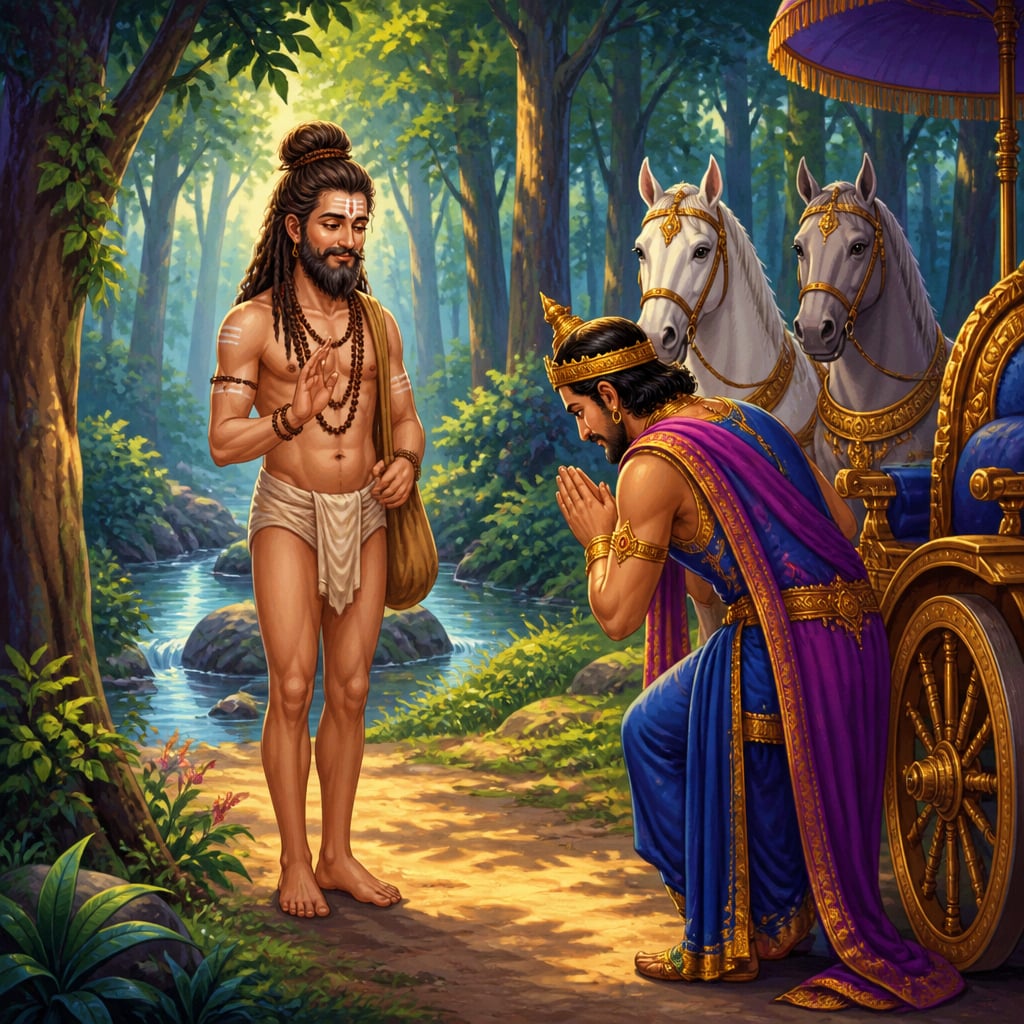
Avadhuta brahmana smiling before King Yadu in sun-dappled forest

"O King, I have had many gurus - twenty-four in total. Let me describe them to you, for they have taught me everything I know about peace, wisdom, and liberation."

The Twenty-Four Gurus

What followed was one of the most remarkable teachings in spiritual literature. The Avadhuta had not learned from famous sages or sacred texts alone. He had learned from observing nature itself - from the earth beneath his feet to the insects around him.

The Five Elements

1. Earth (Pṛthvī) - "From the earth I learned patience and forgiveness. People dig into her, plow her, and burden her with their buildings and refuse. Yet she bears all without complaint, continuing to nourish those who harm her. A spiritual seeker must develop similar patience with the world's provocations."

2. Air (Vāyu) - "The air taught me to move through the world without attachment. The wind touches everything - flowers, garbage, palaces, slums - yet takes on none of their qualities. It remains pure, carrying the fragrance it encounters but not clinging to it. So should a sage pass through life."

3. Sky (Ākāśa) - "From the sky I learned that the Self is ever-pervading yet untouched. Clouds form in the sky, storms rage across it, yet the sky itself is never stained. The Self similarly witnesses all experiences without being affected by them."

4. Water (Āpas) - "Water taught me purity and the blessing of a sage's presence. Just as water naturally cleanses whatever it touches, and just as a holy river purifies those who bathe in it, so does the presence of a realized soul purify all who come near."

5. Fire (Agni) - "Fire taught me to consume what is offered without discrimination. Fire accepts whatever is placed into it - whether gold or garbage - and transforms it into light and heat. A sage similarly accepts whatever comes from devotees and transforms it into blessings."

The Celestial Teachers

6. Moon (Candra) - "The moon appears to wax and wane, to be born and die each month. Yet the moon itself is unchanged - only its reflection varies. Similarly, the body goes through childhood, youth, old age, and death, but the Self within is constant and eternal."

7. Sun (Sūrya) - "The sun draws water from the ocean, holds it in clouds, and returns it as rain for the benefit of all. A sage similarly may accept offerings, but only to redistribute them for the welfare of others. Also, the sun is one but appears multiple when reflected in different water bodies. The Self is similarly one, appearing many due to various mental reflections."

The Animals and Insects

8. Pigeon (Kapota) - "A pigeon couple became so attached to each other and their offspring that when a hunter caught them, they all died together - none willing to escape alone. From this I learned that excessive attachment, even to loved ones, leads to destruction. Love must be held with open hands."

9. Python (Ajagara) - "The python taught me contentment. It lies in one place, eating only what comes to it by fate. It does not chase food or store provisions. A sage should similarly accept whatever Providence sends, neither hoarding nor anxiously seeking."

10. Ocean (Samudra) - "The ocean taught me equanimity. Rivers constantly pour into it; the sun constantly evaporates from it. Yet the ocean remains the same - neither overjoyed by what it receives nor disturbed by what it loses. The wise remain similarly balanced amid life's fluctuations."

A honey bee suspended between two flowers

11. Moth (Patanga) - "The moth, attracted by fire's beauty, flies into the flame and dies. From this I learned that the senses, if allowed to chase attractive objects, lead to destruction. The seeker must master the senses rather than be mastered by them."

12. Bee (Madhukara) - "The bee taught me two lessons. First, it gathers nectar from many flowers without harming any - a sage should similarly gather wisdom from many sources. Second, the bee stores honey that others take away - hoarding invites loss. Better to use wisdom immediately than to store it for a future that may not come."

13. Elephant (Gaja) - "The powerful elephant is captured through its desire for a female. Hunters dig a pit, cover it, and place a wooden female elephant on top. The male, overcome with lust, approaches and falls into the pit. From this I learned that desire for the opposite sex has brought down even the mightiest beings."

14. Deer (Mṛga) - "The deer is so entranced by the hunter's music that it stands frozen, allowing itself to be captured. From this I learned that attachment to music and pleasant sounds can captivate the mind. All sensory pleasures have this binding power."

15. Fish (Mīna) - "The fish is caught by the lure of taste - it bites the hook for a morsel of food. From this I learned that of all the senses, taste is the most difficult to conquer. Many who have controlled other desires remain slaves to their palate."

The Human Teachers

Pingala the courtesan at her doorway

16. A Prostitute named Pingala - "In Videha, there lived a courtesan named Pingala who would wait each night for wealthy clients. One night, when no one came, she fell into despair. Then suddenly, clarity arose: 'I have wasted my life hoping for worldly satisfaction. Let me turn to the Lord, who alone can give lasting fulfillment.' That very night she attained peace. From her I learned that disillusionment with the world is the beginning of wisdom."

17. A Child (Kumāra) - "From observing a small child I learned to live without anxiety about the future. The child does not worry about tomorrow's food or next year's shelter. It plays freely, cries when hurt, and then forgets. This freedom from worry is natural wisdom that adults have lost."

18. A Maiden (Kumārī) - "A young woman was home alone when guests arrived. She went to husk rice, but her bangles clattered loudly. Embarrassed, she removed them one by one until only one remained on each wrist - and silence prevailed. From her I learned that living alone or with very few companions prevents the noise and conflict that comes with crowds."

More Unlikely Teachers

19. Arrow-maker (Iṣukāra) - "I once watched an arrow-maker so absorbed in his work that a king's procession passed by without him noticing. From him I learned the power of concentration. When the mind is truly focused, the entire world disappears."

20. Snake (Sarpa) - "The snake taught me to live alone, avoiding society, speaking little, and having no fixed home. A sage wanders like a snake - solitary, focused, and free."

21. Spider (Ūrṇanābhi) - "The spider creates its web from within itself, plays within it, and eventually reabsorbs it. Similarly, the Supreme creates the universe from within, sustains it, and withdraws it. The Self is both the material and efficient cause of our experienced reality."

22. Wasp (Bhramarī-kīṭa) - "A wasp captures a caterpillar and places it in its nest. The caterpillar, constantly meditating on the wasp out of fear, eventually transforms into a wasp. From this I learned that whatever we constantly meditate upon, we become. Therefore, meditate on the Divine."

23. My Own Body - "From my body I learned detachment. I have cared for this body, fed it, protected it - yet it brings me disease, decay, and will eventually abandon me through death. Seeing this, I no longer identify with it."

24. My Own Intelligence - "Finally, my own discriminating intelligence taught me to distinguish the eternal from the temporary, the real from the unreal. Through this discrimination (viveka), I understood that I am not the body, mind, or senses, but the witnessing consciousness beyond them all."

The Deeper Teaching

When the Avadhuta finished, King Yadu understood: a true seeker can learn from anything and everything. The world itself is a university, and every experience is a potential lesson. The question is not whether we encounter teachings, but whether we have eyes to see them.

Krishna recounted this story to show that the path to wisdom does not require retreating from the world. It requires engaging with the world consciously, seeing the spiritual significance hidden in ordinary things.

The twenty-four gurus represent the entire creation - elements, celestial bodies, animals, humans, and even our own bodies. Each carries a message for those willing to listen. The Avadhuta's genius was not superior birth or rigorous practice - it was attention, the willingness to learn from wherever learning presented itself.

The Timeless Message

This teaching has resonated across centuries because it democratizes wisdom. You need not travel to distant ashrams or find rare gurus. Your teachers surround you. The ant teaches diligence. The crow teaches alertness. The sunrise teaches punctuality. The seasons teach impermanence.

The twenty-four gurus are not merely a list to memorize - they are an invitation to transform how we see the world. Every creature, every element, every experience carries wisdom for those with the humility to receive it.

As we prepare to enter the Uddhava Gita in subsequent lessons, this teaching sets the tone: the highest wisdom often comes from the humblest sources, and the greatest guru is life itself when approached with awareness and humility.

Living traditions

The 24-gurus teaching has influenced modern environmental spirituality. It is cited in eco-dharma movements that see nature protection as spiritual practice. The observation-based learning method also aligns with experiential education philosophies. Many leadership and management books reference the Avadhuta's approach as an example of learning from all sources.

Reflection

More in Skanda 11: General History

All lessons in Skanda 11: General History · Srimad Bhagavatham course