Uddhava Gita: Final Instructions (Part 5)
Go to Badrinath
Krishna concludes His instructions, directing Uddhava to go to Badrinath for meditation. He explains that all religions ultimately lead to Him. Uddhava, heart breaking, circumambulates Krishna and departs. This is their final meeting - the most intimate farewell in scripture.
The Most Tender Farewell
We have reached the climax of the Uddhava Gita, perhaps the most emotionally charged passage in all of Vedic literature. Krishna has finished His comprehensive teaching on bhakti, jnana, yoga, dharma, and maya. Now comes the moment both have been dreading: the time for Uddhava to leave. What unfolds is not merely instruction but the very essence of divine love expressed in parting.
The Conclusion of Teaching
Krishna looks at His dear friend and devotee one final time as teacher. He has given everything, the secrets of devotion, the nature of the Self, the workings of illusion, the paths of liberation. Nothing has been held back. The teachings that will guide humanity for millennia have poured forth from His lotus lips.
"I have revealed to you, dear Uddhava, the most confidential knowledge," Krishna says softly. "This teaching destroys all ignorance and leads directly to Me. One who understands these instructions becomes free from doubt and attains liberation."
But knowledge alone is not enough. The teaching must now be lived. And for that, Uddhava needs a sacred place of practice.
The Directive to Badrinath
Krishna gives His final practical instruction: Uddhava must travel to Badrikashrama, the sacred Himalayan hermitage that will later be known as Badrinath. There, in the pure mountain air, surrounded by eternal snows, free from the distractions of ordinary life, Uddhava should meditate on what he has learned.
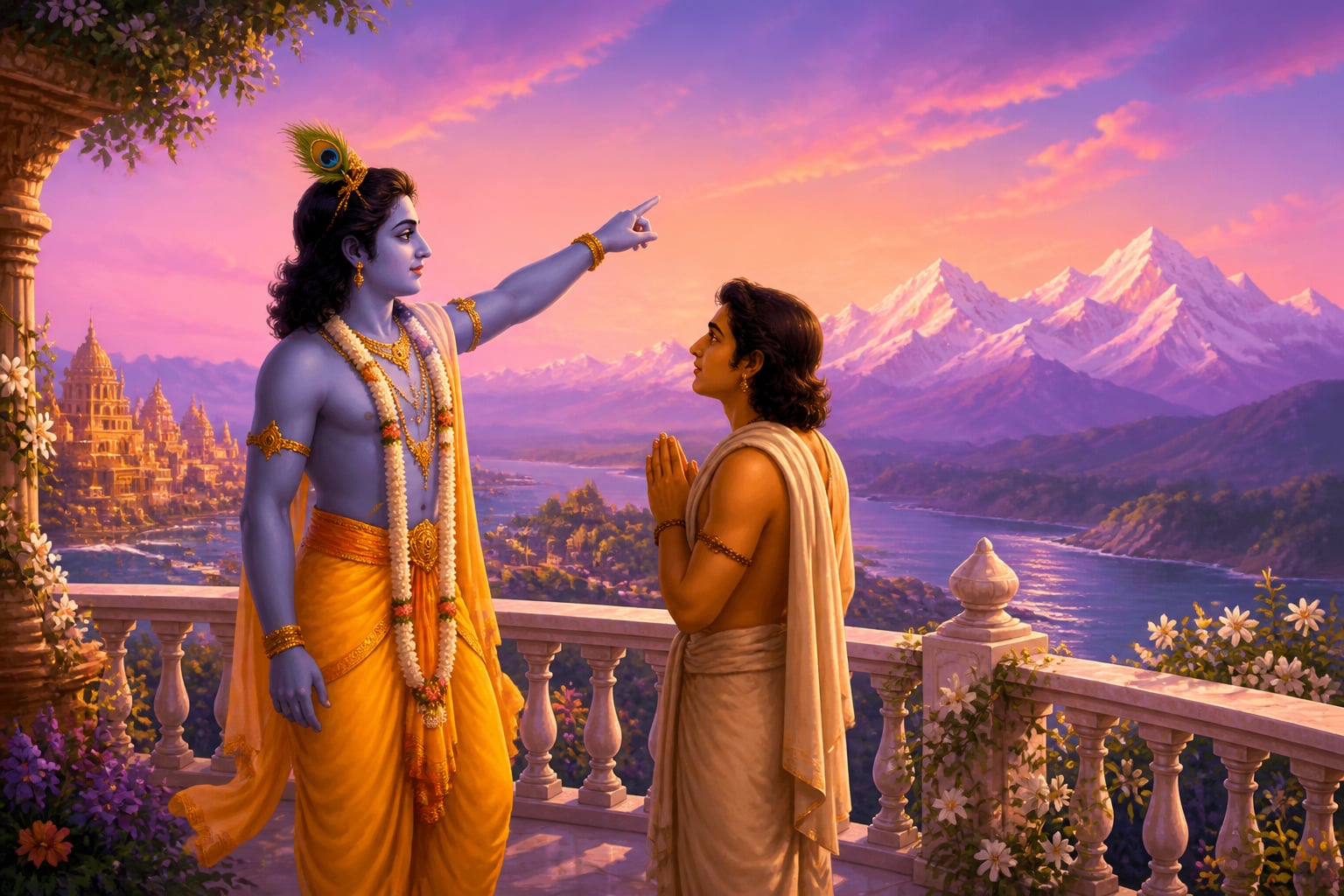
"Go to My ashrama at Badri," Krishna instructs. "Bathe in the waters of the Alakananda, wear bark cloth and subsist on forest foods. Be free from passion, endure cold and heat with equanimity, and fix your mind on Me alone."
Badrinath is not merely a geographical location but a spiritual reality. The Lord Himself, in His form as Narayana, eternally meditates there. Uddhava is being sent not into exile but into the Lord's own meditation hall.
"There, becoming free from the modes of nature through knowledge and realization, you will attain Me," Krishna promises.
All Paths Lead Home
Before the final parting, Krishna offers a teaching of extraordinary universality. Anticipating the diversity of spiritual paths that would develop over the ages, He declares:
"Whatever one's path, whatever the method of worship, whatever the conception of the Divine, if practiced with sincerity and devotion, all paths eventually lead to Me."
This is not religious relativism but divine confidence. The Lord who is the source of all religions recognizes Himself in all genuine seeking. Whether one approaches through elaborate ritual or simple prayer, through intellectual inquiry or ecstatic devotion, through service to humanity or retreat into solitude, the sincere seeker will find Krishna waiting at the journey's end.
"Those who worship the demigods with faith," Krishna explains, "are actually worshipping Me, though in an indirect way. Even those paths eventually lead home, though the journey may be longer."
This teaching liberates the heart from sectarian anxiety. One need not fear that following the wrong path will lead to eternal condemnation. The Lord is too loving, too patient, too skillful to allow any sincere soul to remain lost forever.
Uddhava's Heart Breaks
As the reality of separation sinks in, Uddhava is overwhelmed. He has lived his entire life in Krishna's presence. From childhood, Krishna was his companion; in youth, his confidant; in maturity, his Lord and Master. Every happy memory, every moment of meaning, involves that dark-skinned youth with lotus eyes.
And now, departure. Forever.
Uddhava falls at Krishna's feet, unable to speak. Tears stream down his face, wetting the divine feet that have walked beside him through all of life's joys and sorrows. His body trembles with the effort of containing grief that cannot be contained.
"How can I leave You?" he finally manages. "You are my life, my breath, my very self. Without You, what is the meaning of liberation? What is the value of all knowledge if You are not there to share it?"
This is the cry of the true devotee, one who would rather stay in bondage with the Lord than be liberated without Him. Uddhava has understood the deepest teaching: the goal is not escape from suffering but union with the Beloved.
Krishna's Response
Krishna's eyes also glisten. Though He is the Supreme Lord, transcendent and eternal, He feels the pain of separation as acutely as Uddhava. This is the mystery of divine love, the Infinite becomes vulnerable to the finite, the Eternal is touched by time.
"Uddhava, you and I are never truly separate," Krishna assures him. "I am always in your heart, and you are always in Mine. Wherever you go, I am there. Whenever you think of Me, I am present."
He continues: "This body that you see will disappear from the world, but My essential nature is eternal. I exist in the hearts of all beings, in the words of scripture, in the rhythm of the sacred syllables, in the rising of the sun and the flowing of the rivers."
"When you meditate in Badrinath, you will find Me there. When you serve the sages, you serve Me. When you see the mountains and rivers, you see My form. I have not left you, I could never leave you."
The Final Circumambulation
Uddhava rises, composes himself, and performs the final act of devotion. He walks around Krishna three times, keeping the Lord always on his right, the traditional pradakshina that honors the divine.
With each circuit, he tries to imprint every detail in his memory: the curve of Krishna's smile, the sweep of His peacock feather, the blue-black luster of His skin, the compassion radiating from His eyes. These images will sustain him through the long years of practice in the Himalayas.
He places Krishna's lotus feet on his head one last time, that sacred touch a blessing to carry into eternity. Then, with supreme effort, he turns and begins to walk away.

The Walk Away

Each step is agony. Uddhava looks back once, twice, unable to believe this is really happening. Krishna stands watching, hand raised in blessing and farewell.
The distance grows. The figure of Krishna becomes smaller. The golden city of Dvaraka recedes. Everything Uddhava has ever known and loved remains behind as he walks toward an unknown future.
Yet something accompanies him, the teaching that is now part of his very being, the love that death cannot diminish, the promise that separation is illusion and reunion is eternal.
The Teaching Lives On
Uddhava would indeed reach Badrinath. He would practice the teachings received from his beloved Lord. He would attain the realization Krishna promised. And through his devoted preservation and transmission, the Uddhava Gita would reach us across the millennia.
Every word we read is Uddhava's gift. Every teaching that illumines our darkness carries his tears. The farewell that broke his heart has become the doorway through which countless seekers have found the same Lord.
For Krishna was right: He is never truly absent. In these very teachings, He lives and speaks still. The reader who studies with devotion will find not dusty scripture but living presence. The student who practices will discover not distant philosophy but intimate companionship.
Uddhava's farewell was not an ending but a transformation. The Lord who was visible became invisible; the love that was particular became universal. And across time and space, the same teaching reaches every heart that yearns for the Divine.
Go to Badrinath, beloved reader, not necessarily the physical place, but the inner sanctuary where the Lord eternally waits. There, in the silence of the heart, the same Krishna who taught Uddhava is teaching still.
Living traditions
- Char Dham Yatra: The pilgrimage to four sacred sites (Badrinath, Kedarnath, Gangotri, Yamunotri) that includes Badrinath as the most important destination
Reflection
- Have you experienced how separation from someone or something beloved can paradoxically deepen your connection to them? How might this apply to spiritual practice?
- Krishna assures that all sincere paths lead to Him. How does this teaching affect your view of spiritual traditions different from your own?
- Where is your 'Badrinath', the place or practice where you can integrate spiritual teachings into lived experience? Are you making time for such dedicated practice?