Mausala: Krishna's Departure

The Lord withdraws His pastimes

The curse takes effect. At Prabhasa, the Yadavas become intoxicated and fight among themselves with iron clubs made from the cursed mace. Krishna sits under a peepal tree where a hunter's arrow pierces His foot. The Lord departs for His eternal abode, ending His earthly pastimes.

The Lord Withdraws His Pastimes

We have come to the most solemn chapter in the Bhagavatam, the end of Krishna's earthly lila. The curse spoken by the sages has germinated through the years, and now its fruit ripens. What unfolds is not tragedy but transcendence, not the death of God but the withdrawal of His visible form. Understanding this distinction is essential to understanding everything that follows.

The Signs Multiply

As Kali Yuga approached, ominous signs appeared throughout Dvaraka. The sun and moon were eclipsed at unusual times. Jackals howled at sunset. Women dreamed of dark figures carrying away their husbands. The sea, normally so generous to the coastal city, turned restless and threatening.

Krishna observed all this with perfect equanimity. He knew what was coming, He had known from the beginning. His earthly pastimes had served their purpose: dharma had been re-established, the Bhagavad Gita and now the Uddhava Gita had been spoken, countless souls had been liberated through contact with Him.

Now it was time to orchestrate His own departure.

The Yadavas at Prabhasa

Krishna gathered the Yadava clan for a pilgrimage to Prabhasa, the sacred tirtha on the western coast. Ostensibly, this was for purification through holy bathing. In truth, it was the stage for the curse's fulfillment.

At Prabhasa, the Yadavas began to drink, heavily, excessively. The wine loosened their tongues and inflamed their tempers. Old rivalries surfaced. Petty insults escalated into rage.

"You sided with the Pandavas against your own people!" one shouted. "Your arrogance has always been insufferable!" another responded.

The argument spiraled out of control. And then someone remembered the eraka grass growing along the shore, the same grass that had grown from the iron powder of the cursed mace.

The Mausala Parva
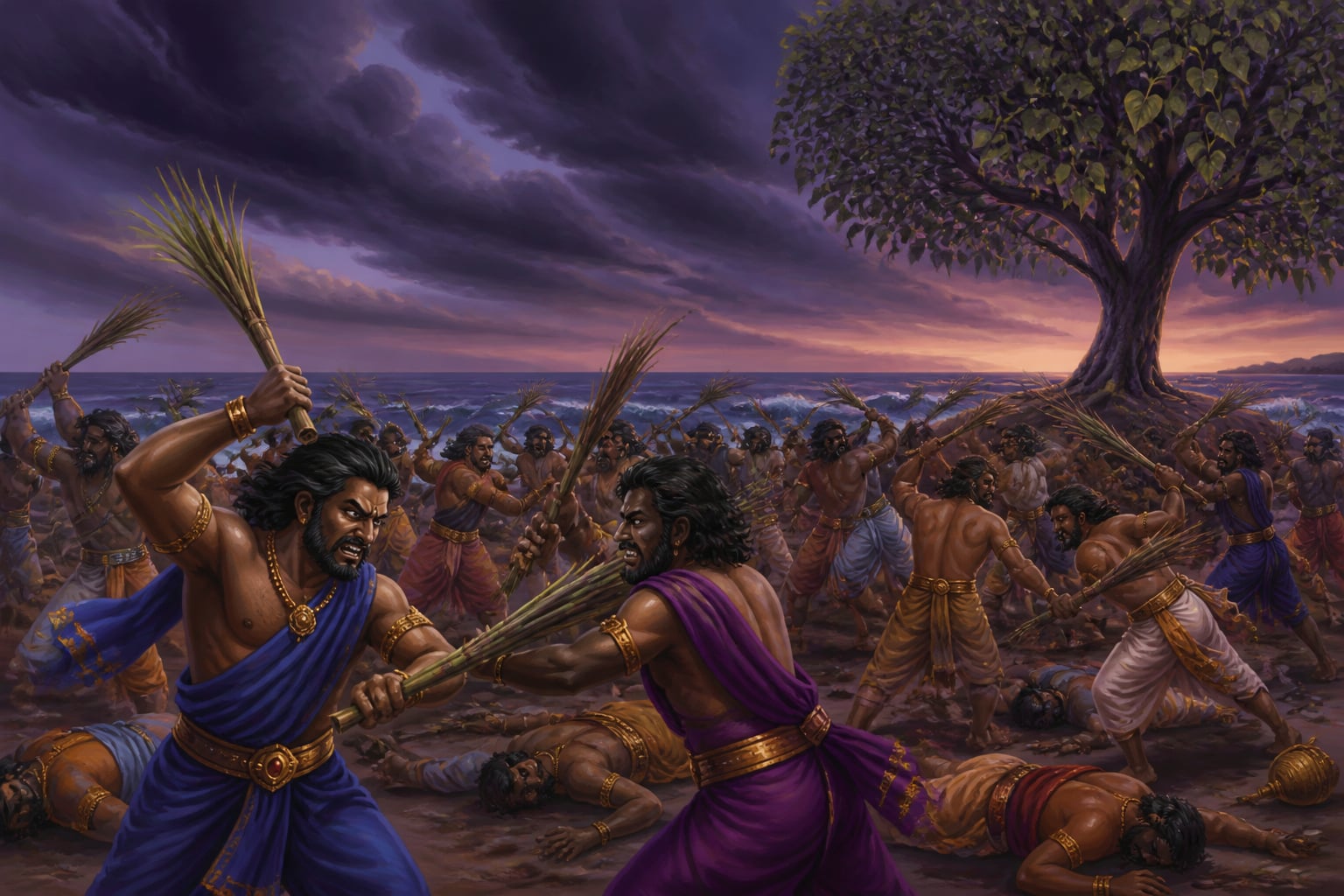
Yadavas fighting with iron clubs at Prabhasa

They tore up the grass and discovered it had become hard as iron. Each blade transformed into a lethal club (mausala) in their hands. The wine-maddened Yadavas fell upon one another.

Brothers killed brothers. Fathers slew sons. Friends of a lifetime became mortal enemies. The flower of the Yadava race, warriors who had conquered countless kingdoms, who had never known defeat in external battle, destroyed themselves from within.

Krishna stood apart, watching. He made no move to stop the carnage. To intervene would be to deny the sages' curse, and the curse had served its purpose, providing a mechanism for the Yadavas to leave this world simultaneously with their Lord.

Balarama, Krishna's elder brother, sat under a tree and entered deep meditation. His serpent form, Ananta Shesha, emerged from his mouth and departed for the celestial realms. The first companion had gone ahead.

The Hunter's Arrow

When the battlefield grew silent, Krishna walked alone to a forest nearby. He sat beneath a sacred peepal tree, His left foot resting on His right thigh. In that pose, resembling a deer sleeping, He began His own departure.

A hunter named Jara was tracking game in the forest. Seeing what he thought was a deer's ear through the foliage, he released an arrow. The arrow, its tip made from the same cursed iron, struck Krishna's foot.

Krishna seated beneath peepal tree as hunter Jara's arrow strikes his foot

Jara the hunter kneeling before Krishna

Jara rushed forward to claim his prize and discovered, to his horror, that he had struck not a deer but the Lord of the universe. He fell at Krishna's feet, weeping, begging forgiveness for his terrible mistake.

Krishna smiled, that smile which had charmed the Gopis, reassured Arjuna, and confounded demons. "Do not grieve, O hunter. You have acted according to My will. In a previous life, you were Vali, the monkey king whom Rama killed with a hidden arrow. This balances that karma. Go now to the celestial realms, your action was My instrument, not your sin."

The Departure

What happened next is described with deliberate restraint in the scriptures. Krishna closed His lotus eyes. His transcendent form began to radiate unprecedented brilliance. The celestials gathered overhead, showering flowers, sounding their instruments, weeping with devotion.

The Lord who had appeared in the prison cell of Kamsa, who had been carried across the Yamuna by Vasudeva, raised among cowherds in Vrindavan, performed countless miracles, spoken the eternal wisdom of the Gita, now withdrew that form from human sight.

He did not die. The Eternal cannot cease to exist. He simply became invisible to the eyes of this world. Where His form had been, there was now brilliant light. And then the light itself withdrew, leaving only the memory of His presence.

Dvaraka Submerges

With Krishna's departure, there was no reason for Dvaraka to remain. The golden city that He had manifested through yogic power began to sink beneath the waves. The sea, held back for so long, reclaimed its territory.

Arjuna arrived too late, summoned by Krishna but delayed on the journey. He found only chaos: the Yadava women wailing, the city crumbling, the ocean advancing. He managed to evacuate some survivors, but even his prowess had diminished with Krishna's absence. His famous Gandiva bow felt heavy; his arms trembled; his aim faltered.

The age of heroes was ending. Kali Yuga had truly begun.

Understanding the Departure

The superficial reading sees tragedy: a great civilization destroyed by infighting, its Lord killed by a random hunter's arrow. But the Bhagavatam insists on a deeper understanding.

Krishna was not killed, He cannot be killed. As He told Arjuna in the Gita: "I am unborn and eternal." His earthly form was a concession to devotees who needed to see Him with physical eyes. When that form was withdrawn, He did not cease to exist, He simply became perceptible only to those with purified vision.

The Yadavas did not die meaninglessly, they returned to their celestial origins. Many were partial incarnations of the demigods; they had descended with Krishna and now departed with Him. Their fighting was not delusion but a cosmic choreography, a way for all to leave together.

Even the curse that triggered these events was part of the divine plan. Krishna had allowed it, had in fact orchestrated it by having Samba dress as a pregnant woman. Without the curse, how would the invincible Yadavas have departed? They could not be killed by any external enemy. Only their own internal discord could provide the mechanism for their exit.

The Grief of the Gopies and Devotees

News of Krishna's departure spread across the land. In Hastinapura, the Pandavas received word and understood that their own time was ending. They would soon begin their final journey to the Himalayas.

In Vrindavan, the Gopis, those whose devotion had already been tested by years of separation, now faced the final absence. Yet even here, the teaching holds: for true devotees, the Lord is never absent. He lives in their hearts more fully than He ever lived in Dvaraka.

The Bhagavatam records that for these great devotees, Krishna's departure was not different from His presence. They had learned, through the long years of separation, that physical proximity is the least important aspect of divine connection. What matters is the heart's orientation, and their hearts would never turn from Him.

The Eternal Continues

Krishna did not disappear into nothingness. According to the Bhagavatam, He returned to His eternal abode, Goloka Vrindavan, the spiritual realm where His pastimes continue forever, uninterrupted by time.

There, the Gopis dance with Him eternally. There, the cowherds play with Him in endless childhood games. There, Radha and Krishna unite in love that knows no separation. What manifested temporarily in this world exists permanently in that realm.

For devotees, the goal is not merely to remember Krishna but to join Him there, to enter the eternal lila that the earthly pastimes only hinted at. The ending of the earthly story is actually an invitation to the never-ending story beyond.

Meditation at the Sacred Peepal

The place where Krishna sat beneath the peepal tree remains sacred to this day. Pilgrims visit Bhalka Tirtha near Somnath, where tradition places the hunter's arrow. They sit beneath peepal trees and meditate on the paradox: the Infinite taking on finite form, then withdrawing that form while remaining infinitely present.

The meditation is not morbid but liberating. If even Krishna's body departed, why do we cling so fiercely to ours? If the Lord Himself demonstrated that physical forms are temporary vehicles, why do we mistake them for our true identity?

In Krishna's departure is hidden the secret of our own eventual liberation: we too will leave these bodies, and if our hearts are properly oriented, we too will find that what seemed like ending was actually beginning.

Living traditions

Reflection

More in Skanda 11: General History

All lessons in Skanda 11: General History ยท Srimad Bhagavatham course