Shri Rudram: The Hymn Chanted for Three Thousand Years

Namakam, Chamakam, and Shiva Mahimna Stotram

The Shri Rudram is the oldest surviving hymn to Shiva, embedded in the Krishna Yajurveda and chanted in Indian temples for three thousand years. This lesson opens at a Vedic recitation, walks the structure of both Namakam and Chamakam, and answers the question every newcomer has: what is it actually saying?

The Same Bath, Every Morning, Since 1010 CE

In the inner sanctum of the Brihadeeswara temple at Thanjavur, around four o'clock on a typical morning in the third week of November 2025, a temple priest named Sundaramurthy Sivam stands before a black granite Shivalinga more than three metres high. The lamps in the inner chamber flicker. The smell of fresh sandal paste and bilva leaves fills the small space. The first chant has not yet begun. He picks up a small brass vessel of milk, then a vessel of water from the Cauvery, then honey, then curd, then ghee. He has done this every morning for the last twenty-three years.

He begins to chant. The hymn he chants is roughly three thousand years old. It is not the Shiva Purana. It is not the Bhagavad Gita. It is older than both. It is the Shri Rudram, embedded in the Krishna Yajurveda's Taittiriya Samhita, in book four, chapters five and seven. As he pours the milk, he is reciting the verses of the Namakam, the namo namah half of the hymn, which describes who Shiva is. As he completes the bath and offers the final ghee, he turns to the Chamakam, the cha me cha me half, which asks for what Shiva grants. Praise first. Then the request.

The same sequence has been performed in this exact chamber, in this exact order, for slightly over a thousand years, since the day Rajaraja Chola I consecrated the temple in 1010 CE. The walls of the temple itself carry sections of the Rudram inscribed in Tamil-Grantha script, the Chola king's signature embedded in the hymn so that the worship he commissioned could not be lost. The bath continues. The hymn carries.
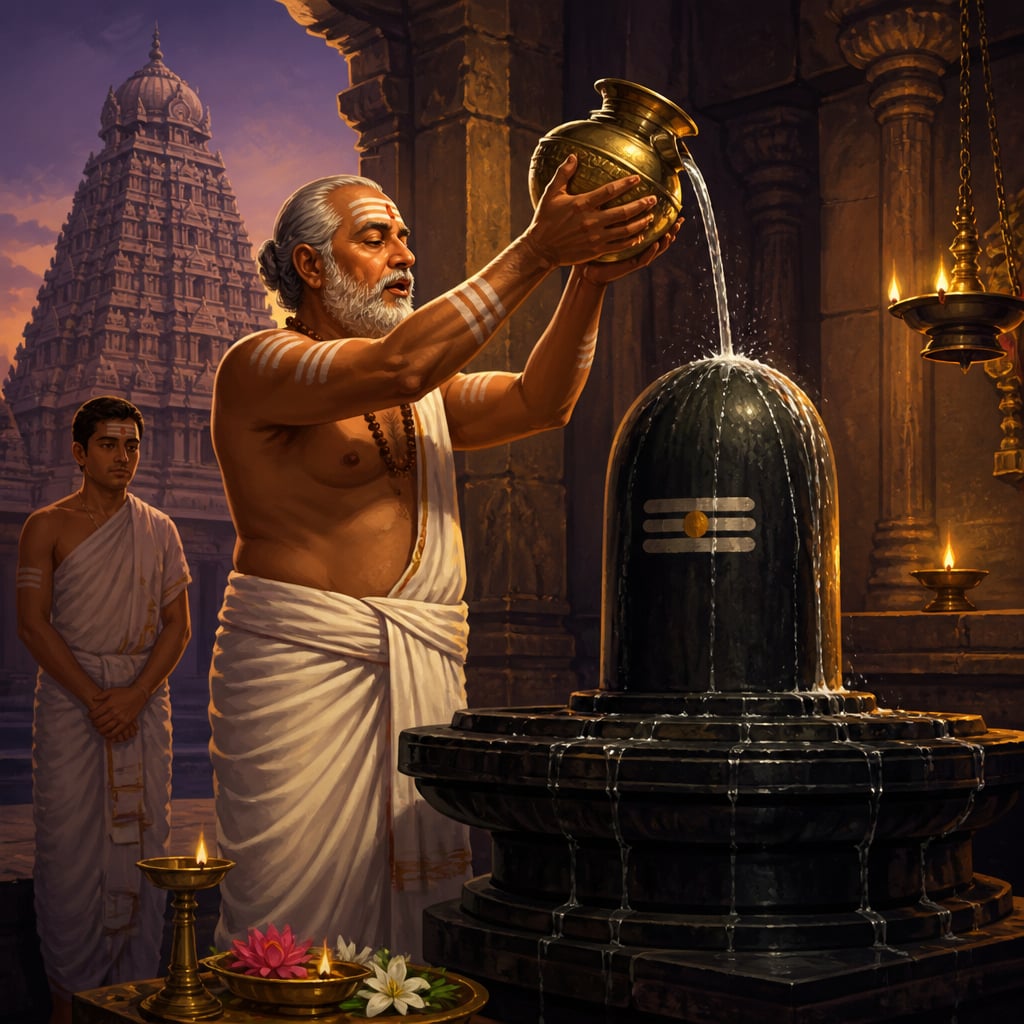
A senior priest pouring water from a brass kalasha over the linga at Brihadeeswara temple, Thanjavur

Most worshippers who come to Brihadeeswara in the morning rush do not realise what they are walking into. They are walking into one of the longest continuously running religious recitations on planet Earth.

The Architecture of the Hymn

The Shri Rudram is two halves of a single sequence. The architecture is precise, and once seen, hard to unsee.

The first half is the Namakam. The word means the namo, that is, the bowing. Every verse ends in namo namah, salutations, salutations. Across eleven anuvakas (sections), the Vedic seer addresses Rudra in every form imaginable. Salutations to the one of the bow. Salutations to the one of the arrows. Salutations to the one of the mountains, the forests, the rivers. Salutations to the merchants. Salutations to the thieves. Salutations to the dog-handlers. Salutations to the chiefs, salutations to the lowest of soldiers. Salutations to the form that heals. Salutations to the form that destroys. The Namakam refuses to leave any corner of reality outside of Rudra. Wherever the seer looks, there is another form to bow to.

The second half is the Chamakam. The word means the cha me, that is, and to me. Every verse ends in cha me, cha me, and to me, and to me. Across eleven matching anuvakas, the seer asks for what is needed. Food, and to me. Strength, and to me. A long life, and to me. Children, and to me. Cattle, and to me. Intelligence, and to me. Inner steadiness, and to me. Liberation, and to me. The Chamakam is unembarrassed about asking. It asks for the worldly and the transcendent in the same breath.

The order is the entire teaching.

नमस्ते रुद्र मन्यव उतोत इषवे नमः। नमस्ते अस्तु धन्वने बाहुभ्यामुत ते नमः॥

namaste rudra manyava utota iṣave namaḥ namaste astu dhanvane bāhubhyām uta te namaḥ

Salutations to your wrath, Rudra, and salutations to your arrow. Salutations to your bow, and salutations to your two arms.

Krishna Yajurveda, Taittiriya Samhita 4.5.1.1, opening of the Namakam

First the seer salutes the wrath. Then the arrow. Then the bow. Then the arms that hold it. Only after this naming does the asking begin. The Vedic teaching is that the deity must be seen before the deity can be addressed. To skip the seeing and go straight to the asking is to address no one in particular and hope someone is listening.

The Mahamrityunjaya at the Heart of the Rudram

Near the centre of the Namakam, embedded in the seventh anuvaka of the same Rudram tradition, sits one of the most chanted verses in any human language, the Mahamrityunjaya mantra.

त्र्यम्बकं यजामहे सुगन्धिं पुष्टिवर्धनम्। उर्वारुकमिव बन्धनान्मृत्योर्मुक्षीय मामृतात्॥

tryambakaṃ yajāmahe sugandhiṃ puṣṭi-vardhanam urvārukamiva bandhanān mṛtyor mukṣīya māmṛtāt

We worship the three-eyed one, fragrant, increaser of nourishment. As the cucumber is freed from its stem, may we be freed from death, not from immortality.

Rig Veda 7.59.12 and Krishna Yajurveda 3.60, the Mahamrityunjaya verse

The verse is older than the rest of the Rudram around it. Its image is precise. The cucumber, when ripe, falls cleanly off its stem. There is no tearing. The fruit and the stem separate when the time comes. The seer asks for that kind of dying. Not premature, not violent. A clean release at the moment of ripeness, and a movement into the immortal that follows. The verse is bound to the story of Markandeya, the boy who, at the age of sixteen, embraced the Shivalinga as Yama came for him with the noose. Shiva, the tradition says, burst from the linga and granted Markandeya immortality. Every chanted Mahamrityunjaya is a small repetition of that moment.

In modern hospital chapels and ICU waiting rooms across India, the Mahamrityunjaya is what families chant when there is nothing left to do.

The Stotra Tradition: Pushpadanta and Mahimna

The Vedic Rudram is the older root. The classical stotra tradition is the second great stream of Shaiva hymn-making, and its founding work is the Shiva Mahimna Stotram, attributed to a Gandharva named Pushpadanta.

Pushpadanta composing the Shiva Mahimna Stotram in shame at a forest shrine

The story behind the hymn is the story of a fall and a recovery. Pushpadanta was a celestial musician with the power of invisibility. He had a habit of stealing flowers from the divine garden of King Chitraratha, a great Shiva devotee, and offering them in his own worship. The thefts were undetected for a long time. Then one day, distracted, Pushpadanta walked over a patch of bilva leaves the king had laid out for Shiva. The instant his foot crossed the consecrated leaves, his powers vanished. He could no longer fly. He could no longer become invisible. He could not even leave the garden.

Humiliated, he sat down. There was nothing left to do but sing. He began to compose. The hymn that came out of him was not a list of demands. It was a long, careful naming of Shiva's mahima, his greatness. Forty-three verses, each describing one quality, one paradox, one image of the deity. He sang the unfathomable forms. He sang the ash and the trident and the matted hair. He sang the unmatchable scale of the cosmic dance. He did not ask for his powers back. He named what was in front of him.

By the time he reached the closing verses, his powers had returned. The story says Shiva himself appeared and named the hymn the Mahimna Stotra, the hymn of greatness, and gave it as a gift to the world.

महिम्नः पारं ते परमविदुषो यद्यसदृशी स्तुतिर्ब्रह्मादीनामपि तदवसन्नास्त्वयि गिरः।

mahimnaḥ pāraṃ te paramavidūṣo yad-yasadṛśī stutir brahmādīnām api tad avasannā astvayi giraḥ

If the praise of one who does not know the limits of your greatness is unfit, then even the speech of Brahma and the gods falls silent before you.

Shiva Mahimna Stotram, verse 1, by Pushpadanta

The opening of the Mahimna is itself the lesson. The seer admits he cannot fully name the deity. He sings anyway. The act of trying to name the greatness is what restores the singer.

Two Stotras, One Architecture

The Vedic Rudram and the classical Mahimna are different in age, language, and form. The Rudram is older, in chanted Vedic Sanskrit, with strict pronunciation rules. The Mahimna is later, in classical Sanskrit, in a singable poetic metre. Yet the architecture is the same.

Shri Rudram (Vedic) Shiva Mahimna Stotram (Classical)
Roughly 3000 years old Roughly 1500 years old
Krishna Yajurveda 4.5 and 4.7 Independent stotra by Pushpadanta
Chanted, strict swara rules Sung, flexible musical setting
Namakam (describes) then Chamakam (asks) First names mahima, then closes with surrender
Used for daily Rudrabhisheka Used as personal recovery and praise

Both begin by naming who Shiva is. Both make the asking, when it comes, a quiet event inside the naming, not the entire transaction. This is the architecture.

Most modern prayer reverses this. The contemporary prayer goes: please give me, please help me, please remove this, please save them. The naming step is missing. The deity is being addressed without being seen. The hymn tradition treats this as the structural reason most modern prayer feels hollow. Not because the asker is insincere. Because the architecture has been inverted.

What This Looks Like in 2025

The Sringeri acharya chanting the Shri Rudram with disciples at dawn

At the Sringeri Sharada Peetham in Karnataka and the Kanchi Kamakoti Peetham in Tamil Nadu, the senior acharya begins each morning with a recitation of the Shri Rudram. The late Sri Chandrashekhara Saraswati Mahaswami of Kanchi, who lived to a hundred, is said to have not missed a daily Rudram for over seventy years. In Karnataka, Sri Sri Ravi Shankar's Art of Living foundation runs Rudra Pooja yagnas in which thousands of priests chant the Namakam and Chamakam together, often eleven times in succession (a count called Ekadasha Rudri). At Pashupatinath in Kathmandu, the same hymn has been chanted continuously, with no break, since at least the early Licchavi inscriptions of the fifth century.

In the recording studios, the hymn has had a parallel modern life. M. S. Subbulakshmi's 1973 Shri Rudram recording for HMV, made when she was almost sixty, is still the reference recording across the south Indian Shaiva household. Subbulakshmi fasted for parts of the recording. She insisted on singing the entire Namakam and Chamakam in single takes, with no edits, because she felt the hymn would not sustain breaking. The recording continues to play in lakhs of homes every morning, fifty years later. It is, in a quiet way, the most listened-to Vedic hymn in modern history.

The psychologist B. Alan Wallace, who has written on contemplative practice and attention, describes a phenomenon he calls unembarrassed attention to the object before the asking. He arrived at this from Tibetan Buddhist sources. The architecture he describes, naming the object of devotion fully before letting any request enter, is the same architecture the Vedic seer of the Rudram laid out three thousand years earlier. Across traditions and centuries, the same finding keeps appearing. The asking, to land, must come second.

A Quiet Closing

Back in the inner chamber of Brihadeeswara, the bath has finished. The granite linga is slick with the offerings. The Chamakam is at its closing verses. The asking has been folded inside the naming. The priest will return tomorrow. He will pour the same five substances, in the same order, while chanting the same hymn that Sundaramurthy's grandfather chanted, that the priests under Rajaraja Chola chanted, that the seers of the Yajurveda first set down a thousand years before that. The bath is older than every state, every empire, every language now spoken in the country.

The lesson the hymn teaches is short, even if the hymn itself is long. The deity must be named before the deity can be addressed. Praise is not a softening of the ask. Praise is the seeing that makes the asking land.

The next lesson moves from the chanted hymn to the offered substance, the Rudrabhisheka itself, and asks what each of the five offerings means inwardly.

Living traditions

The Shri Rudram has had a quietly extraordinary modern afterlife. UNESCO recognised the tradition of Vedic chanting that carries it as a Masterpiece of the Oral and Intangible Heritage of Humanity in 2003. M. S. Subbulakshmi's 1973 HMV recording of the full Namakam and Chamakam remains the reference recording in south Indian Shaiva households fifty years after release, and is one of the most listened-to Vedic recordings in modern history. The Kanchi Shankaracharya Sri Chandrashekhara Saraswati Mahaswami, who lived to a hundred, is said never to have skipped a daily Rudram for over seventy years; his disciple network at the Kanchi Kamakoti Peetham continues the practice. Sri Sri Ravi Shankar's Art of Living foundation has hosted multiple Ati Rudra Maha Yagnas, the eleven-day form of the Rudram, drawing tens of thousands of devotees per event. Sadhguru's Isha Foundation in Coimbatore performs a continuous Rudram tradition at the Dhyanalinga and Bhairavi temples. The Mahamrityunjaya, embedded in the same Rudram lineage, has crossed into popular culture, appearing in film soundtracks, hospital chapels, and yoga studios across the world. The architecture the lesson teaches (naming first, asking second) has been independently rediscovered in modern relational psychology and management literature, including the work of B. Alan Wallace on contemplative attention and Brené Brown on the precedence of recognition over request. Across all of it, the hymn the Yajurvedic seer first set down three thousand years ago continues, every morning, in temples and homes across the world, in the same architecture, in roughly the same words, exactly the way it has always been.

Reflection

More in Shiva Sadhana: Practice

All lessons in Shiva Sadhana: Practice · Shiva Purana course