Mahamrityunjaya: The Mantra for Hard Times
Markandeya's gift to the world
The Mahamrityunjaya is a single verse from the Rig Veda, chanted in India at every moment of serious illness or danger. This lesson walks the verse word by word, traces its Vedic source in Mandala 7, and shows how the mantra has been used from the ancient battlefield to the modern hospital corridor.
The Boy Clutching the Linga
The ashram of the sage Mrikandu, somewhere in the forests south of the Vindhyas, on a morning the boy had known was coming his entire life. Markandeya, sixteen years old, sat on the floor of his father's prayer hall with both arms wrapped around the small linga of grey stone his father had taught him to worship. His eyes were closed. His lips were moving. He was reciting one verse from the Rig Veda, repeated again and again, the verse his father had given him when he was six years old, the only thing he had been told would help.
Outside the ashram, the air went cold. The trees stopped moving. Mrikandu, sitting some distance away, looked up. A figure on a black buffalo was riding through the gate. The figure carried a noose of dark rope. His skin was the colour of storm clouds. He was Yama, the god of death, and he had come for the boy.
Yama had no choice. The boy had been granted only sixteen years of life by the writ of his own birth, a boon that had come with a fixed end. The day was today. The hour was now. Yama rode up to the prayer hall, swung his noose, and threw it around the boy and the linga together.
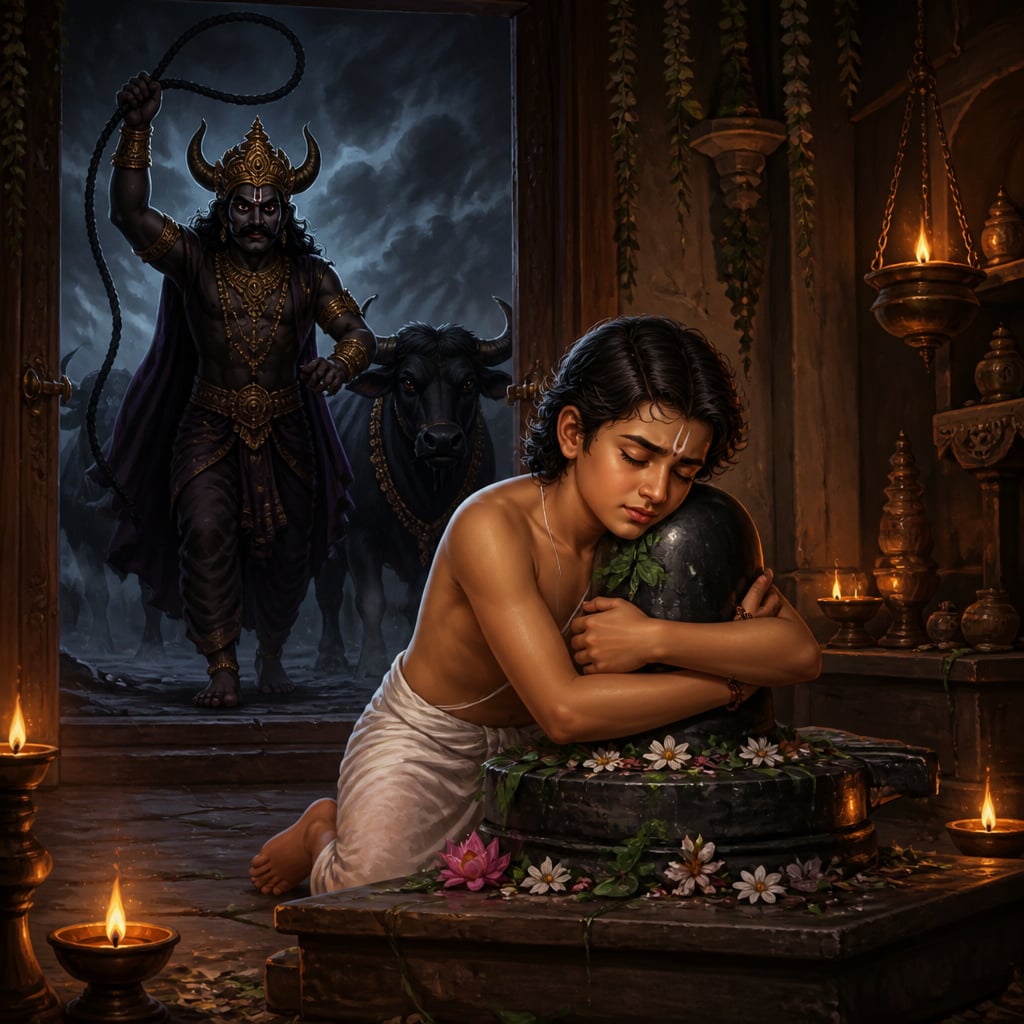
What happened next is the origin of the mantra this lesson is about. The mantra in Markandeya's mouth, repeating over and over, was the Mahamrityunjaya. The verse a sixteen-year-old boy was reciting at the moment a god came to kill him. What follows is the architecture of that verse, how to use it, and why three thousand years later it is still the first mantra a Hindu mother teaches a child going into surgery.
A Rig Vedic Verse Older Than the Story
The Mahamrityunjaya is not, strictly speaking, a Shiva Purana mantra. The verse is far older than the Purana that frames it. It comes from the Rig Veda, Mandala 7, sukta 59, verse 12, attributed to the rishi Vasishtha, one of the seven Saptarshis. By traditional reckoning, the verse is at least three thousand years old. By academic dating, it is between 1500 and 1200 BCE. It is one of the oldest surviving Sanskrit healing verses we have.
The Shiva Purana picks up the verse in its Kotirudra Samhita and gives it its frame. The frame is the Markandeya story. The frame names the verse Mahamrityunjaya, the great conqueror of death. The frame instructs the devotee on when to chant it, how to count it, and what the inner posture must be. The Vedic verse is the bone. The Puranic frame is the muscle.
Here is the verse, in its full form, exactly as a temple priest in Varanasi would chant it this morning.
ॐ त्र्यम्बकं यजामहे सुगन्धिं पुष्टिवर्धनम्। उर्वारुकमिव बन्धनान्मृत्योर्मुक्षीय मामृतात्॥
oṃ tryambakaṃ yajāmahe sugandhiṃ puṣṭi-vardhanam urvārukam iva bandhanān mṛtyor mukṣīya mā'mṛtāt
We worship the three-eyed one, the fragrant, the increaser of nourishment. Like the cucumber from its stalk, may we be released from death, but not from immortality.
Rig Veda, Mandala 7.59.12
Seven phrases. Less than thirty syllables. The most-recited Shiva mantra in the world.
The Architecture of the Verse
The verse has a precise inner architecture. Walk through it one phrase at a time and the lesson unfolds.
- Tryambakam literally means the three-eyed one. The third eye on Shiva's forehead is the eye that sees what the two physical eyes cannot, the inner eye, the eye of awareness. To call the lord by this name is to ask awareness itself to attend.
- Yajāmahe is we worship. Plural, not singular. The verse is composed in the voice of a community, even when chanted by one person. The chanter is never alone.
- Sugandhim is the fragrant. The Vedic image is of a divine presence sensed before seen, the way the air changes around a temple before you arrive at the door.
- Pushti-vardhanam is the increaser of nourishment. Pushti is the Sanskrit word for the felt sense of being well-fed, well-rested, well-loved. The lord is not asked to remove the difficulty. The lord is asked to increase the inner fund the chanter draws from while the difficulty is being met.
- Urvārukam iva bandhanāt is the verse's heart. Like the cucumber from its stalk. The Vedic image is precise. A ripe urvāruka, a long cucumber, when fully ripe, falls from its stalk on its own, with one small twist of the stem. Unripe, it has to be cut. Ripe, it lets go. The verse is not asking for escape from death. The verse is asking for ripeness, so that when death comes, it comes as a clean release, not as a tear.
- Mrityor mukshīya is may we be released from death.
- Mā amritāt is not from immortality. The closing phrase is the one most readers miss. The chanter is asking to be released from death, but not from the immortality that lies beyond it. The release the verse asks for is not annihilation. It is graduation.
The whole verse, read as one breath, is therefore a request for ripeness. Increase what is inside me. Let what holds me to the stalk loosen when the time is ripe. Let me fall cleanly. Let me not be cut.
What the Boy Was Asking
Return to the prayer hall. Markandeya's father had given him this verse when the boy was six. Mrikandu had been told, by the lord himself in an earlier vision, that any son he had would be either short-lived and brilliant or long-lived and dull. Mrikandu had chosen brilliant. He had been given Markandeya. He had been given sixteen years.
When Markandeya turned six, his father told him the truth. Not all of it, but enough. You will face something at sixteen. When you do, hold the linga and recite this verse. Do not stop reciting until I tell you to stop. For ten years the boy practised the verse. By the time Yama's noose came, the verse was not in the boy's mind. The verse was in the boy's breath. He was not chanting. He was being chanted.

The Shiva Purana is precise about what happened next. Yama's noose fell around the linga and the boy together. Shiva burst from the linga. The Purana describes the lord emerging from the stone in his Mahakala form, the destroyer of time itself, and kicking Yama from his buffalo with one foot. Yama fell. The noose dissolved. Shiva turned to the boy.
The Purana records the verse Shiva spoke to Markandeya:
चिरञ्जीवी भव वत्स अष्टावर्षाख्यं तव। चिरायुष्ट्वं ददामि अहं मम भक्तस्य ते सदा॥
cirañjīvī bhava vatsa aṣṭāvarṣākhyaṃ tava cirāyuṣṭvaṃ dadāmi ahaṃ mama bhaktasya te sadā
Live long, child. Eight times the years you have already lived. To my devotees I give this always.
Shiva Mahapurana, Kotirudra Samhita
The boy was sixteen. Eight times sixteen is one hundred and twenty-eight. The Purana adds that Markandeya then lived not just a long life but a deathless one, becoming one of the chiranjivis, the immortals who walk the earth in every age. The mantra he had been reciting at the moment of the kick became, from that day, the Mahamrityunjaya.
When to Chant
The Shaiva tradition gives precise instructions for when the Mahamrityunjaya is to be used. The list is not abstract. It is a list a grandmother teaches a granddaughter the night before a hospital admission.
- Before any surgery or medical procedure, by the patient and by the family in the waiting room.
- During an illness that has not yet turned, especially when the diagnosis is uncertain.
- In the days following an accident, for the recovery of one who has been hurt.
- For a friend or family member in danger, even at distance, the mantra carries.
- At sleeplessness, when fear of something unnamed is keeping the chanter awake.
- Before any high-stakes moment, an exam, a court appearance, a difficult conversation, a long flight.
- Daily, in the morning, as a maintenance dose, particularly during periods of high stress.
The mantra is counted on a rudraksha mala of one hundred and eight beads. One full mala is one round. The traditional minimum for a recovery is one mala a day for forty days. The traditional intensive practice, the Mahamrityunjaya purascharana, is a hundred and twenty-five thousand recitations over a defined period, performed by or for someone in a critical condition. The intensive is rare and is performed by initiated priests. The daily practice is for everyone.
There is no fee for the daily practice. There is no qualification needed. The mantra is in the public domain. It has been in the public domain for three thousand years.
What Happens Inside the Body
Sara Lazar, a neuroscientist at Harvard Medical School, ran a series of MRI studies through the 2000s on long-term meditators and mantra reciters. Her 2005 paper in NeuroReport found that regular mantra recitation thickened specific regions of the prefrontal cortex and the right anterior insula, the regions of the brain associated with attention and interoception, the inner sense of the body. The thickening was visible in subjects who had been reciting for as little as forty days. Lazar's finding was that mantra is not a placebo. Mantra is a structural neurological intervention.
Herbert Benson, a cardiologist at Harvard who founded the Mind/Body Medical Institute in 1988, had documented something similar two decades earlier. Benson called it the relaxation response. He found that any short, repeated phrase, recited silently with the breath for ten to twenty minutes, lowered blood pressure, slowed heart rate, reduced cortisol, and produced a state Benson called measurable physiological calm. Benson was professionally cautious about which traditions he cited. He noted in his 1975 book The Relaxation Response that the Hindu Mahamrityunjaya, the Christian Jesus Prayer, and the Tibetan Om Mani Padme Hum all produced the same measurable effect.
The Shiva Purana would not have been surprised by either finding. The Purana names the inner posture the mantra produces with the word pushti, the felt sense of being well. Lazar measured pushti as cortical thickening. Benson measured pushti as the relaxation response. The mantra has not changed in three thousand years. The instruments have.
Modern Echoes

When oncologists at the Tata Memorial Hospital in Mumbai surveyed cancer patients in 2018, they found that 70 percent of patients undergoing chemotherapy reported daily Mahamrityunjaya recitation as part of their coping. The number was higher than any single counselling intervention the hospital offered. The 2018 survey was published in the Indian Journal of Palliative Care and is now cited in Indian medical-school curricula on doctor-patient communication. The mantra arrived in the wards before the hospital did.
In the 2020 lockdown, Indian streaming platforms reported that the Mahamrityunjaya was the single most-played Sanskrit chant in the country, with over two billion plays across the year. The chant rose during the second wave in April and May of 2021. People with no Sanskrit training, in apartments where no one had ever performed a yajna, played the mantra on loop while a relative was on a ventilator three cities away.
A boy was holding a stone in a forest somewhere south of the Vindhyas. He was reciting one verse. The mantra has not stopped travelling since.
Living traditions
The Mahamrityunjaya is, by streaming-platform play counts, the single most-played Sanskrit chant in the world. The 2020 lockdown saw over two billion plays of the chant on Indian streaming platforms in a single year, and the count rose during the second wave of April and May 2021. The 2018 Tata Memorial Hospital survey, published in the Indian Journal of Palliative Care, found that 70 percent of cancer patients undergoing chemotherapy reported daily Mahamrityunjaya recitation as part of their coping, a number higher than any single counselling intervention the hospital offered. The 2005 MRI work of Sara Lazar at Harvard Medical School demonstrated that regular mantra recitation thickens specific regions of the prefrontal cortex within forty days, confirming the Shaiva tradition's traditional window for the daily mala. The cardiologist Herbert Benson, in his 1975 book The Relaxation Response, documented the same effect in physiological terms: blood pressure drops, heart rate slows, cortisol falls. Indian medical schools at AIIMS Delhi and at the JIPMER campus in Pondicherry now include a unit on mantra-assisted coping in their doctor-patient communication curricula. The Mrityunjay Mahadev temple in Varanasi has been performing continuous Mahamrityunjaya japa, sustained twenty-four hours a day, for at least three centuries by uninterrupted oral testimony. The verse the boy was reciting in his father's ashram has not stopped travelling since.
- Daily Mahamrityunjaya Japa: The household practice of one mala of the Mahamrityunjaya each morning, counted on a rudraksha mala of 108 beads. Performed by the family member herself when well, or on her behalf by a relative or temple priest when she is unable. The traditional minimum for a recovery is one mala daily for forty days. The traditional intensive, performed at the bedside of someone in critical condition, is the Mahamrityunjaya purascharana, 1,25,000 recitations distributed across forty days, usually performed by an initiated priest or by a coordinated family rota.
- Mahamrityunjaya Homa on Pradosham: The fortnightly fire ritual, performed on each Pradosham (the thirteenth lunar day, occurring twice a month), in which the Mahamrityunjaya is offered into the fire 108 times by the priest, with each repetition followed by an offering of ghee, bilva leaves, or sesame seeds. The homa is performed for an individual under threat of illness or accident, or as a general protection ritual for the household. The Shaiva tradition holds that the fire carries the mantra in a way the voice alone cannot, since the fire is the original yajna intermediary between the chanter and the deity.
- Mrityunjay Mahadev Temple: The canonical Mahamrityunjaya temple, located in the Daranagar locality of the old city of Varanasi, about a kilometre west of the Vishwanath corridor. The central linga is identified by tradition as one of those worshipped by Markandeya himself. The temple has a sacred well in its courtyard, the Dhanvantari Kupa, said to contain water from all the rivers of India and to have healing properties. Devotees perform abhisheka with this water, recite 108 Mahamrityunjayas, and tie a thread around a column in the inner sanctum as a vow during a family illness. The temple runs a continuous japa, twenty-four hours a day, sustained by rotating teams of priests. Patients from across India travel here at the start of major treatments, and the tradition is to return at the end of the treatment, whatever its outcome.
- Markandey Mahadev Temple at Kaithi: The site identified by tradition as the spot of Markandeya's tapas, where the boy held the linga while Yama arrived. Located at the confluence of the Ganga and the Gomati, about thirty kilometres east of Varanasi. The temple sits on a high bank above the sangam. The central linga is small, ancient, and is said to be the original linga the boy embraced. The temple is the site of the annual Markandeya Jayanti, drawing tens of thousands of pilgrims each Vaishakha Shukla Saptami. A bathing ghat below the temple is used by devotees performing ritual abhisheka with sangam water before the darshan. The Kartika Purnima fair held here each November is one of the largest in eastern Uttar Pradesh.
Reflection
- What situation in your life has run out of strategies, and what would change if you treated the recitation of the Mahamrityunjaya as the action rather than as the consolation while you wait for the next strategy?
- Why does the Mahamrityunjaya close with mā amritāt, not from immortality, and what does this closing teach about the difference between escaping death and ripening for it?
- What is the Shaiva theology that holds that a single repeated verse can produce both psychological calm and a structural change in the chanter, and how does this differ from a tradition that treats prayer purely as petition?