Shivaratri and Pradosham: Why Night, Why Twilight, Why Monday
The Shaiva calendar in practice
A hunter named Chitrabhanu, lost in the forest on a moonless night, climbs a bilva tree and stays awake till dawn. He does not know it is Shivaratri. Leaves fall on the Linga below. The lesson uses his story to explain why Shivaratri is observed at night, why Pradosham falls at twilight, and why Monday belongs to Shiva.
The Hunter on the Bilva Tree
On the fourteenth night of the dark fortnight of the lunar month of Phalguna, sometime in the early Puranic period, a Shabara hunter named Chitrabhanu had wandered too far into the forest along the banks of the Narmada. He had killed nothing all day. The sun had set. He had not eaten. He had not drunk water. He had a wife and small children waiting in the village, and his arrows in the quiver had not been loosed.
A tiger appeared on the path. The hunter dropped his bow and climbed the nearest tree. The tree was a bilva, the three-leafed tree the Shaiva tradition holds as Shiva's own. The tiger settled at the foot of the tree and waited. The hunter, perched on a low branch, knew that the moment he closed his eyes the tiger would have him. To stay awake, he began doing the only thing his hands could do in the dark. He plucked bilva leaves, one by one, and dropped them.
Below him, hidden under a thick layer of fallen leaves and forest earth, stood a small Shiva linga that the hunter could not see and did not know existed. Each leaf the hunter dropped, all night, fell on the linga. He did not bathe before the act. He did not chant any mantra. He did not know what he was doing.
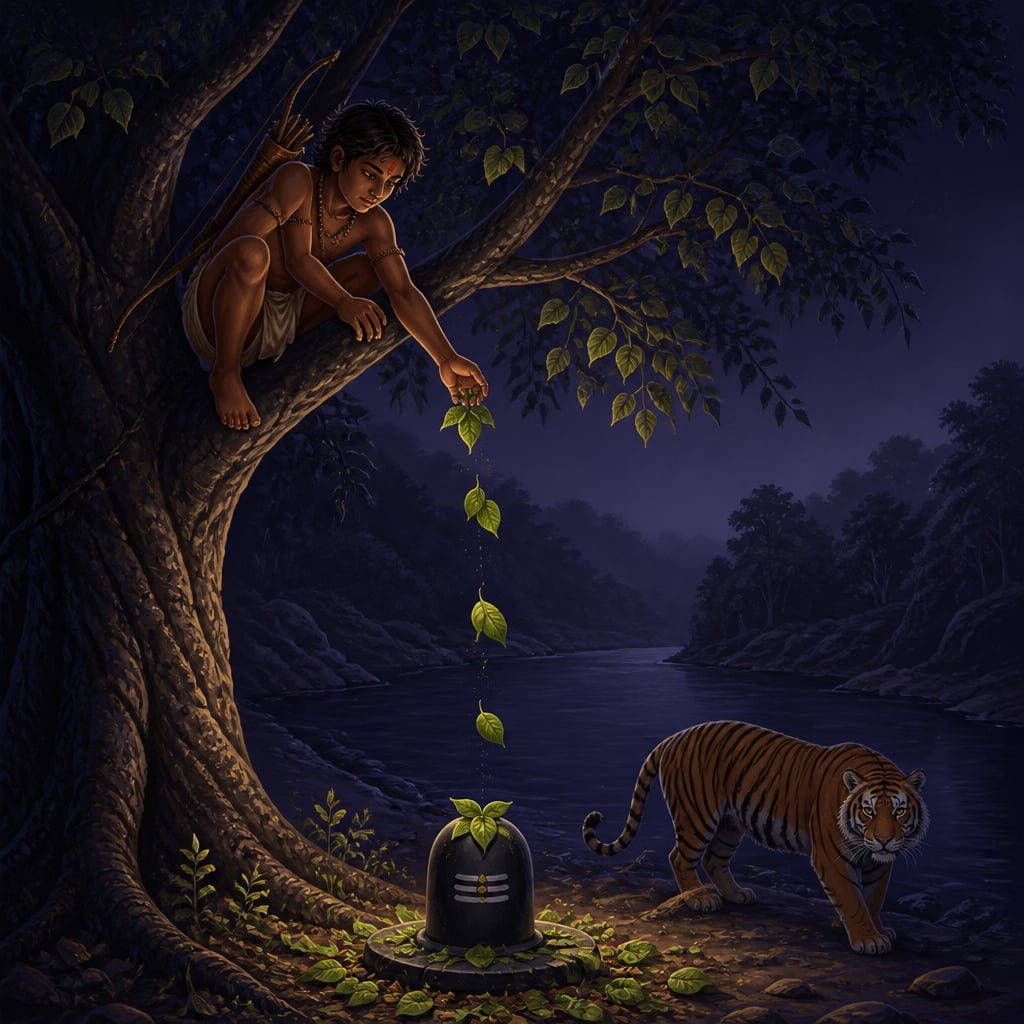
By dawn, the tiger had left. The hunter climbed down. The Shiva Purana, in the Vidyeshwara Samhita, records the next moment with great care. Shiva himself appeared at the foot of the tree, embraced the man, and said the unbroken vigil that had begun in fear and ended in dawn was the most complete Shivaratri vrata anyone had performed. Chitrabhanu was given moksha on the spot. The night he had spent on the bilva branch became the canonical origin of the Shivaratri vow that, two thousand years later, several hundred million Hindus across the world will keep this very year.
This lesson is the answer to a question the story raises but does not state. Why does the Shaiva tradition choose this night, twice-a-month twilight, and Monday as the times when sadhana lands deepest. The story is not random. The hour is not random. What follows is the architecture of the Shaiva calendar.
Why the Night: Shivaratri
Shivaratri literally means the night of Shiva. It is the single most important Shaiva observance of the year. The full canonical name is Maha Shivaratri, the Great Night of Shiva, and it falls on the fourteenth night of the dark fortnight of Phalguna, in late February or early March in the Gregorian calendar.
The Shaiva tradition gives several layered reasons for the choice of this night.
The first is the Chitrabhanu story above. The fourteenth night of Phalguna is the night the hunter kept vigil. The vrata is the cosmic anniversary of his unintentional sadhana.
The second is the cosmological account in the Linga Purana and the Shiva Purana itself. On this night, at the close of the cosmic dissolution and the beginning of a new cycle, Shiva is said to have danced the Tandava that destroys and re-creates the universe. The night is the cosmos's own moment of pause between cycles. Sitting up through this night is, in the tradition's idiom, sitting up through the cosmos's most charged transition.
The third is the bridal account from the Shiva Purana's Rudra Samhita. On this night, Shiva and Parvati were married. The vigil is the wedding feast that the cosmos holds annually for the union of the masculine and feminine principles of reality.
Three accounts, one night. The Shaiva tradition is comfortable holding all three at once, the way it holds Nataraja and Dakshinamurti and Bhairava as the same one Shiva. The night is the convergence of cosmic dissolution, sacred marriage, and a hunter's accidental sadhana. The vrata observes all three together.
The Architecture of the Vrata
The Shivaratri vrata has four traditional limbs:
- Upavasa (the daylong fast). Most observers fast from sunrise of the fourteenth tithi until the next morning, taking only water or fruit. The fast is not penance. It is the body's way of clearing the space the night will be filled with.
- Jagarana (the all-night vigil). The vrata is, above all, the night-vigil. The body stays awake through all four three-hour watches, called praharas, of the night.
- Abhisheka in the four praharas. At each prahara, a different abhisheka is performed on the linga: milk in the first, curd in the second, ghee in the third, honey in the fourth. The Shivaratri puja is, structurally, four pujas spaced through one night.
- Mantra and bilva. Through the night, the Panchakshari Om Namah Shivaya is repeated, and bilva leaves are offered to the linga. The hunter's accident becomes the householder's intention.
The Shaiva tradition is precise about why night. The day belongs to the bright gods, to action, to the householder's external duties. The night belongs to Shiva, who sits at the cremation ground at the edge of the village, and to the inner work that can only be done when the village's outer work is asleep. The night is the time the village's busiest minds have no choice but to sit still. The vrata uses that stillness.
Why the Twilight: Pradosham
Pradosham is the twilight observance kept twice each lunar month, on the thirteenth tithi of both the bright and dark fortnights. The window is the ninety minutes that span sunset, traditionally calculated as the forty-five minutes before sunset and the forty-five minutes after.
The word itself means the moment of gathering twilight, from pra (forward, intensified) and dosha (the meeting of evening). The hour is the moment the day ends and the night has not yet begun. The Shaiva tradition holds this hour as Shiva's most accessible window.
The canonical Pradosham story comes from the Shiva Purana's Kotirudra Samhita. After the Samudra Manthana, the churning of the cosmic ocean, the deadliest poison of the cosmos, Halahala, rose to the surface and threatened to destroy all creation. The devas and asuras stood paralysed. Shiva drank the poison and held it in his throat, which turned blue (giving him the name Nilakantha, the Blue-Throated One). The cosmos was saved.

The gods, watching this, were so overcome that they began to dance and chant in joy. The hour at which the gods danced was the twilight hour. Shiva, recovered, danced with them, between the two horns of Nandi the bull. That dance is the canonical Pradosham. The twilight hour is the cosmos's annual remembrance of the moment Shiva drank the poison the cosmos could not hold.
The lesson the tradition draws is structural. Pradosham is the hour of transitions. Day to night, light to dark, breath in to breath out. The Shaiva tradition holds that consciousness is most pliable in the gap between two states, and that Shiva, who himself sits in the gap between manifestation and dissolution, is most reachable in the gap between day and night. Pradosham is the householder's twice-monthly rehearsal of that gap.
The Architecture of Pradosham
The Pradosham vrata is much shorter than Shivaratri and built for the working householder.
- A light fast through the day, broken at the start of the Pradosham window.
- A bath before the window opens.
- Either a temple visit during the ninety-minute window, with abhisheka of the linga and circumambulation of Nandi, or a home worship with bilva leaves, lamp-lighting, and the Mahamrityunjaya mantra.
- The vrata closes when the window closes.
The two monthly Pradoshams are sometimes named for additional auspiciousness when they fall on specific weekdays. Soma Pradosham falls on a Monday and is held to relieve mental afflictions. Bhauma Pradosham falls on a Tuesday and is held to relieve debt. Shani Pradosham falls on a Saturday and is held to relieve the Saturn-related afflictions of the seven-and-a-half-year Sade Sati cycle. The tradition has matched specific Pradoshams to specific kinds of human burdens with characteristic Shaiva precision.
Why the Monday: Shravan Somvar
Somvar is the Sanskrit name for Monday. The literal meaning is the day of Soma, the moon. The moon is on Shiva's matted hair as a crescent in the canonical iconography, and the day named for the moon has been Shiva's day across the entire Shaiva calendar.
Most devout Shaivas keep some form of Monday observance through the year. The lightest form is a vegetarian diet on Mondays. A heavier form is a Monday fast broken at sunset. The heaviest is a temple abhisheka on Monday morning. The Shaiva calendar has Monday as the weekly equivalent of what Pradosham is for the fortnight and what Shivaratri is for the year.
The most intense form of Monday observance is Shravan Somvar, the Mondays of the lunar month of Shravan, July or August in the Gregorian calendar. Shravan is the most auspicious Shaiva month of the year, and its four or five Mondays are kept as a continuous progressive vow. Each Monday escalates the offerings. The first Monday is white (milk and rice), the second is yellow (turmeric), the third is red (kumkum and roli), the fourth is mixed (panchamrita).

Shravan is also the month of the Kanwar Yatra, in which several million pilgrims walk barefoot from the Ganga to their hometown Shiva temples carrying water in kanwars, ornate decorated pots suspended from a bamboo pole. The water is poured as abhisheka on the linga at the home temple on the chosen Monday. The Kanwar Yatra is, in 2026, one of the largest annual religious gatherings in the world by participant count, exceeding even the Hajj in raw numbers though smaller in concentration.
The deeper reason for Monday is cosmological. The moon governs the inner world of the body, the manas (mind-stuff), and the tides of mood. Shiva, holding the crescent on his head, is the lord of that inner world. Monday is the day on which the ordinary householder is most explicitly invited to do the inner work. The week has six other days for the outer.
The Calendar as Sadhana
If you put the three together, the Shaiva calendar of practice has a precise architecture.
| Frequency | Observance | Window | Function |
|---|---|---|---|
| Annual | Maha Shivaratri | One full night, fourteenth of dark Phalguna | Cosmic transition, sacred marriage, hunter's vigil |
| Fortnightly | Pradosham | Ninety minutes around sunset, thirteenth tithi | The hour of the gap between states |
| Weekly | Somvar | All Monday | The day of the moon, the inner world |
| Monthly intensified | Shravan Somvar | All Mondays of Shravan | The progressive monsoon vow |
The pattern is concentric. The week contains the day. The fortnight contains the week. The year contains the fortnight. The householder who keeps any one of these has begun the calendar. The householder who keeps all four has the full Shaiva year.
The Shaiva tradition's argument is that sadhana is not flat in time. Some hours hold the practice better than others. Some nights hold it best of all. The tradition has, over many centuries, mapped which hours those are, and the map is the calendar. The map is not a superstition. It is the tradition's accumulated empirical claim, tested across many generations of practitioners, that the inner work lands more cleanly in some windows than in others. The householder who works with the calendar is using the map.
The modern Shaiva calendar app, of which there are now many in the Indian app stores, is a 21st-century interface to a 12th-century insight. The Shaiva tradition was the first major Indian tradition to systematise sadhana as a function of time. The modern interface is the latest layer, not the substance.
Modern Echoes
The insight that consciousness is more pliable at certain hours has been independently verified by 21st-century chronobiology. The 2017 Nobel Prize in Physiology or Medicine went to Jeffrey Hall, Michael Rosbash, and Michael Young for the discovery of the molecular mechanisms controlling the circadian clock. The same body of research has shown that the windows around sunrise and sunset, the so-called transitional windows, are when the brain's default mode network is most accessible to consciously-directed attention. The Shaiva tradition's choice of Pradosham as the twilight window for sadhana is, in the language of modern neuroscience, a choice of the moment when the brain's narrative-self is most pliable.
The research on all-night vigils is more sparse, but the work of Matthew Walker at UC Berkeley, published in Why We Sleep (2017), shows that the dawn after a sleepless night produces measurable changes in the prefrontal cortex's processing of emotional memory, with both risks and unique opportunities. The Shaiva tradition's framing of the Shivaratri vigil as a moment when the inner work lands deeper than usual is consistent with what is now beginning to be measured. The vigil is not magic. It is, among other things, a deliberate use of the dawn-after-vigil state for inner work.
The Monday observance has its own independent echo. A 2023 paper in the Journal of Behavioral Medicine showed that adherents of weekly fasting and reflection rituals across multiple traditions, when controlled for other variables, showed measurably lower markers of inflammation and chronic stress over a five-year period. The week is the unit of stress accumulation. The weekly observance, on whichever day, is the unit of stress release. The Shaiva tradition put that observance on Monday, the start of the working week, deliberately. The week is set up by the day's practice, not closed by it.
Back on the bilva branch above the Narmada, the hunter does not know that the leaves he is dropping in fear are landing on a hidden linga. He does not know that the night will be remembered by hundreds of millions of his descendants for two thousand years. He only knows that the tiger is waiting and that the leaves are within his reach. By dawn, the tiger has left. The leaves have done their work. The night has done its work. The calendar that begins from this night is, in 2026, still keeping its appointments with the householder who learns to keep its hours.
Historical context
The Shivaratri, Pradosham, and Somvar observances reach their canonical form in the Vidyeshwara and Kotirudra Samhitas of the Shiva Purana (5th to 10th century CE) and are systematised by the Saiva Siddhanta agama tradition between the 11th and 13th centuries.
The Shaiva calendar of practice was systematised across the Indian subcontinent during the period of greatest Shaiva institutional vitality (8th to 13th century CE), under the patronage of the Cholas in the South, the Chalukyas in the Deccan, the Karkota and later Lohara dynasties in Kashmir, and the Lichchhavi and Malla dynasties in Nepal. The Maha Shivaratri vigil, the Pradosham twilight observance, and the Shravan Somvar vrata received their canonical literary form in the Vidyeshwara and Kotirudra Samhitas of the Shiva Purana, with the Pradosham mapping to specific weekdays for specific human burdens added by the Saiva Siddhanta acharyas in the 12th and 13th centuries. The Lingayat reform of the 12th century under Basavanna and the Tamil Nayanmar movement under Sambandar, Appar, and Sundarar made the calendar's observances available to the entire householder population, not merely to temple priests, and embedded them in the village's daily and weekly rhythm. Subsequent Vijayanagara, Nayaka, and Maratha rulers preserved the institutional infrastructure, and the modern Tamil Nadu HR&CE Department, the Maharashtra Devasthan Department, and the Pashupati Area Development Trust now administer the major Shaiva temples on whose calendars the householder's annual cycle still hangs.
Living traditions
The Shaiva calendar of practice is, in 2026, more institutionally alive than at any point in the modern era. The Maha Shivaratri vigil draws several hundred million observers across the world each year, with the 2024 observance at Pashupatinath alone registering over 1.2 million pilgrims, the highest in the temple's recorded history. The Kanwar Yatra of Shravan has grown from roughly 5 million participants in the 1990s to an estimated 35 million in 2024, making it one of the largest annual religious gatherings in the world by raw participant count. The Pradosham observance has been organised across South India by the Tamil Nadu HR&CE Department's Pradosham Calendar publication, distributed annually to every government-administered Shaiva temple. Modern Shaiva calendar applications, of which there are now several dozen in the Indian app stores, have made the precise tithi calculations, sunset times for Pradosham, and Shravan Somvar dates universally available, with Drik Panchang's app alone reporting over 50 million downloads as of 2024. The Saiva Siddhanta Maha Samajam at Tiruchirapalli has run an annual Shivaratri Sadhana Camp since 1998 that draws roughly five thousand young Tamil Shaivas each year for a three-day immersion in the night-vigil tradition. The 12th-century calendar that the Shaiva tradition systematised at Chidambaram and Pashupatinath is, in 2026, walked, kept, and timed by more devotees than at any prior moment, which is perhaps the longest commentary the tradition has ever offered on the empirical soundness of the times it chose.
- The Pradosham Abhisheka and Nandi Pradakshina: The twice-monthly temple observance kept at every major Shaiva temple in India and across the diaspora on the thirteenth tithi of both the bright and dark fortnights. The priests perform a special abhisheka on the linga during the ninety-minute window around sunset, with milk, curd, ghee, honey, and water in succession, accompanied by the recitation of the Pradosha Mahatmya from the Kotirudra Samhita and the Pradosham anchor verse. The lay devotee performs three slow circumambulations not around the main sanctum but around the Nandi statue, in deliberate acknowledgement of Nandi as the witness between whose horns Shiva is held to be dancing at that very hour. The practice is taught informally from grandparents to grandchildren and is alive in households across South India, Maharashtra, Gujarat, and the Indian diaspora.
- Maha Shivaratri Jagarana: The annual all-night vigil kept across India on the fourteenth night of the dark fortnight of Phalguna. The traditional practice has four limbs: a daylong fast on water and fruit only (upavasa), the all-night vigil itself (jagarana), the four-prahara abhisheka with milk, curd, ghee, and honey in succession, and continuous Panchakshari mantra repetition with bilva-leaf offering. Major temples remain open through the entire night and conduct hourly aarti, with the Lingodbhava Murti (the form of Shiva emerging from the cosmic linga of light) revealed at midnight in the South Indian agamic tradition. Several hundred million Hindus across the world keep some form of the vigil each year, ranging from a temple visit at midnight to the full four-prahara observance.
- Shravan Somvar Vrata: The progressive Monday vow kept through the four or five Mondays of the lunar month of Shravan (July or August), with each successive Monday escalating the offerings on the linga. The first Somvar uses white offerings (milk, rice, jasmine), the second uses yellow (turmeric, marigolds), the third uses red (kumkum, hibiscus, roli), and the fourth or fifth combines all into the panchamrita (milk, curd, ghee, honey, sugar). Most observers keep a complete fast on each Shravan Monday, broken only at sunset after the home or temple abhisheka. The vrata is one of the most widely observed Hindu vows in the modern era, kept by tens of millions of householders across India each year, and is especially dear to women, who often take it for the longevity and well-being of their families.
- Pashupatinath Temple: The largest active Shiva temple complex in the Indian subcontinent and the canonical destination of the Maha Shivaratri pilgrimage in the Himalayan and North Indian Shaiva tradition. The temple sits on the banks of the Bagmati river and houses a unique four-faced (chaturmukha) Shiva linga in its main sanctum, said to be one of the most powerful Shaiva manifestations in the subcontinent. The Pashupatinath complex includes hundreds of smaller shrines, ghats for cremation, and the Aryaghat where the Maha Shivaratri rituals climax at midnight. The temple is a UNESCO World Heritage Site since 1979 and is administered jointly by Indian and Nepali Brahmin priests in a tradition that goes back at least to the time of Adi Shankaracharya.
- Marundeeswarar Temple, Tiruvanmiyur: One of the largest urban Shaiva temples in India and a canonical site for the Pradosham observance in modern South Indian Shaiva life. The temple is dedicated to Shiva as Marundeeswarar, the Healer Lord, and draws several thousand devotees on every Pradosham evening for the sunset abhisheka. The temple's Pradosham pradakshina around Nandi is performed in dense formal lines, and the temple priests conduct the abhisheka and Pradosha Mahatmya recitation in continuous rotation through the ninety-minute window. The temple is a 7th-century foundation expanded by the Cholas and refurbished extensively in the 16th and 17th centuries.
Reflection
- Which hour of your own day or week is currently your highest-leverage window for inner work, and how much of that window is presently being used for it?
- Why does the Shiva Purana name a hunter who did not know he was performing the vrata as the canonical first observer of Shivaratri?
- What does it mean about the dharmic worldview that consciousness is held to be more pliable at the seams between two states than in the middle of either state?