Bilva, Bhasma, Rudraksha, and the Ishta-Linga

Sacred objects and Basavanna's Lingayat reform

The Shaiva tradition has three physical markers: the bilva leaf, the ash of bhasma, and the rudraksha bead. This lesson reads what each one actually is and why the tradition chose it. It closes with the Lingayat practice of wearing a personal Ishta-Linga, the most intimate form of Shaiva sadhana.

A Linga in a Cloth Knot

In a stone-paved courtyard in the city of Kalyana, in the kingdom of the western Chalukya king Bijjala II, sometime around the year 1160, a treasury minister named Basavanna stops in front of an old temple guard who has just been turned away at the threshold. The guard is a leather-worker. The priest at the door will not let him cross. The guard stands with his palms together, his head down, his sandals already left at the gate. The smell of camphor drifts out from the inner sanctum. A bell rings in the morning service. The guard is not invited to its sound.

Basavanna is in his late thirties. He is the Bhandari, the chief treasurer, of the kingdom. He could, with one word, force the priest to let the guard in. He does not. Instead he reaches to his own neck. Tied there, in a small square of clean cloth, is a linga the size of a small fruit. He has been carrying it under his clothing since his early twenties. He unties the knot. He takes the linga out. And he places it in the leather-worker's hands.

"This is your temple now," he says, in the Kannada the city speaks. "You will not need any other."
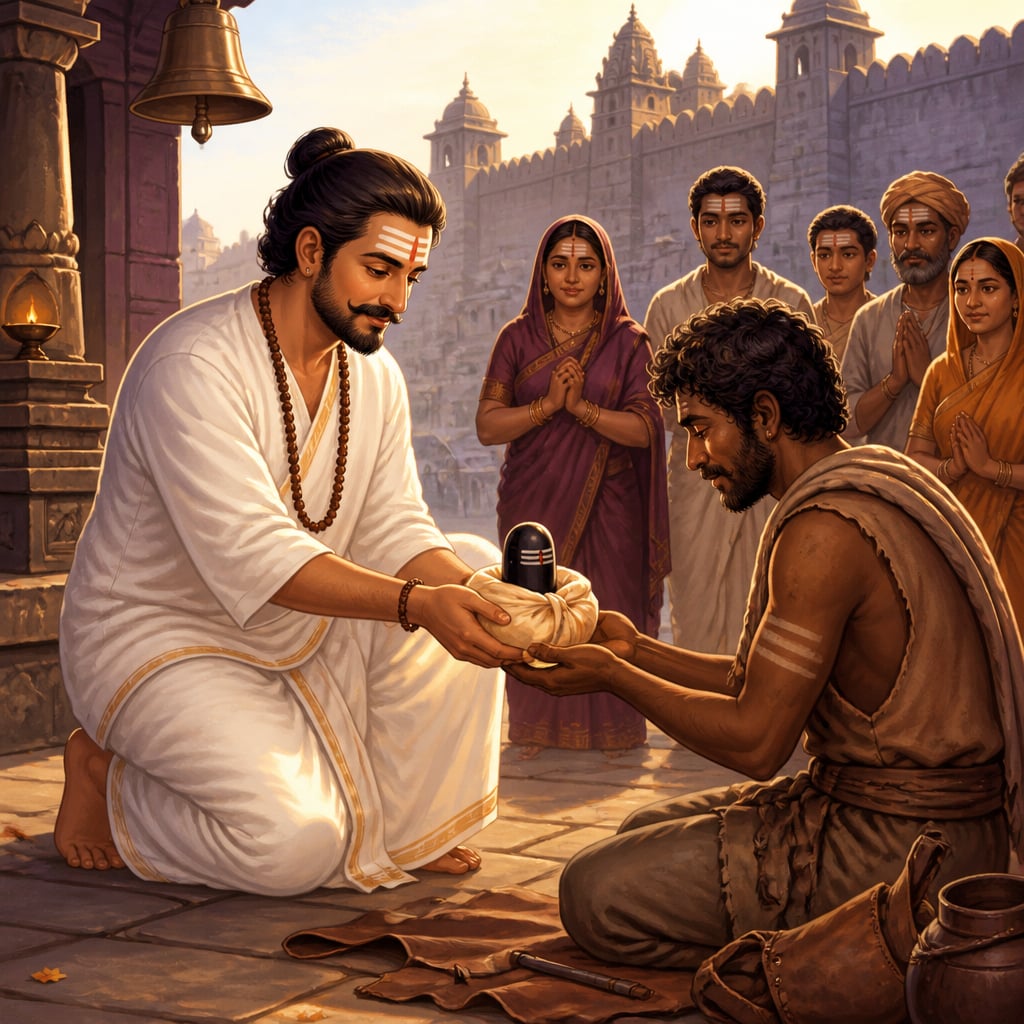
Basavanna placing a small black linga wrapped in cloth into the trembling cupped hands of a leather worker

The leather-worker does not know what to do with what has just happened. He stands in the courtyard with the small linga warm in his palm, the priest still inside the inner sanctum, the bell still ringing. The world the priest defends has not changed. But for the leather-worker, in that moment, it has been quietly walked around.

The gesture in this courtyard becomes, within thirty years, one of the largest devotional reforms in Indian history. Three hundred years before the Bhakti movements of the north, Basavanna and his community will turn a small object tied in cloth into the seed of a movement that today has roughly one hundred million people, the Lingayats, almost all of them in Karnataka, Maharashtra, Telangana, and Andhra Pradesh. The Ishta-Linga around every devotee's neck is the single most concentrated symbol of that reform. To understand it, the lesson first has to walk through the four sacred objects every Shaiva household has kept close for two thousand years.

Bilva: The Three-Lobed Leaf

The first object is the bilva leaf. It comes from the wood-apple tree, Aegle marmelos, a thorny tree planted near most Shiva temples. The leaf has three lobes joined at one stem. The Shaiva tradition reads those three lobes as the three eyes of Shiva, or the three powers of will, knowledge, and action.

The Bilvashtakam, an eight-verse hymn traditionally attributed to Adi Shankaracharya in the eighth century, describes the practice plainly. The devotee picks a single leaf, washes it, and places it on the linga while reciting "Om Namah Shivaya". The hymn says, with quiet certainty, that even one bilva leaf offered with full attention destroys the sins of a lifetime.

The leaf is not torn; it is plucked at the stem. It is offered with the rougher underside touching the linga. Old leaves are returned to the base of a tree or to a river. The bilva tree itself is not cut for any other purpose.

The most useful thing about the bilva is its scale. The leaf is small. It is free. It grows in temple gardens and along village paths. Anyone, of any income or caste, can pick one and offer it. The Shaiva tradition has been, from the beginning, a tradition that cannot be priced out.

Bhasma: The Ash That Names a Body

A Shaiva sadhu applying bhasma with bilva leaves and rudraksha beside him

The second object is bhasma, sacred ash. It is, by tradition, the ash of cow dung cakes burned in a Vedic fire ceremony called the Agnihotra. It is grey, soft, fine, and slightly fragrant. A Shaiva touches it to the forehead, the throat, and the chest each morning, in three horizontal lines called the Tripundra.

The practice is not aesthetic. It is a daily reminder. The Shiva Purana says, plainly, that the body is destined for the cremation fire and that ash is what the body will be. The Shaiva who wears bhasma every morning is wearing the ash they will become. The reminder is not morbid. It is calming. The day is to be lived in the knowledge of its end.

The second meaning is inner. Bhasma is what is left when desire has burned. The tradition treats bhasma as the symbol of the inner work of burning down attachment and ego. Wearing the Tripundra is the daily acknowledgement that the work is not finished.

Rudraksha: The Tear of Rudra

The third object is the rudraksha, the seed of the Elaeocarpus ganitrus tree, which grows mostly in the Himalayan foothills and parts of Indonesia. The seed is hard, brown, and naturally lined into segments called mukhas (faces). A five-mukha seed is the most common. Seeds with one, fourteen, or twenty-one mukhas are rare and are treated as more powerful for specific purposes.

The Shiva Purana gives the seed a strange and beautiful origin. Rudra sat in meditation for one thousand years. When he opened his eyes, two tears fell. Where they fell, the rudraksha trees grew. The seed is, in the tradition's reading, a tear of compassion that hardened into wood. Wearing one is wearing a small piece of Shiva's grief.

Devotees string the seeds into malas of one hundred and eight beads to count repetitions of the Panchakshari mantra (Om Namah Shivaya) or the Mahamrityunjaya mantra. They also wear single seeds against the skin through the day. Studies at IIT Madras and AIIMS Delhi in the late 2010s measured small but consistent electromagnetic effects of rudraksha seeds worn against the skin, including modest reductions in heart rate variability stress markers. The findings are early and contested. The tradition is not surprised.

The Ishta-Linga: Shiva on Your Person

The fourth object is the linga itself. The Shiva Purana describes hundreds of forms of the linga, from the great self-manifested Jyotirlingas at Kashi and Kedarnath, to the cave-shrine lingas of Amarnath and Mahabaleshwar, to the small clay or stone household lingas that Shaivas have worshipped for two thousand years. The household linga is, traditionally, larger than a thumb and smaller than a palm, and is kept in a wooden or copper case in the home shrine.

The key innovation, in the twelfth century, was the Ishta-Linga, the personal linga. It was, and is, a small black or grey stone linga, roughly the size of a marble, fixed inside a small silver or wood case, and worn on a black thread around the neck. The tradition gives the Ishta-Linga to a devotee at a specific initiation called Linga-dharana, performed by a Lingayat guru, often as early as the eighth day after birth. From that day onward, the devotee wears the linga every day, never removes it except for direct worship, and is buried with it at death.

The Ishta-Linga turns Shaiva worship into something portable. The devotee does not need a temple. They do not need a priest. They do not need an auspicious day. They sit, twice a day at minimum, hold the small linga in the cupped left palm, look at it, recite Om Namah Shivaya, and rest in the awareness of the god who is now, literally, in their hand. The garbhagriha (the inner sanctum) has been moved from the temple into the body.

This is not a metaphor. This was the actual claim of the twelfth century reform. Basavanna and his community said it directly. The body is the temple. The Ishta-Linga is the proof.

Basavanna and the Anubhava Mantapa

Return to the courtyard at Kalyana. Within a few years of the moment with the leather-worker, Basavanna and a small circle of devotees set up a hall in the city called the Anubhava Mantapa, the hall of experience. It was, by every measure available to historians, the first egalitarian spiritual academy in recorded Indian history. The hall was open to anyone of any caste, any gender, any profession. The poet Akka Mahadevi, whose story Chapter 9 of this course tells in full, came to the hall in her twenties and recited her vachanas there. The cobbler-saint Madivala Machideva, the boatman-saint Ambigara Chowdayya, and dozens of other Lingayat saints from caste backgrounds the formal Brahminical tradition had excluded for centuries, all sat in the same hall and discussed the linga together.

The Anubhava Mantapa assembly composing vachanas at twelfth-century Kalyana

The form they used was the vachana, a short, free-verse Kannada poem written in the first person, addressed to one's own chosen form of Shiva. Basavanna addressed his vachanas to Kudala Sangama Deva, the Shiva of the river-meeting at Kudala Sangama where two rivers join. His most famous vachana opens with the simple line:

ಎನ್ನ ಕಾಲೇ ಕಂಬ, ದೇಹವೇ ದೇಗುಲ

enna kāle kamba, dehavē dēgula

My legs are the pillars, my body is the temple

Basavanna, Vachana 820, 12th c. Kannada Lingayat tradition

The vachana finishes with the claim that the head is the golden dome of the temple and that the only worship Shiva accepts is the worship of a still, listening body. The whole agama infrastructure, the priest, the threshold, the offering, the auspicious hour, is, in one short poem, made beside the point.

What the Reform Refused, and What It Kept

The twelfth century Lingayat reform was unambiguous about three refusals. It refused caste as a precondition of worship. The Anubhava Mantapa took anyone. It refused the priest as a necessary intermediary. The devotee held the linga directly. It refused gender as a barrier. Akka Mahadevi was treated as a peer of Basavanna, and the vachana literature she produced is read, today, as among the great spiritual poetry in any Indian language.

The reform was equally clear about what it kept. It kept the linga. It kept the bilva, the bhasma, and the rudraksha. It kept Om Namah Shivaya as the central mantra. It kept the Sanskrit philosophical core of Shaiva Siddhanta. The reform did not throw out the tradition. It moved the tradition's centre of gravity from the agama temple to the human body, and from the priest's sanctum to the devotee's cupped left palm.

This is the difference between a reform and a rebellion. A rebellion would have burned the temple down. The Lingayat reform kept the temple, kept the rituals, kept the mantras, and added one quiet new claim: that the same temple already exists in the chest of every devotee.

The Same Question Now

The Lingayat community is the largest single religious group in Karnataka today, at roughly seventeen percent of the state's population, with significant communities in Maharashtra, Telangana, and Andhra Pradesh. In 2018, the government of Karnataka recommended Lingayat status as a separate religion under Indian law, sparking a national conversation about religious identity. Several recent Chief Ministers of Karnataka have come from the community.

Mahatma Gandhi, in a 1928 article in Young India, called Basavanna's vachanas the model for what an authentic Indian religious reform should look like. The poet and scholar A.K. Ramanujan, in his 1973 Penguin volume Speaking of Siva, translated the vachanas of Basavanna, Akka Mahadevi, and Allama Prabhu, and the book became a foundational text in comparative-religion programs at Berkeley and Chicago. The four objects of this lesson, meanwhile, continue to anchor several million Shaiva households every morning. The cost remains essentially zero. The infrastructure is the body.

Back in the courtyard, the morning bell has finished ringing. The leather-worker stands with the small linga warm in his palm. The priest is still inside. The world has not changed. But the leather-worker now knows what no priest can tell him. The temple has come out to meet him, and it will not go back in.

Living traditions

The four sacred objects and the Lingayat reform have a quietly enormous modern presence in India. The Lingayat community is the largest single religious group in Karnataka, at roughly seventeen percent of the state's population, with significant communities in Maharashtra, Telangana, and Andhra Pradesh. In 2018, the government of Karnataka under Chief Minister Siddaramaiah formally recommended Lingayat status as a separate religion under Indian law, a decision the central government has not approved but which sparked a national conversation about the boundaries of Hindu religious identity. Several recent Chief Ministers of Karnataka, including B.S. Yediyurappa, Jagadish Shettar, and Basavaraj Bommai, have come from the Lingayat community, and the community runs a major network of educational and charitable institutions through the Basava Samithi, the various Lingayat mathas, and the Basava International Foundation. Mahatma Gandhi, in a 1928 article in Young India, called Basavanna's vachanas the model for what an authentic Indian religious reform should look like. The Indian-American poet and scholar A.K. Ramanujan's 1973 Penguin translation Speaking of Siva is still in print after fifty years and remains a foundational text in the comparative-religion programs at Berkeley, Chicago, and several Indian universities. In 2019, the government of India released a commemorative coin and stamp marking the 850th anniversary of the Anubhava Mantapa. The four sacred objects of this lesson, meanwhile, continue to anchor several million Shaiva households every morning across India, with a daily reach that no central institution has ever measured but that no central institution has ever disturbed. The cost of the practice remains essentially zero. The infrastructure remains the body. Eight hundred and sixty years after the courtyard at Kalyana, the claim still holds.

Reflection

More in Shiva Sadhana: Practice

All lessons in Shiva Sadhana: Practice · Shiva Purana course