Dhyana: Meditation the Shiva Way

Stillness without becoming cold

Every Shaiva practice eventually leads to sitting still. The chapter ends here. This lesson opens with the ninth-century Kashmiri householder Vasugupta finding the Shiva Sutras on a rock face, then walks the tradition's actual meditation instructions from the Vijnanabhairava Tantra: 112 ways to still the mind.

The Rock at Mahadeva Mountain

In the early ninth century, in a small Kashmiri village a few kilometres outside Srinagar, a householder named Vasugupta woke from a dream. In the dream, Shiva had told him to walk up Mahadeva mountain at first light and look for a rock. On the rock would be sutras. He was to copy them down before the sun was high.

Vasugupta was not a famous man. He had a household, a small library of Tantras, and a modest reputation as a Shaiva scholar in Pravarapura, the old name of Srinagar. He took his wife's lamp and a sheaf of birch bark and walked up the hill in the cold dawn. The path was steep. His sandals slipped on dew. He found the rock. On its underside, half hidden by lichen, were inscribed seventy-seven short sutras in old Kashmiri script.

He copied them. He brought them home. He read the first one before he sat down to breakfast.
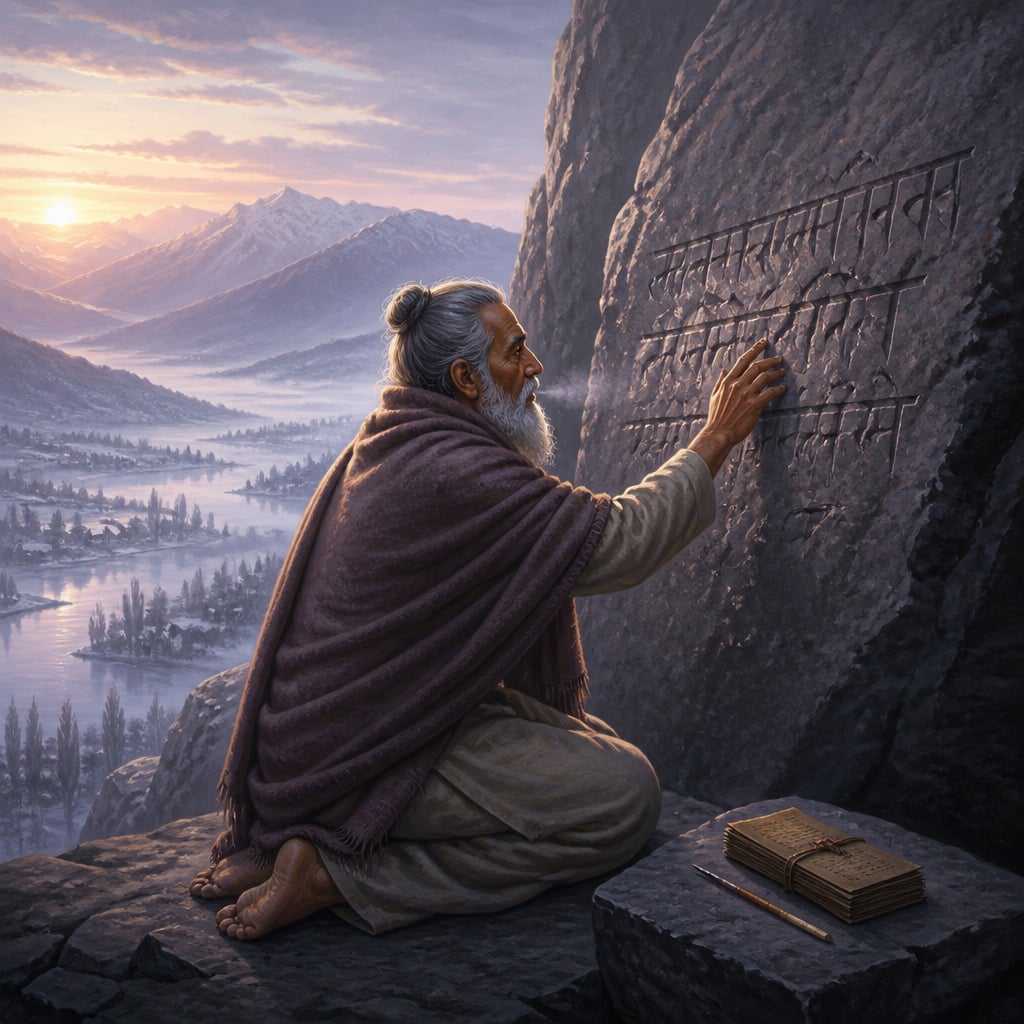
Vasugupta kneeling before a flat stone face on Mahadeva mountain, tracing the freshly revealed Shiva Sutras at first dawn

caitanyamātmā. Consciousness is the Self.

The Shiva Sutras had arrived. From these seventy-seven lines, Vasugupta and his student Kallata would build the foundation of what is now called Kashmir Shaivism, and through it, one of the most precise meditation traditions the world has ever produced. Whether the rock was real or the dream a literary device, the Shaiva tradition has held the story for twelve hundred years, because the story makes a point. The instruction did not come from a textbook. It was found, by an ordinary householder, on a real morning, on a real mountain.

Three Doorways, Three Methods

The Shaiva tradition is unusually honest about meditation. It admits that practitioners begin in different places and need different doors. Vasugupta and his successors named three.

The āṇavopāya is the method of the body and the breath. It uses posture, breath counting, mantra, and the small mechanical aids that any beginner needs. The Shaiva tradition does not look down on it. It is where most practitioners begin and where most practitioners stay, and the tradition's view is that this is fine.

The śāktopāya is the method of focused awareness. The practitioner sits, settles the body and breath, and then turns attention itself toward consciousness. Mantra is used here too, but as a tool of awareness, not as a count. The Vijnana Bhairava Tantra, the 112 dharanas, is the canonical manual for this stage.

The śāmbhavopāya is the highest method, and the most disconcerting to describe. It is the method without method. The practitioner simply recognises that consciousness is the Self, and rests there. There is no breath count, no mantra, no technique. There is only the recognition. Abhinavagupta, the great tenth century Shaiva philosopher who wrote the Tantraloka, called śāmbhavopāya the method that ends method.

The ladder is real. Most practitioners start with āṇavopāya, deepen into śāktopāya, and only after years of practice arrive, briefly, at śāmbhavopāya. The Shaiva tradition's instruction to a new sadhaka is plain. Do not skip rungs. Start with the body. Start with the breath. The higher methods will arrive when they arrive.

The Gap Between Two Breaths

If the Vijnana Bhairava Tantra is the canonical manual of Shaiva dharana, the most quoted of its 112 techniques is the meditation on the gap between two breaths.

The verse, attributed to Shiva himself in conversation with Parvati, reads:

ऊर्ध्वे प्राणो ह्यधो जीवो विसर्गात्मा परोच्चरेत्। उत्पत्तिद्वितयस्थाने भरणाद्भरिता स्थितिः॥

ūrdhve prāṇo hy adho jīvo visargātmā paroccaret utpatti-dvitaya-sthāne bharaṇād bharitā sthitiḥ

Above is the prana, below is the jiva. The supreme rises in the form of an outflow. At the place of the twofold rising, by holding, comes the state of fullness.

Vijnana Bhairava Tantra, Verse 24

A modern householder in the gap-between-breaths meditation at dawn

The instruction is simple enough that any reader can try it now. Sit still. Breathe normally for a few minutes. Then begin to notice the small gap at the top of every exhalation, before the next inhalation begins. Notice the second small gap at the top of every inhalation, before the exhalation begins. Two gaps. Two doorways.

Do not lengthen the gap. Do not control the breath. Just let attention rest, briefly, in the gap. Then the breath continues. The gap returns. Attention rests again.

The Shaiva claim is that, in the gap, the practitioner is briefly free of the breath cycle that defines embodied life. In that small freedom, consciousness shows itself as itself. The longer the practitioner sits with the gap, the longer those small recognitions hold. After months of practice, the gap is no longer a place attention visits. It becomes a quality the practitioner carries through the day.

This is the doorway the Shaiva tradition has put inside every household for twelve hundred years. It needs no special posture, no special place, no special clothes. A working mother can practice it on a Mumbai local at six in the morning. A software engineer can practice it during a one minute pause between meetings. The practice is small enough to fit anywhere, and deep enough to hold a lifetime.

Bhasma on the Brow, Stillness in the Eye

Shaiva meditation is rarely practiced without two physical aids. Both are visible. Both are small. Both have outlasted every fashion in spiritual practice.

The first is bhasma, sacred ash. The Shaiva sadhaka, before sitting to meditate, applies three horizontal lines of bhasma across the forehead. The bhasma is made from the ashes of a sacred fire, often the fire used in the morning's puja. The application is brief. A pinch of ash, three lines, a moment of contemplation, then the sit.

The meaning is not subtle. Everything the practitioner sees during the day, including the practitioner's own body, will eventually be ash. The bhasma is the reminder, applied to the most visible part of the body, that the practice is not for someone who will live forever. The mark on the brow is the day's contract with impermanence.

The second aid is the gaze. Shaiva meditation often uses an open gaze rather than closed eyes. The practitioner looks at a fixed point: a small flame, a Shivalinga, an image of Nataraja, the cosmic dancer.

The Nataraja icon, still face inside the cosmic dance

The Nataraja icon is the meditation instruction made visible. Shiva is dancing the universe into existence and out of existence at once. His four arms are in motion. His matted hair flies sideways. The demon Apasmara is crushed under his right foot. The cosmic flames frame the figure. And his face, at the centre of all this, is completely still. Eyes half open. A small smile. No tension. No distress.

The instruction is in the contradiction. The practitioner is not asked to stop the dance of life. She is asked to find the still face inside the dance. The Chola bronze sculptors in Tamil Nadu, around the year 1000 CE, captured this so well that the image has become the canonical icon of meditative consciousness in any Indian tradition.

Why the Shiva Sadhaka Does Not Become Cold

This is the lesson's most important point, and the reason the chapter ends here. Many meditation traditions, when they go deep, produce a cold practitioner. Detached. Unmoved. Hard to reach. The world has its share of these.

The Shaiva tradition has a long argument with that outcome. Shiva himself is the model. He is the great ascetic, sitting in samadhi for ages on Kailasa. He is also the householder married to Parvati, the doting father of Ganesha and Kartikeya, the cremation ground dancer who befriends every fierce being everyone else flees. The icon refuses to choose between these. Shiva is Ardhanarishvara, half ascetic and half householder, joined down the middle.

The meditation method that produces this Shiva is, by design, a method that refuses to choose. The practitioner does not retreat. She finds the gap between breaths in the middle of her workday. She applies bhasma in front of the same mirror where she fixes her hair before a meeting. She gazes at Nataraja in a small framed print on her office desk. The practice is woven into the day, not subtracted from it.

The test of a Shaiva meditator, the tradition holds, is not how still she can be on the cushion. It is how present she can be at the dinner table. The cold meditator has gone wrong somewhere. The warm one, the still and warm one, has understood what Shiva was teaching.

Modern Echoes

The Shaiva meditation tradition has had an unusually strong modern second life. Jon Kabat-Zinn, the molecular biologist who founded the Mindfulness Based Stress Reduction (MBSR) program at the University of Massachusetts in 1979, drew explicitly from the dharma traditions, including the Vijnana Bhairava lineage, when designing his eight week protocol. MBSR is now offered in over seven hundred medical centres worldwide and reaches several million practitioners a year.

The field of contemplative neuroscience has gone further. Richard Davidson at the University of Wisconsin and Daniel Goleman documented in their 2017 book Altered Traits that long term meditators show measurable reductions in the brain's default mode network, the chatter region that produces what the Shaiva tradition would simply call vikalpa. Judson Brewer, formerly of Brown University, has shown in fMRI studies that the gap between two breaths, the same dharana the Vijnana Bhairava points to, is associated with the strongest reductions in default mode network activity. Sam Harris, the neuroscientist and meditation teacher, built his Waking Up app on a recognition based instruction that any reader of the Shiva Sutras would identify as a 2020s rendering of śāmbhavopāya.

The Shaiva scholar Mark Dyczkowski, working in Varanasi for fifty years, has translated the core Kashmir Shaiva texts into accessible English. The 112 dharanas, once the secret instruction of a small lineage in Srinagar, are now available in any bookshop and on any phone. The democratisation Vasugupta began on his rock has, eleven hundred years later, reached the wrist of anyone with a meditation app.

The still face inside the dance, it turns out, was the instruction the world was waiting for.

The Mountain in the Morning

Vasugupta carried the seventy-seven sutras down the mountain that morning and read the first one before breakfast. He did not stop being a householder. He did not retreat to a cave. He went on with his life and built, inside it, the meditation tradition that has now reached us. The rock is still pointed out by guides at the foot of the Shankaracharya hill in Srinagar. The first sutra is still the same. Consciousness is the Self.

Living traditions

The Shaiva meditation tradition has had an unusually strong modern second life. Jon Kabat-Zinn's Mindfulness Based Stress Reduction (MBSR), founded in 1979 at the University of Massachusetts, drew explicitly from the dharma traditions including Kashmir Shaivism and now reaches several million practitioners through over seven hundred medical centres worldwide. Daniel Goleman and Richard Davidson's 2017 book Altered Traits, which became a New York Times bestseller, documents fMRI evidence for the kinds of long term changes the Shaiva tradition has been claiming for twelve hundred years. Judson Brewer at Brown University has shown that the Vijnana Bhairava's verse 24 dharana on the gap between two breaths is associated with the strongest measured reductions in default mode network activity. Sam Harris's Waking Up app, with several million paying subscribers, teaches a recognition based instruction that any reader of the Shiva Sutras would identify as a contemporary rendering of śāmbhavopāya. Mark Dyczkowski, working from Varanasi for fifty years, has translated the core Kashmir Shaiva texts into accessible English, and Bettina Baumer's lectures continue the Lakshman Joo lineage in Europe and India. The Vijnana Bhairava Tantra is now in print in dozens of editions and has become a standard reference text in academic contemplative studies. The Nataraja icon stands in front of the European Centre for Nuclear Research (CERN) in Geneva, gifted by the Government of India, in recognition of the icon's value as a metaphor for the dance of subatomic particles. The still face inside the dance, it turns out, was the instruction the world was waiting for.

Reflection

More in Shiva Sadhana: Practice

All lessons in Shiva Sadhana: Practice · Shiva Purana course