Rudrabhisheka: Bathing the Linga

Milk, water, honey, curd, ghee

Before sunrise at the Mahakaleshwar temple in Ujjain, the priest stands before the Linga with five brass pots. Milk first. Then curds, honey, ghee, and rose water. Each substance carries a specific quality being offered back. This lesson follows the rudrabhisheka from its Vedic source to the steps of a household practice.

Five Pots and a Mountain of Stillness

In the Mahakaleshwar temple at Ujjain, an hour before sunrise, the chief priest stands in the inner shrine before a black stone linga that has been there longer than any record. Five brass pots are arranged on a low platform beside him. A copper vessel of water from the Kshipra river sits at the back. Behind him, a single oil lamp throws warm light against the wet stone of the floor. The drains under the linga have been cleaned overnight. The day's work is about to begin.

He will pour, slowly, for the next forty minutes. Milk first. Then curd. Then ghee (clarified butter). Then honey. Then sugar dissolved in a little water. Then water itself, last, in a long thin stream. While he pours, two assistants behind him will recite the Shri Rudram, the oldest hymn to Rudra in continuous use in India for nearly three thousand years.
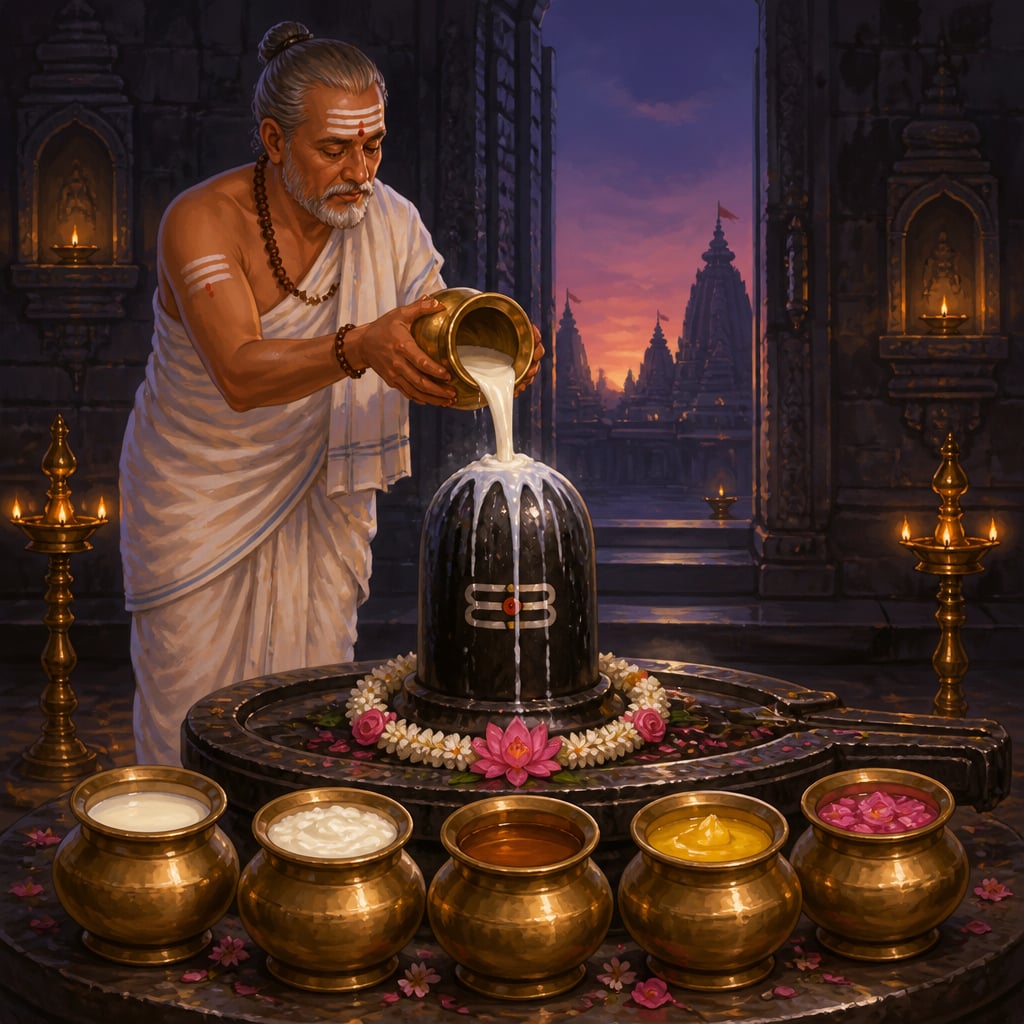
A senior priest at Mahakaleshwar with five brass pots of milk, curd, honey, ghee and rose water arrayed for abhisheka

This is Rudrabhisheka. The bathing of the lord. It is performed every morning at every major Shiva temple in the country, and in tens of thousands of household puja rooms, in roughly the same shape, with roughly the same substances, with roughly the same hymn running underneath. The question this lesson is built around is simple. Why does the deepest worship in the Shaiva tradition use substances rather than words?

What an Abhisheka Actually Is

The word abhisheka comes from the Sanskrit root sich, to pour, with the prefix abhi, towards. It is literally a pouring-towards. The same word names the coronation of a king. When Rama is to be made king of Ayodhya, the ritual is called rajyabhisheka. The water is poured over the head of the future king. The act of pouring is itself the making.

The Shaiva tradition takes the same act and turns it inward. The linga is the still axis. The bhakta is the pourer. Whatever passes between them is what changes. The Shiva Purana in its Vidyeshwara Samhita is unusually direct about this. It says that linga puja without abhisheka is incomplete, and abhisheka without the Rudram is half-formed. The pouring and the hymn together are the practice.

The substances used have a specific order, a specific meaning, and a specific cumulative effect. The tradition calls them the panchamrita, the five nectars. With water, they are six. The order is fixed. The meaning is layered. The result, over months of daily practice, is a kind of inner cleaning that no other Shaiva sadhana quite achieves.

What Each Substance Is For

The Shiva Mahapurana and the later commentaries of Adi Shankaracharya in his Shivanandalahari explain each offering. The translations are paraphrased, not quoted, but the structure is canonical.

The priest at Mahakaleshwar will pour these in this order every morning of his working life. The household bhakta who keeps a small linga at home will pour the same substances on a Pradosham evening, on a Monday at dawn, or on the great night of Mahashivaratri. The substances are not chosen for cosmetic reasons. Each one is a small inner training.

The Hymn That Runs Underneath

While the pouring happens, the hymn the Shri Rudram is recited. The Rudram comes from the Krishna Yajur Veda, in the Taittiriya Samhita, fourth book, fifth section. It is the oldest sustained hymn to Rudra in any Indian source. It has been chanted continuously for almost three thousand years. The first half, the Namakam, is built on the repeated word namo, salutations. It addresses Rudra in every form he might take.

नमः शिवाय च शिवतराय च॥

namaḥ śivāya cha śivatarāya cha

Salutations to Shiva, and to him who is more auspicious still.

Krishna Yajur Veda, Taittiriya Samhita 4.5.8

This verse contains the literal first scriptural occurrence of the mantra Om Namah Shivaya, the five-syllable mantra at the centre of the Shaiva path. Every priest pouring milk on a linga in 2026 is reciting a phrase that has been on the lips of priests pouring milk on lingas since before the Buddha was born.

The second half, the Chamakam, is built on the repeated phrase cha me, and to me. Where the Namakam describes what Shiva is, the Chamakam asks for what Shiva grants. Long life, food, family, courage, clear thought, peace at the end of the day. The two halves together are the Vedic shape of the abhisheka. Describe the lord. Ask for what is needed. Pour the substances while you do both.

Honey streaming over the black Shiva linga with bilva leaves and ash

What the Substances Are Doing to You

The Shiva Mahapurana is precise about the inner mechanics. The substances are not for Shiva. Shiva does not need milk. The substances are for the bhakta. They train the bhakta to give before asking, to slow down before deciding, and to notice that everything offered to the still axis comes back, eventually, in the form of something cleaner.

This is one of the deeper Shaiva claims. The linga is not the recipient. The linga is the still mirror. Whatever you pour over it is what you are pouring through yourself. The slowness of the abhisheka is the entire point. Modern life rushes. The abhisheka is the one practice in the day where the bhakta is forbidden to hurry.

The priest at Mahakaleshwar will tell you, if you ask, that the first six months of his daily abhisheka were the slowest six months of his life. He learned to pour. He learned to keep his hand steady. He learned to time the pouring with the breath. After ten years, he says, the abhisheka does him more than he does it. He stands in front of the linga and the substances move themselves through his hands.

The Householder Version

A grandmother teaching her granddaughter the household abhisheka

Most bhaktas are not priests. The same practice scales down without losing its shape. A small shaligrama stone, a brass plate, a single bilva leaf, and a copper vessel of water are enough. The full panchamrita is for special days. On most mornings, water alone will do. The water is poured slowly. The bhakta says Om Namah Shivaya while pouring. Five minutes is enough.

The Shaiva calendar gives the householder anchors. Every Monday is Shiva's day in north India and most of the south. Every Pradosham, the thirteenth lunar day twice a month, is the special evening for abhisheka. The annual Mahashivaratri in February or March is the great night when the abhisheka is performed every three hours, all night long, in temples and homes across the country. The Shravan month in July or August is the monsoon month when the abhisheka practice surges, with pilgrims walking hundreds of kilometres to pour Ganga water on a linga at the end of the journey.

The scale changes. The shape does not. Five substances. Six with water. One still axis. One slow pour. One repeated mantra.

Why Substances and Not Just Words

This is the question the tradition keeps returning to. The Vedas are full of words. The Upanishads are entirely about what cannot be said. Why does the Shaiva path, when it goes deepest, leave language and pick up a brass pot of milk?

The answer the tradition gives is that the body learns through the body. Words can describe the inner offering of sweetness. Pouring honey on a black stone, in silence, while a hymn that is older than your civilization is recited beside you, makes the offering happen. The substance is the word made material. The pour is the prayer becoming a body.

Modern science has slowly arrived at the same insight. Researchers like Andrew Newberg at the Marcus Institute of Integrative Health have studied what happens in the brains of practitioners during slow rhythmic devotional acts. The findings are consistent. Slow rhythmic motor activity, paired with sustained attention on a single object, paired with repetitive sacred sound, produces a measurable shift in autonomic state. The parasympathetic nervous system takes over. The default mode network quiets. The sense of separation between self and object softens. The bhakta and the linga, in the language of the Shaiva tradition, become less separate. The lab result and the abhisheka result are not different.

This is the second great Shaiva claim that the tradition has held for two thousand years. Words alone cannot move the body. The body needs a substance to pour, a stone to pour it on, and a hymn old enough that the pouring is held inside it.

A Closing Pour

Back at Mahakaleshwar, the priest is finishing. The water from the Kshipra goes last, in a single long stream. The linga is wet. The substances are gone, drained away into the channels under the floor. The Rudram has ended. The bhaktas who have been watching from the outer shrine, sometimes a few dozen, sometimes thousands, will now come forward for the Bhasma Aarti, the ash worship that follows the abhisheka and is unique to Mahakaleshwar. The next round of devotees is already gathering at the doors.

The abhisheka has done its work, again, the same way it has every morning for centuries.

The substances poured this morning are gone. What they leave behind, in the priest, in the bhaktas, in the slow attention the room has held, is the only thing the Shaiva tradition has ever cared about. The next lesson moves from the bath to the body. Bilva, ash, rudraksha, and the small linga that the Lingayats hung around their necks in the twelfth century, so the temple could come with you wherever you go.

Living traditions

The Rudrabhisheka is, by participation, one of the most-performed sustained rituals in contemporary India. The Mahakaleshwar Bhasma Aarti has waiting lists running to several months, with the Mahakaleshwar Mandir Samiti reporting over twenty lakh online booking attempts in 2024 alone. The Tarakeshwar Shravan Mela in West Bengal draws an estimated thirty to fifty lakh pilgrims across the four Shravan Mondays each year. The Kashi Vishwanath Dham corridor expansion in 2021, with a project cost of about ₹800 crore, was explicitly designed to handle the abhisheka crowds, especially the Shravan Kanwar Yatra. Nationally, the Shravan Kanwar Yatra is now estimated to involve more than four crore participants annually across northern India, making it among the largest sustained religious gatherings in the world. Beyond the temple, Andrew Newberg's research at the Marcus Institute of Integrative Health and similar studies at the National Institute of Mental Health and Neurosciences in Bengaluru have begun to formally document what the Shaiva tradition has held for two thousand years, that slow rhythmic devotional acts produce measurable shifts in autonomic state and brain network activity. The yoga teacher Sadhguru's Isha Foundation runs a full annual Mahashivaratri abhisheka programme that streams to more than ten crore viewers globally, the largest religious livestream from India in any year. The lesson the Shiva Purana embedded in the act of pouring a brass pot of milk on a black stone has not aged in three thousand years, and shows every sign of continuing to anchor the Shaiva calendar of an ordinary working Indian household.

Reflection

More in Shiva Sadhana: Practice

All lessons in Shiva Sadhana: Practice · Shiva Purana course