Panchakshari: Om Namah Shivaya in Practice
Five syllables, how to actually use them
Five syllables. Na, Ma, Shi, Va, Ya. Each syllable holds one element, one face of Shiva, one cosmic act. This lesson walks through what each syllable holds inwardly and shows how a household practitioner uses the mantra. The closing teaching is a grammar lesson: Namah Shivaya is in the dative case. There is no 'I' in the sentence.
The Boy at Kalady
It is early in the eighth century, on the bank of the Periyar river in what is now Kerala. A small village called Kalady sits where the river curves around a low rock. The sun has not yet risen. A widow named Aryamba is watching her son leave the house with a copper pot.
The boy is eight years old. His name is Shankara. He is going to the river to bathe before his morning recitation. His mother has lost her husband. The boy is the only child she has left. She watches him walk to the water in the half-light, his shoulders narrow, the pot bumping against his hip.
What he will say at the river that morning, the tradition tells us, is one short line. He has been saying it every morning since he could speak. His mother taught it to him. Her mother taught it to her. Across the southern country, on the same morning, hundreds of thousands of children are saying the same line at the same hour.
Five syllables. Om Namah Shivaya. I bow to Shiva.
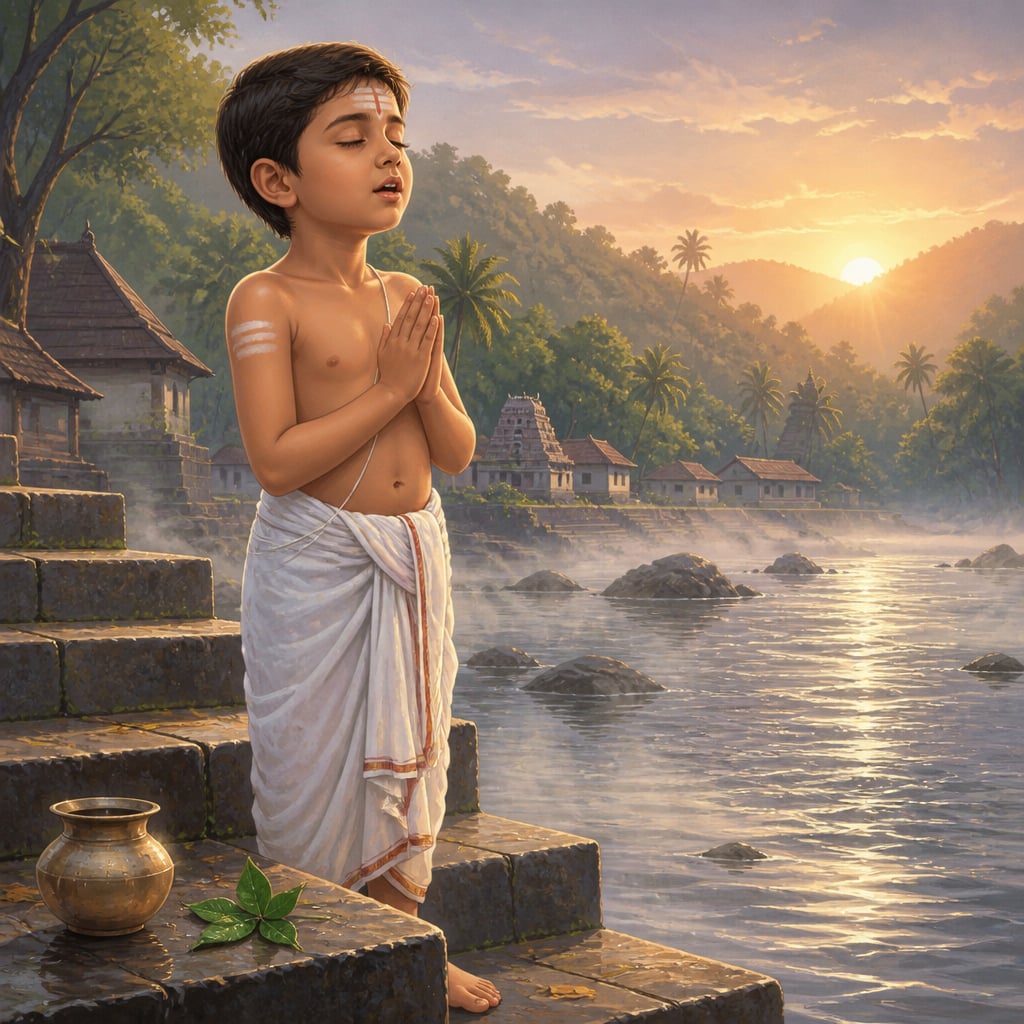
The line is so simple a child can carry it. It is also, the Shaiva tradition insists, the most concentrated single sentence in the spiritual vocabulary of Bharat. What follows is a slow walk through what these five syllables actually contain, and how a household practitioner is meant to use them.
Where the Mantra Sits in the Veda
Long before Shankara was born, the line was already old. The mantra is called the Panchakshari, the five-syllable mantra, from pancha (five) and akshara (syllable, indestructible sound). Its formal source is the Shri Rudram, the great hymn to Shiva preserved in the Krishna Yajur Veda. Tradition treats the placement of Namah Shivaya as deliberate. It sits, the priests will tell you, at the literal centre of the Shri Rudram, the way the linga sits at the centre of a temple.
A small clarification matters here. The full chant is Om Namah Shivaya. Counted strictly, that is six syllables. The tradition counts only the five syllables that name Shiva, Na, Ma, Shi, Va, Ya. The Om is treated as the seed-sound that opens any sacred utterance, not as a syllable in the count. When you hear someone say "the five-syllable mantra", these are the five.
In the previous chapter of this course we walked the Panchanana, the five faces of Shiva. The Panchakshari is its sound version. Each of the five syllables is matched to one face, one element, and one cosmic act:
| Syllable | Element | Face | Cosmic Act |
|---|---|---|---|
| Na | Earth | Sadyojata | Creation |
| Ma | Water | Vamadeva | Preservation |
| Shi | Fire | Aghora | Dissolution |
| Va | Air | Tatpurusha | Concealment |
| Ya | Ether | Ishana | Grace |
When the boy at Kalady says the five syllables, he is, in the tradition's reading, walking the entire field of consciousness in five short steps. He is greeting the earth that holds him, the water that feeds him, the fire that clears him, the air that hides what is not ready to be known, and the ether through which grace, eventually, comes. The whole cosmos in one breath.
How a Householder Actually Uses It
The line is small enough for a child. It is also the daily practice of millions of working adults today. The teaching is precise about how to use it.

The basic unit of practice is japa, the slow repetition of the mantra. The classical count is 108, the number of beads on a Shaiva rudraksha mala. A practitioner sits, holds the mala in the right hand, and moves one bead between thumb and middle finger for each repetition. One full mala is 108 mantras. Roughly five to seven minutes of breath.
Three windows of the day are recommended:
- Brahma Muhurta, the hour before sunrise. The mind is unfreighted, the world has not yet asked anything. One mala here is the strongest single act of the day.
- Sandhya, the twilight hour at sunset. The day's accumulations meet the coming dark. One mala here clears what was carried.
- Before sleep. A short count, often 21 or 27, taken slowly, dissolves the day's rehearsals before they enter the night.
The instruction Shankara himself gave in his short hymn the Shiva Panchakshara Stotram is even simpler than this. Each verse takes one of the five syllables and places it as a salutation. The full hymn is short enough to memorise in an afternoon, and is still chanted today at temple thresholds across Kerala and Tamil Nadu, eleven hundred years after the boy first composed it.
A second teaching, less often quoted, also matters. The Linga Purana says that the Panchakshari can be used in any posture and any moment. You do not need a mala. You do not need a shrine. You do not need to face east. You can chant while walking to a meeting, while waiting in a queue at the bank, while sitting in a hospital corridor while a parent is in surgery. The five syllables are designed to travel.
What Each Syllable Is Doing Inside You
The Shaiva Agamas treat the five syllables not as a request directed outward but as an arrangement of energies inside the chanter. To say Na is not to inform Shiva of anything. It is to align with the earth-mode of consciousness already in you, the one that begins each morning. The same applies to each of the five. The chant is, in the technical reading, a self-organising act.
The order of the syllables is also deliberate. Na, Ma, Shi, Va, Ya moves from earth (densest, most concrete) to ether (subtlest, most spacious). Each repetition of the mantra is therefore a small inner journey from the body to space. Over a full mala of 108 repetitions, the practitioner has made that journey 108 times. The mind, the tradition says, eventually gives up its old organisation and takes on the order of the chant.
The grammar is also worth noticing. Namah Shivaya is in the dative case. The mantra does not say I praise Shiva. It says salutation to Shiva. The "I" disappears. The acting subject of the sentence is gone. What is left is only the bow and the one being bowed to. For a tradition that treats the ego as the central knot, this grammatical erasure is not accidental. It is the medicine.
The Quiet Long Life of the Practice
Shankara did not invent the Panchakshari. He inherited it. By the time he was eight at Kalady, the mantra had been chanted in the south for at least a thousand years and had been embedded in temple liturgy from the Krishna Yajur Veda before that. What he did, later in life, was systematise its place in Shaiva practice. His commentaries on the Brahma Sutras and the Upanishads, written before he was thirty, all return to the same point. The five syllables are not a decoration of the Vedanta. They are its compressed form.
This is why, in temples from Pashupatinath in Kathmandu to Rameshwaram on the southern tip of Tamil Nadu, the Panchakshari is the line a priest will give to a first-time visitor who asks what to chant. The practitioner does not need a guru. The practitioner does not need initiation. The five syllables are open. They are the public square of Shaiva practice. Other mantras are reserved for specific lineages and specific transmissions. This one is for the bus driver at Madurai, the IT engineer at Bengaluru, the eight-year-old at Kalady.
Modern Echoes

In the twentieth century, the south Indian sage Ramana Maharshi, who lived at the foot of Arunachala from 1896 until his death in 1950, was repeatedly asked by visitors what mantra a beginner should use. His answer, recorded in Talks with Sri Ramana Maharshi (the verbatim transcripts kept by Munagala Venkataramiah from 1935 to 1939), was almost always the same. He recommended the Panchakshari. He pointed to the simplicity of the five syllables, the lack of need for elaborate ritual, and the way the mantra dissolves the chanter into the mountain itself. Arunachala, he said, was the same Shiva the syllables named.
The cultural anthropologist Diana Eck, in her 2012 book India: A Sacred Geography, traced the geographic distribution of the Panchakshari across the Indian subcontinent and concluded that it is, alongside the Mahamrityunjaya covered in the previous lesson, one of the two most widespread personal practices in the living Shaiva world. Streaming counts on Indian audio platforms confirm this. The recordings of Om Namah Shivaya by singers like S. P. Balasubrahmanyam from the early 1990s, and more recently by Krishna Das in the United States, sit among the most-played Sanskrit chants on the internet. A line a widow taught a small boy on the Periyar in the eighth century is now repeated, in some form, every minute of every day somewhere in the world.
Closer to ordinary life, hospital chaplaincy programmes at the All India Institute of Medical Sciences in Delhi and at Apollo Hospitals across south India report that the Panchakshari is the most-requested chant in palliative wards, ahead of any other Sanskrit, Pali, or Persian devotional line. The five syllables are small enough to fit in the last breath.
The Closing Image
Return now to that morning at Kalady. The boy is at the water. The pot is on the bank. The sun is just beginning to come up over the rock. He says the five syllables. They land in the river. The river carries them down to the sea. His mother, watching from the path, lets out a breath she did not know she was holding.
That is the whole practice. Five short syllables, said honestly, repeated daily, allowed to do their slow work. The Shaiva tradition has, over three thousand years, built one of the largest temple economies in the world, one of the most sophisticated ritual liturgies, one of the deepest philosophical literatures, and one of the most beautiful sculptural traditions on earth. All of it rests on this small line.
The inner transformation the line teaches is not surrender exactly, and not yet stillness, but the quiet ground beneath both. The "I" of the chanter steps aside. What is left is only the bow. And in that bow, the noise of the day, the bargaining, the running commentary of the small self, has nowhere to land. Stillness, śānti, is what the tradition calls this. Not the stillness of a body that has stopped moving, but the stillness of a sentence in which the chanter has consented to disappear.
The boy walks back up the path with the empty pot. The next chapter of his life will take him out of Kalady, up to Kashi, into the mountains, and finally back south to the deep silence at Kanchipuram. Through every step, the same five syllables will travel with him.
If you take nothing else from this chapter on Shiva sadhana, take these five. They are enough.
Historical context
Vedic to Modern Bharat (roughly 4000 BCE to present)
The Panchakshari is one of the few continuous threads that runs unbroken from the Vedic period to the present. Its Vedic root is the line 'Namah Shivaya' embedded in the Shri Rudram of the Krishna Yajur Veda's Taittiriya Samhita 4.5, preserved in oral transmission since the Vedic period. Its Puranic systematisation appears in the Linga Purana, particularly Chapter 85 of its Uttara Bhaga (composed roughly between 600 and 1000 CE), which calls the five-syllable mantra 'sarva-mantra-uttama-uttamam', the highest of the highest among all mantras. The decisive synthesis came in the 8th century, when Adi Shankara, born at Kalady on the Periyar river in Kerala, composed his Brahma Sutra commentaries and his short Shiva Panchakshara Stotram. Shankara's contribution was not the invention of the mantra (which was already old) but its placement at the centre of the Advaita Vedanta synthesis. From his lifetime onward, the Panchakshari became the standard household mantra of Shaiva Bharat, given freely to first-time visitors at every major Shiva temple from Pashupatinath in Kathmandu to Rameshwaram on the southern tip of Tamil Nadu. The modern transmission, through 20th-century sages like Ramana Maharshi at Arunachala (1896 to 1950) and through global devotional artists like Krishna Das and S. P. Balasubrahmanyam, has carried the same five syllables into homes that no longer perform formal puja and into hospital palliative care wards across Bharat. The line a widow taught a small boy on the Periyar in the 8th century is now repeated, somewhere in the world, every minute of every day.
Living traditions
The Panchakshari is, by streaming counts on Indian and global audio platforms, among the two or three most-played Sanskrit chants in the world today. The S. P. Balasubrahmanyam recordings from the early 1990s, the Anuradha Paudwal versions from the early 2000s, and the Krishna Das (American kirtan singer, student of Neem Karoli Baba) recordings from the late 1990s onward have placed the five syllables in millions of homes that no longer perform formal puja. Hospital chaplaincy programmes at the All India Institute of Medical Sciences in New Delhi and at Apollo Hospitals across south Bharat report that the Panchakshari is the most-requested chant in palliative care wards, ahead of any other Sanskrit, Pali, or Persian devotional line. The cultural anthropologist Diana Eck, in 'India: A Sacred Geography' (2012), traced the geographic distribution of the mantra across the subcontinent and concluded that, alongside the Mahamrityunjaya, it is one of the two most widespread personal practices in the living Shaiva world. The five syllables crossed global borders without translation: Sanskrit was not adapted to English to make the practice portable. The line that a widow taught her son on the Periyar in the eighth century is now repeated, in some form, every minute of every day somewhere in the world.
- Panchakshari Japa: The slow, sustained repetition of Om Namah Shivaya, traditionally counted on a rudraksha mala of 108 beads. The classical instruction is one mala in the Brahma Muhurta hour before dawn, a quarter-mala (27 repetitions) at the twilight Sandhya, and a short count before sleep. The verse the Linga Purana calls 'sarva-mantra-uttama-uttamam' (the highest of the highest among all mantras) is given to first-time temple visitors, to the dying, and to children, with no initiation required. Adi Shankara's Shiva Panchakshara Stotram, composed in the 8th century, is the householder's deeper companion to the bare mantra and is short enough to memorise in an afternoon.
- Sri Ramana Ashramam: The ashram founded around the residence of Ramana Maharshi (1879 to 1950), the twentieth-century sage who consistently recommended the Panchakshari to first-time visitors asking what mantra to chant. The ashram preserves the Old Hall where Ramana sat in silence with thousands of seekers, the Samadhi shrine where he is interred, and the Skandashramam cave higher up Arunachala where he lived for many years. The 14 km circumambulation path around Arunachala (Giri Pradakshina) is performed daily by thousands, often in silent Panchakshari japa. The Ashramam Bookshop carries the verbatim Talks volumes that record Ramana's recommendations of the mantra.
- Sri Adi Shankaracharya Janmabhoomi Kshetram: The traditional birthplace of Adi Shankara, the eighth-century acharya whose Shiva Panchakshara Stotram and Brahma Sutra commentaries placed the Panchakshari at the centre of Shaiva-Vedanta practice. The kshetram contains the Sri Krishna Temple and the Sri Sharada Temple, both established by the Sringeri Sharada Peetham. The Manikya Mandapa marks the spot where, tradition says, the boy Shankara summoned a crocodile to grant his mother permission for sannyasa. The Periyar river still flows past the same bank where, the lesson opens, the boy chanted the five syllables before sunrise.
Reflection
- If you committed to chanting the Panchakshari, just five syllables, eleven times every morning before checking your phone, what would have to change about your morning? And what stops you from making that change tonight?
- Why might the Shaiva tradition have placed its most powerful practice in a form so simple that a child can carry it, rather than in a form that requires years of preparation to access?
- The grammar of 'Namah Shivaya' has no 'I' in it. The chanter erases themselves from the sentence. What does this say about the Shaiva understanding of how the ego is actually dissolved, as compared with the modern self-improvement model that treats the ego as something to be strengthened, healed, or affirmed?