Vivaha: The Wedding

Saptapadi, Agni Sakshi, and the World's Oldest Wedding Liturgy

How a Hindu marriage is constituted at the moment of the seventh step around fire. The Rig Veda 10.85, recited at weddings for at least 3,000 years. Kanyadaan as dharmic responsibility transfer, not dowry. The Saptapadi as a 3,500-year-old implementation-intention framework. The $300B global wedding industry rebranded the format and removed the witness. The grandmother kept the fire.

The Smoke Rising at Dusk
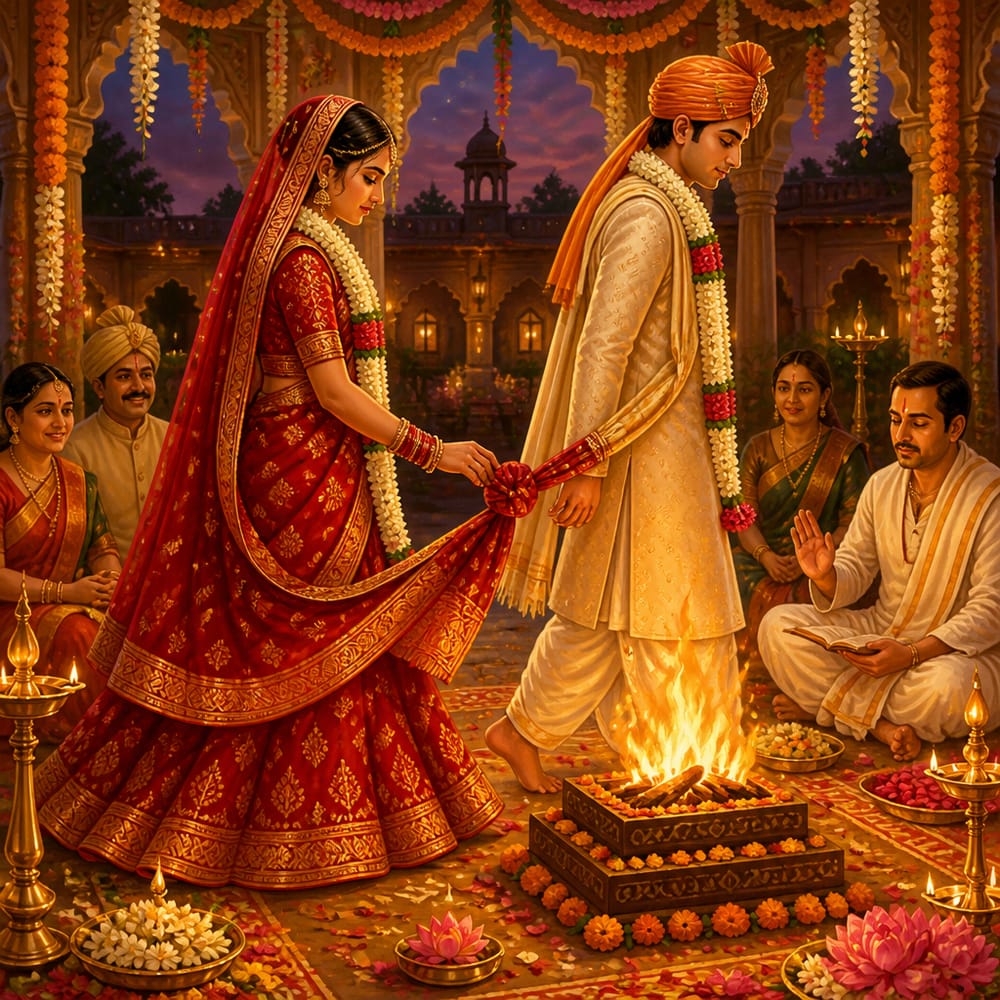
Bride and groom taking the Saptapadi seventh step around the fire

In the courtyard of my Sushila ajji's house in Lucknow, on a December evening when I was eight years old, my Saroj mausi got married. The mandap was a square of four banana stalks, tied at the corners with mango leaves. In the centre, a small square pit of dry mango wood and ghee burned steadily. The smoke rose straight up into the open sky above the courtyard. The sun had just set. The lamps on the walls were lit one by one. The priest, a thin man in a white dhoti, sat at the southern edge of the mandap with a small palm-leaf manuscript open on his lap.

Mausi sat on one side of the fire in a red Banarasi sari my ajji had kept folded in a steel trunk for thirty years. My new uncle sat on the other side. The priest began to chant in Sanskrit. The bride and groom stood. They tied the ends of their clothing together in a loose knot. They began to walk around the fire.

One step. Two. The priest spoke a vow with each step. Three. Four. Five. Six. The seventh step.

At the seventh step, my Sushila ajji, who had been dabbing her eyes for an hour, leaned down to me and whispered the only thing she ever told me about marriage. Agni saakshi. Agni saakshi. Fire is the witness. Fire is the witness.

She never explained the rest. She did not tell me that the seven vows the priest had just recited were composed in Sanskrit at least three thousand years ago and were now the longest continuously used wedding text in human history. She did not tell me that a global wedding industry worth more than three hundred billion dollars a year was, by 2024, selling versions of the same fire ceremony at Bali resorts to non-Hindu couples with the witness removed. She did not tell me that the moment my mausi's saree had crossed the line of the fire on the seventh step was the moment, in dharmic terms, that she had become married.

Not the registrar. Not the rings. Not the photograph. The seventh step.

This lesson is the explanation she did not give me.

Two Hands at the Fire

Father placing his daughter's hand into the groom's at Kanyadaan

The Hindu wedding has many forms across Bharat. None of them is the only one. But across Punjab, Tamil Nadu, Kerala, Bengal, Gujarat, and Maharashtra, four elements are always present.

Regional surfaces vary. In a Punjabi wedding, the bride and groom complete four phera (circumambulations) around the fire while the four Lavan hymns are recited; the saptapadi is folded into the four-phera form. In a Tamil wedding, the groom ties the mangalsutra or tali around the bride's neck in three knots, each knot a vow; she is then led around the fire seven times. In a Bengali wedding, the bride circumambulates the groom seven times in the Saat Paak, after which the Subho Drishti is the first formal exchange of glances. In a Marathi wedding, the Antarpat (a curtain held between the couple) is dropped during the Mangalashtak verses, and the saptapadi follows. In a Malayali wedding, the mangalyam is tied with a turmeric thread, and the jeerakam-jaggery mixture is exchanged as the symbol of the bond's sweetness in difficulty.

Different gestures, same engine. A fire. Seven vows. Two hands joined. A witness that does not forget.

The Oldest Wedding Liturgy in the World

The textual lineage is the most remarkable in the history of any ritual.

The Rig Veda Book 10, Hymn 85 is called the Vivaha Sukta. It contains 47 verses describing the wedding of Surya, the daughter of the sun (also called Savitri), to Soma, the moon. The hymn names the priest, the gifts, the journey of the bride from her father's house, the entry into the groom's home, the blessings of the gods, and the seven steps around the fire. Verse 36 contains the canonical Panigrahana mantra spoken by the groom as he takes the bride's hand.

गृभ्णामि ते सौभगत्वाय हस्तं मया पत्या जरदष्टिर्यथासः। भगो अर्यमा सविता पुरंधिर्मह्यं त्वादुर्गार्हपत्याय देवाः॥

gṛbhṇāmi te saubhagatvāya hastaṃ mayā patyā jarad-aṣṭir yathāsaḥ bhago aryamā savitā puraṃdhir mahyaṃ tvādur gārhapatyāya devāḥ

I take your hand for your good fortune, that you may grow old with me, your husband. Bhaga, Aryaman, Savitri, and Purandhi (the gods) have given you to me to be the mistress of my household.

Rig Veda, Mandala 10, Sukta 85, Verse 36

This verse has been recited at Hindu weddings for at least three thousand years, and arguably much longer. It is the longest continuously used wedding text in human history. The Code of Hammurabi includes marriage contracts; they are dated to 1750 BCE and are no longer in use anywhere. The Egyptian wedding hymns of the New Kingdom are preserved in temple inscriptions; they are no longer in use anywhere. The Vivaha Sukta is recited in a courtyard in Lucknow tonight.

The Atharva Veda Book 14 contains parallel marriage hymns. The Apastamba, Ashvalayana, and Baudhayana Grihya Sutras (c. 800 to 600 BCE) codify the procedure: the homa, the panigrahana, the saptapadi, the Lajahoma (parched rice offering), the Asmarohana (stepping on a stone), and the seventh step. The Manu Smriti chapters 3 and 9 list the eight forms of marriage and the rights and duties that follow. The Mahabharata Anushasana Parva elaborates on stridharma and the husband-wife as ardhangini, the half-body of one self.

The Saptapadi mantra from the Apastamba Grihya Sutra names each of the seven steps with its specific vow.

ऎकमिषे विष्णुस्त्वा अन्वेतु। द्वे ऊर्जे विष्णुस्त्वा अन्वेतु। त्रीणि व्रताय विष्णुस्त्वा अन्वेतु। चत्वारि मायोभवाय विष्णुस्त्वा अन्वेतु। पञ्च पशुभ्यो विष्णुस्त्वा अन्वेतु। षड् ऋतुभ्यो विष्णुस्त्वा अन्वेतु। सप्त सख्यो विष्णुस्त्वा अन्वेतु॥

ekam iṣe viṣṇus tvā anvetu. dve ūrje viṣṇus tvā anvetu. trīṇi vratāya viṣṇus tvā anvetu. catvāri māyo-bhavāya viṣṇus tvā anvetu. pañca paśubhyo viṣṇus tvā anvetu. ṣaḍ ṛtubhyo viṣṇus tvā anvetu. sapta sakhyo viṣṇus tvā anvetu.

One step for sustenance, may Vishnu walk with you. Two steps for strength. Three for righteousness. Four for happiness. Five for family. Six for the rhythms of the seasons. Seven for friendship. Through every step, may Vishnu walk with you.

Apastamba Grihya Sutra, Saptapadi mantra

Seven vows. Each one specific. Each one bound to a single step. The wedding is constituted at the moment the seventh step lands.

Why Fire Is the Witness

The symbolism of the wedding is not decorative. Every element is engineered.

The fire, Agni, is the only canonically valid witness to a Hindu marriage. No priest, no government, no document, no photograph can replace it. The Grihya Sutras are unambiguous: the marriage is incomplete without the homa fire, and complete the moment the saptapadi is finished around it. Why fire? Three reasons. Agni carries offerings to the gods, so he is the deity who relays the vow upward. Agni cannot be deceived, so he is the witness who does not forget. And Agni transforms whatever he touches, so he is the deity who marks the threshold between two unmarried lives and one married life.

The seven steps map to seven specific domains of partnership. Anna (food and sustenance), bala (strength), dhana (prosperity), sukha (happiness), praja (family), ritu (the rhythms of seasons and health), sakhi (friendship). The wedding is not one vague vow. It is seven specific vows, each with its own footstep, each named in Sanskrit, each carried by Vishnu the preserver.

The Kanyadaan is the most misunderstood element of the wedding, and the one that the modern world most often gets wrong. The parents pour water from a small vessel over the joined hands of the bride and groom. The water represents the transfer of responsibility for the bride's dharma from the father's house to the husband's house. It is not a transfer of property. It is not a dowry. The bride is not a thing being given. She is a person whose welfare and dharma are now being entrusted to a new guardian, who accepts the obligation publicly, in front of fire. The Sanskrit verb in the Kanyadaan mantra is daana, the same root as in deva-daana (offering to the gods). Modern dowry harassment, the demand for cash and goods from the bride's family, is a perversion of the Kanyadaan framework. Kanyadaan is not dowry. The two words must never be confused. Naming the corruption protects the original.

Some elements are gender-coded. The sindoor in the parting and the mangalsutra around the neck are wife-only markers in the North Indian tradition; the mangalyam around the neck and the metti (toe rings) on both feet are wife-only markers in the South. There is no equivalent groom-only daily marker in most regions. Many modern households have begun to add mutual elements, often a simple gold or silver ring for both partners, to balance the daily visible commitment. The tradition has no objection to this; the Saptapadi is the binding ritual, and what each partner wears afterward is a household choice.

What the Body Remembers

The wedding does something measurable to the body.

In 1993, Janice Kiecolt-Glaser and her team at Ohio State University published a study in the Journal of Consulting and Clinical Psychology. They tracked ninety newlywed couples for two years. They measured stress hormones (cortisol, ACTH, growth hormone, prolactin) during conflict in the lab. The finding the household tradition had always known: couples who reported their wedding ceremony as highly meaningful showed significantly lower cortisol during conflict at the two-year follow-up. Couples who described their wedding as logistical or performative showed elevated stress hormones during the same conflict tasks.

The ceremony's meaningfulness has a measurable physiological outcome two years later.

In 2001, Linda Waite and Maggie Gallagher published The Case for Marriage, a meta-analysis of marriage research. The book documented that publicly witnessed, ceremonially marked marriages outperform private agreements on every measurable dimension: physical health, mental health, financial outcomes, child welfare, and longevity. The mechanism, Waite argues, is the public commitment device. A vow witnessed by a roomful of named people behaves differently in the body than a private intention.

The Saptapadi is the most concentrated form of this mechanism ever designed. Helen Fisher at Rutgers University, in her work on pair-bonding neuroscience, identifies three distinct neurochemical systems: lust (testosterone, estrogen), romantic attraction (dopamine, norepinephrine), and long-term attachment (oxytocin, vasopressin). The seven specific vows of the Saptapadi appear to engage all three. Anna and bala bind the lust system to material co-survival. Dhana and sukha bind the dopamine system to shared reward. Praja, ritu, and sakhi bind the oxytocin system to long-term care.

A vague vow exchange engages one of the three. The Saptapadi engages all three. Three thousand years of households knew this without the journals.

What the World Calls It Now

The global wedding industry is now estimated at more than three hundred billion dollars a year. A meaningful slice of it sells the Hindu format to non-Hindu couples with the witness removed.

Luxury resorts in Bali, Tulum, and Hawaii offer spiritual fire ceremonies and vow exchanges around a sacred flame as premium destination-wedding packages. The structure is identical to the Saptapadi: a fire in the centre, seven vows, two clasped hands. The Agni-sakshi rationale, the Vishnu invocation, the Vivaha Sukta verses, are absent. The fire is decoration. The vows are general. The format is the most-copied wedding ritual in the world.

Vow ceremonies, intention exchanges, and meaningful weddings have become a category in the Western wedding-planning industry. They sell, on average, the bottom one percent of the Saptapadi structure: the idea of a vow at a wedding, without the seven specific vows, without the fire, without the named gods, without the three-thousand-year textual lineage.

The Practice (Sanatan) The Coopt (modern wedding industry)
Saptapadi (seven Sanskrit vows by step) Generic vow exchange
Agni Sakshi (fire as witness) Decorative flame at altar
Kanyadaan (dharma transfer) Father walks bride down aisle
Vivaha Sukta (3,000-year liturgy) Couple-written wedding vows
Panigrahana (Rig Veda 10.85.36 verse) The handfasting trend

None of this is a complaint. It is the receipts.

What to Call It Yourself

The naming matters.

The seven steps around the fire are not the seven vows around a flame. They are the Saptapadi, the heart of the Hindu wedding, with each step bound to one specific vow named in Sanskrit. Recite them by name. Anna. Bala. Dhana. Sukha. Praja. Ritu. Sakhi.

The pouring of water at the bride's hand is not giving away the bride. It is Kanyadaan, the parents' transfer of dharmic responsibility, and the husband's public acceptance of that responsibility in front of fire. It is not, ever, dowry.

The fire is not a candle ceremony. It is Agni Sakshi, the canonical witness who does not forget. Without the fire, there is no Hindu wedding. With the fire, the seventh step is the moment the marriage is constituted.

Modern Echoes

Kiecolt-Glaser's 1993 paper measured what the Vivaha Sukta has been claiming for three thousand years: a meaningful, witnessed ceremony alters the body's stress response years after the wedding. Waite and Gallagher's The Case for Marriage (2001) is the meta-analytic version of the same finding. Helen Fisher's pair-bonding neuroscience identifies three brain systems that long-term partnership must engage; the Saptapadi's seven specific vows happen to engage all three.

A three-hundred-billion-dollar wedding industry has been busy translating Rig Veda 10.85 into something it can sell. The Bali fire-ceremony package is the Saptapadi with the seven vows generalised and the witness extinguished. The original is still in a courtyard in Lucknow, with the dry mango wood burning, and a priest reading from a palm-leaf manuscript that was first composed before the pyramids of Giza were finished.

Back to the Smoke

My mausi has been married thirty-two years now. My Sushila ajji is gone. The courtyard has a roof on it now and the banana-stalk mandap is no longer there. But somewhere in mausi's body, the cortisol response that was set in front of that fire is still doing its work. Agni saakshi. Fire is the witness.

Key figures

Surya (Savitri), Daughter of the Sun

Eternal; the Vivaha Sukta of Rig Veda 10.85 is dated 1500 to 1200 BCE in Western dating, far older in Indian scholarly dating

Agni

Eternal; named in the very first hymn of the Rig Veda (1.1) as the priest, the deity, the messenger, the witness

Sita and Rama

Ramayana period (traditional dating circa 5114 BCE for Rama's birth; the Janakpur wedding follows shortly after)

Case studies

Rig Veda 10.85: The World's Oldest Wedding Liturgy

The Rig Veda Book 10, Hymn 85, is called the Vivaha Sukta. Its 47 verses describe the wedding of Surya, the daughter of the sun, to Soma the moon. The hymn names the priest, the chariot that carries the bride, the entry into the husband's house, the seven steps around the fire, and the blessings of the gods. Verse 36 contains the canonical Panigrahana mantra spoken by every Hindu groom for at least three thousand years. The hymn's seven core stanzas correspond exactly to the seven Saptapadi vows. By any measure, this is the longest continuously used wedding text in human history.

Other ancient civilisations had wedding liturgies. The Code of Hammurabi (c. 1750 BCE) contains marriage contracts. The Egyptian New Kingdom temple inscriptions preserve wedding hymns. The Greek and Roman wedding poems are extensively documented. None of these are still in use today. Only the Vivaha Sukta is. The Apastamba Grihya Sutra of the eighth century BCE codified the procedure; the Manu Smriti elaborated the social framework; the regional variations of Tamil, Bengali, Marathi, Punjabi, and Malayali weddings preserved the same Sanskrit core under different surface gestures. Three thousand years, one liturgy, one fire.

The Rig Veda 10.85.36 verse is recited at Hindu weddings on every continent today, by priests trained in the Apastamba and Ashvalayana traditions, to grooms in dhotis and grooms in tuxedos. The hymn has outlived every empire that surrounded its composition. The household pattern outlasted the political structures that contained it.

When the modern world treats Hindu wedding rituals as folkloric or outdated, check the textual record. The Vivaha Sukta is the longest continuously used wedding text in human history. The fire in the courtyard tonight is the same fire the Rig Veda named three thousand years ago.

The Saptapadi mantra you will hear at any Hindu wedding tonight was set in Sanskrit before the pyramids of Giza were finished. The household kept what the empires lost.

Rig Veda Book 10, Hymn 85 (Vivaha Sukta), 47 verses, 3,000 to 3,500 years of continuous documented use; the longest continuously used wedding text in human history.

Kiecolt-Glaser and Waite-Gallagher: The Body Remembers the Vows

In 1993, Janice Kiecolt-Glaser and her team at Ohio State University published a controlled study in the Journal of Consulting and Clinical Psychology. They tracked ninety newlywed couples for two years. They measured stress hormones (cortisol, ACTH, growth hormone, prolactin) during conflict tasks in the lab. The finding: couples who reported their wedding ceremony as 'highly meaningful' showed significantly lower cortisol during conflict at the two-year follow-up than couples who described their wedding as 'logistical' or 'performative'. In 2001, Linda Waite and Maggie Gallagher published The Case for Marriage, a meta-analysis showing that publicly witnessed, ceremonially marked marriages outperform private agreements on physical health, mental health, financial outcomes, and child welfare.

The Hindu tradition codified the meaningful, witnessed wedding three thousand years ago in the Vivaha Sukta and the Saptapadi. The Grihya Sutras specify that the marriage is constituted in front of fire, with seven specific Sanskrit vows, in the presence of the families. The structure is the maximal form of what Waite and Gallagher call the public commitment device. Helen Fisher's pair-bonding neuroscience adds that long-term partnership engages three distinct brain systems (lust, romantic attraction, attachment); the Saptapadi's seven domain-specific vows happen to engage all three. The labs are converging, finding by finding, on what the household has done for thirty centuries.

Kiecolt-Glaser's 1993 paper has been cited over 1,500 times and is foundational in marriage psychology research. Waite and Gallagher's The Case for Marriage shifted the academic and policy debate on marriage outcomes. Helen Fisher's pair-bonding work informs everything from couples therapy to dating-app design. None of them cite the Vivaha Sukta or the Apastamba Grihya Sutra. Each one vindicates a specific element of the practice the household has been keeping all along.

A meaningful, fire-witnessed, vow-specific wedding is not ceremonial overhead. It is a measurable physiological intervention with a two-year half-life. The Saptapadi is the most concentrated form of the public commitment device the labs have measured. The household tradition got there first.

The cortisol response set in front of the wedding fire is still doing its work two years later. The Saptapadi is the labs' most-durable public commitment device, with a three-thousand-year head start.

Kiecolt-Glaser et al, 1993, Journal of Consulting and Clinical Psychology: ceremony meaningfulness predicts cortisol response to conflict at 2-year follow-up. Waite and Gallagher, 2001, The Case for Marriage: publicly witnessed ceremonial marriages outperform private agreements on every measured outcome.

Bali Fire Ceremonies and Tulum Vow Exchanges: The Saptapadi, Rebranded

By 2024, the global wedding industry was estimated at more than three hundred billion US dollars annually. A meaningful slice of that market sells the Hindu wedding format to non-Hindu couples with the witness removed. Luxury resorts in Bali, Tulum, Hawaii, Sri Lanka, and Goa now offer 'spiritual fire ceremonies' and 'sacred vow exchanges around a flame' as premium destination-wedding packages, often priced between five thousand and fifty thousand US dollars. The structural elements are identical to the Saptapadi: a fire in the centre, seven vows, two clasped hands, a witness format. The Agni-sakshi rationale, the Vivaha Sukta verses, the Vishnu invocation, and the Sanskrit lineage are absent. Vow ceremonies and intention exchanges are now a category in mainstream Western wedding planning.

The Hindu tradition had already named, dated, and codified every element. The fire is Agni Sakshi, the canonical witness who does not forget. The seven vows are anna, bala, dhana, sukha, praja, ritu, sakhi, named in the Apastamba Grihya Sutra. The hand-taking is panigrahana, fixed in Rig Veda 10.85.36 three thousand years ago. The wedding industry's repackaging keeps the surface (the fire, the vows, the clasped hands) and removes the cosmology (the deity, the Sanskrit, the textual lineage). The structure works because it was built to work; what is sold at Bali is the structure with the rationale removed.

Hundreds of thousands of non-Hindu couples have now had a fire ceremony of some form at their wedding. The Saptapadi format has become, by quiet adoption, the most-copied wedding ritual in the world. The Hindu household, in the meantime, continues to perform the original at scale, with the same Vivaha Sukta verses and the same seven Sanskrit vows, in roughly fifteen million weddings every year across South Asia.

When the world calls it a sacred fire ceremony, call it Agni Sakshi. When the world calls it a vow exchange, call it the Saptapadi, and name the seven vows by their Sanskrit names. When the world calls Kanyadaan giving away the bride, name it correctly: a dharmic responsibility transfer, never a property transfer, never dowry. The Sanskrit names carry the cosmology that the English translations have stripped away.

The most-copied wedding format in the world is the Saptapadi with the seven Sanskrit vows generalised and the Agni witness extinguished. The original is in a Lucknow courtyard tonight, with the priest reading from the same hymn that was set down before the pyramids.

Global wedding industry: more than $300 billion annually as of 2024. Destination-wedding fire-ceremony packages at Bali and Tulum resorts: $5,000 to $50,000 per ceremony. Number of non-Hindu couples who have adopted some form of fire ceremony at their wedding: in the hundreds of thousands. Attribution to the Vivaha Sukta or the Apastamba Grihya Sutra in any of these listings: effectively zero.

Historical context

Multi-layered. Rig Veda Book 10 Hymn 85 (Vivaha Sukta) compositional layer dated 1500-1200 BCE in Western dating, 6000-4000 BCE in Indian scholarly dating per R.C. Majumdar; the Atharva Veda Book 14 contains parallel marriage hymns. Apastamba, Ashvalayana, and Baudhayana Grihya Sutras (c. 800-600 BCE) codify procedure. Manu Smriti (c. 200 BCE-200 CE) codifies the eight forms of marriage. The Ramayana (traditional dating ~5114 BCE for Rama's birth) preserves the Sita-Rama wedding at Janakpur as the canonical model.

The Hindu wedding format has been continuously practised in Bharat for at least three thousand years and arguably much longer, making it the longest-running ritual format in human history. The Rig Veda 10.85 Vivaha Sukta is the world's oldest wedding liturgy still in continuous use. The Atharva Veda Book 14 supplements it with parallel hymns. The Grihya Sutras of the eighth to sixth centuries BCE codified the procedure (homa, panigrahana, saptapadi, lajahoma, asmarohana) that every regional variation today still follows. The Manu Smriti's eight forms of marriage organised the social classification, with the Brahma form as the most widely practised. Across the Vedic, Itihasa, Smriti, and Puranic periods, the wedding format remained remarkably stable: the same Sanskrit verses, the same fire, the same seven steps. Regional variation evolved on the surface (Tamil tali tying, Bengali Saat Paak, Marathi Antarpat, Punjabi four-phera) but the underlying engine, the saptapadi around the agni-sakshi, has not changed.

Living traditions

The lesson here is to give the practice its right name. The seven steps around the fire are not a vow exchange around a flame. They are the Saptapadi, with each step bound to one specific Sanskrit vow named in the Apastamba Grihya Sutra. Recite them by name: anna, bala, dhana, sukha, praja, ritu, sakhi. The pouring of water at the bride's hand is not giving away the bride. It is Kanyadaan, the parents' transfer of dharmic responsibility, and it is never dowry. The fire is not a candle ceremony. It is Agni Sakshi, the canonical witness who does not forget. The wedding is not the registrar's signature. It is the seventh step in front of fire. The Bali fire-ceremony package at the luxury resort is selling Rig Veda 10.85 with the witness removed. The Sanskrit names carry the cosmology. Use the Sanskrit names. Tell your friends. The Vivaha travels better when it carries its proper name.

Reflection

More in The Sixteen Samskaras

All lessons in The Sixteen Samskaras · Samskaras: The Sanatan Operating System course