Learning Begins
Vidyarambha, Upanayana, and Vedarambha: how the Hindu civilisation invented the world's oldest school admission, the world's oldest student initiation, and the world's oldest curriculum convocation, and how Harvard's freshman convocation, Hogwarts' Sorting Hat, and the modern adult-learning literature are still rediscovering the design
A child of three writes the first letter of the alphabet on a tray of rice. A boy of eight is given the sacred thread by his teacher and whispered the Gayatri Mantra into his right ear. A young scholar at the start of formal Veda study performs the upakarma and begins the curriculum. The lesson opens these three samskaras of learning, traces them from the Atharva Veda through the Manava Grihya Sutra to Chandragupta Maurya's recorded Upanayana at Taxila, and shows how the same identity-commitment design that Knowles named as the foundation of adult learning and Hattie identified as the strongest predictor of academic achievement was already operating in the Hindu household three thousand years before either researcher arrived.
A Child Writing in Rice on Vijayadashami Morning
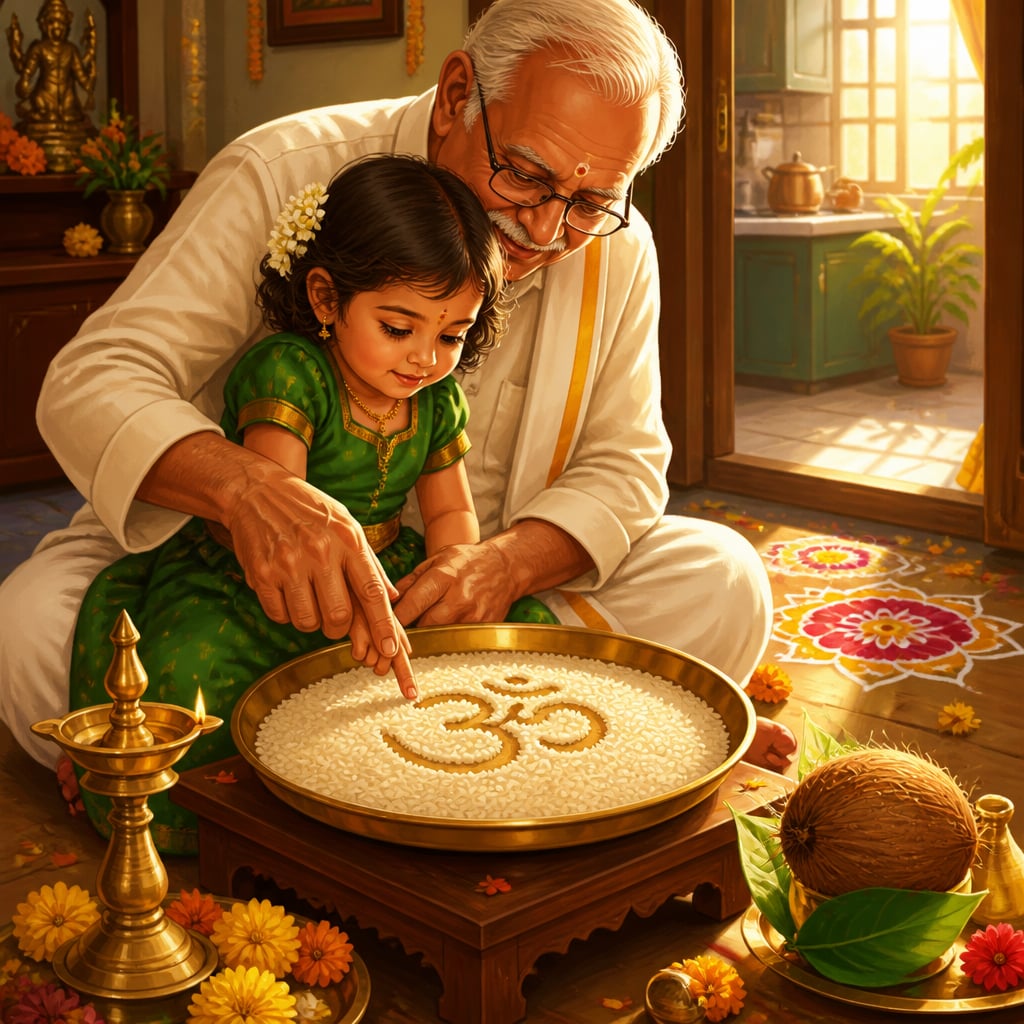
In a small flat in Mylapore, Madras, on a Vijayadashami morning in 1992, a child of three years and four months sits on her grandfather's lap. The grandfather is a retired Sanskrit teacher. In front of them is a brass tray, and on the tray is a thin layer of uncooked white rice. The grandfather takes the child's right hand in his own. He guides the small index finger to the rice. Together, slowly, they trace the Tamil letter அ. Then ஆ. Then இ. The child laughs at the way the rice grains feel under her finger. The grandfather does not laugh. He is whispering, very softly, the opening line of the Saraswati stuti: saraswati namastubhyam, varade kamarupini. He pauses. He guides the child's hand again. The same three letters. He says, almost to himself, ezhuthu pillai aanaal, vidya kanda devi varum. When the writing-child appears, the goddess of knowledge will come.
The child does not understand. The child is three. But twenty-two years later, when she is finishing her doctorate in computational linguistics at the Indian Institute of Science, she will remember the rice under her finger and the grandfather's whisper. She will remember it the way one remembers a smell. The Vidyarambha, the formal beginning of letters, has placed an anchor in the body of the child that no later education can remove.
Five years after that morning, in the same family, her older brother turns eight. He is the first male grandchild of the family. The household priest arrives at six in the morning of an auspicious day chosen by the family panchanga. The boy is bathed, dressed in a fresh white dhoti, and seated on a wooden plank facing east. The priest performs a brief homa. The boy's father, who has fasted for the previous twenty-four hours, takes the sacred thread, the yajnopavita, made of three twisted strands of cotton, and places it over the boy's left shoulder. The priest then leans close to the boy's right ear and whispers the Gayatri Mantra: om bhur bhuvah svah, tat savitur varenyam, bhargo devasya dhimahi, dhiyo yo nah pracodayat. The boy is asked to repeat. He stumbles on the third line. The priest waits. The boy gets it. The boy is now a brahmachari. The boy is now, in the language of the dharma literature, dvija, twice-born. His first birth was from his mother. His second birth has just occurred from his teacher.
Four years after the boy's Upanayana, when he begins formal Veda study at a small patashala in Kanchipuram, he performs the Vedarambha samskara. The teacher seats the boy on a kusha mat. The boy recites the Gayatri three times. The teacher names the first verse he will learn, the opening of the Krishna Yajur Veda's Aruna Prashna. The curriculum begins.
Three samskaras. Three doors. Each one marks a transition from one identity to another, with a public ritual, a presiding figure, and a memorable physical anchor (the rice under the finger, the thread on the shoulder, the kusha mat under the body). The Hindu civilisation invented the school admission, the student initiation, and the curriculum convocation. The world is still rediscovering each, fragment by fragment, three thousand years late.
Three Doors, One Pedagogy
The Hindu pedagogical samskaras are arranged as a sequence of three increasingly formal initiations into learning. Each one corresponds to a specific developmental stage and a specific shift in the child's identity.
Vidyarambha, the beginning of letters, is the first door. The samskara is performed when the child is between three and five years old, on an auspicious day (most commonly Vijayadashami in southern India and certain regional new-year days elsewhere), at a Saraswati shrine or before a Saraswati image at home. The child traces the first letters of the alphabet on a tray of rice or on the tongue with honey or on a slate, with the guidance of an elder, often the grandfather or the family teacher. The samskara marks the formal opening of the child's path into literacy.
Upanayana, the leading-toward, is the second door. The samskara is performed when the boy is between eight and twelve years old (the Manava Grihya Sutra's prescription is age eight for the Brahmin, eleven for the Kshatriya, twelve for the Vaishya, with regional and lineage variations). The presiding teacher places the yajnopavita over the boy's left shoulder, recites the Gayatri Mantra into the boy's right ear, and formally accepts the boy as a brahmachari. The samskara marks the boy's entry into formal study of the Vedas and his second birth as a dvija. Historically Upanayana was prescribed for the three twice-born varnas; reform movements from the nineteenth century onward, particularly the Arya Samaj of Dayananda Saraswati, have universalised the rite within reformed lineages, while traditional practice in many communities continues with the classical varna prescription.
Vedarambha, the beginning of the Vedas, is the third door. The samskara is performed at the formal start of Veda study, typically several years after Upanayana once the brahmachari has mastered the preliminary study (sandhya, basic Sanskrit grammar, the foundational mantras). The teacher initiates the student into the formal curriculum of Veda recitation, beginning with a specific opening verse from the Vedic shakha (recension) the lineage transmits. The samskara marks the transition from preparatory study to the formal Veda curriculum and is often performed publicly at the patashala or at the family shrine.
The three samskaras are not redundant. Each addresses a specific developmental and social transition. Vidyarambha opens the child's relationship with the symbolic system of language. Upanayana opens the child's relationship with the teacher and with the larger lineage of learning. Vedarambha opens the student's relationship with the specific textual tradition into which he is being formally inducted. The Hindu pedagogical sequence is therefore a layered architecture: language, lineage, text. No comparable three-stage sequence exists in any other classical pedagogical tradition.
The Practice, Across India
Vidyarambha is most prominently observed in southern India and Kerala on Vijayadashami, the tenth day of Navaratri. At Mookambika Devi temple in Kollur, Karnataka, at Saraswati shrines across Kerala, at the Vidya Saraswati temple at Basar in Telangana, and at countless household shrines, families bring three-to-five-year-old children for the formal beginning of letters. The standard ritual is the rice tray, the elder's guiding hand, and the recitation of a Saraswati stuti. In Kerala the ritual is called Vidyarambham and is performed at the Panmana Ashramam, the Thunchan Parambu (the home of the Tamil-Malayalam grammarian Thunchaththu Ezhuthachan), and many local Saraswati temples. In Tamil Nadu the day is called Vijayadashami and the Ayudha Puja precedes the Vidyarambha. In northern India, the parallel observance is Akshaya Tritiya in some lineages and Basant Panchami in others, with Saraswati Puja at the centre.

Upanayana runs across the country with strong regional variations. In southern India among the Smarta and Sri Vaishnava Brahmin communities, Upanayana is performed between ages seven and eleven, often as part of the larger thread-renewal ritual cycle that includes annual Avani Avittam. In northern India among Brahmin and Kshatriya families that retain the practice, Upanayana is performed between eight and twelve, often as a multi-day ceremony with elaborate community participation. In Maharashtra among Chitpavan and Deshastha Brahmin families, the Munja or Vratabandha is the local name for Upanayana and is observed with substantial community ritual. In Bengal among Brahmin families, the equivalent ceremony is called Paita and is performed with regional variations. In Gujarat among Pushti Marg Vaishnavas and Smarta Brahmins, the ceremony is called Janoi. The Arya Samaj movement, founded in 1875 by Dayananda Saraswati, universalised Upanayana within its reformed lineages and continues to perform it for boys and girls of all varna backgrounds at its yajna-shalas across India and the diaspora.

Vedarambha is observed primarily within the Brahmin patashala system, in which the brahmachari, after completing Upanayana and preliminary study, formally begins the recitation of the specific Vedic shakha his lineage transmits. The major surviving patashalas include the Sringeri Sharada Peetham (Karnataka), the Ahobila Mutt (Andhra Pradesh), the Kanchi Kamakoti Peetham (Tamil Nadu), the Pushpagiri Peetham, and dozens of smaller institutions. The brahmachari's curriculum runs anywhere from two to twelve years depending on the lineage's depth of study, and the formal Vedarambha at its start is performed with a homa, the recitation of the Gayatri, and the teacher's naming of the first verse of the curriculum.
The Scripture Says
The foundational source for Upanayana is the Manava Grihya Sutra, the Apastamba Grihya Sutra, the Bodhayana Grihya Sutra, and the Ashvalayana Grihya Sutra, all dated to between the eighth and the third centuries BCE. The Manava Grihya Sutra prescribes the age of the boy (eight for the Brahmin, eleven for the Kshatriya, twelve for the Vaishya), the timing of the ceremony (typically in the spring or summer in the bright fortnight of an auspicious month), the seating of the teacher and the boy, the threefold yajnopavita made of cotton for the Brahmin, hemp for the Kshatriya, and wool for the Vaishya, and the canonical mantra-sequence at the centre of which is the whispering of the Gayatri Mantra into the boy's right ear.
The Atharva Veda's Book 11, Hymn 5 is the Brahmacharya Sukta, a hymn of eighteen verses praising the brahmachari, his discipline, his teacher, and his transformation through the rite of initiation. The hymn is one of the strongest scriptural anchors for Upanayana and names the brahmachari as the new sun of his lineage, the carrier of the family's accumulated learning, the one whose discipline upholds the cosmic order.
The Chandogya Upanishad's Sixth Prapathaka contains the Aruni-Shvetaketu episode, in which the father Uddalaka Aruni asks his son Shvetaketu, who has just returned from twelve years at the gurukula, the question that opens the Upanishadic teaching: yenashrutam shrutam bhavati, amatam matam, avijnatam vijnatam (that by which the unheard becomes heard, the unthought thought, the unknown known). The episode is the canonical narrative of a brahmachari's return from formal Veda study and is widely cited in the Vedarambha tradition as the model of the educated young Brahmin returning to the household.
The Manusmriti's Second Adhyaya, verses 36 to 65, contains the most systematic codification of the brahmachari's discipline: the eight-fold rules of conduct, the daily routine, the relationship with the teacher, the food, the dress, the sleep, the speech. The Manusmriti is the procedural text most cited by traditional commentators on the Upanayana samskara.
The foundational source for Vidyarambha is comparatively later. The samskara is mentioned in the Markandeya Purana, the Vishnu Dharmottara Purana, and the Vidyaranya's Sayana Bhashya commentary, with the most detailed prescriptions in the medieval Dharmasindhu and the Nirnaya Sindhu compendia. The selection of Vijayadashami as the canonical day appears in the Devi Bhagavata Purana, which connects the day to the Devi's victory over Mahishasura and to the Pandavas' recovery of their weapons from the Shami tree at the close of the agnatavasa.
Vedarambha is documented across the grihya literature. The Apastamba Grihya Sutra and the Manava Grihya Sutra both prescribe the upakarma at the start of the Vedic curriculum, with the formal recitation of the opening verses of the lineage's shakha and the homa offering to the rishis of the Veda. Avani Avittam, the annual upakarma renewal, descends from this same ceremony.
The Symbolism
Vidyarambha's rice tray is not arbitrary. Rice, in the Hindu cosmographic system, is anna, the divine substance, the form of Lakshmi. To trace the first letter on rice is to write the alphabet on the body of Lakshmi, the goddess of prosperity. The child's first contact with the symbolic system of language is therefore a contact with the substrate of life itself. Saraswati and Lakshmi are honoured together in the gesture: Saraswati through the alphabet, Lakshmi through the rice. The two consorts of Vishnu hold the child's first letter in their joined hands.
Upanayana's yajnopavita carries multiple symbolic loads. The three twisted strands represent the three Vedas (Rig, Yajur, Sama), the three gunas (sattva, rajas, tamas), the three lokas (bhuh, bhuvah, svah), the three sandhya windows (sunrise, noon, sunset), and the three debts the brahmachari must repay (to the rishis through study, to the gods through yajna, to the ancestors through progeny). The thread is worn over the left shoulder and under the right arm, crossing the heart from the side of intellect (left) to the side of action (right), so that learning passes from concept to deed at every breath. The whispering of the Gayatri into the right ear is significant: in the Tantric framework, the right ear is the seat of dakshina nadi, the channel of formal knowledge, while the left ear is the seat of vama nadi, the channel of intuitive knowledge. Formal Veda study begins through the dakshina door.
Vedarambha's homa at the patashala marks the brahmachari's formal admission into the lineage of the Vedic curriculum. The fire is the witness of the boy's commitment, in the same role Agni plays as witness at the Saptapadi of the wedding ceremony. The teacher's naming of the first verse is the formal entry into the textual tradition. From that day, the brahmachari is reciting verses that his teacher's teacher's teacher recited, in identical Sanskrit, with identical svaras, in identical sequence, at the start of the same curriculum. The lineage runs unbroken to the rishi at the source.
Why the Body Responds
Layer four, habit architecture. The three pedagogical samskaras together form one of the most elegant identity-formation systems in any tradition. The mechanism is named in modern terms by Malcolm Knowles, the founder of adult learning theory, who in his 1975 book Self-Directed Learning identified the formal declaration of student identity as the foundation of all subsequent learning motivation. The brahmachari's verbal commitment at Upanayana, his physical marking with the yajnopavita, and his teacher's formal acceptance together produce, in modern habit-formation language, the strongest possible identity anchor for the learning role. The boy is not merely beginning to study. He has, in a public ritual, declared himself a student, accepted a teacher, and received a continuously visible marker of the new identity. Every subsequent moment of study is reinforced by the underlying identity commitment.
John Hattie, the educational researcher whose 2008 book Visible Learning aggregated meta-analyses of over eight hundred educational studies, identified identity commitment (the student's internal conviction that I am a learner) as the single strongest predictor of academic achievement, with effect sizes substantially larger than those of teacher quality, classroom size, or curriculum design. The Upanayana, three thousand years before Hattie's meta-analysis, encoded the identity commitment as a public, embodied, ritually witnessed act with a continuously visible physical marker. The Hindu civilisation discovered the strongest learning lever and built it into a samskara that every observant Brahmin household has performed continuously across the recorded history of the tradition.
Vidyarambha addresses the developmental stage at which the child's brain is most receptive to language acquisition. The selection of ages three to five for the formal alphabet introduction corresponds, in modern developmental psychology, to the peak of the brain's neuroplasticity for symbolic learning. The use of the rice tray, the honey on the tongue, and the slate provides multimodal sensory anchoring of the abstract symbols (visual, tactile, gustatory), a design that contemporary early-childhood pedagogy has rediscovered through Montessori's tactile-letter materials and the multisensory phonics movement of the late twentieth century.
Vedarambha's deferred-gratification structure (the brahmachari studies for years before formal Veda recitation begins) addresses the motivational architecture of long-form curricular study. The student has formally committed at Upanayana but has not yet been admitted to the formal Veda curriculum; this gap creates the anticipatory motivation that Walter Mischel's marshmallow studies and the broader self-regulation literature have identified as a strong predictor of academic achievement. The samskara converts the achievement of the foundational study into the entry into the higher curriculum, providing the structural reward that sustains the multi-year discipline.
What the Labs Found
The research record on initiation rituals and learning is now substantial. Knowles's foundational 1975 work on self-directed learning established the formal student-identity commitment as the strongest predictor of adult learning success. Hattie's 2008 Visible Learning meta-analysis, citing over eight hundred educational studies, confirmed identity commitment as the highest-effect-size variable in academic achievement, ahead of teacher quality, peer effects, and curriculum design.
Arnold Van Gennep, in his 1909 book Les Rites de Passage, established the three-stage architecture (separation, liminality, incorporation) of all human transition ceremonies, with explicit reference to Hindu samskaras as the foundational case studies. Van Gennep's framework, still standard in the anthropology of ritual, identified the Upanayana and the Vedarambha as among the most clearly structured initiation ceremonies in any tradition, with each stage of his three-stage architecture explicitly demarcated in the Hindu samskara protocol.
Jeffrey Arnett's research on emerging adulthood, developed across the early 2000s, has identified a striking finding: societies without clear transition ceremonies between adolescence and adulthood show significantly higher rates of identity diffusion, prolonged psychological adolescence, and elevated anxiety in the eighteen-to-twenty-eight age band. The Hindu samskaras of Upanayana, Vedarambha, Samavartana, and Vivaha provide a clear sequential transition architecture for the Hindu young adult, from the entry into formal study at eight to the householder's entry at marriage, with each transition publicly ritualised and identity-anchored.
Montessori's work on early childhood, beginning in the 1900s, identified the three-to-five-year window as the peak of the absorbent mind, the period in which the child acquires symbolic systems with extraordinary efficiency. Her sandpaper-letter materials, in which the child traces letters on a tactile surface, are functionally identical to the Vidyarambha rice tray. The Hindu civilisation had identified the same window and the same multisensory pedagogical method approximately two thousand years before Montessori observed it.
What the World Calls It Now
The modern echoes are precise.
Harvard University's freshman convocation, held annually at Memorial Church, includes a procession, a candle-lighting, an oath, and the formal acceptance of the new students into the academic community. The structural elements are recognisably the secularised descendants of Upanayana: the procession, the new identity declaration, the formal acceptance by the institutional authority, and the lit symbol of learning. Yale, Princeton, Oxford, Cambridge, and most other elite universities run structurally similar convocations. None of these ceremonies cite the Manava Grihya Sutra or the Apastamba Grihya Sutra. The form has been carried, the lineage has been forgotten.
J.K. Rowling's Sorting Hat ceremony in the Harry Potter novels, read by over five hundred million readers worldwide, has become one of the most widely recognised fictional initiation ceremonies in contemporary culture. The ceremony's structure (the formal declaration of identity, the assignment to a teacher's house, the public witness, the physical marker of belonging) is, beat for beat, the design of Upanayana. Rowling has acknowledged drawing on multiple ritual traditions in her construction of Hogwarts's ceremonies. The Hindu samskara remains uncited.
The modern American graduation industry, estimated at four and a half billion dollars annually in 2022, runs on the structural elements of Samavartana, the convocation samskara that closes the formal study cycle (covered in the next lesson). The cap, the gown, the procession, the formal degree conferral, and the family feast are recognisable continuations of the Indian convocation tradition. The Megasthenes Indica, written around 304 BCE, contains the earliest external eyewitness account of the Hindu graduation ceremony at Pataliputra.
The Vidyarambha rice tray has its modern echo in the Montessori sandpaper-letter materials, the Reggio Emilia tactile pedagogy, the multisensory phonics movement, and the educational toy industry's recent emphasis on tactile-letter products. Maria Montessori's work, published from the 1900s onward, identified the absorbent-mind window of three to five years and the multimodal sensory pedagogy as the foundations of effective early literacy. The Vidyarambha samskara had operationalised both findings approximately two thousand years before Montessori's observation.
The Knowles 1975 book on self-directed learning has founded a multi-billion-dollar adult-education industry, with corporate training, executive education, MOOCs, and continuing professional development all running on the formal-identity-commitment architecture Knowles identified. The Hindu Upanayana, three thousand years before Knowles, ran the same architecture as a household ritual.
What to Call It Yourself
From this lesson onward, when you see a freshman convocation, name the older protocol. Upanayana. When you watch the Sorting Hat scene at Hogwarts, name the older ceremony. The formal initiation of a brahmachari into the lineage of his teacher. When you read about identity commitment as the strongest predictor of academic achievement, name the older instrumentation. The Manava Grihya Sutra. When you watch a child trace her first letter on a sandpaper card at a Montessori classroom, name the older instrument. The Vidyarambha rice tray. The grandmothers and the grandfathers and the family priests have been running these protocols continuously for three thousand years. The labs and the universities and the educational toy industry are arriving, one fragment at a time, three thousand years late. The course names the depth of the older source so the practitioner can hold both the contemporary form and the original architecture in the same gaze.
Key figures
Chandragupta Maurya
Founder of the Mauryan Empire; the most famous historical brahmachari whose Upanayana and Taxila education are documented in classical and external sources; the canonical case study of the Hindu pedagogical system producing a world-historical leader. · c. 340 to 297 BCE
Chandragupta Maurya, founder of the Mauryan Empire that would consolidate the Indian subcontinent for the first time in recorded history, received his Upanayana and his subsequent education at Taxila under the philosopher and political strategist Chanakya (also known as Kautilya, author of the Arthashastra). The Buddhist Mahavamsa, the Greek accounts preserved by Plutarch and Justin, and the classical Indian sources including the Mudrarakshasa and the Vishnu Purana all converge on the Taxila education as the formative period of Chandragupta's preparation for empire. The age of Upanayana in his case is recorded as approximately eight years, the canonical Manava Grihya Sutra prescription for the Kshatriya. The curriculum included the Vedas, statecraft, military strategy, philosophy, and the practical disciplines of governance. The result, by the time Chandragupta returned to defeat the last Nanda king around 322 BCE, was the most consequential leader the subcontinent had produced. Megasthenes, the Greek ambassador to the Mauryan court, would later document the educational system that produced Chandragupta in his Indica, the earliest external eyewitness account of Hindu samskaras.
Chandragupta's Upanayana at Taxila is the canonical historical case study of the Hindu pedagogical samskara producing a world-historical leader. The Arthashastra, attributed to his teacher Chanakya, is one of the foundational texts of Indian political economy and explicitly references Upanayana as the qualifying credential for the Kshatriya seeking formal education in statecraft. The Nalanda University Archives, before the university's destruction in the twelfth century, referenced Upanayana as the entrance qualification for Brahmin and Kshatriya students. The samskara was, in this sense, the world's oldest documented university entrance credential, three thousand years before the modern admissions process. Chandragupta is the case study; the Manava Grihya Sutra is the procedural code; the Arthashastra is the curriculum; the Mauryan Empire is the outcome.
Thunchaththu Ezhuthachan
Tamil-Malayalam grammarian, poet, and scholar; the canonical figure of the Vidyarambha tradition in Kerala; the author of the Adhyatma Ramayana Kilippattu and the Mahabharatam Kilippattu, foundational works of modern Malayalam literature; the patron-figure of the Kerala Vidyarambham observance. · c. 1495 to 1575 CE
Thunchaththu Ezhuthachan is the most consequential figure in the early modern history of Kerala literacy. His Adhyatma Ramayana Kilippattu, written in Malayalam in a sixteenth-century vernacular accessible to the wider Malayali population beyond the Sanskrit-educated Brahmin class, is widely credited with establishing modern Malayalam as a literary and devotional vernacular. His grammatical and pedagogical works codified the early Malayalam alphabet for systematic teaching. After his death, his home in Tirur, Malappuram district, became the Thunchan Parambu, a pilgrimage site for the Vidyarambham ceremony. To this day, on Vijayadashami morning, thousands of Kerala parents bring three-to-five-year-old children to the Thunchan Parambu to perform Vidyarambham at the site associated with the canonical figure of Malayalam literacy. The Kerala state government has, in recent decades, recognised the Thunchan Parambu as a cultural-literacy heritage site and has supported the continuing observance of the samskara at the location.
Ezhuthachan is the case study of the Vidyarambha samskara as a culturally formative practice for an entire regional language tradition. The Kerala Vidyarambham at the Thunchan Parambu is one of the most powerful contemporary expressions of the samskara, drawing tens of thousands of children annually. The figure's significance is not theological but pedagogical: he stands for the formal opening of the regional vernacular alphabet to the broader population, and the samskara performed at his memorial site enacts the same opening for each generation of Kerala children. Ezhuthachan is also the proof that Vidyarambha is not merely a Brahmin observance; the samskara, in its Kerala expression, serves the entire literate community of the state.
Malcolm Knowles
American adult-education researcher; founder of andragogy (the theory of adult learning); author of Self-Directed Learning (1975) and The Modern Practice of Adult Education (1970); the modern documenter of the formal student-identity commitment as the foundation of learning motivation. · 1913 to 1997 CE
Malcolm Knowles, working through the 1960s, 1970s, and 1980s at North Carolina State University and Boston University, established the field of andragogy, the theory of adult learning, as distinct from pedagogy, the theory of child education. His 1975 book Self-Directed Learning identified six core principles of effective adult learning, of which the foundational principle was the formal declaration of student identity: the learner must, through a structured commitment, formally identify himself or herself as a student of the specific subject matter, with a named teacher, a named curriculum, and a named expected outcome. Without this formal identity commitment, Knowles found, adult-learning interventions produced significantly weaker results regardless of the quality of the instruction. The finding has shaped the multi-billion-dollar contemporary adult-education industry, including corporate training, executive education, MOOCs, and continuing professional development. Knowles's framework remains, four decades after the foundational publication, the dominant theoretical model in adult-education research.
Knowles's 1975 finding is the modern echo's most rigorous receipt for the Upanayana samskara's identity-commitment architecture. The brahmachari's verbal commitment, his physical marking with the yajnopavita, and his teacher's formal acceptance together produce, in modern habit-formation language, exactly the identity commitment Knowles identified as the foundation of all subsequent learning motivation. The Hindu civilisation discovered the strongest learning lever and built it into a samskara that every observant Brahmin household has performed continuously across the recorded history of the tradition, three thousand years before Knowles arrived to name the mechanism. The course names the lineage.
Case studies
Chandragupta Maurya's Upanayana at Taxila and the World's Oldest University Entrance Credential
Around 340 BCE, in a small Kshatriya household whose precise lineage is debated across the Buddhist Mahavamsa, the Greek accounts of Plutarch and Justin, the classical Indian Mudrarakshasa, and the Vishnu Purana, a boy of approximately eight years old received his Upanayana. The boy's name was Chandragupta. The presiding teacher who would shortly take charge of his education was Vishnugupta, also known as Chanakya or Kautilya, the philosopher and political strategist who would later author the Arthashastra, the foundational text of Indian political economy. The Upanayana was the formal threshold of a multi-year curriculum at Taxila, the great university city of the north-western subcontinent, whose teachers drew students from across the Mauryan, Greek, Persian, and Bactrian regions. The Taxila curriculum, as documented in the Buddhist Jataka tales, the Arthashastra itself, and the surviving epigraphic and literary records, included the four Vedas, the six Vedangas, statecraft (rajaniti), military strategy (dhanurveda), philosophy (darshana), grammar (vyakarana), logic (nyaya), medicine (ayurveda), and the practical disciplines of imperial administration. The Upanayana was the qualifying credential for the Brahmin and Kshatriya student seeking admission to such a curriculum. The Nalanda University Archives, before the university's destruction in the late twelfth century, similarly referenced Upanayana as the entrance qualification for Brahmin and Kshatriya students. The samskara was, in this sense, the world's oldest documented university entrance credential, with a continuous institutional history spanning at least eighteen centuries from the Taxila of Chandragupta to the Nalanda of the medieval period. Chandragupta's case is the canonical historical instance: the boy who received Upanayana at eight, completed the Taxila curriculum, returned to defeat the last Nanda king around 322 BCE, founded the Mauryan Empire, and consolidated the Indian subcontinent for the first time in recorded history. Megasthenes, the Greek ambassador to Chandragupta's grandson Bindusara's court at Pataliputra, would later document the Hindu graduation ceremony in his Indica, providing the earliest external eyewitness account of the Indian samskara of learning.
In the Hindu reading, Chandragupta's Upanayana is not merely a biographical detail. It is the canonical demonstration that the samskara of formal student initiation produces, when followed by the appropriate curriculum and the appropriate teacher, the consequential leader. The Manava Grihya Sutra prescribes the rite. The Atharva Veda's Brahmacharya Sukta lifts the brahmachari to a cosmic figure. The Arthashastra codifies the curriculum. The samskara, the scripture, and the curriculum together form the integrated pedagogical system that produced Chandragupta. The Hindu civilisation has, in this case, the most consequential historical proof of concept available for any educational system: the samskara that initiated the boy is operationally identical to the samskara performed today on every observant Brahmin and Kshatriya boy, and the architecture that produced Chandragupta is, structurally, the same architecture available to every contemporary Hindu household that performs the rite.
The Mauryan Empire, founded by Chandragupta around 322 BCE and extended by his grandson Ashoka in the third century BCE, was the first political entity to consolidate substantially the entire Indian subcontinent. The Arthashastra, attributed to Chanakya, became the foundational text of Indian political economy and remained, for over two millennia, the principal manual of Indian statecraft. The Taxila and Nalanda university traditions continued for over a millennium, with Upanayana serving as the entrance credential throughout. The institutional integration of the samskara, the curriculum, and the teacher's role produced a continuous pedagogical lineage that no other classical civilisation matched in either depth or duration.
A pedagogical samskara that has produced, demonstrably, the most consequential leaders of Indian classical history, is not a folk ritual. It is a working educational technology with a documented historical record of outcomes. The Hindu civilisation's three-thousand-year continuous practice of Upanayana is the longest-running educational-credential system in human history, three millennia before the modern university degree was conceived. The lesson is not nostalgia; it is acknowledgement. The samskara that produced Chandragupta is the samskara performed today. The architecture is unbroken. The course names the depth so the practitioner can hold the contemporary form against the historical lineage.
Every contemporary Indian university entrance examination, every contemporary admission ritual, every contemporary degree-conferral ceremony is, in structural terms, a descendant of the Upanayana samskara that admitted Chandragupta to Taxila. The course names this lineage so that the practitioner, encountering both the contemporary admissions process and the historical Hindu samskara, can hold the depth of the older source against the surface of the modern institutional form.
Chandragupta Maurya, c. 340 to 297 BCE; Upanayana at Taxila under Chanakya; founding of the Mauryan Empire c. 322 BCE. The Arthashastra of Kautilya, c. 4th century BCE to 2nd century CE. The Mahavamsa, the Mudrarakshasa, the Vishnu Purana, and the Greek accounts preserved by Plutarch and Justin all documenting the Taxila education. The Megasthenes Indica, c. 304 BCE, recording the Hindu graduation ceremony. Nalanda University Archives, before destruction c. 1193 CE.
Knowles's Self-Directed Learning and Hattie's Visible Learning: Modern Vindication of the Identity-Commitment Architecture
In 1975, Malcolm Knowles, then at North Carolina State University, published Self-Directed Learning: A Guide for Learners and Teachers, the foundational text of the field of andragogy (the theory of adult learning) as distinct from pedagogy (the theory of child education). The book identified six core principles of effective adult learning, and its foundational principle was the formal declaration of student identity. The learner, Knowles found, must, through a structured commitment, formally identify himself or herself as a student of the specific subject matter, with a named teacher, a named curriculum, and a named expected outcome. Without this formal identity commitment, adult-learning interventions produced significantly weaker results regardless of the quality of the instruction, the resources of the institution, or the motivation of the individual. The finding has shaped the contemporary adult-education industry, including corporate training, executive education, the MOOC platforms (Coursera, edX, Udemy), and the multi-billion-dollar continuing professional development segment. Three decades later, in 2008, John Hattie, then at the University of Auckland, published Visible Learning: A Synthesis of Over 800 Meta-Analyses Relating to Achievement, the most comprehensive aggregation of educational research ever produced. Hattie's meta-analytic finding was striking and consistent across studies. Identity commitment (the student's internal conviction that *I am a learner*) had the highest effect size on academic achievement of any variable measured, with effect sizes substantially larger than those of teacher quality, classroom size, peer effects, or curriculum design. The Visible Learning framework has become, in the fifteen years since publication, one of the most-cited references in modern educational research and policy. Together, the Knowles 1975 framework and the Hattie 2008 meta-analysis establish the formal student-identity commitment as the single strongest lever in education at any age. The Hindu Upanayana samskara, three thousand years before either researcher arrived, encoded this exact identity commitment as a public, embodied, ritually witnessed act with a continuously visible physical marker (the yajnopavita). The boy who has received Upanayana has, in a public ritual, declared himself a student, accepted a teacher, and received the visible marker of the new identity. Every subsequent moment of study is reinforced by the underlying identity commitment, exactly as Knowles and Hattie would later identify.
The Vedic frame named the same observation through the language of the brahmachari's transformation. The Atharva Veda's Brahmacharya Sukta describes the brahmachari as a cosmic figure: he sustains heaven and earth through the discipline of his tapas. The Manusmriti's Second Adhyaya codifies the discipline that flows from the identity commitment: daily sandhya, daily Veda recitation, simple food, simple dress, exclusive devotion to the teacher. The classical Indian sources operated through the language of identity transformation (the boy becomes dvija, twice-born, with a new mode of existence) rather than through the language of effect-size measurement. The two vocabularies describe the same observation. The Indian household, across three thousand years, has operated the protocol on the basis of the transformation. The 2008 meta-analysis vindicates the protocol by quantifying the effect-size.
The Knowles framework has been cited over fifteen thousand times since publication and is the dominant theoretical model in contemporary adult-education research and practice. The Hattie meta-analysis has been cited over thirty thousand times and has shaped educational policy across multiple national systems, including the United Kingdom's national curriculum, the New Zealand education ministry's pedagogical guidelines, and the Australian Institute for Teaching and School Leadership standards. The classical Indian sources have not, however, entered the citation network of these papers. The mechanism is named in modern terms; the older source is not.
The pedagogical architecture that the Manava Grihya Sutra prescribed in 800 BCE is now vindicated, in effect-size and andragogy vocabulary, by 1975 and 2008 papers that did not cite the Manava Grihya Sutra. This is the canonical pattern of modern educational research vis-a-vis the Indian source. The mechanism is not denial. The mechanism is friction. Western educational research operates within a citation network that does not include classical Sanskrit primary sources, and the absence is not noticed because the absence is structural. The course is the bridge. The Upanayana samskara anchors the identity commitment. The Knowles and Hattie frameworks measure the effect of the identity commitment. Both name the same protocol.
When a 2024 corporate training programme prescribes formal goal commitment, named-mentor pairing, and visible identity markers (badges, certificates, role designations) to maximise learning effectiveness, the underlying claim has been imaged in the Knowles 1975 framework and the Hattie 2008 meta-analysis. The Upanayana samskara, three thousand years earlier, was running the same protocol as a household ritual. The course is the bridge that names both the modern instrumentation and the older Indian source the modern programme has not always cited.
Knowles, M.S., 1975, Self-Directed Learning: A Guide for Learners and Teachers; Knowles, M.S., 1970, The Modern Practice of Adult Education. Hattie, J.A.C., 2008, Visible Learning: A Synthesis of Over 800 Meta-Analyses Relating to Achievement; Hattie, J.A.C., 2012, Visible Learning for Teachers.
Harvard's Freshman Convocation, Hogwarts's Sorting Hat, and the World's Continuous Reinvention of Upanayana
Each September, Harvard University holds its freshman convocation at Memorial Church on the Cambridge campus. The new students process in academic robes from Harvard Yard to the church. The university president addresses them. Faculty members in full academic regalia witness the ceremony. The students light candles, take an oath of academic conduct, and are formally welcomed into the academic community. The structural elements (the procession, the new identity declaration, the formal acceptance by the institutional authority, the lit symbol of learning, the witnessed oath) are recognisably the secularised descendants of Upanayana. Yale, Princeton, Oxford, Cambridge, MIT, Stanford, and most other elite universities run structurally similar convocations, with regional variations. The American university convocation industry, in aggregate, processes approximately twenty million students annually through structurally Upanayana-derived initiation ceremonies, none of which cite the Manava Grihya Sutra, the Apastamba Grihya Sutra, or the Hindu samskara as the historical antecedent. In parallel, the most widely recognised fictional initiation ceremony of the contemporary cultural imagination is J.K. Rowling's Sorting Hat ceremony, performed in the great hall of Hogwarts on the first day of each new student's arrival at the school. The ceremony's structure (the formal declaration of identity, the assignment to a teacher's house, the public witness, the physical marker of belonging through the house tie and the house common room) is, beat for beat, the design of Upanayana. The Harry Potter novels have sold over five hundred million copies worldwide and have shaped the imagination of two generations of contemporary readers around the structure of an initiation ceremony that the Hindu civilisation has been performing continuously for three thousand years. Rowling has acknowledged drawing on multiple ritual traditions in constructing Hogwarts's ceremonies; the Hindu samskara remains uncited. The Megasthenes Indica, written around 304 BCE, contains the earliest external eyewitness account of the Hindu samskara of learning, predating the foundation of Harvard by approximately two thousand years and the first publication of Harry Potter by approximately twenty-three centuries.
In the Hindu reading, the freshman convocation and the Sorting Hat are not parodies of Upanayana, nor are they unwelcome echoes. They are the world's continuous reinvention of an architecture that the Hindu civilisation discovered and codified three thousand years ago. The reinvention demonstrates the architecture's fundamental soundness. Knowles and Hattie have shown why the architecture works (the formal identity commitment is the strongest lever in education); Harvard and Hogwarts have shown that the architecture, once discovered, is recognisably the same regardless of cultural context. The Hindu samskara is the original. The world's modern universities and the world's most-read fiction have, independently, arrived at the same structure. The lineage costs the modern institution nothing to acknowledge and gives the practitioner everything to know.
The American university convocation system, the global elite-university initiation system, the Hogwarts Sorting Hat ceremony as a cultural reference point, and the broader contemporary educational-initiation imagination are not under threat from the Hindu lineage being named. The convocations continue. The novels sell. The fictional ceremonies inspire. The course is not asking for a boycott. The course is asking for a name. When you watch a freshman convocation, knowing or not knowing the Manava Grihya Sutra; when you read the Sorting Hat scene, knowing or not knowing the Atharva Veda's Brahmacharya Sukta; when you receive your own degree at a graduation ceremony, knowing or not knowing the Megasthenes Indica, you are participating in a tradition with a precise origin and a continuous lineage. Naming the lineage costs the institution nothing and gives the practitioner everything.
Cooption is not always malice. The American university convocation genuinely descends from medieval European university traditions that themselves drew on Christian monastic initiation rites, themselves drawing partly on Roman ritual frameworks. The Sorting Hat is genuinely a creative composite of multiple ritual sources. None of these traditions, however, is older than the Atharva Veda's Brahmacharya Sukta. The defence is naming. Use the older words. Upanayana. Brahmachari. Yajnopavita. The contemporary global system is allowed to flourish. We are allowed to remember whose protocol it is.
The next time you watch a freshman convocation, attend a graduation ceremony, or read the Sorting Hat scene in a Harry Potter novel, you will know two things the institution and the author do not announce. The protocol has a 1200 BCE codification in the Atharva Veda's Brahmacharya Sukta and an 800 BCE procedural code in the Manava Grihya Sutra. The samskara has been continuously performed in observant Hindu households for at least the last two and a half millennia. The course is the receipt. Carry it lightly. Use it when needed.
Harvard University freshman convocation, held annually at Memorial Church. American higher education enrolment, approximately twenty million students annually. J.K. Rowling, Harry Potter and the Philosopher's Stone, 1997, with the series selling over five hundred million copies by 2023. Megasthenes, Indica, c. 304 BCE, the earliest external eyewitness account of the Hindu samskara of learning.
Historical context
Vedic to modern: c. 1200 BCE Atharva Veda's Brahmacharya Sukta (Book 11, Hymn 5) lifting the brahmachari to a cosmic figure; c. 800 to 300 BCE Manava, Apastamba, Bodhayana, and Ashvalayana Grihya Sutras codifying the Upanayana samskara; c. 340 to 297 BCE Chandragupta Maurya's Upanayana and Taxila education under Chanakya; c. 304 BCE Megasthenes's Indica recording the Hindu graduation ceremony at Pataliputra; medieval Markandeya Purana, Vishnu Dharmottara Purana, and Dharmasindhu codifying the Vidyarambha samskara; sixteenth-century Thunchaththu Ezhuthachan and the Kerala Vidyarambham tradition; 1875 CE Arya Samaj's universalisation of Upanayana across varnas and sexes; 1909 CE Van Gennep's Les Rites de Passage; 1975 CE Knowles's Self-Directed Learning; 2008 CE Hattie's Visible Learning meta-analysis.
Living traditions
The Vidyarambha rice tray, the Upanayana yajnopavita, and the Vedarambha homa are alive in tens of millions of Hindu households today, on every Vijayadashami morning at every Saraswati shrine, at every Brahmin and reformed-lineage Upanayana ceremony from age eight onward, at every patashala's annual upakarma at the start of the curricular year.
The Vidyarambha rice tray, the Upanayana yajnopavita, and the Vedarambha homa are alive in tens of millions of Hindu households today. Every Vijayadashami morning at every Saraswati shrine, every Brahmin and reformed-lineage Upanayana ceremony from age eight onward, every patashala's annual upakarma at the start of the curricular year is the system functioning exactly as designed. The vocabulary is the discipline. From this lesson onward, when you see a freshman convocation, name the older protocol. Upanayana. When you watch the Sorting Hat, name the older ceremony. The formal initiation of a brahmachari into the lineage of his teacher. When a child traces letters on a sandpaper card at a Montessori classroom, name the older instrument. The Vidyarambha rice tray. The samskaras do not require the names. The practitioner does.
- Vidyarambham at the Thunchan Parambu and the Kerala Saraswati Shrines: Every Vijayadashami morning, tens of thousands of Kerala parents bring three-to-five-year-old children to the Thunchan Parambu in Tirur, the home of the sixteenth-century grammarian and poet Thunchaththu Ezhuthachan, for the formal Vidyarambham ceremony. Similar large-scale observances happen at the Panmana Ashramam, at the Kalpathy Sri Sri Vishwanatha Swami Temple in Palakkad, and at countless smaller Saraswati shrines across Kerala. The ceremony's structure is invariant: the child sits on the elder's lap, the elder's hand guides the child's index finger across a tray of rice (or honey on the tongue, or a slate), the first letters of the Malayalam alphabet are traced (typically OM, then the vowels A, AA, I, II, U, UU), and the Saraswati Stuti is recited. The Kerala state government, recognising the Thunchan Parambu as a heritage site of cultural-literacy significance, has supported the continuing observance and the preservation of the site. The samskara has, in modern Kerala, become one of the most universally observed Hindu ceremonies, crossing caste, sub-community, and household lines.
- Upanayana at the Smarta, Sri Vaishnava, and Arya Samaj Lineages: Upanayana is performed across observant Hindu households worldwide as the formal initiation of the boy (and, in reformed lineages, the girl) into the brahmachari stage of life. The Smarta Brahmin households of Tamil Nadu, Karnataka, Andhra Pradesh, and Kerala perform the rite between ages seven and eleven, with the Manava Grihya Sutra and the regional smarta paddhati as the procedural sources. The Sri Vaishnava households of Tamil Nadu and Andhra Pradesh follow a parallel protocol with Pancharatra Agama elements added, including the post-Upanayana samasrayana initiation. The Iyengar households similarly perform the samskara with their lineage-specific mantras and procedural elements. The Chitpavan and Deshastha Brahmin households of Maharashtra perform the Munja or Vratabandha as the local Upanayana, with extensive community ritual. The Bengali Brahmin households perform the Paita with regional variations. The Gujarati Pushti Marg and Smarta households perform the Janoi. The Arya Samaj movement, founded in 1875, performs Upanayana for boys and girls of all varna backgrounds at its yajna-shalas across India and the diaspora, with the Vedic mantras retained and the varna-restriction explicitly removed. The samskara, across all these regional and reformed expressions, retains its core elements: the yajnopavita, the whispered Gayatri, the teacher's formal acceptance, and the boy's (or girl's) formal commitment to the brahmachari discipline.
- Vedarambha and Annual Upakarma at the Patashalas: Vedarambha, the formal beginning of Veda study, is performed at the patashala (the traditional Vedic school) at the start of each brahmachari's curriculum and is renewed annually at the Avani Avittam upakarma. The major surviving patashalas include the Sringeri Sharada Peetham's pathshala system (Karnataka), the Ahobila Mutt's pathshala (Andhra Pradesh), the Kanchi Kamakoti Peetham's affiliated patashalas (Tamil Nadu), the Pushpagiri Peetham's pathshala (Andhra Pradesh), and dozens of smaller institutions across India. The brahmachari's curriculum runs anywhere from two to twelve years depending on the lineage's depth of study, and each year's session begins with the formal Avani Avittam upakarma on the full moon of Shravana, in which the previous year's yajnopavita is discarded with appropriate mantras, a new yajnopavita is worn, and the lineage's specific Vedic shakha is recited as the renewal of the formal commitment to the curriculum. The patashala system has, despite the broader decline of formal Veda study in the modern period, retained its core institutional integrity, with thousands of brahmacharis continuing the formal multi-year curriculum across India.
- Mookambika Devi Temple, Kollur: The Mookambika Devi temple at Kollur, dedicated to a form of the Devi who unites Saraswati, Lakshmi, and Mahakali in a single iconic murti, is one of the most significant Saraswati shrines in southern India. The temple is a particular destination for the Vidyarambham samskara and for parents seeking the Devi's blessing on a child's formal beginning of letters. The temple's main sanctum holds the Mookambika linga with the goddess's three forms; the surrounding shrines house specific Saraswati and Lakshmi murtis. On Vijayadashami morning, hundreds of three-to-five-year-old children are brought to the temple for the formal Vidyarambham, with the rice tray, the elder's guiding hand, and the Saraswati Stuti recited at the inner sanctum. The temple also serves the broader pedagogical-samskara needs of the region, with priests offering the Vidyarambham as a year-round service for families whose schedule does not align with Vijayadashami. The temple's connection to Adi Shankara, who is said to have meditated at the site and to have composed certain hymns there, gives the location an additional layer of pedagogical-spiritual significance.
- Sringeri Sharada Peetham: The Sringeri Sharada Peetham, founded by Adi Shankara in the eighth century CE, is one of the four cardinal mathas (Dakshinamnaya) of the Smarta Advaita lineage and is the principal traditional centre of Vedic education in southern India. The peetham's pathshala system has continuously transmitted the Vedic curriculum for over twelve centuries, with brahmacharis from across India undertaking multi-year residential study. The peetham's Sharada Devi shrine is one of the most important Saraswati shrines in the country. The annual Avani Avittam upakarma at the peetham, performed on Shravana Purnima, is one of the largest and most institutionally significant upakarma observances in India, with hundreds of dvijas across multiple Vedic shakhas renewing their yajnopavita and reciting their lineage's opening verses. The peetham also performs the formal Vedarambha for new brahmacharis at the start of their curriculum, with the Shankaracharya himself or his designated representative serving as the presiding teacher. Visitors to the peetham can observe the daily Saraswati puja, the morning Veda recitation by the resident brahmacharis, and, with appropriate prior arrangement, certain ceremonies of the upakarma cycle.
Reflection
- Look back at your own formal beginnings of learning: the first day of school, the first university orientation, the first day of a new course of self-directed study. Which of these were marked publicly, with a teacher's witness, with a continuously visible anchor? Which were marked privately, by your own internal decision alone? What does the difference reveal about which of those learning thresholds held over time?
- The Manava Grihya Sutra prescribed Upanayana as the formal initiation of the boy into formal Veda study at age eight, with a teacher's whispered Gayatri, a continuously visible yajnopavita, and a multi-year curriculum to follow. Knowles in 1975 and Hattie in 2008 identified the formal student-identity commitment as the strongest predictor of academic achievement. What does it mean to inherit a pedagogical tradition whose central mechanism has been continuously vindicated by every era of measurement that has been applied to it?
- The Hindu pedagogical samskara is an integrated system: the rite, the curriculum, the teacher's role, the physical marker, the developmental staging. The contemporary educational system has fragmented these elements: enrolment is administrative, curriculum is contracted, teacher relationships are transactional, markers are bureaucratic credentials, developmental staging is increasingly collapsed. What would change in your own learning life if you reintegrated some of these fragments into a more coherent personal pedagogical architecture?