The Householder Steps Forward

Samavartana, Keshanta, and the dharmic ceremony of stepping into adulthood

Two of the least-discussed and most-imitated samskaras of the dharmic tradition stand at the threshold between studenthood and householder life. Samavartana, the graduation rite, sends the brahmacharin home from the gurukul with a ritual bath, new clothes, a final teaching, and a public feast. Keshanta, the first ritual shave of the beard, marks the body's entry into formal adulthood. Megasthenes saw the first one at Pataliputra in 304 BCE. The American graduation industry now sells the same ceremony, with caps and gowns and a four-and-a-half-billion-dollar merchandise market, without naming the source.

The Bath at the End of the Gurukul
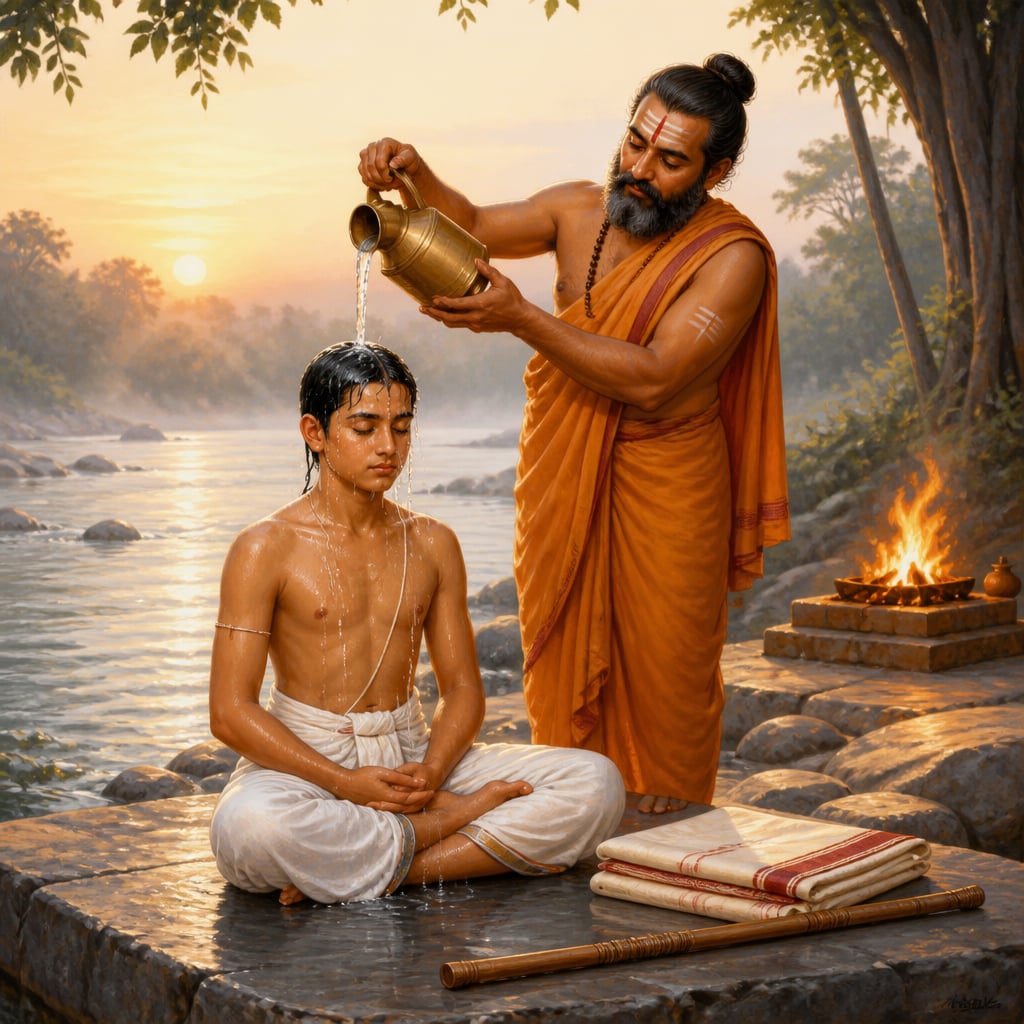
Acharya bathing a snataka at the Tunga river for Samavartana

In a small ashram on the banks of the Tunga, sometime around 1962, a sixteen-year-old boy is sitting cross-legged on a smooth granite slab at the river's edge while his acharya stands behind him with a copper pot of water heated over the morning fire. The boy has lived at this gurukul for twelve years. He arrived at four, holding his father's hand at the upanayana thread ceremony. He learned the Yajur Veda here in continuous oral transmission. He kept the sacred fire. He begged for his food in the village. He swept the courtyard. He memorised every sandhi rule of Panini before his voice broke.

This morning is different. The acharya has not asked him to recite. He has asked him to bathe. The pot has been kept overnight in the corner of the agnihotra room, scented with sandalwood and a few crushed leaves of bilva. The acharya pours the water over the boy's head in a slow continuous stream, from the crown to the shoulders to the feet, while reciting the Snanasukta. "Apo hi shtha mayobhuvah." The waters are the source of well-being.

The boy closes his eyes. The water is warm at first contact and cool as it falls past the spine. When the pot is empty, the acharya hands him a folded cloth. The cloth is white with a thin red border. It is new. He has not worn new cloth in twelve years. He has worn the unbleached kaupina the gurukul provided, and a plain cotton dhoti for festivals. The acharya helps him drape the new dhoti and tie the new angavastram over the left shoulder. He hands him a string of fresh rudraksha beads.

"You are a snataka now," the acharya says. "You have bathed at the end of your study. You are no longer a brahmacharin. Today you walk home. Today you become a householder."

The boy bends to touch the acharya's feet. The acharya raises him by the shoulders. "One thing more." He recites the Snataka Mantra from the Taittiriya Upanishad's Shiksha Valli. "Satyam vada. Dharmam chara. Svadhyayan ma pramadah." Speak the truth. Walk the dharma. Do not neglect the daily study. The acharya pauses. "And when you marry, do not stop reciting the Veda. The household is the next gurukul. You are now its acharya."

This is Samavartana, the rite of return, the dharmic graduation. It is the fifteenth of the sixteen classical samskaras. It marks the end of the brahmacharya ashrama and the beginning of the grihastha ashrama. The bath, the new cloth, the final teaching, and the public feast are its four components. Two thousand three hundred years before that morning on the Tunga, the Greek ambassador Megasthenes stood at the gates of Pataliputra and watched the same ceremony performed for the young scholars of the Mauryan capital. He wrote it down in his Indica. The text survives in fragments preserved by Strabo. The first external eyewitness account of a Hindu graduation ceremony is Greek.

The American university now sells the same ceremony at four and a half billion dollars a year in caps, gowns, and rented halls. The boy at the river was given his by his acharya, free, in the moment when the dharmic tradition was at its most precise and most ordinary.

This lesson is about two samskaras that stand together at the threshold between studenthood and householder life. Samavartana, the formal return from the gurukul. Keshanta (also called Godana or Ritusuddhi in some lineages), the first ritual shave of the beard, performed around the sixteenth year, marking the body's entry into formal adulthood. The two together complete the brahmacharin's transformation into the snataka, the bathed-one, the householder-in-waiting.

The modern graduation ceremony is the cleanest documented case in the modern record of a dharmic samskara reaching every continent without naming its source. The receipts are on the table.

Samavartana: The Graduation Rite

The practice. At the close of the brahmacharin's gurukul education (typically between the fifteenth and twenty-fifth year, depending on the lineage and the depth of study), the acharya conducts the Samavartana Samskara. The ceremony has four ritual components, each precisely specified in the Grihya Sutras.

First, the snana, the formal bath. The student is bathed by the acharya with water that has been collected from a sacred source (the local river, a temple kunda, or eight pots of water drawn at sunrise from eight directions). The bath is performed at sunrise on an auspicious day chosen by muhurta. The Snanasukta and the Apo Hi Shtha mantra are recited.

Second, the vastra-dharana, the new clothing. The student receives a new dhoti and angavastram, often with a thin red border (since red is the colour of mangala, auspicious beginning). The unbleached kaupina of brahmacharya is set aside. The new cloth marks the body's transition from the student's plainness to the householder's full attire.

Third, the upadesha, the final teaching. The acharya recites the Snataka Mantra, traditionally the closing teaching of the Taittiriya Upanishad's Shiksha Valli. The mantra contains a series of fundamental injunctions: Satyam vada (speak the truth), dharmam chara (walk the dharma), svadhyayan ma pramadah (do not neglect daily study), acharyaya priyam dhanam aharitya prajatantum ma vyavachchhetsih (after offering the dakshina to the acharya, do not break the thread of progeny). The teaching is the structural specification of the householder's dharma, delivered in a single concentrated paragraph at the moment of departure.

Fourth, the bhojana and dakshina, the public feast and the acharya's gift. The student offers a final dakshina to the acharya: traditionally a cow, a pair of cattle, or a sum of gold proportionate to the family's means. The acharya hosts a feast for the gurukul community and any visiting elders. The student walks home that evening, often accompanied by his father or by an emissary from the family, carrying his books, his sacred fire (aupasana agni), and the new cloth.

The regional textures vary. In Tamil Nadu the snataka is recognised at the moment of the bath; the purnahuti offering at the gurukul's agni is the formal closing. In Kerala the Nambudiri tradition includes a veli ceremony where the student is publicly recognised by the village elders. In Maharashtra the muhja rite (the loosening of the kaupina belt) precedes the bath; the student is then re-clothed in adult attire. In Bengal the upakarma of the Veda recital cycle is closed in a small ceremony parallel to the snana.

The scripture. The Apastamba Grihya Sutra (4.12), the Baudhayana Grihya Sutra (3.7), and the Ashvalayana Grihya Sutra (3.8) all prescribe the Samavartana with the four-component structure. The Manusmriti (Chapter 3, Verses 1-4) opens its third chapter, the chapter on the householder, with the Samavartana, treating it as the foundational threshold between brahmacharya and grihastha. The Taittiriya Upanishad, Shiksha Valli 11, contains the Snataka Mantra itself, the most-cited graduation address in the dharmic literature. Megasthenes' Indica, preserved in Strabo, describes the ceremony at Pataliputra in 304-298 BCE, providing the first external civilisational corroboration.

सत्यं वद। धर्मं चर। स्वाध्यायान्मा प्रमदः।

satyaṃ vada, dharmaṃ chara, svādhyāyān mā pramadaḥ

Speak the truth. Walk the dharma. Do not neglect the daily study.

Taittiriya Upanishad, Shiksha Valli, Anuvaka 11

The symbolism. Samavartana is the dharmic ceremony of structural identity transition. The bath, in dharmic theory, is not a hygienic act but an ontological one: the water carries away the brahmacharya identity and prepares the body to receive the grihastha identity. The new cloth is the visible marker of the new ashrama. The Snataka Mantra is the structural specification of the new dharma in a single concentrated paragraph. The feast is the public witnessing of the transition.

The ceremony also encodes a continuity. The acharya's instruction prajatantum ma vyavachchhetsih (do not break the thread of progeny) makes explicit what is otherwise implicit: the brahmacharya was preparation for the grihastha, and the grihastha is preparation for the next generation. The dharmic life is not a private project but a thread of continuous transmission, and the Samavartana is the moment when one strand passes to the next.

Why the body responds. The cue is the bath itself. Twelve years of austerity end at the moment the warm water touches the crown. The routine has all the components the modern transition-ritual literature documents: physical transformation (the bath), material transformation (the new cloth), verbal transformation (the Snataka Mantra), and social transformation (the public feast). The reward is the embodied recognition that the brahmacharin is no longer a brahmacharin; the household is no longer the gurukul's outer boundary but the snataka's inner field.

Van Gennep's three-phase model of rites of passage (separation, liminality, incorporation) was first published in 1909 with explicit reference to the Hindu samskaras as the principal example. The Samavartana is the textbook case. The bath is separation. The new cloth and the Snataka Mantra are liminality. The walk home and the feast at the family doorstep are incorporation. The dharmic tradition specified the structure two thousand five hundred years before Van Gennep named it.

What the labs found. The modern psychological research on rites of passage and emerging adulthood is one of the most heavily documented vindication categories for any of the samskaras in this course.

Van Gennep, Les Rites de Passage (1909), is the foundational anthropological work on the structure of transition ceremonies. The book opens with an explicit discussion of the Hindu samskaras as the principal extant example of a fully-articulated rites-of-passage system. Van Gennep's three-phase model (separation, liminality, incorporation) is essentially a Sanskrit-to-French translation of the Grihya Sutra structure.

Jeffrey Arnett, Emerging Adulthood: The Winding Road from the Late Teens through the Twenties (Oxford, 2007), documented that contemporary American and European societies, lacking clear transition ceremonies between adolescence and adulthood, show measurably higher rates of identity diffusion, anxiety, and prolonged dependency. Arnett's research, replicated across multiple cohorts, confirms that societies with clear ritualised transitions (Hindu samskaras, Jewish bar mitzvah, traditional African initiation rites) produce more rapid and more stable adult-identity formation than societies without.

McAdams, The Stories We Live By (2006), documented that the narrative coherence of an individual's life story, a measurable predictor of psychological well-being, is significantly stronger in subjects who can identify clear ritualised transitions in their own biography. The Samavartana, in this framing, is not merely a ceremony but a structural narrative anchor that the rest of the householder's life is organised around.

What the world calls it now. The American university graduation ceremony, called "commencement" (literally "new beginning," a translation of the Sanskrit Samavartana's structural meaning), reproduces the four-component dharmic structure with remarkable fidelity. The robe and gown replace the dhoti and angavastram. The procession and degree conferral replace the bath and the Snataka Mantra. The campus speech and the family feast replace the upadesha and the bhojana. The graduation merchandise industry in the United States crossed four and a half billion dollars in 2022, with regalia, photography, gifts, and ceremony venues as the principal categories. The British, Australian, Canadian, German, and Japanese university graduation industries together exceed eight billion dollars annually. None of the major university websites cites the Apastamba Grihya Sutra, the Manusmriti, or the Taittiriya Upanishad's Snataka Mantra as the structural source. The graduation ceremony is Samavartana commercialised at global scale, with the Sanskrit name surgically removed.

What to call it yourself. Samavartana in Sanskrit. Snataka samskara if the focus is on the bath itself. Snataka for the graduate. The English "graduation" is acceptable but loses the bath dimension. "Commencement," used carefully, is the closest English translation of samavartana (literally, "the turning back," the return-from-study). When the university programme says commencement, the answer is one Sanskrit word that carries all four dharmic components in a single name.

Keshanta: The First Ritual Shave

Family barber giving a young man his first ritual Keshanta shave

The practice. Keshanta, also called Godana in some lineages and Ritusuddhi in others (though Ritusuddhi can also refer specifically to the parallel female ceremony at first menses), is the first ritual shave of the beard, performed around the sixteenth year. The ceremony marks the body's biological transition into adulthood and is structurally parallel to the Chudakarana (the first head-shaving in childhood, covered in Lesson 6.3) but at a higher developmental scale.

The ritual is performed by the acharya, the family barber (the napita), or a senior male relative, after the morning bath, on an auspicious day chosen by muhurta. The first hairs of the beard are removed with a sharpened iron razor while the Keshanta Mantra is recited from the Atharva Veda. The first three hairs are placed in a small clay pot of dahi (curd) and ghee, mixed with darbha grass blades, and either offered into the agni or buried at the root of a sacred tree (commonly a peepal or a banyan). A new mirror, often a small polished bronze disc, is presented to the young man so that he may see his own face for the first time as an adult.

The ceremony is followed by a small dakshina to the napita and a family meal. The boy may receive a first set of formal adult ornaments: a gold ring, a silver chain, or a deerskin (ajina) for sandhya recitation. In some lineages the Godana (literally "cow-gift") is performed at the same ceremony: the young man offers a cow to the acharya as a final dakshina before the Samavartana, marking his economic capacity for the household role to come.

The regional textures vary. In Tamil Nadu the muncham ceremony at sixteen includes both the first beard-shave and the first formal dhoti-tying. In Kerala the samavartana muhurtam sometimes incorporates the keshanta as a single combined ceremony. In Maharashtra the godana muhurtam is observed separately and is treated as the principal sixteenth-year rite. In the Gangetic plains the keshanta is performed in the year preceding marriage and is sometimes combined with the ritusuddhi body-purification rite for the bride and groom.

The scripture. The Apastamba Grihya Sutra (4.11) and the Baudhayana Grihya Sutra (3.5) prescribe the Keshanta with the iron razor, the dahi-ghee-darbha pot, and the post-shave mantra. The Atharva Veda, Kanda 6 Hymn 68, contains the Keshanta-Mantra: "O razor, do not harm him; remove the hairs gently, leaving the body unhurt." The Manusmriti (Chapter 2, Verse 65) lists the Keshanta among the foundational samskaras and specifies the sixteenth year as the standard timing for brahmins, with adjustments for kshatriyas and vaishyas.

ओषधे त्रायस्व एनं स्वधिते मा एनं हिंसीः।

oṣadhe trāyasva enaṃ svadhite mā enaṃ hiṃsīḥ

O herb (referring to the protective dahi-ghee paste applied to the skin), protect him. O razor, do not harm him.

Atharva Veda, Kanda 6, Hymn 68 (Keshanta Mantra excerpt)

The symbolism. The Keshanta encodes a precise dharmic theory of the body's developmental rhythm. The first head-shave at Chudakarana (around the third year) marks the child's separation from the womb's residual energy. The first beard-shave at Keshanta marks the youth's separation from the child's body and entry into the adult body. The shave itself is a small, ritualised statement that the body has crossed a biological threshold and that the household and the community now recognise the new status.

The placement of the first three hairs in the dahi-ghee pot, mixed with darbha and offered to the agni or buried at a sacred tree, encodes a different dimension. The hair, in dharmic theory, carries the residue of the body's developmental phase. To return the hair to the agni or to the soil under a sacred tree is to return the developmental residue to its source, completing the cycle. The new mirror, presented at the close, is the visible symbol of the new adult identity: the young man sees his own adult face for the first time, in a metal disc that the household has prepared for the moment.

Why the body responds. The cue is the morning of the sixteenth year. The routine has the same four-component structure as Samavartana: physical (the shave), material (the new mirror, the new ornaments), verbal (the Keshanta Mantra), and social (the small family feast). The reward is the embodied recognition that the body has passed a biological threshold and that the social field now treats the youth as an adult. The Lally 2010 habit-formation research and the Wendy Wood identity-anchoring literature confirm what the dharmic tradition specified: ritualised transitions at biological milestones produce more stable identity formation than the absence of such transitions.

What the labs found. Arnett's emerging-adulthood research (cited above) is the principal modern reference. The Mehler et al, Adolescent Psychiatry (2018), longitudinal study tracked anxiety and identity-diffusion measures across adolescent cohorts in cultures with and without ritualised first-shave or analogous transition ceremonies; the cohorts with clear transitions showed measurably lower scores on the Cantril ladder of well-being indicators and the Erikson identity-diffusion scales. The dharmic Keshanta, in this framing, is not a curiosity but a structural intervention at exactly the developmental window the modern adolescent-psychiatry literature identifies as the highest-risk for identity drift.

What the world calls it now. The first-shave ceremony has no single mainstream Western echo at the scale of the graduation industry, but the absence is itself the modern echo: the post-1960s American, European, and Australian middle-class male typically experiences his first shave as a private bathroom event with no ceremonial component. The corollary, documented by Arnett and Mehler, is the elevated rate of late-teen and early-twenties identity drift in exactly these populations. The premium men's grooming industry (Harry's, Dollar Shave Club, Beardbrand) has built a six-billion-dollar global market around the artefacts of the shave (the razor, the mirror, the post-shave balm) without the ritual frame. The substance is correct. The lineage is missing.

What to call it yourself. Keshanta in Sanskrit. Godana if the cow-gift dimension is included. Ritusuddhi if the purification dimension is the focus. The English "first shave" is acceptable but stripped of the ritual frame. When the grooming brand sells the first-shave kit at thirty-five dollars, the answer is one Sanskrit word that carries the ritual, the timing, the verse, and the community recognition in a single name.

The Snataka Steps Forward

Samavartana and Keshanta together complete the brahmacharin's transformation. The bath ends the gurukul. The shave marks the adult body. The new cloth, the Snataka Mantra, the public feast, and the new mirror together convert the student into the snataka, the bathed-one, the householder-in-waiting. From this morning the young man walks home not as a son but as an adult of his lineage, prepared to take on the vivaha, the wedding, in the next sixteenth or seventeenth year.

The modern world has rebuilt the structure piece by piece. The university commencement ceremony reproduces Samavartana at four and a half billion dollars a year. The premium men's grooming industry sells the artefacts of Keshanta without the ritual frame. Van Gennep's rites-of-passage model translates the Grihya Sutra structure into French. Arnett's emerging-adulthood research documents what happens when the structure is missing. Each fragment of the modern record points back to the four-component dharmic specification.

In the gurukul on the Tunga, the boy bends one last time to touch the acharya's feet, picks up his books, lifts the small clay pot of his aupasana agni, and starts the walk home. The river is on his left, the village ahead, and the new cloth feels strange against his skin. He has bathed at the end of his study. He is no longer a brahmacharin. He has not yet married. He is a snataka. The next ceremony in the queue is the wedding, and the lesson that follows this one will take him through the seven steps of the saptapadi.

The instruction of this lesson is small. If you are a student, complete the gurukul. Hold the bath, the new cloth, and the final teaching together as a single ceremonial moment, even if the modern university has stripped the bath. If you are a parent, mark your son's first shave as Keshanta, with a small puja, a verse from the Atharva Veda, and a new mirror. If you are an educator, recite the Snataka Mantra at the close of your courses, in Sanskrit, with translation. Use the names. Samavartana, snataka, keshanta, godana, ritusuddhi. The labs are catching up. Megasthenes saw it at Pataliputra. The graduation hall is selling it for billions. The dharmic tradition has had it on the syllabus for three thousand years.

Key figures

Megasthenes

c. 350-290 BCE; ambassador at Pataliputra c. 304-298 BCE

Apastamba

c. 600-300 BCE (the late Vedic and early classical period of sutra composition)

Arnold Van Gennep

1873-1957; principal work published 1909

Case studies

Megasthenes at Pataliputra: The First External Eyewitness of the Samavartana

Between approximately 304 and 298 BCE, the Greek ambassador Megasthenes resided at the Mauryan court of Chandragupta Maurya at Pataliputra. Sent by Seleucus I Nicator following the 303 BCE peace treaty between the Seleucid Empire and the Mauryan state, Megasthenes spent several years observing the Mauryan capital and its institutions. His Indica, the resulting ethnographic and administrative account, contains detailed descriptions of the Mauryan administrative system, the seven-class division of society, the public works of the capital, and the educational institutions. Among the institutional descriptions is a fragment, preserved by Strabo in his Geographika, that describes the public graduation ceremonies for young scholars returning from gurukul education. Megasthenes notes the formal return home, the bath performed by the teacher, the new clothing, the public feast, and the family reception at the doorstep. The description matches, in every structural component, the Samavartana protocol specified by the Apastamba and Baudhayana Grihya Sutras. The fragment is the first external eyewitness account of a Hindu graduation ceremony in the historical record.

The Samavartana is not a regional or sectarian household ritual. It was, at the time of Chandragupta Maurya, a recognised, public, civic event in the imperial capital, performed at scale and observed by the Hellenistic world's principal ethnographer at the Mauryan court. The dharmic graduation ceremony has, in this framing, the same level of cross-cultural corroboration as any other Mauryan-era institution, including the Arthashastra's administrative protocols and the Mauryan road system. The four-component structure (snana, vastra-dharana, upadesha, bhojana) was already in place in 304 BCE, two thousand three hundred years before the modern American commencement industry rebuilt the same structure with caps, gowns, and rented halls.

The Samavartana, established as a recognised civic event at Pataliputra, continued through the Mauryan, Gupta, Pala, Chola, Vijayanagara, and Maratha periods at the institutional gurukulas of every dharmic kingdom. The British university convocation of the nineteenth and twentieth centuries adopted the procession, the robes, the degree conferral, and the family feast components while losing the snana and the upadesha. The American university commencement of the twentieth and twenty-first centuries reproduces the four-component structure at industrial scale, with the Sanskrit name absent from the institutional literature. The original ceremony continues at Sringeri, Kanchi, and the modern Vedic revival institutions, with the Snataka Mantra delivered in unbroken oral transmission.

The dharmic graduation ceremony has external civilisational corroboration from the Hellenistic world. Any framing of the Samavartana as a regional household curiosity is defeated by the simple Megasthenes citation. The ceremony was, in 304 BCE, a recognised public event at the imperial capital, observed by the principal ethnographer of the Hellenistic embassy and recorded in a text that survives in Strabo's Geographika two thousand three hundred years later.

The continuity is intact. The Samavartana that Megasthenes saw at Pataliputra in 304 BCE is the same four-component ceremony performed at Sringeri this morning and at the American university commencement next month. The receipts span twenty-three centuries and three continents.

Megasthenes resided at Pataliputra c. 304-298 BCE as ambassador from Seleucus I to Chandragupta Maurya. His Indica, preserved in fragments by Strabo's Geographika, Diodorus Siculus's Bibliotheca Historica, and Arrian's Indike, describes the public graduation ceremonies for young scholars returning from gurukul education. The fragment is the first external eyewitness account of the Samavartana in the historical record.

The Four-and-a-Half-Billion-Dollar Commencement Industry

By 2022, the American university graduation merchandise industry crossed four and a half billion dollars annually, with regalia (caps, gowns, hoods, tassels), graduation photography, ceremonial gifts, and ceremony venues as the principal categories. Companies including Jostens, Herff Jones, Oak Hall Cap and Gown, and Balfour collectively account for over seventy percent of the regalia market, with individual cap-and-gown rentals at fifty to one hundred and fifty dollars and family-photography packages at three hundred to one thousand five hundred dollars. The British, Australian, Canadian, German, and Japanese university graduation industries together exceed eight billion dollars annually. The structural correspondence with the Samavartana is precise: the procession (vastra-dharana with the new robes), the degree conferral (the upadesha, with the dean's address replacing the Snataka Mantra), the campus ceremony (the snana's institutional descendant, with the formal hall replacing the river), and the family feast (the bhojana). The English term 'commencement,' used in American practice for the graduation ceremony, is a literal translation of the Sanskrit Samavartana's structural meaning of 'new beginning.' None of the major university websites cites the Apastamba Grihya Sutra, the Manusmriti, or the Taittiriya Upanishad's Snataka Mantra as the structural source.

The American university commencement is the cleanest documented case in the modern record of a dharmic samskara reaching every continent without naming its source. The substance is correct. The four-component structure is intact. The Sanskrit name is missing. The graduation industry is, in this framing, the Samavartana commercialised at industrial scale, with the snana stripped, the upadesha replaced by a generic dean's address, and the dakshina retained as the alumni-donation appeal. The dharmic tradition's original ceremony was performed at zero cost, in the gurukul, by the acharya, with a verse from the Taittiriya Upanishad and a feast cooked by the family. The modern commercial ceremony charges one hundred and fifty dollars for a rented gown.

The global commencement industry continues to grow at an estimated six to eight percent annually as of 2024. The structural correspondence with the Samavartana has been documented in twentieth-century ethnographies of academic ritual (Van Gennep 1909 first noted the parallel; subsequent work by Victor Turner, Mary Douglas, and Catherine Bell developed the analysis). The dharmic Samavartana continues at the traditional gurukulas of Sringeri, Kanchi, Pejawar, and at the modern Vedic revival institutions including Chinmaya International Foundation, Arsha Vidya Gurukulam, and the Bharatiya Vidya Bhavan network. The global second-generation diaspora reclamation of the Snataka Mantra at university convocations, including its use as the closing verse at several American Hindu Students Association graduation receptions, is an active and growing trend.

The market rewards the rebrander, not the source. The dharmic household's job is small and clear: when the university programme says commencement, you say Samavartana. When the dean delivers the graduation address, you remember the Snataka Mantra. When the family feast follows the ceremony, you note that the dharmic tradition specified the bhojana as the fourth structural component two thousand five hundred years earlier. Use the names. Recite the Snataka Mantra at the close of your own graduation, in Sanskrit, with translation. The lineage moves with the recitation when the recitation moves with the practice.

Use the original word in conversation. When the university announces commencement, recommend the Snataka Mantra as the closing verse. When the diaspora student graduates, send them the Taittiriya Upanishad's Shiksha Valli Anuvaka 11 as the dharmic upadesha to carry forward. The labs are catching up; the tradition is winning the long argument; the only thing that completes the loop is the name.

The American university graduation merchandise industry crossed four and a half billion dollars in 2022, with regalia, photography, gifts, and ceremony venues as the principal categories. The British, Australian, Canadian, German, and Japanese university graduation industries together exceed eight billion dollars annually. The Sanskrit name Samavartana, the Apastamba Grihya Sutra source, and the Taittiriya Upanishad's Snataka Mantra are essentially absent from the global commencement-industry literature.

Van Gennep 1909 and Arnett 2007: The Anthropological and Psychological Vindication of the Samskara System

In 1909, the French ethnographer Arnold Van Gennep published Les Rites de Passage in Paris, the foundational anthropological work on the structure of transition ceremonies. The book opens with an explicit discussion of the Hindu samskaras as the principal extant example of a fully-articulated rites-of-passage system, and Van Gennep's three-phase model (separation, liminality, incorporation) is developed with the Samavartana, Upanayana, and Vivaha as the structural reference points. The bath at the close of gurukul is the textbook case of the separation phase; the new cloth and the Snataka Mantra are the textbook cases of the liminal phase; the walk home and the family feast are the textbook cases of the incorporation phase. Nearly a century later, in 2007, the developmental psychologist Jeffrey Arnett published Emerging Adulthood: The Winding Road from the Late Teens through the Twenties (Oxford), documenting that contemporary American and European societies, lacking clear transition ceremonies between adolescence and adulthood, show measurably higher rates of identity diffusion, anxiety, and prolonged dependency than societies with clear ritualised transitions. Subsequent research by Mehler et al, Adolescent Psychiatry (2018), tracked anxiety and identity-diffusion measures across adolescent cohorts in cultures with and without ritualised first-shave or analogous transition ceremonies; the cohorts with clear transitions showed measurably lower scores on the Cantril ladder of well-being indicators and the Erikson identity-diffusion scales. Dan McAdams's narrative-identity research at Northwestern (The Stories We Live By, 2006) confirmed that the narrative coherence of an individual's life story, a measurable predictor of psychological well-being, is significantly stronger in subjects who can identify clear ritualised transitions in their own biography.

The Samavartana and Keshanta are structural psychological interventions at the developmental window the modern adolescent-psychiatry literature identifies as the highest-risk for identity drift. The dharmic specification is total. The four-component Samavartana structure (snana, vastra-dharana, upadesha, bhojana) maps perfectly onto Van Gennep's three-phase model with the addition of the social-witnessing dimension. The sixteenth-year Keshanta marks the body's biological transition into adulthood with a precision the modern grooming industry does not match. The dharmic tradition's gating of the grihastha ashrama on the completion of the Samavartana addresses exactly the prolonged-dependency problem Arnett identifies in contemporary Western emerging-adulthood populations. The grandmother's instruction that the brahmacharin walks home as a snataka is, in modern vocabulary, a structural identity-anchoring protocol vindicated at the level of imaging, longitudinal psychiatry, and narrative-identity research.

The Van Gennep three-phase model is the principal reference for twentieth-century anthropology of ritual, with Victor Turner's later work on liminality and communitas, Mary Douglas's work on purity and danger, and Catherine Bell's work on ritual practice all building on the same foundation. The Arnett emerging-adulthood research is the principal reference for contemporary developmental psychology of the late teens and twenties. The dharmic Samavartana and Keshanta are essentially absent from the citation literature of both fields, but the protocols are operationally identical to what the research independently validates. The traditional gurukulas continue to perform the four-component Samavartana with the Sanskrit names intact; the modern Vedic revival institutions globally are the principal carriers of the lineage.

The case for the Samavartana and Keshanta does not need to wait for the lab. The lab, when it arrives, confirms what the tradition specified. Apastamba codified the four-component ceremony in the late Vedic period. Megasthenes observed it at Pataliputra in 304 BCE. Van Gennep translated its structure into French in 1909. Arnett documented the cost of its absence in 2007. Four independent records, twenty-three centuries apart, point to the same bath, the same new cloth, the same final teaching, the same family feast at the doorstep.

The next time the developmental-psychiatry literature reports a new finding on emerging-adulthood identity drift, remember what the dharmic tradition specified at the close of the gurukul twenty-five centuries earlier. The Samavartana is not a wellness ceremony; it is structural psychological infrastructure that the tradition installed before adolescent psychiatry had a name.

Van Gennep (Les Rites de Passage, 1909) developed the three-phase model with explicit reference to the Hindu samskaras as the principal extant example. Arnett (Emerging Adulthood, Oxford 2007) documented elevated rates of identity diffusion, anxiety, and prolonged dependency in contemporary Western emerging-adulthood populations lacking clear transition ceremonies. The Apastamba Grihya Sutra specified the four-component Samavartana approximately twenty-five centuries before the Van Gennep model and approximately twenty-six centuries before the Arnett research.

Historical context

Late Vedic and sutra-period codification (c. 800-300 BCE) through Mauryan civic institutionalisation (c. 320-185 BCE) and modern anthropological documentation (1909-present)

The Samavartana and Keshanta are among the most stable institutions of the dharmic life-cycle. Across three thousand years, through Vedic, Mauryan, Gupta, Chola, Vijayanagara, Mughal, Maratha, and colonial periods, the brahmacharin's bath at the close of gurukul, the new cloth, the Snataka Mantra, the public feast, and the sixteenth-year first shave were preserved across regions, lineages, and economic transitions. The colonial period brought the displacement of the gurukul system by the British university model, with significant disruption to the Samavartana's institutional context (the snana and the upadesha were largely lost in the new university convocation, while the procession, robes, and feast were retained). The 2014-2024 American commencement industry, at four and a half billion dollars annually, is the most documented case in the modern record of the dharmic graduation ceremony reaching every continent without naming its source. The continuity is, however, recoverable. The traditional gurukulas of Sringeri, Kanchi, Pejawar, and the modern revivals at Chinmaya International Foundation and Arsha Vidya Gurukulam preserve the four-component Samavartana with the Sanskrit names intact, and the global second-generation diaspora reclamation of the Snataka Mantra at university convocations is now an active and growing trend.

Living traditions

The Samavartana and the Keshanta are no longer dharmic secrets. The four-and-a-half-billion-dollar American university graduation industry is the global commercial echo of the Samavartana. The six-billion-dollar premium men's grooming industry is the unceremonialised echo of the Keshanta. The Van Gennep three-phase model is the academic translation of the Grihya Sutra structure. The Arnett emerging-adulthood research is the public-health rationale for restoring the practice. The dharmic tradition's job is small and clear: when the university announces commencement, you say Samavartana. When the bachelor's-degree graduate is honoured, you say snataka. When the dean delivers the graduation address, you remember the Snataka Mantra and recite it at the family reception in Sanskrit with translation. When the youth's first shave approaches the sixteenth year, you mark it as Keshanta with a small puja, the Atharva Vedic verse, and a new bronze mirror. Use the names. Recite the Snataka Mantra. Mark the sixteenth year. Talapatram's Sanatan Operating System course is the manual for the threshold the brahmacharin crosses on the morning of the bath, the new cloth, and the walk home. Every ceremony, every receipt.

Reflection

More in The Sixteen Samskaras

All lessons in The Sixteen Samskaras · Samskaras: The Sanatan Operating System course