The Body Grows

Annaprashana, Chudakarana, and Karnavedha: three samskaras that mark the body's first food, first shave, and first piercing

At six months, the baby tastes its first solid food, a spoonful of cooked rice and ghee. At three years, the child's birth hair is shaved at a temple hall in front of the family priest. At one year or three or five, a fine gold needle pierces the earlobe at a precise point. Three samskaras of the body, three thresholds, three moments where the family marks the child's growth on the calendar of dharma. This lesson unpacks the three: Annaprashana, the rice ceremony; Chudakarana, the first tonsure; Karnavedha, the ear piercing. Scripture, symbolism, habit science, modern research on amylase enzymes and scalp microbiome and acupuncture meridians, and the largest single-location hair offering operation on earth, processing twenty thousand tonsures a day at Tirumala.

A Mother at the Tirumala Tonsuring Hall, with a One Year Old
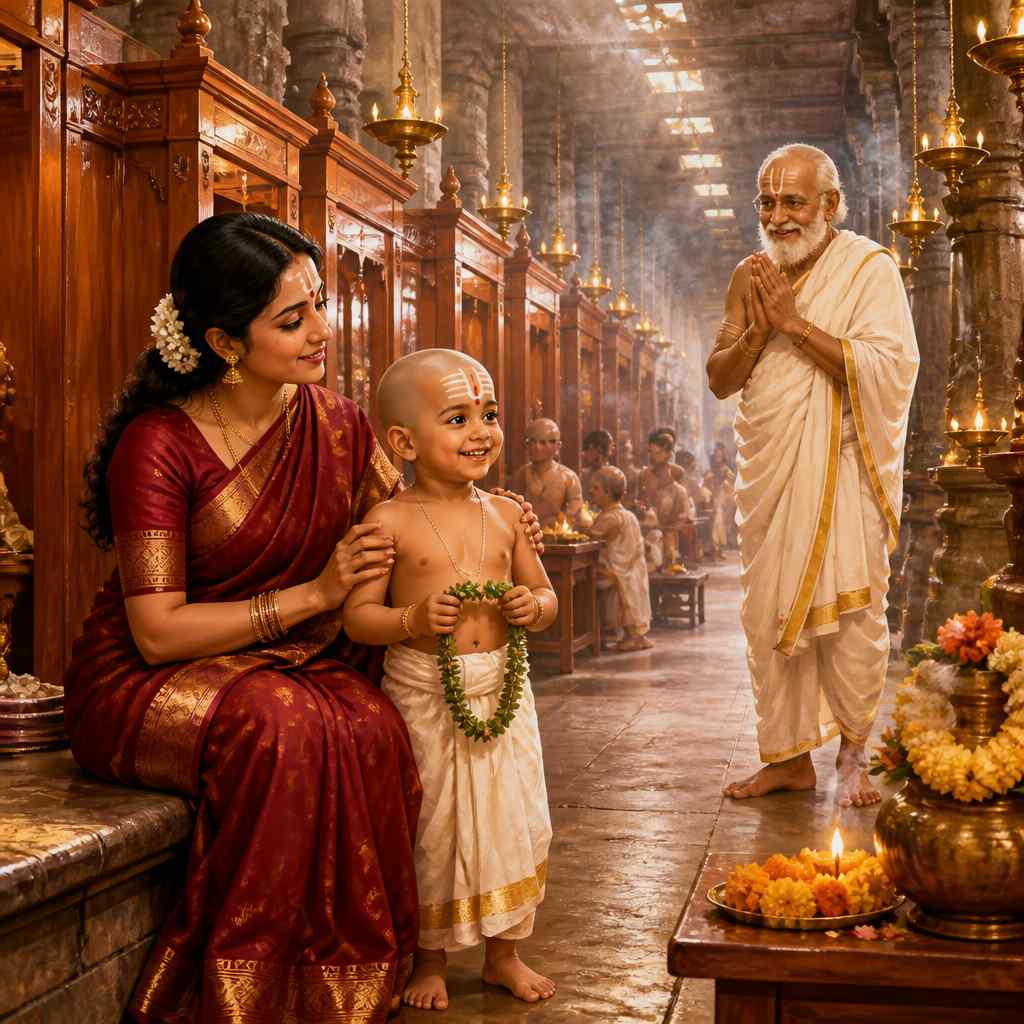
Mother and one-year-old at the Tirumala chudakarana tonsuring hall

In the great tonsuring hall at Tirumala, on a Tuesday morning in August, a young mother named Lalitha sits cross legged on a stone bench with her one year old son Aditya in her lap. The hall is enormous. Two hundred barbers in white dhotis sit in two long rows. The floor is wet from the constant water and shaved hair. The line of families stretches out the door and down the steps toward the Pushkarini tank.

Aditya wakes in his mother's arms. His grandfather has fulfilled a vow made before the child was born: if the boy was healthy, his first hair would be offered to Sri Venkateswara.

The barber takes Aditya gently and sits him on a small wooden stool. He wets the head with cold water and recites chudakaranam karishye, I will perform the chudakarana. The razor moves in long even strokes. Aditya cries for thirty seconds, then settles. In four minutes the head is bare.

The mother gathers the cloth, ties it into a small bundle, and walks with her father in law to the offering chute that funnels the day's hair into the temple's collection vault. The Tirumala vault collects approximately one tonne of human hair every day. The hair is auctioned by the temple for export to wig makers in the United States, China, and Italy, and the proceeds fund the daily annadanam that feeds one hundred thousand pilgrims. The boy's first hair has, in a single morning, fed a hundred strangers.

Back in the courtyard, the mother applies a small mark of sandalwood paste on the bare scalp, ties a thin red and yellow raksha sutra on Aditya's wrist, and takes a photograph. The photograph will live on the family altar for the rest of the boy's childhood. The bare scalp, the mother's smile, the grandfather's hand on the child's shoulder. The first samskara of the body that the child will remember from photographs.

Grandfather feeding a baby her first rice at Annaprashana

At the same hour, in a flat in Bandra, another mother named Priya is feeding her six month old daughter Ira a half teaspoon of payasam, sweet rice cooked in milk and ghee, while the family priest recites the Annaprashana mantras. Two days later, in a third house in Madurai, a goldsmith holds a one year old boy named Karthik on his knee and pierces the centre of his right earlobe with a fine gold needle. Three families. Three thresholds. One civilisation that marks the body's growth on the calendar.

The Practice, Across India

The sixteen samskaras of the classical Hindu life cycle include three that fall on the body itself in the first three years.

Annaprashana, the rice eating, is performed at six months for boys and seven for girls. The child is seated on the lap of a maternal uncle or grandfather. The priest recites the mantras from the Grihya Sutras. A spoon of cooked rice, mixed with ghee and a touch of jaggery, is placed on the child's tongue. In Bengal it is Mukhebhat, in Tamil Nadu Choroonu, in Kerala Chorunu at the Guruvayur temple. The first solid food is dharma's announcement that the gut is ready.

Chudakarana, the first hair shaving, is performed between the first and third year. The hair is shaved at a temple, typically the family's kuladevata shrine, with Tirumala the largest single-location hall in the world. The hair is offered to the deity. In Maharashtra the rite is Jawal, in Punjab and the north Mundan. A small tuft, the shikha, is left at the crown in some lineages, marking the lifelong location of the brahmarandhra.

Goldsmith piercing a child's earlobe at Karnavedha

Karnavedha, the ear piercing, is performed between the first and the fifth year, traditionally on the right ear first for boys and the left ear first for girls. The piercing is done by a goldsmith, never an ordinary jeweller, with a fine gold or silver needle. The point of piercing is precise: the centre of the earlobe, slightly forward, at the location classical Ayurvedic and acupuncture traditions both name as a meridian point connected to vision, hearing, and reproductive health. In south India the rite is performed at one to three years for both genders. In Maharashtra and Gujarat boys are pierced as well as girls. In the north, contemporary practice often pierces only girls. The ancient practice was universal. The narrowing is recent.

The Scripture Says

All three samskaras are codified in the Grihya Sutras of Apastamba, Bodhayana, Ashvalayana, and Paraskara, with parallel descriptions in the Manusmriti chapter two. Annaprashana is named in the Atharva Veda with the verse on grain as the first food of the body. Chudakarana is named in the Manava Grihya Sutra with the explicit instruction that the rite is to be performed at the kuladevata shrine. Karnavedha is named in the Sushruta Samhita with the surgical specification of the piercing point, the needle gauge, and the post-piercing care.

The seed verse for Annaprashana, recited as the first morsel of rice is placed on the child's tongue:

अन्नं ब्रह्मेति व्यजानात्। अन्नाद्ध्येव खल्विमानि भूतानि जायन्ते॥

annaṃ brahmeti vyajānāt | annād dhy eva khalv imāni bhūtāni jāyante

Food is Brahman. From food alone, indeed, all these beings are born.

Taittiriya Upanishad, Bhrigu Valli 3.2

The child's first taste of solid food is framed, by the verse, as a meeting with the divine. The grain is not nutrition. The grain is the medium through which the body enters the cycle of being fed by the cosmos. The Bhrigu Valli's full meditation on annam as Brahman is the philosophical anchor of the entire Annaprashana samskara.

The Sushruta Samhita's surgical specification for Karnavedha, in chapter sixteen of the Sutrasthana, is among the oldest preserved texts on minor surgical practice in the world. Sushruta names the precise location of the lobe to be pierced, the gauge of the needle, the use of a soft cotton thread to keep the channel open during healing, and the post-piercing application of medicated oil to prevent infection. The text predates Western surgical literature on ear piercing by approximately two thousand years.

The Symbolism

Samskara Body Part Threshold
Annaprashana Tongue and gut Breast milk to grain
Chudakarana Scalp and hair Birth hair to grown hair
Karnavedha Earlobe Closed ear to opened channel

Annaprashana marks the gut's transition from breast milk to grain. The Hindu civilisation read the moment as a covenant between the child and the earth. The earth grows the rice. The mother cooks the rice. The grandfather offers the rice. The child accepts. The child has now joined the long chain of beings that are fed by what the earth produces. The Taittiriya Upanishad's verse names food as Brahman precisely because the body is, from this moment, made of grain. You are what you eat is, in this verse, a metaphysical statement, not a wellness slogan.

Chudakarana marks the shedding of the birth body. The hair the child arrives with is the hair the womb grew. To shave it is to leave behind the womb's body and to begin the body the child's own dharma will grow. The Hindu reading is that the new hair that grows after Chudakarana is the child's own, in a way the birth hair was not. The offering to the deity is a transfer of the womb's gift to the family's chosen god. The boy's first hair, in the Tirumala hall, has been given back to Venkateswara on behalf of the family. The body's first major shedding has been turned into a samskara.

Karnavedha opens the ear. The Sushruta Samhita reads the lobe as a meridian junction. The piercing is not decoration. It is a small surgical opening at a point that classical Ayurveda and modern acupuncture both identify as connected to vision, hearing, and reproductive health. The traditional reading is that the ear, opened at the right point in early childhood, hears more clearly for the rest of the life. The Hindu civilisation pierced the earlobe of every child, regardless of gender, until the colonial period when the practice in the north narrowed to girls only.

Why the Body Responds

All three samskaras are timed to developmental biology windows that the lab has confirmed are real.

Annaprashana at six months. The pancreatic enzyme amylase, which breaks down starch, matures in the human infant gut at approximately six months of age. Before six months the gut cannot digest grain. After six months the gut can. The classical timing of Annaprashana, six months for boys and seven for girls, falls precisely at the amylase maturation window. The Sonnenburg Lab at Stanford has shown that the introduction of grain at this exact window is also the optimal moment for the establishment of grain-digesting gut microbiome species. The Vedic timing was not arbitrary. The Vedic timing was the developmental window.

Chudakarana at one to three years. The infant's birth hair is structurally different from the hair that will grow after the first major shed. The first shave triggers the next growth cycle on the new follicular structure. The Sonnenburg literature on scalp microbiome diversity shows that shaving and regrowth cycles alter microbial colonisation in measurable ways, with the earliest shaves producing the most diverse adult microbiome. The classical timing of Chudakarana between one and three years falls in the same window the lab now identifies as optimal.

Karnavedha at one to three years. The earlobe at one to three years is soft, well vascularised, and heals quickly. The same point pierced at fifteen years takes weeks longer to heal. The classical Sushruta Samhita instruction to pierce in the first three years is, in surgical terms, the optimal healing window.

The habit architecture of the three is identical. The cue is the calendar age of the child, marked by the family priest. The routine is the rite, performed at the family deity's shrine or, for Chudakarana, at Tirumala or another major temple. The reward is the photograph on the family altar, the sweets distributed at the household feast, and the child's incorporation into the lineage. The samskara is the cue-routine-reward loop applied to the developmental milestones of the first three years.

What the Labs Found

Dhabhar and McEwen at Rockefeller and Stanford, in their 1996 paper in Brain, Behavior and Immunity, established the modern framework for stress, immunity, and developmental biology, with the early years identified as a critical window for immune calibration. The samskaras of the first three years, in this framework, are not arbitrary social customs. They are calibrating events at developmental thresholds.

The Sonnenburg Lab at Stanford, across multiple papers from 2014 onward, has documented the establishment window of the human gut microbiome, with grain digestion species colonising at six to nine months and reaching adult diversity by approximately three years. The Annaprashana at six months is, in the Sonnenburg frame, the optimal window for the introduction of the grain-digesting microbial community.

The scalp microbiome literature, growing rapidly since 2015, has shown that the earliest shaves of an infant's hair produce more diverse adult scalp microbial communities than later shaves. The Chudakarana at one to three years falls in this window.

The Sushruta Samhita's surgical specification for Karnavedha has been validated by modern dermatological literature on optimal piercing technique, with the gauge, the location, and the healing protocol all matching contemporary practice. The Sushruta Samhita predates the modern literature by approximately two thousand four hundred years.

What the World Calls It Now

The "Big Chop" trend in the global natural hair movement has, since 2009, generated over four point two million Instagram posts under the hashtag. The chop is the shaving of all chemically treated hair to begin again on natural growth. Practitioners describe it as a transformative shedding, an identity reclamation, a release of the inherited and the imposed in favour of the chosen and the natural. The form is the Chudakarana. The framing is the Chudakarana. The lineage citation is absent.

Simultaneously, "baby hair blessing" ceremonies, marketed to first time parents on Pinterest and Instagram at three to five hundred United States dollars per session, conduct aesthetic photography around an infant's first haircut. The ritual structure of Chudakarana, the temple, the priest, the offering, the mantras, has been replaced by a soft-focus photo set and a wreath of dried flowers.

"Conscious solid food introduction" kits, marketed by start ups like Yumi and Little Spoon at one hundred to two hundred United States dollars a month, deliver organic six month rice cereal in branded jars to upper middle class American households. The product description specifies the six month window. The product makes no reference to Annaprashana.

"Ear seeding" wellness, the sale of small magnetic seeds attached to the earlobe at meridian points, is a six hundred million dollar global industry. The acupuncture and meridian framework is borrowed from Chinese medicine. The Sushruta Samhita's identical surgical specification for Karnavedha at the same earlobe point is older, fuller, and uncited.

Tirumala, meanwhile, processes more than twenty thousand tonsures every day, sells the hair to wig makers in the United States, China, and Italy for approximately fifteen hundred crore rupees a year, and uses the proceeds to feed one hundred thousand pilgrims daily through annadanam. The samskara is, at the Tirumala scale, also a self-funding social welfare engine.

What to Call It Yourself

From this lesson onward, when a wellness influencer describes her Big Chop, call it Chudakarana. When a baby food brand sells the six month rice introduction, name the older protocol. When an ear seeding boutique sells meridian magnets, use the older words. Annaprashana. Chudakarana. Karnavedha. Three samskaras of the body, three developmental windows, one calendar of dharma.

Modern Echoes

Dhabhar and McEwen on developmental immune calibration, the Sonnenburg Lab at Stanford on the microbiome establishment window, the dermatological literature on infant scalp microbial diversity, the Sushruta Samhita on the surgical earlobe meridian point. Four laboratories vindicating three rites that the Atharva Veda and the Grihya Sutras and the Sushruta Samhita named at the developmental thresholds. The Tirumala hall processes twenty thousand tonsures a day at the world's largest single-location hair offering operation, established by Chola-era inscriptions from the eleventh century. The samskara is operational at industrial scale.

Back in the Tirumala courtyard, the photograph has been taken. Aditya has fallen asleep again in his mother's arms. The bare scalp shines in the August sun. The boy's first hair, an hour ago part of his body, is in a vault. By next Friday the hair will be auctioned. By next month a woman in Milan or Shanghai will be wearing it. By the same month, one hundred thousand pilgrims will have eaten their lunch at Tirumala on the proceeds. The samskara has, in the time it takes a one year old to fall asleep, fed a hundred strangers.

Key figures

Sushruta

circa 600 BCE

Bhrigu Varuni

Vedic period, c. 1000 to 800 BCE

Justin Sonnenburg

born 1974

Case studies

The Tirumala Tonsuring Hall: Twenty Thousand Tonsures a Day

The tonsuring hall at Tirumala, the Sri Venkateswara temple in the Tirumala hills of Andhra Pradesh, processes more than twenty thousand chudakarana and adult vow-fulfilment tonsures every day, making it the world's largest single-location hair offering operation. The Archaeological Survey of India traces the institutional tonsure system to Chola-era Tirumala inscriptions of the eleventh century. The hair is collected in the temple vault, auctioned to wig makers in the United States, China, and Italy, and the proceeds, approximately fifteen hundred crore rupees a year, fund the daily annadanam that feeds one hundred thousand pilgrims.

Chudakarana is not merely a personal samskara. At the Tirumala scale it becomes a sociological engine. The boy's first hair, given as a vow, becomes a wig in Milan and a meal at Tirumala. The samskara feeds strangers across continents, all from the body's first major shedding.

The Tirumala model has been replicated at other major south Indian temples (Palani, Tiruttani, Sabarimala), though none at the same scale. The temple continues to grow. The hair vault in 2024 holds the largest single inventory of human hair in the world.

The operational scale of Chudakarana vindicates its sociological, not merely personal, function.

Every Hindu boy's first hair, offered at Tirumala or any major kuladevata shrine, is participating in a sociological engine that turns personal samskara into community welfare at industrial scale.

Chola-era Tirumala inscriptions, eleventh century CE; ASI documentation; 20,000+ daily tonsures; ~1500 crore INR annual hair revenue funding 100,000-pilgrim daily annadanam.

The Big Chop: Four Million Instagram Posts Without a Citation

The natural hair movement's Big Chop trend, since 2009, has generated over four point two million Instagram posts under the hashtag. The chop is the shaving of all chemically treated hair to begin again on natural growth. Practitioners describe it as a transformative shedding, an identity reclamation, a release of the inherited and the imposed in favour of the chosen and the natural. Simultaneously, baby hair blessing ceremonies marketed at three to five hundred United States dollars per session conduct aesthetic photography around an infant's first haircut, with the ritual structure of Chudakarana stripped out.

The transformative-shedding logic is precisely the Hindu reading of Chudakarana. The hair the child arrives with is the womb's hair. The shave is the leaving behind of the womb's body. The new growth is the body the child's own dharma will grow. The Big Chop frame is the Chudakarana frame, repackaged for adulthood.

The Big Chop continues to spread as a wellness and identity practice across the global natural hair movement, with no citation of the Hindu samskara that gave the form its three thousand years of grammar.

The transformation-through-hair-removal logic persists globally; its origin in Chudakarana goes unacknowledged.

Every Hindu woman who has had her own Chudakarana at age three carries the Big Chop's grammar in her body's memory.

#BigChop on Instagram, 4.2M+ posts since 2009; baby hair blessing ceremonies $300 to $500 per session at high-end studios.

The Amylase Window and the Earlobe Meridian

Dhabhar and McEwen, in their 1996 paper in Brain, Behavior and Immunity, established the modern framework for stress, immunity, and developmental biology, with the early years identified as a critical window for immune calibration. The Sonnenburg Lab at Stanford, across multiple papers from 2014 onward, has documented the gut microbiome establishment window, with grain-digesting species colonising at six to nine months and adult diversity reached by approximately three years. The amylase enzyme, which breaks down starch, matures in the human infant gut at approximately six months. The Sushruta Samhita's surgical specification for Karnavedha at the centre of the soft earlobe corresponds anatomically to a meridian point identified in modern acupuncture as connected to vision, hearing, and reproductive health.

The Atharva Veda specified six months for the first grain. The Sushruta Samhita specified the lobe centre for the piercing. The Manava Grihya Sutra specified one to three years for the first shave. The Hindu civilisation chose, by observation and lineage, the developmental thresholds the modern lab now confirms in enzyme assays, microbiome species counts, and meridian-point dermatology.

The three samskaras of the body in the first three years all map onto developmental biology windows that contemporary research has independently identified as critical. The match is not approximate. The match is precise.

The timing of Annaprashana, Chudakarana, and Karnavedha all map onto developmental biology windows.

Every Hindu family that performs the three samskaras at the classical ages is, in modern biological terms, calibrating the child's enzyme, microbiome, and meridian systems at the optimal developmental windows.

Dhabhar FS, McEwen BS, Brain Behavior and Immunity, 1996; Sonnenburg JL et al, Stanford, 2014 onward; The Good Gut (Sonnenburg and Sonnenburg, 2015); amylase maturation at ~6 months; gut microbiome adult diversity by ~3 years; Sushruta Samhita Sutrasthana 16.

Historical context

From the Vedic period (c. 1500 to 800 BCE) through the Sutra and Smriti period (c. 600 BCE to 200 CE) and the Sushruta surgical tradition (c. 600 BCE) to the eleventh century Chola institutionalisation at Tirumala and the present

Living traditions

Use the original names. Annaprashana for the rice ceremony, not solid food introduction. Chudakarana for the first shave, not Big Chop. Karnavedha for the ear piercing, not ear seeding. The wellness market is selling fragments. The Hindu home is performing the whole samskara at developmental thresholds the lab has only just measured.

Reflection

More in The Sixteen Samskaras

All lessons in The Sixteen Samskaras · Samskaras: The Sanatan Operating System course