The Final Three

Vanaprastha, Antyeshti, Shraddha-Tarpana, and how the dharmic tradition closes a human life with dignity

The Hindu life cycle does not end with the wedding. Three samskaras come after. Vanaprastha is the gradual withdrawal from household duty into contemplation. Antyeshti is the cremation, the final yajna in which the body is offered to fire. Shraddha-Tarpana is the annual remembrance, the libation of water and rice the householder offers to the ancestors. Together they form the most fully engineered end-of-life and post-life protocol in the world. Manu wrote the retirement code two thousand years before the FIRE movement rebranded it. The hospice movement, in 1969, began documenting what the Antyeshti was designed to address. The grandmother knew. She had attended the rites.

A House in Pune, Three Days After the Death
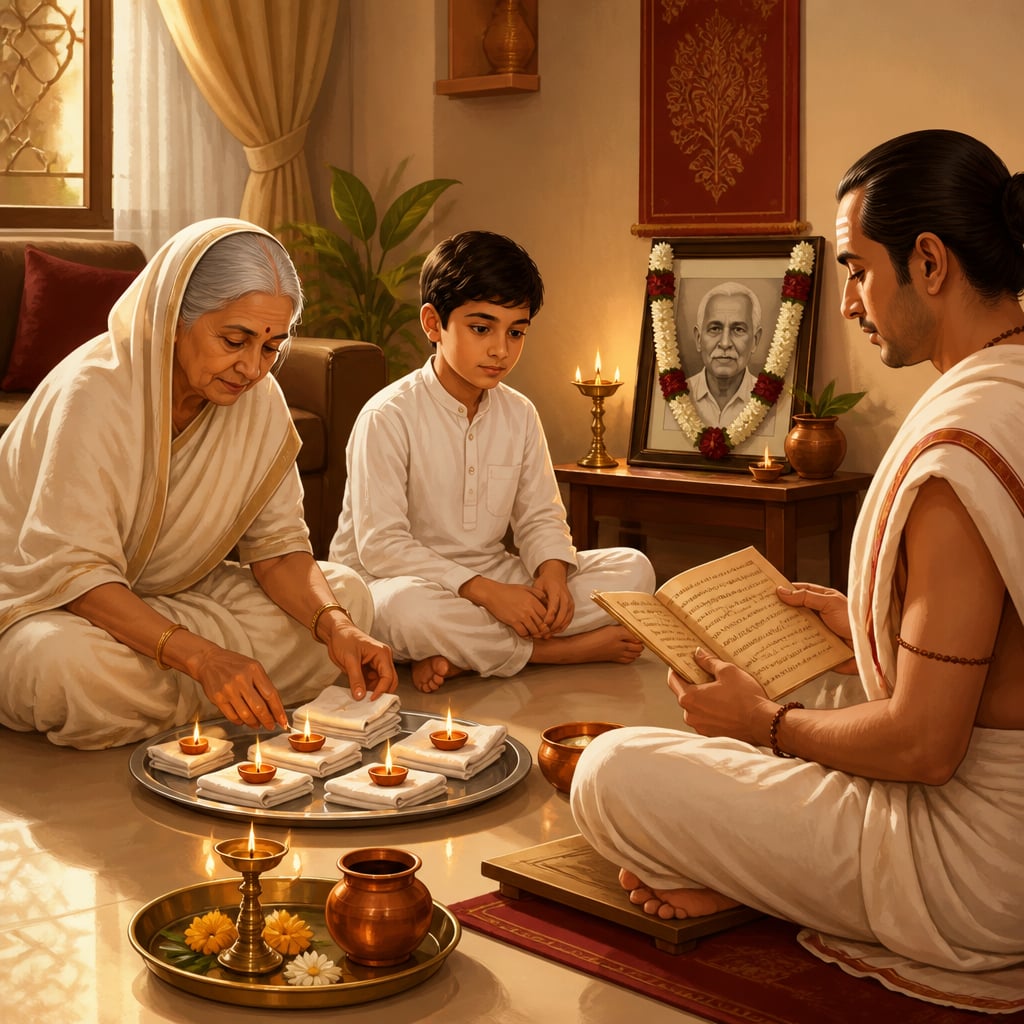
Pune household holding the third-day Shraddha rites for a grandfather

In a small house in Pune, sometime in the late 1990s, a boy of twelve is sitting on the floor of the living room. His grandfather has died three days ago. The house is full of relatives. His aaji is in white. His mother is in white. The men of the household have shaved their heads. The brass lamp has been burning continuously since the body was taken to the shmashan ghat on the morning of the death. A black-and-white photograph of his grandfather, garlanded with a thin white sandalwood mala, sits on a low wooden stool in the corner of the room. A small clay pot of water and a single tulsi leaf rest beside it.

The family priest is sitting cross-legged on a mat, chanting from a small palm-leaf manuscript. The aaji is not crying. She is folding small pieces of cotton cloth into squares, placing them on a steel plate, lighting a small earthen lamp on each one. "Tu kalji ghe nako," she says quietly to the boy. Do not worry. "Aajoba prinamala gele." Aajoba has gone to the path of the ancestors. The boy will not understand the sentence for many years. He understands only that the house has, in three days, become a different house, that everyone is doing something specific with their hands, and that no one is panicking. The grief is being held inside a structure.

This lesson is about that structure. The dharmic tradition treats the closing of a life not as a private collapse but as a publicly choreographed sequence of three samskaras. Vanaprastha, the gradual handover of household responsibility into contemplative withdrawal, often beginning in the late fifties or sixties. Antyeshti, the funeral itself, the last yajna, in which the body is offered to fire as the final libation. Shraddha-Tarpana, the annual and lifetime offerings of water and rice the householder makes to the ancestors thereafter. Together they form what is, in the documented record, the most fully engineered end-of-life and post-life protocol of any continuous tradition on earth.

Most of the modern world has heard of cremation as a Hindu funeral practice. Almost none of the modern world has been told that the cremation is the second of three integrated samskaras, that the first is a retirement code Manu wrote in the second century, that the third is an annual ritual the householder runs every Pitru Paksha for the rest of his life, and that the entire sequence has been documented as a dignified-dying and ancestor-honouring framework two thousand years before the modern hospice movement began describing the same psychological and behavioural needs in clinical terms. This lesson is the explanation the family did not pause to give a twelve-year-old boy at three days. It is the explanation the tradition holds for whoever is ready to ask.

A Note Before the Lesson

The topic of death is tender. Many readers will have lost someone recently. Some will be reading this lesson while the loss is still fresh. The dharmic frame does not minimise the grief. It does not pretend that death is anything other than an ending of a life as it was lived. What it offers is a structure: a sequence of acts to perform, a calendar of remembrance to keep, a community to walk the road with, and a cosmology in which the loss is folded into a larger continuity. The lesson is offered in the spirit of the priest in the Pune living room: speak softly, sit on the floor, do the rites in their order, hold the grief inside the structure, and do not hurry past any of the three.

Key figures

Manu (the lawgiver of the Manusmriti)

c. 200 BCE - 200 CE (the text was composed and edited across this window)

Suta and the Garuda Purana tradition

c. 4th-10th century CE (the Garuda Purana's principal layers were composed across this period)

Elisabeth Kübler-Ross

1926-2004; principal work published 1969-2004

Case studies

Manu's Vanaprastha Code (Manusmriti Ch 6, c. 100-200 CE)

The Manusmriti, composed and edited across the late Mauryan and early Gupta periods (approximately 200 BCE to 200 CE), devotes the entirety of chapter six to the Vanaprastha protocol. The chapter opens with the timing prescription (the householder enters Vanaprastha when wrinkles, grey hair, and grandchildren are visible) and continues across approximately ninety verses to specify the lifestyle: the gradual handover of household responsibilities, the shift to forest dwelling or simplified residence, the reduction of meat consumption and elaborate cooking, the increase of contemplative practice (japa, swadhyaya, dhyana), the deepening of the spousal relationship, and the eventual transition into Sannyasa. The chapter is written as a positive prescription, not as social compulsion: the elder is to initiate the withdrawal voluntarily, with the household's continuity assured, and is to be treated by the next generation with continuing respect rather than economic abandonment. The Manusmriti's treatment of Vanaprastha is the world's oldest documented retirement and elder-care protocol, predating the modern Western retirement industry by approximately nineteen centuries.

The dharmic ashrama architecture treats the late-life years as a positively defined life-stage with its own dharma, its own discipline, and its own deepening. The Western alternative narratives, indefinite consumption (golf, cruises, retail leisure) or productive extension (work past retirement, late-life entrepreneurship), each fail to recognise that the post-Grihastha years are structurally distinct. The Vanaprastha protocol gives the elder a positively defined contemplative role, a calendar of practice, a community of similarly placed peers, and a goal that grows in importance as physical capacity declines. The role is not absence; it is a different presence. The receipts for this architecture are nineteen hundred years old.

The Vanaprastha tradition has been preserved across two millennia in continuous household practice, with the literal forest withdrawal becoming rare in modern times but the functional staged retirement preserved across regions, varnas, and economic classes. The grandparents who hand over household keys, who reduce working hours and increase temple visits, who take up daily japa or scripture reading, and who undertake increasing yatras, are running a contemporary Vanaprastha. The Manusmriti's chapter six remains the principal classical anchor and is the oldest single retirement protocol in continuous textual transmission anywhere in the world.

Indian classical scholarship had a positively defined late-life architecture two thousand years before the modern Western retirement industry began assembling its parts. The framing of retirement as a Western twentieth-century invention ignores the documented record of structured, voluntary, contemplative late-life withdrawal codified in the Manusmriti's chapter six. The receipts for Vanaprastha's architectural status are in the second-century classical text, not in twenty-first-century retirement coaching.

Every modern claim that staged retirement, contemplative late-life simplification, or dignified elder-withdrawal is a recent Western insight can be answered with one citation. The Manusmriti chapter six had it codified two thousand years ago. The classical text predates Mr. Money Mustache by nineteen centuries and St. Christopher's Hospice's elder-care framing by approximately eighteen centuries.

The Manusmriti chapter six, composed approximately 100-200 CE, codifies the Vanaprastha protocol in approximately ninety verses, prescribing the timing, the lifestyle, the diet, the spiritual practices, and the spousal arrangement. The text predates the modern FIRE movement by approximately one thousand nine hundred years and the founding of the modern Western pension and retirement-coaching industry by approximately two thousand years.

The FIRE Movement and the $800M Vanaprastha Echo (2011-present)

In 2011, the American blogger Pete Adeney, writing as Mr. Money Mustache, popularised the FIRE movement (Financial Independence, Retire Early). The movement prescribes aggressive savings during the working years toward early withdrawal from economic productivity, followed by a contemplative simplified life of low spending and high freedom. The FIRE blogosphere expanded rapidly: the Mr. Money Mustache blog reached millions of readers; ChooseFI and Afford Anything became the principal podcasts; books including The Simple Path to Wealth (J.L. Collins) and Quit Like a Millionaire (Kristy Shen) became category-defining. The FIRE consulting and coaching ecosystem, including financial-independence retreats, Camp FI gatherings, FIRE-aligned financial planners, and online courses, is estimated at over eight hundred million dollars annually as of 2023. The movement's structural prescription is identical in its underlying logic to Manu's Vanaprastha: aggressive savings during the working years (the Brahmacharya-Grihastha equivalent), followed by withdrawal from economic productivity into a simplified contemplative life (the Vanaprastha equivalent). The differences are real but secondary: FIRE arrives at the withdrawal earlier (often in the thirties or forties), without the prior Grihastha stage's full obligations, and with a financial-independence frame rather than a dharmic one. The structural insight is the Manusmriti's. Mr. Money Mustache does not cite the Manusmriti.

The FIRE movement is the cleanest documented modern case of the Vanaprastha protocol reaching mainstream Western audiences with the dharmic lineage surgically removed. The structural insight is intact: a distinct life-stage characterised by withdrawal from economic production into simplified contemplation. The lineage is gone: no Manusmriti, no ashrama architecture, no trin rina doctrine, no spousal joint Vanaprastha. The dharmic household's job is not to argue with FIRE; the movement's structural advice is broadly aligned with the tradition. The job is to use the original word. Vanaprastha, not FIRE. Ashrama-architecture, not retirement strategy. The naming is the lineage. The lineage is the receipt.

The FIRE movement has helped a generation of Western readers think structurally about late-life withdrawal from economic production, an insight the Western post-1950 pension and retirement industry had largely lost. The Indian household that has always preserved the ashrama architecture was not made worse by Mr. Money Mustache; it was, indirectly, validated by the global appetite for the structural insight. The retirement-coaching industry more broadly, including the Modern Elder Academy ($5,000 per week in Baja California), the Encore.org late-career-transition movement, and the eight-trillion-dollar global pension industry, are each downstream of the same recognition that the Manusmriti codified two thousand years ago.

The market rewards the rebrander, not the source. The dharmic household's job is not to sue Mr. Money Mustache. The job is to use the original word. Vanaprastha, not FIRE. When the conversation reaches for early retirement, financial independence, or the Modern Elder Academy, the response is one calm sentence: 'That is Vanaprastha. The Manusmriti specified the protocol nineteen hundred years ago.' Talapatram's Sanatan Operating System course, in this lesson, is filing the receipt.

Use the original word in conversation. When the friend says she is FIRE-ing at forty, you say she is entering Vanaprastha. When the magazine cover names the Modern Elder Academy, you name the Manusmriti. The movement is selling the structural insight; the dharmic tradition is the source of the structural insight. The naming completes the loop.

The FIRE movement, founded in 2011 with the Mr. Money Mustache blog, has grown into an estimated eight-hundred-million-dollar media and consulting ecosystem by 2023. The Manusmriti chapter six specified the underlying ashrama architecture approximately one thousand nine hundred years earlier. The Manusmriti is mentioned on zero FIRE blog posts, podcast episodes, or coaching curricula in the principal English-language ecosystem.

Kübler-Ross 1969 and Byock 2012: The Hospice Vindication of Antyeshti

In 1967, Dame Cicely Saunders opened St. Christopher's Hospice in London, founding the modern hospice movement and beginning the institutional Western re-recognition of structured dying as a healthcare need. In 1969, Elisabeth Kübler-Ross published On Death and Dying, initiating the modern systematic study of dying patients and bereaved families. Kübler-Ross's principal clinical finding was that unresolved social bonds, unspoken forgiveness, and unfinished communication are the principal sources of prolonged dying and complicated grief. Her later collaborator Ira Byock, in The Best Care Possible (2012) and The Four Things That Matter Most, elaborated the cornerstones of dignified dying: the four utterances 'Please forgive me,' 'I forgive you,' 'Thank you,' and 'I love you'; the family's continuing presence at the deathbed; the structured release of attachments. The continuing-bonds research of Klass, Silverman, and Nickman (1996), in Continuing Bonds: New Understandings of Grief, established that healthy long-term bereavement involves not the severing of the bond with the deceased but its reconfiguration into a continuing internal relationship. Together, this body of work is the modern instrumented confirmation of what the Hindu Antyeshti and Shraddha-Tarpana traditions have held for three millennia: the pre-death moistening of the lips with tulsi water, the recitation of divine names, the asking and giving of forgiveness; the post-death thirteen-day structured grief; the lifetime annual shraddha that institutionalises the continuing bond as a calendar obligation.

The Garuda Purana's pre-death sequence is, line for line, the institutional frame in which Byock's four utterances are made by every dying Hindu in the canonical sequence. Forgiveness is asked and given. Names of the divine are spoken. Attachments are consciously released. The family is present. The priest carries the words. The Kübler-Ross finding that unresolved bonds are the principal source of prolonged dying is the modern clinical translation of what the Antyeshti was designed to address. The continuing-bonds research is the modern instrumented confirmation of what the shraddha tradition has institutionalised for three thousand years. The research vindication is total: the substance is correct, the structure is correct, the timing is correct, the family is correct, the calendar is correct. The Garuda Purana specified each of these by experience two thousand years before the hospice movement measured them.

The modern hospice and palliative care industry exceeds fifty billion dollars annually in the US alone as of 2023. The death doula profession, the death-positive movement (Caitlin Doughty, The Order of the Good Death, 2011), the green burial movement, the Crestone End-of-Life Project (2008), and the broader bereavement-research literature have each grown out of the same slow re-recognition that the dying need community, that the bereaved need ritual, and that the body's disposal is part of the family's farewell. The integrated Antyeshti and Shraddha-Tarpana sequence has been running, in continuous family transmission, for the entire period during which the Western medical system was first medicalising and then re-humanising the closing of life.

The case for the tradition does not need to wait for the lab. The lab, when it arrives, will confirm what the tradition recorded. The Garuda Purana specified the Antyeshti sequence in the Puranic period. The Manusmriti codified the shraddha tradition in the second century. The Atharva Veda's substrate is older still. Cicely Saunders opened St. Christopher's in 1967. Kübler-Ross published On Death and Dying in 1969. Byock published The Best Care Possible in 2012. Three independent records, two thousand years apart, point to the same structured pre-death and post-death sequence. The hospice movement is doing serious good work. The dharmic tradition is the structural source.

Three thousand years of practice, two thousand years of textual codification, and over fifty years of modern hospice and bereavement research all point to the same structured closing of a human life. The grandmother does not need to read Kübler-Ross. She has attended the rites. The hospice movement and the Antyeshti are not in competition. They are the same insight, two thousand years apart, with one of them carrying the integrated whole the other is reassembling, piece by piece.

Cicely Saunders opened St. Christopher's Hospice in 1967, founding the modern hospice movement. Elisabeth Kübler-Ross published On Death and Dying in 1969, initiating the modern bereavement-research literature. Ira Byock published The Best Care Possible in 2012, formalising the four utterances of dignified dying. Klass, Silverman, and Nickman published Continuing Bonds in 1996, establishing the continuing-bonds frame. The Garuda Purana specified the underlying protocol approximately two thousand years earlier. The Garuda Purana is mentioned in zero of the principal modern hospice and bereavement-research curricula.

Historical context

Vedic ancestor practice (c. 1500 BCE) through Manusmriti codification (c. 200 BCE - 200 CE), Garuda Purana elaboration (c. 4th-10th century CE), and the modern hospice and retirement movements (1967-present)

The integrated three-samskara closing sequence (Vanaprastha, Antyeshti, Shraddha-Tarpana) is one of the most stable institutions in Indian civilisation. Across three thousand years, through Vedic, Mauryan, Gupta, Pala, Chola, Vijayanagara, Mughal, Maratha, and colonial periods, the householder has entered Vanaprastha when the body's signs of ageing arrived and the grandchildren came, the family has performed Antyeshti at the shmashan ghat with the priest reading the Garuda Purana's Pretakhanda, and the householder has run the annual shraddha at Pitru Paksha and the lifetime tarpana on the death anniversary of each parent. The practice was preserved across regions, varnas, and economic classes through household and priestly transmission, principally through the senior male line for the Antyeshti karta role and through both lines for the shraddha calendar. The colonial and post-independence reforms have substantially changed the social-ordering portions of the Manusmriti while preserving the Vanaprastha and shraddha architectural layers; the modern karta role is now widely opened to the eldest child of either gender; the cremation itself has shifted from the open-air ghat to the electric crematorium in many urban areas while preserving the priestly recitation, the karta's role, and the post-cremation sequence intact. The 1967-present Western rediscovery of the same architecture under the names hospice, FIRE, death doula, continuing-bonds, and memorial culture is the most documented modern case of an integrated indigenous lifecycle architecture being reassembled, piece by piece, with the Sanskrit names removed and the integrated whole unrecognised. The dharmic household's job is small and clear: keep running the integrated sequence, every Vanaprastha, every Antyeshti, every Pitru Paksha, in every house that still keeps the calendar.

Living traditions

The integrated three-samskara closing sequence of Vanaprastha, Antyeshti, and Shraddha-Tarpana is no longer a Hindu tradition that the modern world is unaware of. The FIRE movement and the eight-trillion-dollar global pension industry are Vanaprastha's modern echoes. The hospice movement, the death doula profession, the death-positive movement, the Crestone open-air cremation project, and the fifty-billion-dollar US hospice and palliative care industry are Antyeshti's modern echoes. The continuing-bonds bereavement research, the memorial-photography market, the online memorial-page services, and the digital ancestor-archive projects are Shraddha-Tarpana's modern echoes. The dharmic tradition's job is small and clear. When the conversation reaches for early retirement, you say Vanaprastha. When the conversation reaches for hospice, you say Antyeshti. When the conversation reaches for memorial culture, you say Shraddha-Tarpana. The Manusmriti, the Garuda Purana, and the standard Tarpana invocation are the textual anchors; the household practice is the living tradition; the priest in the small living room in Pune is the institutional continuity. Use the names. The labs have arrived. The Manusmriti specified Vanaprastha nineteen hundred years before Mr. Money Mustache. The Garuda Purana specified Antyeshti two thousand years before Cicely Saunders. The continuing-bonds frame is, in academic language, what the trin rina doctrine has named for three millennia. Talapatram's Sanatan Operating System course, in this lesson and in the broader Gurukul, is the manual for the household and the line of the dead the integrated sequence belongs to. Every Vanaprastha, every Antyeshti, every Pitru Paksha, every receipt.

Reflection

More in The Sixteen Samskaras

All lessons in The Sixteen Samskaras · Samskaras: The Sanatan Operating System course