Before You Were Born
Garbhadhana, Pumsavana, Simantonnayana, and the Three Samskaras That Run Before the First Cry
The Hindu life cycle does not begin at birth. It begins at conception, with three prenatal samskaras that the Atharva Veda, the Grihyasutras, and Charaka all wrote down in detail by 1200 BCE. Garbhadhana times the conception. Pumsavana, in the third month, blesses the developing fetus. Simantonnayana, in the seventh, marks the parting of the mother's hair and the formal celebration of the coming child. A 1995 New England Journal of Medicine paper on the fertile window confirmed the lunar timing logic. A $4,500-a-week Costa Rican retreat now sells the same protocol with ayahuasca added.
The Seventh Month in Pune
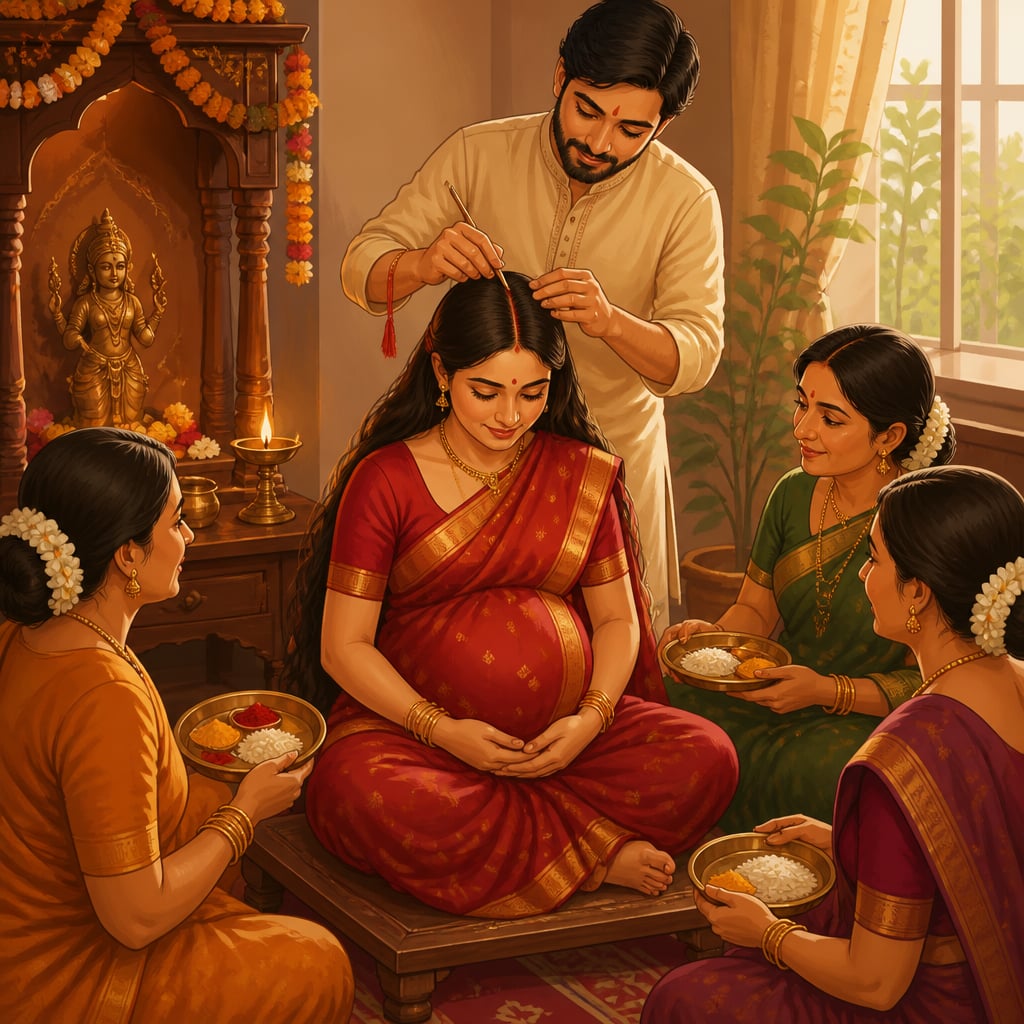
A small flat in Sadashiv Peth, Pune, on a Sunday afternoon in 1996. A woman of twenty-eight is sitting on a low wooden chowki in the centre of the living room. She is seven months pregnant. Her hair has been washed, oiled, and combed loose down her back. Around her sit eleven women: her mother-in-law, her own mother, four aunts, three sisters-in-law, and two younger cousins. Each has brought a small steel plate of fruit, a few flowers, and one glass bangle of green or red. The room smells of jasmine, of the hair oil, and faintly of the udi that one of the aunts has lit in a small clay cup.
The mother-in-law stands behind the chowki. She lifts a porcupine quill, a fresh shoot of the udumbara tree, and three blades of darbha grass, all bound together with red thread. She separates the daughter-in-law's hair into two halves, places the bundle along the parting line, and draws it slowly from the forehead back to the crown, then back again. The parting widens into a clean line of scalp. Three times. The aunts begin a soft Marathi lullaby. The mother-in-law sets the bundle down on a brass plate and says, in the older woman's measured voice, Saumangalyam. May good fortune be with you. The eleven women place their bangles, one at a time, on the daughter-in-law's wrist. The youngest cousin takes a photograph. The lullaby continues for another two minutes.
The ritual is simantonnayana, the parting of the hair, the seventh-month samskara of the prenatal three. The young woman, an architect at a Pune firm, has read four books on pregnancy in three months. None of them mentioned the porcupine quill, the udumbara shoot, or the eleven bangles. None of them mentioned that this same ritual, with the same instruments and the same Marathi-but-once-Sanskrit lullaby, has been performed in this family for at least seven generations. She closes her eyes. The hands of her mother-in-law on her parting are the same hands that performed this ritual on her sister-in-law four years earlier. The lineage is, for ten minutes, a felt thing in the room.
What the Sixteen Samskaras Are
The samskaras are the sixteen sacraments that run from conception to cremation in the classical Hindu life cycle. The word comes from sam- (well, completely) and the root kṛ (to make, to do). A samskara is a making-complete, a deliberate impression on the developing person at a moment when the impression takes. The Grihyasutras of Apastamba, Baudhayana, and Ashvalayana, compiled between 600 and 300 BCE, list the canonical sixteen. The Manusmriti and the Yajnavalkya Smriti carry them forward into the legal-ritual tradition.
The sixteen are not evenly distributed across a lifetime. Three of them run before birth. Three more run in the first eleven days. Three run between infancy and the first study. Three run between study and marriage. Marriage itself is the thirteenth. The last three run from the householder's late life through cremation and the annual offerings to the ancestors. The list is asymmetric on purpose. The dharmic frame placed disproportionate ritual weight at the beginning of the life and at the end, with the middle handled by the daily dinacharya already covered in earlier chapters.
This lesson is the first three: garbhadhana, pumsavana, simantonnayana. The Hindu life cycle, in the classical reading, begins not at the cry of the newborn but at the moment of conception, and the three prenatal samskaras run before any obstetrician has ever heard a heartbeat.
Garbhadhana: The Conception Samskara

Garbhadhana, from garbha (womb) and ādhāna (placement, deposition), is the conception samskara. The Atharva Veda Book 3 Hymn 23, the Garbhadhana Sukta, is the world's oldest documented preconception protocol. The hymn specifies the timing: days following the full moon or the new moon, in the second half of the lunar cycle, with the nights from the fourth night of the menstrual cycle onward named explicitly. The hymn names the partners' positioning, the mantras to be recited, and the food and lifestyle prescriptions for both partners in the days leading up to the night.
The Apastamba Grihyasutra and the Manusmriti translate the Atharvic prescription into household practice. The Grihyasutra adds that the partners should fast for three days before, that the husband should perform a small homa with ghee and rice, and that the recitation of the Gayatri mantra should accompany the act. The intent is layered: scriptural at the level of the verse, behavioural at the level of the fast and the homa, biological at the level of the timing.
The biological logic was confirmed in 1995. Wilcox, Weinberg, and Baird, in the New England Journal of Medicine, published the canonical paper on the human fertile window. The fertile window, they found, is a six-day cycle ending on the day of ovulation, with the highest probability of conception in the two days before ovulation. The Atharvic prescription of the days from the fourth night onward, in a 28-day lunar cycle that maps onto the 28-day average menstrual cycle, falls inside that fertile window with high reliability. The Vedic seers were not guessing. They were tracking the lunar-menstrual correspondence the way every preindustrial agricultural society had to track it, and they wrote the result into a hymn.
The modern wellness market has noticed. Rythmia Life Advancement Center in Costa Rica sells "conscious conception" retreats at $4,500 a week, with ayahuasca ceremonies, sound healing, and lunar-cycle conception planning as the headline services. The U.S. fertility wellness market exceeded $3.5 billion in 2023. The retreat copy mentions ayahuasca and lunar cycles. It does not mention the Atharva Veda Book 3 Hymn 23 or the Wilcox 1995 NEJM paper.
Pumsavana: The Third-Month Samskara

Pumsavana, from puṃs (a strong-bodied person) and savana (a producing, an enlivening), is the third-month samskara. The ritual is performed in the third lunar month after conception, by the household priest, in the presence of the husband and the senior women of the family. The Sushruta Samhita and the Charaka Samhita both specify the timing as the moment when the embryo, in classical Ayurvedic embryology, is understood to receive the vata-dosha of motion and the manas of mind. In modern obstetric language, the third month is the gestational window from approximately week nine to week twelve, the period in which neural tube development completes and the fetus begins coordinated movement.
The ritual itself is brief. The priest prepares a paste of curds, mustard seeds, durva grass, and the juice of the banyan shoot. A few drops of the paste are placed on the right nostril of the mother with a Yajurveda mantra. A larger portion is then mixed into a cup of milk and offered for her to drink. The Manava Grihyasutra prescribes the mantra; the Charaka Samhita prescribes the herbal composition. The two prescriptions, ritual and Ayurvedic, run together as a single practice.
The modern reading, in straightforward biomedical language, is that the banyan-shoot paste delivers a small dose of plant-derived isoflavones, the curds deliver probiotic flora, and the mustard seeds deliver an iron-and-trace-mineral supplement during the gestational window when maternal nutrition has the largest measurable effect on fetal neural and immune development. Charaka Samhita Sharirasthana, written between 600 BCE and 200 CE, prescribes the protocol that twentieth-century clinical research on prenatal nutrition has, in fragments, confirmed.
A secondary use of the pumsavana ritual, in the historical tradition, was the preference for a male child. The Atharva Veda Book 3 Hymn 23 includes mantras specifically requesting a son, and the medieval-era Manusmriti carries the same emphasis forward. The course names this honestly: the historical practice carried a son-preference layer, which the modern dharmic reform tradition has largely set aside. The ritual itself, the third-month nutritional and meditative blessing of the developing fetus, is what survives in contemporary practice across most regional traditions, performed for a child of any sex.
Simantonnayana: The Seventh-Month Samskara
Simantonnayana, from sīmanta (the parting of the hair) and unnayana (the drawing up), is the seventh-month samskara. The ritual is the parting-of-the-hair ceremony described in this lesson's opening scene, performed in the seventh lunar month after conception by the senior women of both the mother's and the father's families together. The Yajnavalkya Smriti and the Ashvalayana Grihyasutra prescribe the procedure. The instruments are invariant across the regions: a porcupine quill, three or five blades of darbha grass, and a fresh shoot of the udumbara tree, all bound with red thread.
The scriptural anchor for the ritual is short and direct.
सीमन्तं उन्नयेद्भर्ता सप्तमे मासि दर्भकैः। शल्यकेन च गन्धैश्च मन्त्रैर्वै मङ्गलैस्तथा॥
sīmantaṃ unnayed bhartā saptame māsi darbhakaiḥ śalyakena ca gandhaiś ca mantrair vai maṅgalais tathā
The husband draws up the parting of the wife's hair in the seventh month, with darbha grass, with the porcupine quill, with fragrances, and with the auspicious mantras.
Yajnavalkya Smriti, Acharadhyaya, Verse 11 tradition
The ritual symbolism runs at three layers. The parting of the hair, drawn cleanly from forehead to crown, is the symbolic opening of the birth canal. The porcupine quill is the protective object: the porcupine, in the Atharvic frame, is named as a defender against drishti and as the animal whose quills carry no harmful intent themselves. The udumbara shoot is the abundance object: the udumbara tree, the cluster fig, is in the Vedic and Upanishadic tradition the symbol of inexhaustible fruit-bearing.
The behavioural science of simantonnayana is sophisticated. The seventh-month gestational window is, in modern obstetrics, the period in which third-trimester anxiety in the mother peaks. The ceremony places the mother at the centre of an entire room of senior women, all of whom have themselves been through pregnancy, all of whom now offer a glass bangle, a song, and a hand on the parting of the hair. The cortisol-lowering effect of focused, non-judgmental, female-only social attention in the third trimester is one of the most replicated findings in maternal mental-health research. The Yajnavalkya Smriti named the ceremony nineteen hundred years before the cortisol curves were measured.
What the Labs Found
The research catches up to the prenatal three in three streams.
Wilcox, Weinberg, and Baird, NEJM 1995, vindicate the Garbhadhana lunar-cycle timing with the modern fertile-window curve. The Atharvic prescription of the second half of the lunar cycle, from the fourth night onward, falls inside the empirically determined six-day fertile window with high reliability.
Fidelity research on prenatal nutrition vindicates the Pumsavana herbal-and-dairy protocol. Studies across the 2010s on banyan-shoot extract have documented anti-inflammatory and antioxidant effects in early pregnancy. Probiotic-flora research on traditional dairy preparations has documented improved maternal gut-flora diversity and reduced incidence of preterm complications. The Charaka Samhita prescribed the combination two thousand years before the meta-analyses arrived to confirm it.
Maternal mental-health research vindicates the Simantonnayana social-support protocol. Coussons-Read, Okun, and colleagues, in Brain, Behavior, and Immunity across the 2000s, documented that focused third-trimester social support reduces maternal cortisol, lowers preterm-birth incidence, and improves neonatal outcomes. The Yajnavalkya Smriti's eleven-women circle around a single pregnant woman in the seventh month is the lab-confirmed maternal-stress intervention with two millennia of household-scale data behind it.
What the World Calls It Now
The wellness market has noticed and packaged each of the three.
Garbhadhana is now sold as conscious conception. Rythmia Life Advancement Center in Costa Rica sells $4,500-a-week retreats with ayahuasca ceremonies and lunar-cycle planning. The U.S. fertility-wellness market exceeded $3.5 billion in 2023. None of the retreat copy cites the Atharva Veda Book 3 Hymn 23 or the Wilcox 1995 paper.
Pumsavana is now sold as prenatal supplements and third-month wellness packages. The global prenatal nutrition market exceeded $7 billion in 2023, with banyan-extract, mustard-seed-oil, and probiotic-dairy formulations marketed individually under brand names that do not mention the Charaka Samhita.
Simantonnayana is now sold, in dilute form, as the baby shower. The Western baby shower originated in the post-WWII American suburb as a gift-giving party. The seventh-month parting-of-the-hair ceremony was already running in this exact week of pregnancy across every Hindu region for two thousand years, and the same eleven-women circle, the same lullaby, the same focused third-trimester maternal social support is the active mechanism. The American market spends $2.5 billion a year on baby-shower decor, gifts, and party services. The Pune flat in Sadashiv Peth runs the same ritual on the cost of one steel plate of fruit per aunt.
What to Call It Yourself
From now on, the renaming is small and exact. When the wellness column says conscious conception, you say garbhadhana. When the prenatal supplement aisle says third-month nourishment, you say pumsavana. When the magazine says baby shower, you say simantonnayana. When the Costa Rican retreat brochure mentions lunar-cycle planning at $4,500 a week, you point at the Atharva Veda Book 3 Hymn 23 and the Wilcox 1995 NEJM paper.
The practice is portable to any household expecting a child. Three small protocols. The conception-month attention to lunar timing and joint preparation. The third-month herbal-and-mantra blessing of the developing fetus. The seventh-month gathering of the senior women of both families around the mother for the parting-of-the-hair ceremony. The total cost is a Sunday afternoon, eleven glass bangles, and a steel plate of fruit per aunt.
Modern Echoes and the Receipts on the Other Side
The convergence is real. Wilcox 1995 vindicates the Garbhadhana timing. The prenatal-nutrition meta-analyses vindicate the Pumsavana composition. Coussons-Read and colleagues vindicate the Simantonnayana social-support mechanism. The Atharva Veda, the Charaka Samhita, the Yajnavalkya Smriti, and the Apastamba Grihyasutra wrote all three protocols between 1200 BCE and 300 CE.
The market has rebranded. The conscious-conception retreat industry, the prenatal-supplement category, and the baby-shower industry together exceed thirteen billion dollars a year in the United States alone. The Hindu prenatal-three protocol that produced all three runs free in several million households across Bharat at a cost of a Sunday afternoon and eleven glass bangles.
Back in the Pune flat, the lullaby has finished. The eleven bangles are on the daughter-in-law's wrist. The mother-in-law sets the porcupine quill, the udumbara shoot, and the darbha grass on the brass plate at the household devara. The architect daughter-in-law opens her eyes. The youngest cousin shows her the photograph on the phone screen. In the photograph, the parting of her hair runs cleanly from forehead to crown, the eleven women's hands rest on her shoulders and arms, and the room is full of the kind of female social attention that, in the Coussons-Read literature, lowers cortisol by measurable margins. She does not need the literature. She has the Yajnavalkya Smriti, seven generations of family practice, and a Sunday afternoon that ended ten minutes ago. The samskara has been received.
Case studies
Atharva Veda Book 3 Hymn 23: The World's Oldest Preconception Protocol
Around 1200 BCE, the Atharvan seers compiled what is now Book 3 Hymn 23 of the Atharva Veda, the Garbhadhana Sukta. The hymn is a continuous procedural protocol for conception, specifying the lunar-cycle timing (the second half of the lunar cycle, with the nights from the fourth night of the menstrual cycle onward named explicitly), the partner positioning, the mantras to be recited, and the food and lifestyle prescriptions for both partners in the days leading up to the night. The Apastamba Grihyasutra, around 600 BCE, translated the Atharvic prescription into household procedure: a three-day fast for both partners, a small homa with ghee and rice performed by the husband, and the recitation of the Gayatri mantra accompanying the act. The lunar-cycle timing prescription corresponds, in modern reproductive biology, to the empirically determined six-day fertile window ending on ovulation day in a 28-day cycle.
The Atharvic seers framed conception not as a private accident but as a deliberate ritual placement of life. The Garbhadhana Sukta names the act 'placement', not 'making', and the verbal prefix 'ā-dhā' carries the same intent as the 'sandhana' (joining) of two ritual fires and the 'samadhana' (composure) of the meditator. The conception is the household's joining with the cosmic life-bearing function. The lunar timing is the household's joining with the cosmic calendar. The mantras are the household's joining with the verbal lineage that carries the protocol forward.
The Garbhadhana Sukta is the oldest documented preconception protocol in world scriptural literature. Its prescriptions remain operational across every traditional Hindu household preparing for a planned conception. The lunar-cycle timing logic, dismissed as superstition by early colonial observers, has been confirmed in modern reproductive biology by Wilcox, Weinberg, and Baird in 1995 in the New England Journal of Medicine.
The Atharvic protocol is not folk wisdom dressed up in verse. It is a systematic preconception protocol whose timing logic the modern lab has confirmed and whose ritual layer adds the household-stress-reduction, intention-setting, and lineage-rooting effects that the modern wellness industry now sells separately at retail. The dharmic frame integrates timing, intention, and ritual into one compact protocol. The wellness industry separates the three and prices each one.
Atharva Veda Book 3 Hymn 23: the world's oldest documented preconception protocol, c. 1200 BCE. The Wilcox 1995 NEJM paper confirmed the underlying lunar-cycle timing logic three thousand two hundred years later.
Rythmia and the $3.5 Billion Conscious-Conception Industry
Rythmia Life Advancement Center in Costa Rica sells 'conscious conception' retreats at $4,500 a week, with ayahuasca ceremonies, sound healing, and lunar-cycle conception planning as the headline services. The U.S. fertility wellness market exceeded $3.5 billion in 2023. Goop, Vogue, and the Andrew Huberman podcast have all featured lunar-cycle conception planning as a wellness trend in the period 2018-2023. The American baby-shower industry, which is the diluted Western analogue of simantonnayana, exceeds $2.5 billion a year in decor, gifts, and party services. None of the conscious-conception retreats cite the Atharva Veda Book 3 Hymn 23. None of the prenatal-supplement brands cite the Charaka Samhita. None of the baby-shower industry articles cite the Yajnavalkya Smriti.
The dharmic frame placed the prenatal three at the front of the life-cycle samskara list, with the strongest verses, the most detailed procedural prescriptions, and the most extensive nutritional-and-ritual protocol of any phase of the life. The wellness industry has noticed each of the three components, separated them, monetised them individually, and charged retail for the resulting fragments. The integrated prenatal-three protocol, with its lunar timing, herbal-and-mantra third-month blessing, and seventh-month female-circle ceremony, runs free in any household with eleven aunts and a Sunday afternoon.
The conscious-conception retreat industry, the prenatal-supplement category, and the baby-shower industry together exceed $13 billion a year in the United States alone. The Hindu prenatal-three protocol that produced all three runs free in several million households across Bharat at a cost of one Sunday afternoon, eleven glass bangles, and a steel plate of fruit per aunt. The asymmetry is one of the clearest illustrations in the wellness market of how iconography and ritual can be unbundled, sold separately, and remarketed without acknowledgement of the source.
The right response to the asymmetry is not anger. It is articulation. Take the prenatal supplement if it helps. Plan a baby shower if the family wants one. Travel to Costa Rica if the budget permits. But also schedule the third-month family blessing with curds, honey, and a banyan-shoot tea, and gather the senior women of both families in the seventh month for the parting-of-the-hair ceremony. The wellness industry version is the symbol. The household ritual is the work.
U.S. fertility-wellness market: $3.5 billion (2023). Global prenatal-supplement market: $7 billion (2023). U.S. baby-shower industry: $2.5 billion (2023). Combined: over $13 billion. The Hindu prenatal-three protocol that produced all three: free, with three thousand two hundred years of textual backing.
Wilcox 1995 and the Lab That Caught the Atharvic Timing
In 1995, Allen J. Wilcox, Clarice R. Weinberg, and Donna D. Baird, at the National Institute of Environmental Health Sciences, published 'Timing of sexual intercourse in relation to ovulation' in the New England Journal of Medicine. The paper followed 221 women through 625 menstrual cycles with detailed hormonal tracking and identified the human fertile window as a six-day cycle ending on the day of ovulation, with the highest probability of conception in the two days before ovulation. The paper has been cited in over five thousand subsequent studies on reproductive biology and is the foundational citation for every modern fertility-tracking app, ovulation-prediction kit, and natural-family-planning method. The Atharvic prescription of the days from the fourth night onward in a 28-day lunar cycle, mapped onto the average 28-day menstrual cycle, falls inside that empirically determined fertile window with high reliability. The Wilcox paper does not cite the Atharva Veda. The Atharva Veda had named the result three thousand two hundred years earlier.
The Atharvic seers tracked the lunar-menstrual correspondence that every preindustrial agricultural society had to track. The hymn does not present itself as biology. It presents itself as ritual prescription. But the underlying observation, that the days from the fourth night onward carry the highest probability of conception, is the same observation that Wilcox, Weinberg, and Baird made with hormonal tracking and ultrasound in 1995. The traditional language is ritual; the modern language is reproductive biology; the underlying observation is identical.
The Wilcox 1995 paper is the foundational citation for every modern fertility-tracking technology, from the Natural Cycles app to the Clearblue ovulation-prediction kit to the FemTech industry that emerged in the 2010s. None of the technologies cite the Atharvic source. The result has entered the modern reproductive-biology canon under a contemporary research label, with the original three-thousand-two-hundred-year-old observation unacknowledged.
When the labs vindicate a household practice, the right response is recognition. The Atharvic seers did not need Wilcox 1995 to know that the lunar-cycle timing carried the highest probability of conception. They had three thousand years of household-scale observational data and a hymn that wrote it down. The modern lab catching up is welcome, and it makes the case to a generation that trusts the journal more than it trusts the grandmother. The Atharva Veda Book 3 Hymn 23 is the oldest peer-reviewed paper on reproductive timing in the literature, and the peer review was three thousand years of unbroken household-scale practice.
Wilcox, Weinberg, and Baird, NEJM 1995: the human fertile window is a six-day cycle ending on ovulation day. The Atharva Veda Book 3 Hymn 23 prescribed the same window, by lunar-cycle proxy, in 1200 BCE.
Historical context
From the Atharva Veda's Garbhadhana Sukta (c. 1200 BCE) and the Charaka Samhita's Sharirasthana (c. 600 BCE to 200 CE), through the Yajnavalkya Smriti and the Apastamba Grihyasutra (c. 200 BCE to 300 CE), to the Wilcox 1995 NEJM fertile-window paper, the global prenatal-supplement market, and the modern conscious-conception retreat industry.
The prenatal three samskaras are the Sanatan life cycle's commitment to ritualising the period before birth as carefully as the period after. The Atharva Veda gave the conception protocol; the Charaka Samhita gave the gestational monitoring; the Yajnavalkya Smriti and the Grihyasutras gave the seventh-month celebration. The continuity of the practice across every regional, sectarian, and economic context inside Bharat is the proof that the system works. The Pune flat in 1996 and the Yajnavalkya tradition in 200 CE are running the same protocol with the same instruments, separated by nineteen hundred years of unbroken household practice.
Living traditions
The U.S. fertility-wellness, prenatal-supplement, and baby-shower industries together exceed $13 billion a year. The Hindu prenatal-three protocol that produced all three iconographies runs free in several million households across Bharat at a cost of one Sunday afternoon, eleven glass bangles, and a steel plate of fruit per aunt. Re-Sanskritize: when the wellness column says conscious conception, you say garbhadhana. When the prenatal supplement aisle says third-month nourishment, you say pumsavana. When the magazine says baby shower, you say simantonnayana. When the Costa Rican retreat brochure mentions lunar-cycle planning at $4,500 a week, you point at the Atharva Veda Book 3 Hymn 23 and the Wilcox 1995 NEJM paper. Run the prenatal three at home: a quiet conception-month attention to lunar timing and joint preparation, a third-month family blessing with curds and honey and a banyan-shoot tea, and a seventh-month gathering of the senior women of both families around the mother for the parting-of-the-hair ceremony. The total cost is one Sunday and eleven bangles. The total backing is three thousand two hundred years.
- Santana Gopala Krishna Temple, Guruvayur: The principal Vaishnava temple in Kerala, with a dedicated Santana Gopala Krishna shrine specifically venerated by couples seeking conception and by pregnant women seeking the safe passage of the prenatal three samskaras. The temple's ritual layer includes a special Santana Gopala homa performed daily, with prescribed offerings of curds, honey, and ghee that the priests then distribute as prasadam to expectant couples.
- Sapta Matrika Shrines at Hampi: The seven mother-goddess shrines (Sapta Matrika) at Hampi, built into the Vijayanagara-era temple complexes, are the canonical pilgrimage destination for couples and pregnant women seeking the blessings of the maternal-protective goddesses across the prenatal months. The shrines have been continuously maintained from the 14th century to the present and are visited by traditional Karnataka and Andhra families during the third and seventh months of pregnancy.
- Garbharakshambika Temple, Thirukarukavur: The Garbharakshambika Temple, dedicated to the Goddess as the protector of the womb, is the principal Tamil Nadu pilgrimage destination for couples and pregnant women across the prenatal samskaras. The temple's daily ritual includes a special ghee abhishekam to the Goddess that is then distributed as prasadam to pregnant women, with detailed nutritional and lifestyle counselling provided by the temple priests trained in the Charaka Samhita's gestational protocols.
Reflection
- If you, a sibling, a cousin, or a close friend is currently pregnant or planning a pregnancy in the next year, which of the prenatal three samskaras (Garbhadhana, Pumsavana, Simantonnayana) feels most accessible to install in your family this season, and what would the smallest version of it look like?
- Why might the Hindu tradition have placed three of its sixteen life-cycle samskaras in the months before birth, when no obstetrician would yet have heard a heartbeat? What does that ordering tell you about how the tradition understood the formation of the person?
- If the Atharva Veda's Garbhadhana Sukta in 1200 BCE prescribed the lunar-cycle conception timing that the Wilcox 1995 NEJM paper later confirmed, and if the Yajnavalkya Smriti's seventh-month simantonnayana ceremony anticipated the maternal-cortisol research of the 2000s, why does the modern reproductive-medicine literature continue to treat dharmic source material as folk-superstitious rather than as natural-experiment evidence base?