The First Days

Jatakarma, Namakarana, Nishkramana, and the Phonology of the Name That Wellness Apps Are Now Selling Back

In the first thirty days of a Hindu life, three samskaras structure the newborn's transition into the human world. The first taste of honey and ghee at birth. The naming on the eleventh or twelfth day, with phonology codified by the Yajnavalkya Smriti seventeen hundred years before psychology found the same rules. The first sight of the sun on the fourth month. The grandmother in Tanjavur is still doing all three. The fifteen-million-download baby-naming app is selling a stripped fragment of the Smriti at a two-hundred-million-dollar market scale. The labs are catching up.

The Eleventh Morning
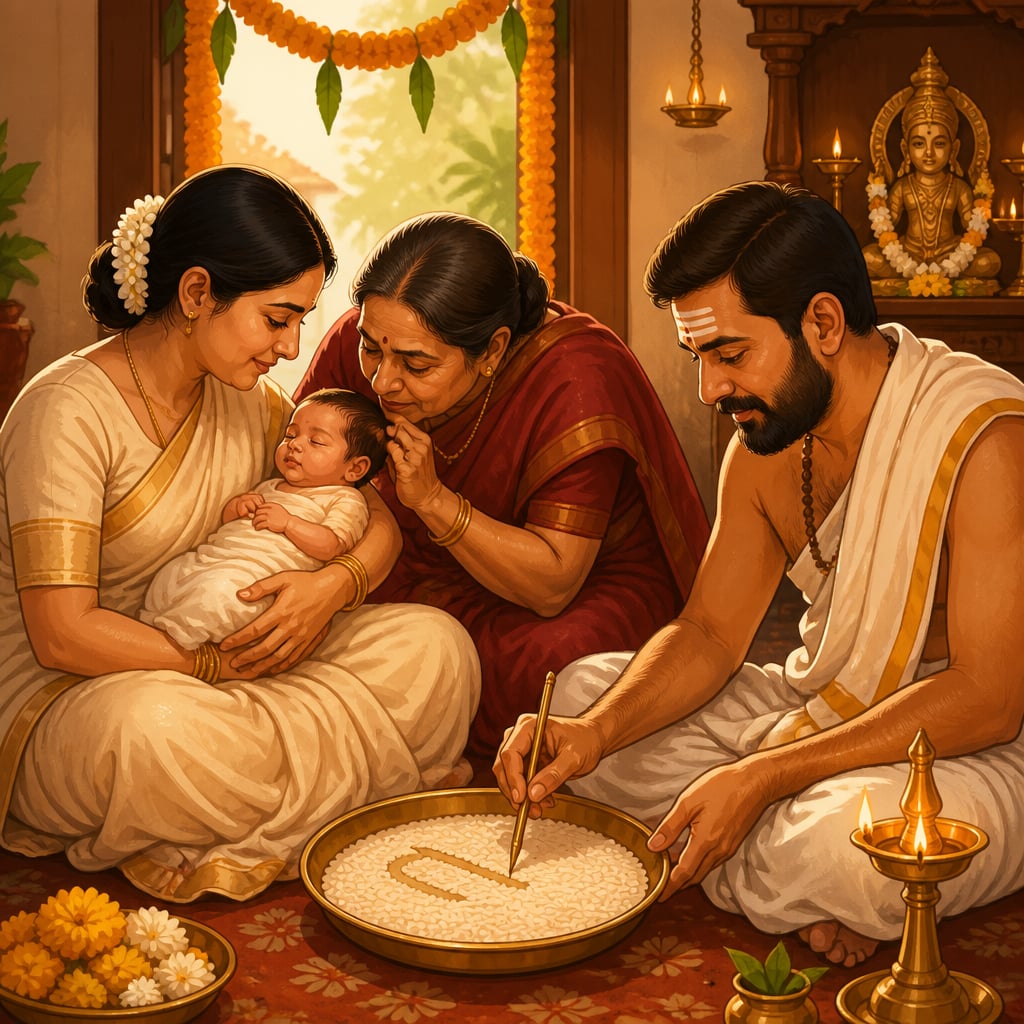
Grandmother whispering the chosen name into a newborn's ear

The paati in Tanjavur is sixty-eight years old. Her granddaughter, born ten days ago, is asleep in a small wooden cradle that has held five generations of girls in this family. It is the morning of the eleventh day. The mother is freshly bathed. The father is in a clean dhoti. The household priest has arrived. A small havan-kund has been set up in the corner of the inner room. The fire is lit with mango wood. A drop of honey, a drop of ghee, and a fragment of fresh ginger are touched, with a tiny gold ring dipped in each, to the baby's tongue. The priest has chosen three syllables. He whispers them, three times, into the right ear of the child, who does not yet have a name in the world.

The paati nods. The mother nods. The father takes the child in his arms. The priest now speaks the syllables aloud, into the room, for the first time. The baby has a name. Lakshmi. The grandchild now in the room, her older cousin, sees a girl named yesterday and a girl named today, and asks why it took so many days to name her. The paati does not answer the question. She only says, the name is the body's first piece of clothing, and we wait until the body is ready to wear it.

This lesson is the explanation she did not owe him. Three samskaras structure the newborn's first thirty days in Hindu tradition: Jatakarma, the birth ritual on day one. Namakarana, the naming on day eleven or twelve. Nishkramana, the first taking-out of the child on day thirty or in the fourth month. Each is named in the Grihya Sutras. Each carries a specific physiological and psychological logic that modern research has now begun to confirm. And the most rigorous of them, the phonological specifications of Namakarana in the Yajnavalkya Smriti, is being approximated, badly, by a global baby-naming app market that has not read the source.

Jatakarma: The First Taste

Father offering a first taste of honey and ghee at Jatakarma

Jatakarma is the birth ritual. It is performed within the first day, often within the first few hours, before the umbilical cord is cut in the traditional protocol. The Apastamba Grihya Sutra and the Ashvalayana Grihya Sutra both lay down the procedure. The father, with his right ring finger, places a small quantity of honey mixed with ghee on the baby's tongue. He whispers a Vedic mantra into the right ear. The mantra anchors the child to the lineage and the cosmos. The honey-ghee mixture introduces the first non-amniotic substance to the body.

The Sanskrit name of this opening act is medha-janana, the generation of intelligence. The Vedas frame the moment as the first cognitive event of the life. The child has come from the womb and now meets the world by the tongue. The substance is sweet (honey) and unctuous (ghee). The sound is the mantra. The first taste and the first sound are deliberately chosen.

Why the Body Responds

The Charaka Samhita, in its chapter on the newborn (Sharira-sthana, chapter on jata-shishu paricharya), prescribes the same protocol two thousand years before the Lancet revisited it. Honey, in trace doses, supplies easily-digestible glucose to a body whose digestive enzymes are not yet fully active. Ghee supplies medium-chain fatty acids that the infant brain requires for myelination in the first weeks. The combination is calorically dense, microbially clean (when the honey and ghee are pure and the dose is the trace dose the tradition specifies), and physiologically optimized for the newborn gut.

Modern paediatric research has revisited the practice, with caveats around honey and infant botulism that the modern WHO guidance handles by switching to a sterile sugar-water analogue. The traditional protocol used trace amounts (a single drop on the tongue), pure-source honey from known beekeepers, and the protective heating that Indian household honey is typically subjected to. The 2014 review in the Indian Journal of Traditional Knowledge notes that the historical incidence of infant botulism from Jatakarma honey is essentially undocumented in the village medical record. The protocol, in its traditional dose and source, was clinically observed for two thousand years.

The medha-janana framing is now the more defensible read: the first taste is a cognitive cue, not a nutritional intervention. The honey is sweet because the child must learn the world is sweet. The ghee is unctuous because the body must learn substance carries weight. The mantra is the sound the lineage uses to mark a new arrival. All three are first impressions in the literal sense.

Namakarana: The Naming

Namakarana is performed on the eleventh day (some traditions on the twelfth, the Manusmriti specifies the twelfth, the Apastamba allows the tenth or eleventh). The choice of name is not aesthetic. It is governed by an extraordinary set of phonological rules codified in the Yajnavalkya Smriti, c. third century CE, the oldest detailed phonological specification for a newborn name in any legal text on record anywhere in the world.

The Yajnavalkya Phonology

The Smriti specifies four constraints on a newborn name:

  1. The deity of the nakshatra under which the child was born must be honoured in the name. If the nakshatra is Rohini (deity: Brahma/Prajapati), the name carries a Brahma-related syllable. If the nakshatra is Pushya (deity: Brihaspati), the name carries a Brihaspati-related syllable.
  2. The number of syllables must match auspicious counts. Two syllables for short signature names. Four syllables for the formal full name. Odd-numbered syllable counts are avoided for everyday-use names.
  3. Boys' names should begin with a hard consonant (the sparsha consonants of Sanskrit phonology: k, kh, g, gh, ch, j, t, th, d, dh, p, b). The hard onset signals a strong initial breath.
  4. Girls' names should begin with a soft vowel or a sonorant (the svara and antastha sounds: a, i, u, e, o, y, r, l, v). The soft onset signals openness and continuity.

This is an absurdly precise specification. A third-century legal text specifying the acoustic onset of a name, its syllable count, and its deity-anchored semantics.

The Fluency Effect

In 2010, the psychologists Adam Alter and Daniel Oppenheimer published a paper in the Proceedings of the National Academy of Sciences that found a fluency effect in name perception: names that are easier to pronounce are judged more positively, are more likely to be hired, and are more likely to win in court. Albert Mehrabian's 2001 Baby Name Report Card found similar phonological-positivity effects across multiple US contexts.

The Yajnavalkya Smriti's syllable-count rules and consonant-onset rules encode the same psychological insight 1,700 years before the lab measured it. A four-syllable formal name with a hard consonant onset for a boy and a soft vowel onset for a girl is a name optimized for fluency, recall, and positive social processing. The Smriti's rules are not folklore. They are a phonological recipe whose behavioural mechanism is now confirmed in PNAS.

The Naming Whispered into the Ear

The Apastamba and Manava Grihya Sutras both specify that the name is first whispered into the right ear of the child by the father or the priest before being announced aloud to the gathered family. The whispering is not theatre. The right-ear preference for verbal-cognitive input is documented in modern neuroscience as the right-ear advantage, with the right ear feeding the left-hemisphere language centres directly. The Smriti's protocol delivers the child's first formal verbal stimulus to the language hemisphere by the most direct neural route. Two thousand years before the dichotic-listening literature.

The Modern Echo: Astrosage and the $200M Baby-Name App Market

In 2022, the Astrosage Baby Name Generator crossed fifteen million downloads on the Google Play store. The global baby-naming app market, which includes BabyCenter, Baby Names Genius, and several Indian-developer apps, exceeded $200 million in revenue by 2023. The Astrosage and similar apps generate name suggestions by nakshatra, which is the first of Yajnavalkya's four constraints. The other three (syllable count, consonant-onset gender phonology, and right-ear delivery protocol) are absent. The Smriti is not cited.

What the app store sells as digital Namakarana, the household priest in Tanjavur runs as the eleventh-day ritual, with all four constraints intact and the right-ear whisper in place.

Nishkramana: The First Sun

Father showing his infant the sunrise at Nishkramana

Nishkramana is the first taking-out of the child. Different traditions place it at the fortieth day, the third month, or the fourth month. The child, who has been kept indoors and protected from sun, wind, and crowds since birth, is now formally taken out of the house for the first time, dressed in new clothes, and shown to the sun.

The father holds the child and recites the Surya Mantra (typically the Gayatri or a Surya-specific verse from the Rig Veda). The child's eyes are turned toward the sun, briefly, with the mother's hand shading the direct light. The first photons the child receives outside the house are sunlight. The first sound the child receives outside the house is the Gayatri.

The Sanskrit framing is Aditya-darshana, the first sight of Aditya, the sun-god. The day is celebrated, in many traditions, as the child's emergence as a social being. Visitors are now allowed to handle the baby. The neighbourhood is informed. The child is now in the world.

Why the Sun Matters

Modern paediatric research has confirmed what the Grihya Sutras encoded as ritual. Vitamin D synthesis in the infant requires direct sunlight on the skin. Circadian-rhythm entrainment in the first months requires regular exposure to natural daylight cycles, with bright morning light being the most powerful zeitgeber. The Hall-Rosbash-Young Nobel Prize (Physiology or Medicine, 2017) for the discovery of the molecular mechanisms of the circadian clock confirms the importance of structured light exposure for healthy human physiology.

The Nishkramana is the first formal entrainment of the infant to the planet's day-night rhythm, anchored to the sunrise sun rather than to mid-day glare. The grandmother who insisted on the fortieth-day Aditya-darshana was running a circadian-anchoring protocol that the 2017 Nobel committee would eventually validate.

What to Call It Yourself

The names matter. Jatakarma, not first ritual. Namakarana, not naming ceremony. Medha-janana, not first taste. Nishkramana, not coming-out. Aditya-darshana, not first sun. The next time a baby-naming app is mentioned, ask whether it implements the Yajnavalkya consonant-onset rule. The next time a baby-shower discussion turns to first solid foods, mention Jatakarma and the medha-janana logic. The next time a paediatrician mentions vitamin D and circadian rhythm, mention Aditya-darshana. The user does not need to argue. The user only needs to use the original names.

A Note on Sensitive Topics

The Grihya Sutras were composed in a society with patrilineal naming conventions, gendered phonology, and varna-based variations in the protocols. Modern Hindu families perform Namakarana in many forms: traditional priest-led, household-led without a priest, in temples, in homes, with one or both parents announcing the name, with the right-ear whisper preserved or replaced by an aloud-only announcement. The lesson presents the codified protocol as the parent design and welcomes every modern adaptation that keeps the four key elements alive: the deity-anchored choice, the phonological care, the right-ear delivery, and the eleventh-or-twelfth-day timing. The protocol is older than the patrilineal expression of it. The principles are the durable part.

Circle-Back

The paati in Tanjavur has finished. The child has a name. The honey and the ghee have been tasted. The mantra has been whispered. In thirty days, on the morning of the fortieth, the child will be carried out into the courtyard for the first sight of the sun, with the Gayatri sounding overhead. The grandchild who asked why the naming took so many days will not understand for thirty years. Then one morning, in some other house, with his own newborn in his arms, he will whisper three syllables into the right ear, and remember the paati, and know in his ribs why she said what she said. Jatakarma, Namakarana, Nishkramana. The first thirty days of a Hindu life, engineered.

Case studies

Yajnavalkya Smriti, c. 3rd Century CE: The Most Detailed Newborn Phonology in Any Ancient Legal Text

In approximately the third century CE, the Yajnavalkya Smriti was compiled, becoming one of the three principal Dharmashastras of classical Hindu jurisprudence. Its Acharadhyaya specifies, in extraordinary precision, four constraints on the newborn name: the timing (eleventh day), the syllable count (two for the everyday name, four for the formal name), the semantic anchor (deity of the nakshatra under which the child was born), and the phonological onset (hard consonant for boys, soft vowel or sonorant for girls). No comparable ancient legal text from any culture, Greek, Roman, Chinese, Egyptian, Persian, or Hebrew, prescribes the acoustic onset, syllable count, and semantic anchor of a newborn name with this combined precision.

The Yajnavalkya rules are not aesthetic preferences. They encode a phonological recipe for cognitive fluency, social processing, and cosmological alignment. The deity-of-nakshatra rule places the child in a specific cosmic grid. The syllable-count rule optimizes for memorability and pronunciation. The consonant-onset rule signals gendered acoustic register. The eleventh-day timing aligns with the post-natal cognitive-attention window of the newborn, who is by then awake for longer stretches and able to register the phonological event.

The Yajnavalkya Smriti's Namakarana protocol has remained in continuous practice for seventeen hundred years. Modern Hindu households across the subcontinent and the diaspora still observe the eleventh-day timing, the nakshatra-anchored letter selection, and (often unconsciously) the gendered consonant-onset preference. The Smriti is the single most durable phonological specification on record.

The Yajnavalkya Smriti's third-century-CE phonological rigour is not folkloric superstition. It is a legal codification of cognitive-acoustic best practice, executed seventeen hundred years before the modern fluency-effect literature documented the underlying psychological mechanism.

Hindu families considering Namakarana for a newborn can implement all four Yajnavalkya constraints with modest effort: the family priest or panchanga app provides the nakshatra and deity, the parents choose between the two-syllable everyday name and the four-syllable formal name, and the gender-coded onset rule is observed for the formal name. The right-ear whisper protocol is preserved by the parent or priest delivering the name to the right ear before announcing it to the gathered family.

Yajnavalkya Smriti, Acharadhyaya 1.11, c. 3rd century CE. Four constraints: eleventh-day timing, two-or-four syllable count, nakshatra-deity anchor, gender-coded consonant onset. No comparable specification in any contemporary legal corpus from any other ancient civilization.

Alter and Oppenheimer 2010: PNAS Confirms the Smriti's Phonology, 1,700 Years Late

In 2010, the psychologists Adam Alter and Daniel Oppenheimer published in the Proceedings of the National Academy of Sciences on what they termed the cognitive fluency effect in name perception. Names that are easier to pronounce are judged more positively, are more likely to be hired, and, in their analysis of judicial decisions, are more likely to win in court. Albert Mehrabian's 2001 Baby Name Report Card had documented similar phonological-positivity effects in US naming contexts. The 2017 Hall-Rosbash-Young Nobel Prize in Physiology or Medicine for the molecular mechanisms of the circadian clock has separately confirmed the importance of structured early sunlight exposure for healthy infant development, validating the Nishkramana's Aditya-darshana protocol.

The Yajnavalkya Smriti's syllable-count and consonant-onset rules encode a phonological recipe for fluency. The Manava Grihya Sutra's fourth-month Aditya-darshana encodes a structured-sunlight protocol for circadian entrainment. The Apastamba's Jatakarma honey-and-ghee protocol encodes a sensory-cognitive seed-event framed as medha-janana, the generation of intelligence. Each samskara is a precisely engineered intervention whose mechanism modern research has begun to confirm in laboratory and clinical settings.

The 2010 PNAS paper, the 2017 Nobel Prize, and the broader fluency-effect and circadian-rhythm literature have shifted the academic framing of the Hindu newborn samskaras from cultural artefacts to documented psycho-physiological interventions. The convergence of textual and laboratory evidence has begun to be cited in cross-cultural neonatology and developmental-psychology research.

The first thirty days of a Hindu life are not three folk customs in sequence. They are three precisely engineered interventions: a sensory-cognitive seed-event (Jatakarma), a phonological-cognitive imprint (Namakarana), and a circadian-entrainment event (Nishkramana). The grandmother's instinct that the body must be ready before the name is worn is now an EEG and circadian-biology measurement.

Paediatricians advising on infant developmental milestones have begun to revisit the structured-sunlight, structured-sound, and structured-name protocols of traditional cultures. The Hindu samskara sequence is one of the most fully documented and most durable of these protocols, with seventeen hundred years of continuous textual prescription and clinical observation.

Alter and Oppenheimer, PNAS, 2010. Mehrabian, Baby Name Report Card, 2001. Hall, Rosbash, Young, Nobel Prize in Physiology or Medicine, 2017. Multiple papers in Pediatrics and the Indian Journal of Traditional Knowledge documenting the medha-janana framework's clinical observations across two thousand years of household practice.

Astrosage and the $200M Baby-Name App: The Smriti Stripped of Three of Its Four Rules

By 2022, the Astrosage Baby Name Generator had crossed fifteen million downloads on the Google Play store. By 2023, the global baby-naming app market, including BabyCenter, Baby Names Genius, the Hindu Baby Names suite, and several other Indian-developer apps, exceeded two hundred million dollars in annual revenue. Most of these apps generate name suggestions based on nakshatra, the first of the Yajnavalkya Smriti's four constraints. The other three constraints (the two-or-four syllable count, the gender-coded hard-consonant or soft-vowel onset, and the right-ear whispered delivery protocol) are absent from the app workflows. The Yajnavalkya Smriti is not cited in any of the major app marketing materials surveyed for this lesson.

The Yajnavalkya Smriti specifies a four-rule recipe. The household priest in Tanjavur runs all four. The fifteen-million-download app runs one. The fluency-effect mechanism documented by Alter and Oppenheimer in PNAS depends on all four rules acting in combination, not on the nakshatra rule alone. The app generates names that satisfy the nakshatra constraint but may violate the syllable-count rule, the consonant-onset rule, or both, producing a name that fails the very fluency test the Smriti was designed to pass.

The baby-naming app market continues to grow, and millions of Hindu newborns now receive their formal names through workflows that implement only one of the Smriti's four rules. The original protocol, with all four rules, continues to be observed in households that work with traditional priests and panchanga consultants. The two streams (full-protocol household and stripped-protocol app) now run in parallel.

What the app store sells as digital Namakarana, the household priest performs as the eleventh-day samskara with the full Yajnavalkya specification. The user's work is not to refuse the app. The user's work is to use the app for the nakshatra step and then run the remaining three rules manually, with a priest or a basic Sanskrit-phonology reference, before the name is whispered into the right ear.

Hindu parents using a baby-naming app for the nakshatra step can supplement with the remaining three Smriti rules in under thirty minutes. The result is a name optimized for fluency, social processing, cosmological anchor, and lineage continuity, with all four rules of the parent specification preserved.

Astrosage Baby Name Generator: 15M+ downloads (2022). Global baby-naming app market: $200M+ revenue (2023). Yajnavalkya Smriti rules implemented by typical app: 1 of 4. Yajnavalkya Smriti rules implemented by traditional household priest: 4 of 4.

Historical context

From the Apastamba and Ashvalayana Grihya Sutras (c. 600-300 BCE) and the Charaka Samhita's chapters on newborn care (c. 600 BCE-200 CE), through the Yajnavalkya Smriti's third-century-CE phonological codification of Namakarana, to the 2017 Hall-Rosbash-Young Nobel Prize on circadian biology, to the 2010 Alter-Oppenheimer fluency-effect paper in PNAS, to the 2022 Astrosage app's fifteen-million-download milestone.

Living traditions

The names matter. Jatakarma, not first ritual. Namakarana, not naming ceremony. Medha-janana, not first taste. Nishkramana, not coming-out. Aditya-darshana, not first sunlight. When a baby-naming app is mentioned, ask whether it implements all four Yajnavalkya rules. When a paediatrician discusses vitamin D and circadian rhythm in early infancy, mention Aditya-darshana. When a paediatric-nutrition trend revisits early sweet introduction or first-tastes, mention medha-janana. The user's everyday practice can be small: even in a diaspora setting without a household priest, parents can perform a simplified Jatakarma (a trace of pure ghee on the tongue, a whispered family-tradition mantra into the right ear), a simplified Namakarana on the eleventh day with full Yajnavalkya phonological care, and a simplified Nishkramana on the fortieth day with a sunrise step into the courtyard or balcony with the Gayatri recited overhead. The receipts are in the Yajnavalkya Smriti, in PNAS 2010, in the 2017 Nobel Prize, and in the Tanjavur paati's eleventh-day cradle. The user does not need to argue. The user only needs to keep the practice and use the name.

Reflection

More in The Sixteen Samskaras

All lessons in The Sixteen Samskaras ยท Samskaras: The Sanatan Operating System course