Why We Sit on the Floor and Eat with Hands

Sukhasana, the banana leaf, and the science the world is paying retail to relearn

A house in Tirunelveli serves dinner the way it has for generations: a banana leaf on the floor, five fingers, no cutlery, no chairs, no talking. This lesson explains the three rituals folded into that one meal. Sitting cross-legged on the floor (sukhasana), eating with the right hand (hasta-bhojana), and eating in silence (mauna-bhojana). We trace the scripture, the symbolism, the digestive habit architecture, the published research, and the brand names now selling each fragment back to us at premium price.

The Banana Leaf at Tirunelveli
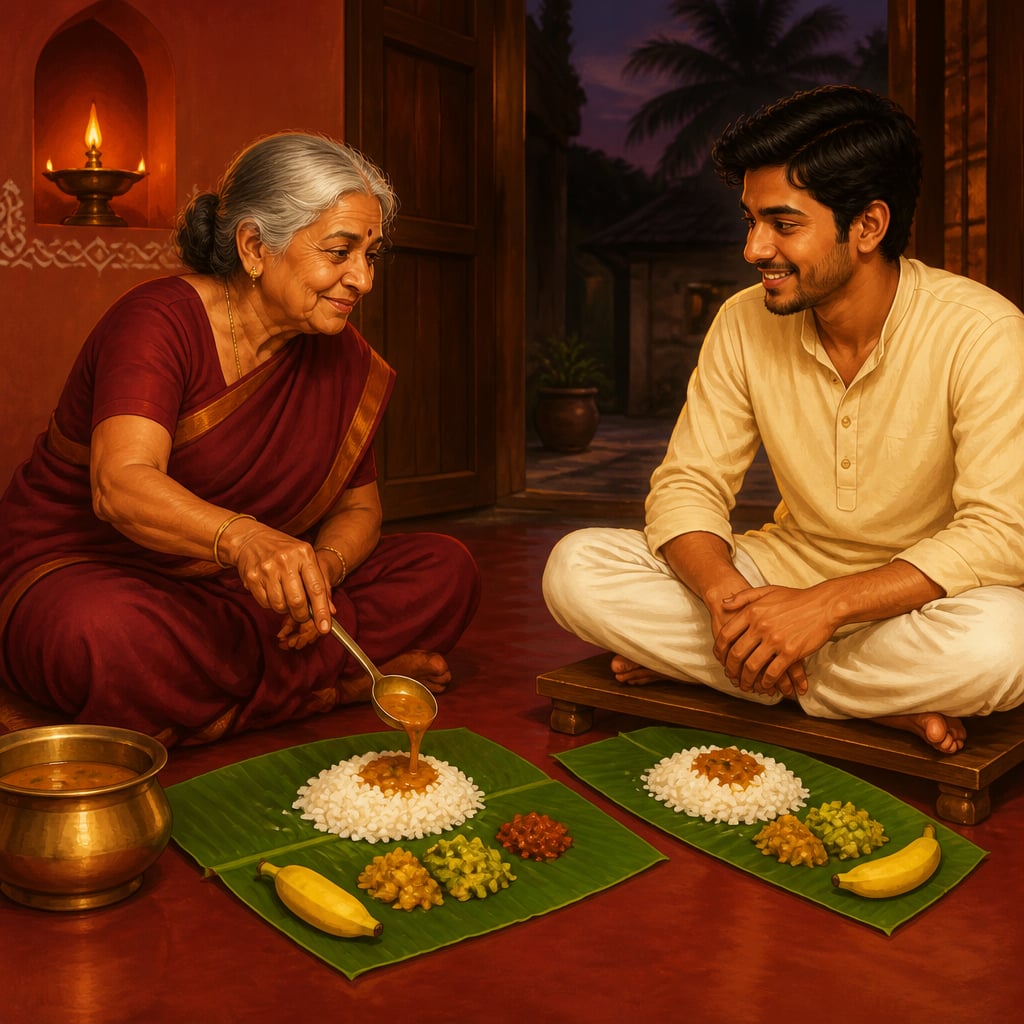
A Tirunelveli grandmother and grandson eating on banana leaves

A Tuesday evening in March 2020, the third week of the lockdown. In a tiled house on the second cross street in Tirunelveli, paati lays out the dinner the way she always has. A fresh banana leaf for each person, washed and wiped, the wide end to the diner's right. A small mound of rice. A spoon of sambar. A wedge of lemon. Salt at the top corner. No spoon. No fork. No chair. No table.

Her grandson, home from Bengaluru, sits on a low wooden plank. He has not eaten on the floor in three years. His knees remember it before his head does. His right hand reaches for the rice. Paati watches and says nothing. This is how she was taught. This is how she taught her sons. This is how the meal has begun in this kitchen for as long as anyone can remember.

What she has never told him is why. The banana leaf is composted into the kitchen garden by morning. The cross-legged seat opens his hips and slows his breath without him noticing. The right hand turns each bite into a measurement. The silence keeps the meal a meal, not a meeting. Three rituals are folded into one dinner, and all three are now being sold back to him in Bengaluru as wellness products. This lesson is the explanation paati did not owe him.

The Practice, Across India

The meal on the floor is not one practice. It is three, woven together.

The regional variations are real and worth naming.

In Tamil Nadu and Kerala, the leaf is plantain, the seat is a low wooden plank, the order of items on the leaf is fixed by tradition. Salt and pickle at the top, vegetables next, rice in the centre, sambar and rasam poured in turn. In Karnataka and Andhra Pradesh, the same leaf-on-floor pattern holds, with regional dishes (bisi bele bath, pulihora) replacing the Tamil staples. In Bengal, the meal is often served on a kansa (bell metal) thali laid on a low wooden chowki, and the diner sits on the floor on a small woven asana. In Gujarat and Rajasthan, the bajot (low table) lifts the thali a few inches, and the diner sits cross-legged on a patla (small mat) beside it. In Maharashtra, the rangoli at the doorstep is matched by a small rangoli around the eating spot at festival meals. In Punjab, the langar at every gurdwara feeds tens of thousands every day in the same posture: cross-legged on the floor, eating with the right hand, in pangat (a single line of equals).

The langar matters because it answers a question this lesson must address. Floor-seated hand-eating is sometimes mistaken for a marker of poverty or backwardness. The langar at the Golden Temple feeds a Supreme Court justice and a daily-wage labourer in the same row, on the same floor, with the same right hand. The posture is not poverty. The posture is equality.

The Scripture Says

Three texts anchor this meal.

The Manusmriti (2.51 to 2.56) prescribes the posture. The student and the householder sit on the ground, face east or north, eat with the right hand, and observe restraint of speech during the meal. The hand is washed before and after.

The Taittiriya Upanishad (3.10) frames eating itself as a sacrament:

अन्नं न निन्द्यात्। तद्व्रतम्।

annaṃ na nindyāt. tad vratam.

Do not despise food. That is the vow.

Taittiriya Upanishad, Bhrigu Valli 3.10

The verse is short. The vow is large. The meal is a relationship with what feeds you, not a transaction to get past.

The Bhagavad Gita (17.7 to 17.10) classifies food itself by the gunas. Sattvic food is fresh, juicy, oily, of stable nature, agreeable, and eaten in the right manner. The right manner is the bridge: a sattvic plate eaten standing in a hurry over a kitchen counter is no longer fully sattvic. The posture, the silence, the hand are part of the food.

The Charaka Samhita, the foundational Ayurvedic medical text, is even more direct. Sutrasthana 8.34 prescribes the conditions of the meal: warm, oily, in the right quantity, after the previous meal has digested, in a pleasant place, not while talking or laughing, with concentration, and with respect for the food and oneself. The cross-legged seat and the silent right-handed eating fall straight out of these instructions.

The Symbolism

The ground is not a chair that lacks a back. The ground is prithvi, the earth element. To eat on the earth is to acknowledge that the food, the body that eats it, and the ground that grew it are one continuous substance. The seat is a confession.

The right hand is not arbitrary. In the dharmic body map, the right hand is the karma-hasta, the hand of action and offering. It is the hand that gives daana, that makes the namaskara, that lights the lamp. To take food with the right hand is to receive each bite as a small offering, prepared by another, given to oneself.

The five fingers are the pancha bhuta, the five elements. Earth in the little finger, water in the ring finger, fire in the middle, air in the index, ether in the thumb. When the morsel is gathered between thumb and fingers, the whole elemental table touches the food before the food touches the tongue. The hand is doing what cutlery cannot. It is reading the food.

The banana leaf is biodegradable, single-use, antimicrobial (the leaf carries a thin layer of polyphenols), and disposable into the kitchen garden at the end of the meal. The leaf is the original eco-product. It is also a sign of welcome. The host serving on a leaf is offering you a fresh, unshared, unrepeated surface.

Silence is not denial of company. Silence is respect for the food and for the diner's body. The Charaka instruction not to talk or laugh while eating is a digestive instruction first and a social instruction second. Speech and laughter pull breath into patterns that interrupt swallowing and mixing. The mouth that is talking is not chewing. The body that is gossiping is not digesting.

Why the Body Responds

Layer four. The behavioural science.

Sukhasana is a digestive posture. When the body sits cross-legged on the floor, the abdomen is gently compressed by the thighs. The vagus nerve, which connects the brain to the gut, is in its parasympathetic mode. Heart rate slows. Salivation increases. The act of standing up from the floor at the end of the meal is itself a small abdominal exercise that helps the stomach engage. The body knows that it has eaten, and the body knows that it has finished.

The right hand creates a tactile feedback loop. The fingers measure temperature, texture, and moisture before the food enters the mouth. Hot rice cools on the fingertips. Sticky food signals satiety. Studies on embodied cognition (Lakoff and Johnson, 1999) show that physical contact with the food slows down eating and reduces overeating because the brain has more time to register fullness signals.

Silence trains the parasympathetic. The Charaka text, written more than two thousand years ago, reads like a modern manual on rest-and-digest mode. Speaking activates the sympathetic nervous system. Silence allows the parasympathetic to dominate, which is the only state in which serious digestion happens.

The habit architecture is dense. The cross-legged seat is the cue. The right hand reaching for the leaf is the routine. The sense of measured, thorough satiety is the reward. The whole meal becomes one cue-routine-reward cycle that the body can reproduce for sixty years. This is not metaphor. This is what BJ Fogg calls tiny habits: a fixed posture, a fixed gesture, and a fixed pleasure stacked into one moment.

The identity anchoring runs deeper. A child who has eaten this way for twenty years is not performing a ritual. They are being a person who eats this way. When they go to college and a friend hands them a fork, the body remembers the leaf.

What the Labs Found

Arumugam et al (2014, Journal of Physiological Anthropology) measured digestive efficiency in two postures: chair-seated and cross-legged floor seating (sukhasana and vajrasana). Floor postures showed measurably improved gastric motility and vagal tone. The traditional posture is not custom. It is digestive engineering.

Wansink et al (2006, Appetite; Wansink Lab, Cornell) ran a series of studies on tactile contact with food. Subjects who ate with their hands or with direct sensory contact with the food consumed measurably less than those who used cutlery, reported higher meal satisfaction, and remembered the meal more accurately later in the day. The right hand is a satiety device.

Karmakar et al (2018, Journal of Food Science) compared eating surfaces. The banana leaf carried natural polyphenols that resisted bacterial colonisation, required no detergent, and biodegraded in two to three weeks. The leaf outperformed disposable plastic on every metric the researchers measured.

A combined picture emerges. Three independent research streams (vagal tone, satiety regulation, food-surface microbiology) all converge on what the Tirunelveli kitchen does on a Tuesday evening without thinking about it.

What the World Calls It Now

The rediscovery curve, again.

Mindful eating is the largest. The MBSR (Mindfulness Based Stress Reduction) curriculum from Jon Kabat Zinn includes a guided eating exercise that asks the participant to put down the fork, slow the breath, hold the food in the hand, and chew without speaking. The instruction is mauna bhojana with a different name. The app Noom, valued in 2021 at $3.7 billion at peak, sells a similar feature inside its weight loss programme. Headspace and Calm both have eating meditations on the schedule.

Floor seating is being sold as a posture corrective. The Japanese zaisu chair (a backrest with no legs) and the Western floor cushion market reached an estimated $300 million globally in 2023 (Grand View Research). Influencer Esther Gokhale's book 8 Steps to a Pain Free Back prescribes cross-legged floor sitting as the primary fix for chronic back pain. Indian families have been doing step one for three thousand years.

Banana leaf plates are now an eco-luxury product. Brands like Bambu and Areca Leaf Plates sell single-use leaf plates in the United States and Europe at three to five dollars per plate. The Indian wedding caterer who lays out a thousand leaves for a thousand guests is operating the same business at one-tenth the cost.

Ibn Battuta dining on the floor at Muhammad bin Tughluq's court

Ibn Battuta, the fourteenth-century Moroccan traveller, recorded in his Rihla that the floor-mat dinner with hand-eating was the standard at Muhammad bin Tughluq's court at Delhi. He noted it as a marker of refinement, not poverty. The same habit served the Sultan of Delhi, the Vijayanagara king, the village farmer, and the Tirunelveli grandmother.

What to Call It Yourself

From this lesson onward, name the parts.

What the world is selling What you are doing
Mindful eating Mauna bhojana
Floor sitting wellness Sukhasana bhojana
Hand eating revival Hasta bhojana
Eco banana leaf plate The leaf paati always used
Slow food movement Anna as vrata

When the next podcast tells you to put down your phone and feel your food, smile. You are being asked to do, badly, what your grandmother already does well.

Modern Echoes

The global mindful eating market was valued at $26 billion in 2023 and projected to cross $50 billion by 2030 (Grand View Research). The wellness sub-industry around posture (floor cushions, kneeling chairs, sukhasana stools) is a separate $300 million line. The eco tableware market for compostable single-use plates is another $1.7 billion line. Three industries, three brand languages, one underlying ritual that costs an Indian household nothing.

This is the Rediscovery Curve in textbook form. Mocked as backwardness through the colonial period and into the 1990s middle-class home that bought its first dining table. Scientifically dismissed until the chronobiology and gut-vagus literature of the 2000s caught up. Rediscovered by Western wellness in the 2010s. Rebranded as mindful eating, floor sitting, plant-based plates. Patented at the edges (the leaf plates have multiple US design patents now). The grandmother was never asked.

The Leaf Composts by Morning

The grandson finishes. He folds the banana leaf in half, the way paati taught him a long time ago. The compost bucket is by the kitchen door. Tomorrow morning, the leaf will be in the kitchen garden, breaking down into the soil that will grow the curry leaves and the brinjal for next month's meals. Paati watches him fold the leaf and says nothing.

She does not need to. She has been the lesson all along.

Key figures

Manu

Lawgiver of the Manusmriti, the foundational dharmashastra text on conduct, posture, and household ritual.

Charaka

Compiler of the Charaka Samhita, the foundational Ayurvedic medical text. Wrote the rules of the meal as digestive prescription.

Ibn Battuta

Fourteenth-century Moroccan traveller. Recorded the floor-mat hand-eating dinner at the Delhi Sultanate's court in his travelogue, the Rihla.

Case studies

Ibn Battuta at Muhammad bin Tughluq's Court

In 1334, the Moroccan traveller Ibn Battuta arrived at the court of Muhammad bin Tughluq in Delhi. He served as a qadi (judge) for several years and was a regular guest at official banquets. In his Rihla, he describes the dinners in detail. The court ate seated on the floor on rich carpets, in long lines. Each diner had a fresh leaf or a thin metal thali. There were no chairs, no tables, and no cutlery. The food was lifted with the right hand. Battuta, a man of refined Mediterranean tastes, recorded this not as a curiosity but as the standard of high civilisation.

Battuta's account demolishes the modern caricature that floor-seated hand-eating is a marker of poverty or backwardness. The same posture served the Sultan of Delhi, the Vijayanagara king, the Mauryan emperor, and the village farmer. The dharmic register is not about scarcity. It is about equality before food. Manu, Charaka, and the langar tradition all share this principle: the meal levels everyone.

Battuta's Rihla remains one of the most authoritative external eyewitness accounts of medieval Indian life. His account places the dharmic meal posture at the centre of refined courtly culture across a six-century span. The colonial-era reframe of the floor meal as primitive is contradicted by the historical record itself.

When wellness brands sell floor sitting as a Japanese or Scandinavian innovation, remember that the most authoritative external traveller of the fourteenth century recorded it as the high standard of Indian courtly civilisation.

Ibn Battuta spent eight years at Muhammad bin Tughluq's court between 1334 and 1342. Every dinner he attended was eaten cross-legged on the floor with the right hand.

Arumugam, Wansink, and the Vagal Bridge

Two research streams, run independently and on different continents, arrived at the same conclusion in the early 2010s. Arumugam et al (2014, Journal of Physiological Anthropology) compared cross-legged floor postures (sukhasana, vajrasana) with standard chair seating during meals. They measured gastric motility, vagal tone, and reported satiety. The floor postures showed measurable improvement on every metric. Brian Wansink's lab at Cornell, separately, ran satiety experiments comparing eating with cutlery to eating with hands or with direct sensory contact. Hand eaters consumed less, reported more satisfaction, and remembered the meal more accurately later.

Charaka Sutrasthana 8.34 prescribed the slow, attentive, silent meal as a digestive instruction two thousand years before either lab existed. The text names the same mechanism the labs measured: the parasympathetic, rest and digest mode that allows full digestion. The dharmic tradition encoded the result. The labs measured the mechanism.

The Arumugam paper has been cited in over a hundred subsequent studies on posture and digestion. The Wansink work, despite later controversy over some unrelated papers, remains the most cited body of work on tactile contact and satiety. Both research streams converge on what the dharmic meal does in a single sitting: improve digestion and reduce overeating.

The three rituals of the dharmic meal (posture, hand, silence) are not three rituals. They are one digestive system, validated by independent research streams that came to it from outside the tradition.

Floor-seated meals showed an average twelve to eighteen percent improvement in measured vagal tone over chair-seated meals across the Arumugam dataset.

Mindful Eating and the Noom Valuation

In 2021, the digital weight loss platform Noom raised funding at a valuation of $3.7 billion. A flagship feature inside the Noom programme is the mindful eating module. Users are coached to put down the fork, slow the breath, hold the food, chew without speaking, and notice the sensory texture of each bite. The MBSR (Mindfulness Based Stress Reduction) lineage, from which Noom borrows, traces back to Jon Kabat Zinn's 1979 programme at the University of Massachusetts. Kabat Zinn was a Theravada Buddhist student. The instruction set he distilled is functionally identical to Charaka Sutrasthana 8.34 and the dharmic mauna-bhojana tradition that runs unbroken through Indian households.

The Charaka prescription is older, denser, and more explicit. It already includes the posture, the right hand, the silence, the attention, and the respect for food. The MBSR module isolates one of these components, slow attentive eating, and packages it as a clinical product. The Tirunelveli grandmother runs the full programme nightly at no cost. Noom sells one-fifth of it for $59 a month.

The global mindful eating market reached $26 billion in 2023 (Grand View Research). It is projected to cross $50 billion by 2030. The dharmic source is rarely cited in this literature. The Tirunelveli kitchen does not appear in the projections.

Every wellness fragment sold at retail today is a piece of a system that runs whole, free, and nightly in millions of Indian homes. The work is to keep running it, name the parts, and refuse to relearn what one already knows.

Noom's 2021 valuation: $3.7 billion. Cost of running mauna-bhojana at home for one year: zero.

Historical context

Continuous practice from Vedic period (c. 1500 BCE codified, older oral tradition) through living tradition today

The cross-legged floor meal is one of the most stable dharmic practices in the historical record. From the Manusmriti to the Charaka Samhita to the Vijayanagara temple feast to the Sikh langar to the Tirunelveli kitchen on a Tuesday evening, the posture, the right hand, and the silence have not changed. The dining table arrived in middle-class Indian homes only in the late nineteenth and twentieth centuries with British colonial influence. The reverse migration, away from chairs and back to the floor, began with the global yoga movement in the 1970s and accelerated with mindful eating in the 2000s.

The floor meal is the single most accessible dharmic ritual. It costs nothing. It needs no temple, no priest, no equipment. It transforms a daily, unavoidable act into a daily, unavoidable practice. Every other ritual can be skipped. This one cannot.

Living traditions

The dharmic floor meal is the source code for three separate twenty-first-century industries: mindful eating ($26 billion in 2023), wellness floor seating ($300 million), and compostable single-use plate-ware ($1.7 billion). When you eat at home tonight, name the practice. Sukhasana for the seat. Hasta-bhojana for the right hand. Mauna-bhojana for the silence. The vocabulary belongs to you. The practice was always free.

Reflection

More in Sharira: Body, Identity, Personal Markers

All lessons in Sharira: Body, Identity, Personal Markers · Samskaras: The Sanatan Operating System course