Skin and Sacred: Sandalwood and Beads

Why a paste, a seed, and a stem still mark the body of a Hindu

Across India, Hindus still rub sandalwood paste on the body, wear rudraksha around the neck, and string tulasi beads at the throat. Each of these is older than the brand it now competes with. This lesson takes three of the most-worn substances in Hindu life and lays out their full architecture: the practice across regions, the scripture behind them, the symbolism, the habit logic, the labs catching up, and the wellness brand that is selling you the same thing under a new name.

The Aaji and the Pot of Paste
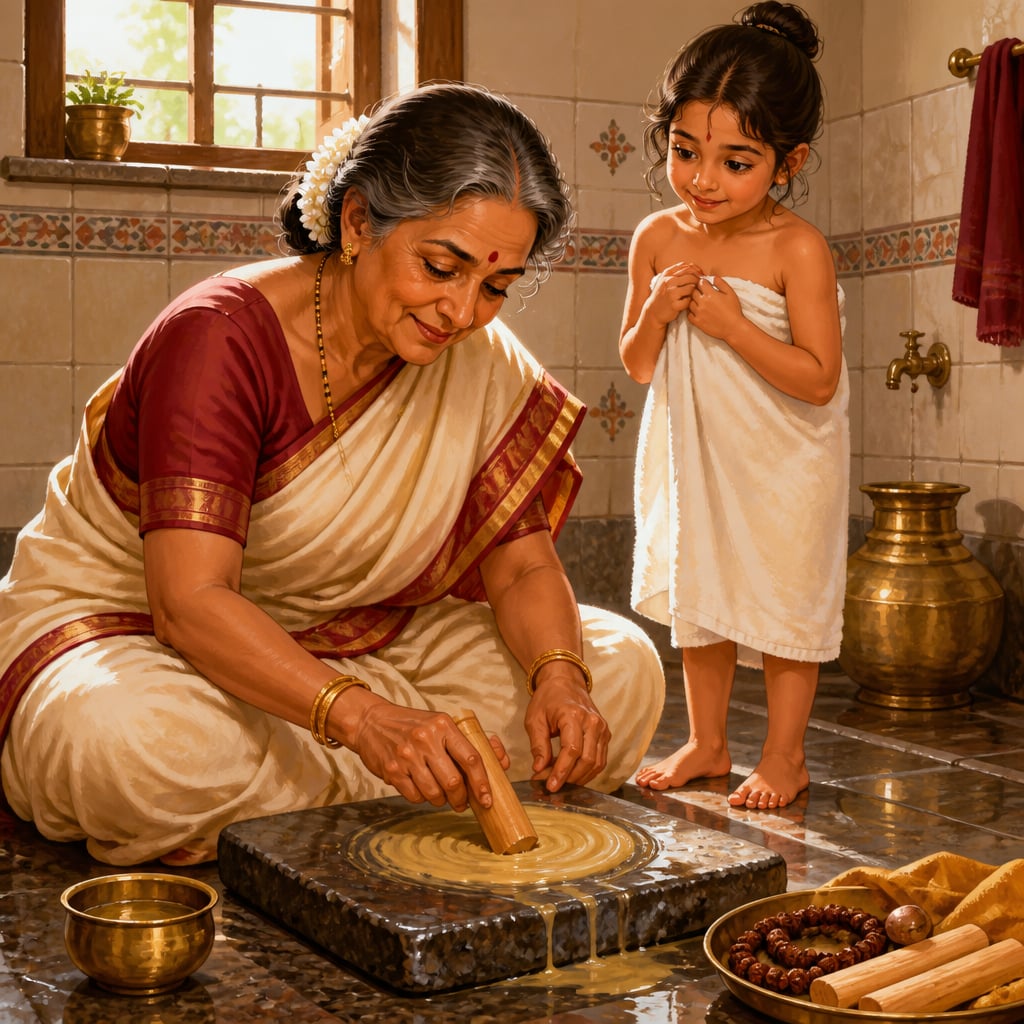
A Marathi aaji rubbing sandalwood on a stone in a Pune bathroom

In a tiled bathroom in Pune, sometime in the late 1990s, an eight-year-old girl is being held still by her grandmother. The aaji is in a soft cotton saree. In her left hand is a small brass bowl. In the bowl is a thick yellow paste, ground that morning on a flat stone with a few drops of rose water. The smell is heavy and cool, almost wet, like a forest after rain. The girl is squirming because the paste is cold on her arm.

"Chandan," the aaji says in Marathi. She does not say what it is for. She does not say which scripture it comes from. She says only, "You will not get prickly heat this summer." She rubs the paste in slow circles on the girl's forearms and the back of her neck, and lets it dry.

The girl will not understand for another twenty years that the paste in that bowl is the same substance the priests at Puri Jagannath have been applying to the deity every summer for at least nine hundred years, that the Atharva Veda named it as a cooling agent, that a German wellness chain in 2021 sold the same paste in a 30 ml glass jar for ninety dollars and called it "East India Sandalwood Hydrating Mask." She will only understand that her aaji was right about the prickly heat.

This lesson is about three substances a Hindu has worn on the skin for as long as the records go back. Chandan, the sandalwood paste. Rudraksha, the seed of the Elaeocarpus ganitrus tree. Tulasi, the holy basil stem strung as a mala. The grandmother did not owe you the explanation. The lesson is the explanation.

Chandan: The Paste That Cools

Chandan, in its most common form, is a paste made by rubbing a stick of Santalum album sandalwood on a wet stone. Different regions add different things. In Maharashtra and Gujarat, a few drops of rose water. In Tamil Nadu, the paste is mixed with kumkum and applied as a thicker tilak that runs from the brow up into the hairline. In Kerala, in many Krishna temples, sandalwood is ground with camphor and offered to the deity before being given to devotees. In Odisha, at Puri Jagannath, the paste is applied to the entire body of the deity through the summer months in a temple-wide ritual called Chandana Yatra, one of the longest continuously documented temple rites in India.

The Atharva Veda already names sandalwood among substances used for cooling and protection of the body. The Brihat Samhita of Varahamihira, written in the sixth century, prescribes sandalwood paste in summer for fever, skin irritation, and what the text calls daha, a burning sensation in the body. The Charaka Samhita treats Chandanadi preparations as standard for pitta disorders, which in modern translation includes inflammation, heat rashes, and certain skin conditions.

चन्दनं शीतलं रूक्षं तिक्तं पित्तकफापहम्।

candanaṃ śītalaṃ rūkṣaṃ tiktaṃ pitta-kapha-apaham

Sandalwood is cooling, dry, bitter, and removes pitta and kapha imbalances.

Bhavaprakasha Nighantu, Karpuradi Varga

The symbolism. Chandan is what you put between you and the heat of the world. Applied at the brow, it cools the seat of thought. Applied at the throat, the seat of speech. Applied at the chest, the seat of feeling. The body is being asked to slow down before it greets the day, the deity, or the guest.

Why the body responds. This is habit architecture in a few grams of paste. The cue is the smell. Sandalwood is one of the most distinctive scents the human nose meets, and it lingers on the skin for hours. The routine is the act of grinding and applying, which is slow by design and impossible to do in a hurry. The reward is the immediate physical drop in skin temperature and the social recognition of the mark. Over a lifetime the smell becomes the trigger. A grandchild in a Pune bathroom in 1995 and a Carnatic singer warming up in a Chennai green room in 2024 are both being cued by the same molecule into the same state.

What the labs found. Modern dermatology has spent the last twenty years catching up. Sharma et al, Phytotherapy Research 2014, documented anti-inflammatory and antimicrobial activity of Santalum album essential oil on skin. Misra and Dey, International Journal of Trichology 2013, recorded measurable cooling and skin-pH stabilization from topical sandalwood paste. The patent fight is its own story. A US firm, in the late 1990s, attempted to patent a sandalwood-based skin formulation. CSIR India successfully challenged the claim, citing Charaka and the Brihat Samhita as prior art going back fifteen centuries.

What the world calls it now. Aesop "Sandalwood Body Cleanser" at fifty-five dollars. Le Labo "Santal 33" eau de parfum at three hundred and fifty. Goop "Cooling Sandalwood Mask" at sixty. Kiehl's "Sandalwood Hydrating Cream." The European wellness market for sandalwood-based skincare crossed two billion dollars in 2023. None of these labels mention Charaka or Bhavaprakasha or the Puri Chandana Yatra.

What to call it yourself. Haldi-chandan if you mix it with turmeric. Chandan tilak if you wear it as a mark. Chandan lepa if you apply it as a paste on the body. The original names are still here. Use them.

Rudraksha: The Seed That Calms

A Shaiva sannyasi with a 108-bead rudraksha mala at dawn

The rudraksha is the dried fruit-stone of Elaeocarpus ganitrus, a tree that grows in the foothills of the Himalayas, parts of Nepal, and Indonesia. It is naturally faceted into ridges called mukhis. A five-mukhi rudraksha is the most common; one-mukhi and twenty-one-mukhi are vanishingly rare. Strung into malas of 108 beads, rudraksha is worn around the neck or wrist by Shaivites, by sadhus across sampradayas, and increasingly by lay Hindus in cities.

The Shiva Purana, in its Vidyeshvara Samhita, gives the canonical story. Lord Shiva, after a long meditation on the suffering of the world, opens his eyes, and a tear falls. From that tear springs the rudraksha tree. The name itself is rudra-aksha, the eye of Rudra. The Atharva Veda already mentions a bead worn for protection. The Padma Purana and Skanda Purana give detailed prescriptions on how many mukhis suit which intention. By the time of the Brihaddharma Purana, the rudraksha has a full classification system attached to it, by face count, by size, by region of origin.

रुद्राक्षधारणाद् एव कोटि-कोटि-गुण-अधिकम्।

rudrākṣa-dhāraṇād eva koṭi-koṭi-guṇa-adhikam

The mere wearing of rudraksha multiplies one's merit by tens of millions.

Shiva Purana, Vidyeshvara Samhita 25.65

The symbolism. The rudraksha is grief turned into a protective shield. Shiva's tear, the response of the cosmos to suffering, becomes the seed the devotee wears against the throat. It is also one of the few sacred objects in Hindu life that is unambiguously open to everyone. There is no caste rule, no gender rule, and no initiation rule on wearing rudraksha. The Shiva Purana is direct about this.

Why the body responds. The bead sits on the skin at the base of the throat, near the carotid artery, and rises and falls with breath. Over hours of wear it becomes a tactile anchor, the way a wedding ring becomes one for the finger. In Shaiva sadhana the bead is also a counter; the right hand moves from bead to bead while the left rests on the lap, a slow embodied japa loop that bypasses verbal thought. Cue is the touch of the seed. Routine is the breath cycle or the mantra count. Reward is the slowing of the heart, repeatable on demand.

What the labs found. The most cited Indian study is Pandya et al, Indian Journal of Psychology 2012, which measured galvanic skin response in subjects wearing a rudraksha mala against controls; the rudraksha group showed statistically significant reductions in stress markers. A separate study by Singh et al, Journal of Clinical and Diagnostic Research 2017, recorded reduced heart rate variability under task stress in rudraksha wearers. The bead is not magical. It is a slow, embodied, low-cost stress-modulation device the tradition has been quietly prescribing for two thousand years.

What the world calls it now. Mala Collective in Toronto sells rudraksha-strung beads at one hundred to two hundred dollars per piece, marketed as natural wood beads for meditation, with no Shaiva attribution and an estimated 4.2 million dollars in 2022 revenue. Etsy lists thousands of rudraksha malas under the search term healing crystal beads. Lululemon, in 2018, briefly retailed a rudraksha-style strand as a yoga accessory.

What to call it yourself. Rudraksha mala, not meditation beads. Mukhi, not face count. Japa, not bead-counting. Use the words.

Tulasi: The Stem at the Throat

A Vaishnava devotee with tulasi mala beside the tulasi vrindavan

The third substance is the most quietly worn of the three. Tulasi mala is a string of small beads carved from the stem of the holy basil plant, Ocimum sanctum. It sits at the throat. Vaishnavas in the Pancharatra and Bhagavata traditions wear two strands across the chest at initiation. The Madhva and Sri Vaishnava sampradayas treat the tulasi mala as a non-negotiable mark of dharma practice. In Bengal, it is woven into the daily life of every Krishna household. In Karnataka, the daily tulasi puja in the courtyard ends with the housewife touching the tulasi to her forehead and her children's foreheads.

The Padma Purana places Tulasi as Vishnu's most beloved offering. The Skanda Purana goes further. "A single tulasi leaf," the text says, "placed at the feet of Vishnu, outweighs every other offering, including gold." At Puri Jagannath, the daily naivedya offered to the deity is incomplete without tulasi. At Tirumala, no offering reaches the sanctum without it.

तुलसी पत्रमेकं तु यो ददाति जनार्दने।

tulasī patram ekaṃ tu yo dadāti janārdane

Even one tulasi leaf, given to Janardana (Vishnu), is enough.

Padma Purana, Uttara Khanda 24.2

The symbolism. Tulasi is the plant that crossed from kitchen courtyard to sanctum. Most Hindu homes still grow her in a raised earthen platform called the tulasi vrindavan, often the only sacred object in a small flat. To wear her stem at the throat is to carry the household altar with you. The throat is the seat of speech. The mala reminds the wearer that what passes through the throat, the breath and the word, belongs to the same order as what is offered to the deity.

Why the body responds. The tulasi mala is light, almost weightless, and its scent on warm skin is sharp and herbal, the smell of the courtyard plant on a summer evening. It is the mildest of the three substances and the one most often worn continuously. Cue is the scent the wearer carries through the day. Routine is the loosely woven bhakti posture, the soft inward orientation toward Vishnu or Krishna. Reward is identity itself. To wear tulasi is to be reminded, every time the mala touches the throat, of which household, which guru, and which deity one belongs to.

What the labs found. Tulasi is one of the most studied medicinal plants in modern Indian science. Cohen, Journal of Ayurveda and Integrative Medicine 2014, documented adaptogenic effects on cortisol and stress markers. Mondal et al, Indian Journal of Physiology and Pharmacology 2011, recorded anti-anxiety and immunomodulatory action. The leaf is the studied object, but the mala carries the molecule on the skin all day.

What the world calls it now. Holy basil capsules sold by Gaia Herbs, Organic India, and Banyan Botanicals. Whole Foods retails Tulsi tea by Organic India at six dollars a box. The European adaptogen market for ashwagandha and tulsi crossed three hundred million dollars in 2022. Goop ran a 2023 feature called Why Holy Basil Belongs in Your Stress-Management Stack with no mention of Vrindavan.

What to call it yourself. Tulasi mala, not basil rosary. Tulasi vrindavan, not the basil pot. Naivedya, not offering. Tulasi is hers; the names are too.

Why the World Is Coming Back to All Three

Three substances. Three traditions, none in conflict. Chandan from Charaka and Puri. Rudraksha from Shiva and the Himalayan foothills. Tulasi from Vrindavan and the household courtyard. Each was the daily practice of a tenth-century householder in Maharashtra, Bengal, Tamil Nadu, or Odisha, before any of the modern brands existed.

The wellness industry, since around the year 2000, has discovered all three. Aesop's sandalwood line, valued at over two billion globally. Mala Collective and Lululemon retailing rudraksha and rudraksha-style beads. Organic India and Gaia Herbs commodifying tulsi. The pattern is the same in each case. The substance is correct. The science is real. The brand is selling you what your grandmother applied to your arm for free in 1995. The 2017 Nobel in Physiology, given to Hall, Rosbash and Young for circadian biology, was already implicit in the way Charaka prescribed abhyanga and chandana lepa in the morning hours; the 2023 wave of academic interest in adaptogens reads like a slow citation of the Bhavaprakasha Nighantu.

The research is real, but the research is layer five out of six. Above it sit the practice, the scripture, the symbolism, and the habit. Below it sits the modern echo, the receipts, the named coopt. When chandan returns to the body of a Hindu child in 2026, it returns with all six layers intact, not just the molecule.

In the Pune bathroom, the aaji finishes the chandan and wipes her hand on a cotton cloth. The girl is allowed to leave. The smell follows her into the rest of her day. Forty years later, in a different city, she will grind the same paste for her own granddaughter on a stone she carried from her aaji's house. The pot of paste, the seed at the throat, the stem on the wrist. The body has been carrying these for as long as anyone has been counting.

Case studies

Chandana Yatra at Puri Jagannath: Nine Centuries of an Unbroken Cooling Ritual

From the eleventh century onward, temple records at Puri Jagannath document Chandana Yatra, a forty-two-day summer ritual in which sandalwood paste is applied to the deity's body daily. Inscriptions from the Eastern Ganga period describe its scale; the Madala Panji, the Puri temple chronicle, treats it as a fixed pillar of the calendar. The practice has continued without interruption through Mughal pressure on the temple, the colonial period, the 1947 partition, and the present. Tonnes of sandalwood paste are still ground every summer at Puri for this single ritual.

Chandana Yatra is the textbook case of all six layers being live at once. Practice: paste applied across forty-two days. Scripture: the Skanda Purana and Madala Panji ground it. Symbolism: cooling the deity is cooling the cosmos. Habit architecture: the ritual is calendar-locked, so no individual decision is required. Research: modern dermatology vindicates the cooling and antimicrobial effects. Modern echo: the same molecule is now sold as a sandalwood serum at western counters. The temple has been doing the full stack for nine hundred years.

Chandana Yatra at Puri is among the longest continuously documented temple rituals in India. It has produced a stable supply chain of sandalwood farmers in Karnataka and Tamil Nadu. It also stands as the single most cited piece of prior art when foreign patent claims on sandalwood-based formulations have been challenged.

When a practice is institutionalised across centuries by a major temple, the practice becomes its own evidence. The receipts are the calendar, the inscriptions, and the unbroken farmer-priest-deity supply chain.

The Puri temple uses an estimated several hundred kilograms of sandalwood paste each summer for Chandana Yatra alone, sourced from the Karnataka sandalwood corridor.

Pandya 2012: The Lab Confirms What the Atharva Veda Said About Rudraksha

In 2012, Pandya and colleagues published a study in the Indian Journal of Psychology measuring galvanic skin response, a standard physiological marker of stress, in subjects wearing a 108-bead rudraksha mala against control subjects wearing identical-weight wooden beads. The wearers were monitored across multiple sessions under controlled task conditions. The rudraksha group showed statistically significant reductions in stress markers compared to controls.

The Atharva Veda already treats the bead at the throat as a protective and calming object. The Shiva Purana frames rudraksha as a continuously generative tool when worn over the carotid pulse. The 2012 study is layer five, the research vindication, of a system that already had layers one through four in place. It does not discover the practice; it confirms what the practice was always claiming.

The study added rudraksha to the small but growing literature on embodied wearable stress modulation. It has been cited in subsequent work on japa-based stress reduction and on the physiology of bead-counting practice. It has not, on its own, slowed the wellness market's appropriation of rudraksha as a generic meditation bead.

Modern physiological research is welcome confirmation, but it is not the source of the claim. The claim is older than the research by twenty centuries. Treat the lab as the youngest member of the family, useful and respected, but not the elder.

The rudraksha group in the 2012 study showed statistically significant reductions in galvanic skin response across repeated sessions compared to controls.

Mala Collective: Rudraksha Without the Rudra

Mala Collective, a Toronto-based wellness retailer, sells rudraksha-strung beads at one hundred to two hundred dollars per piece. The product copy describes them as natural wood beads for meditation. There is no reference to Shiva, the Shiva Purana, the Shaiva sampradayas, or the Indian and Nepali growers who supply the seeds. Estimated 2022 revenue from the rudraksha line crossed four million dollars. The same store sells single-mukhi pieces, which the Shiva Purana classifies as among the rarest and most prized, without naming the mukhi system at all.

Mala Collective is the cleanest example in the modern echo column for this lesson. The substance is correct. The bead is genuine rudraksha. The market has retained layer one (the practice, in the form of wearing) and layer five (the research, gestured at vaguely as wellness). It has stripped layer two (the Shiva Purana), layer three (Shiva's tear, the symbolism), layer four (japa as habit architecture), and layer six in reverse, since it is now itself the modern echo. The ritual is being sold back to the people who originated it, with the original names removed.

The wellness wearable bead market in North America crossed an estimated several hundred million dollars by 2023, with rudraksha and rudraksha-style beads a meaningful share. Indian and Nepali farmers see a small fraction of the retail margin. Most North American buyers do not know they are wearing the eye of Rudra.

The wellness market's preferred move is to keep the substance and erase the source. The defence is not anger; it is the use of the original names. Rudraksha mala, not meditation beads. Mukhi, not face count. Shiva-akshi, not natural wood.

Mala Collective's estimated 2022 revenue from rudraksha lines: 4.2 million USD, with no Shaiva attribution in product copy.

Historical context

Continuous tradition (Vedic, c. 1500 BCE onward, with substance-specific expansions in the Puranic and classical Ayurvedic periods)

Across the long span of Hindu life, sandalwood, rudraksha, and tulasi are not innovations of any one century. They are continuous practices that the Vedas reference, the Puranas elaborate, the Ayurvedic compendia codify, the temple calendars institutionalise at sites like Puri and Tirumala, and the household reproduces every morning.

Living traditions

The 1997 CSIR challenge to a US sandalwood-related patent claim cited classical Sanskrit texts as prior art and won. The Indian government has since formalised a Traditional Knowledge Digital Library that now blocks similar patent attempts on chandan, rudraksha-related preparations, and tulasi at the source. When you wear chandan, rudraksha, or tulasi today, you are wearing material that has its own institutional defence apparatus. Use the original names: chandan, rudraksha mala, tulasi mala.

Reflection

More in Sharira: Body, Identity, Personal Markers

All lessons in Sharira: Body, Identity, Personal Markers · Samskaras: The Sanatan Operating System course