The Forehead Tells a Story

Tilak, Kumkum, Vibhuti: The Grammar of the Hindu Brow

Walk into any Hindu temple and read the foreheads. The vertical urdhva pundra of the Vaishnava, the three horizontal lines of vibhuti on the Shaiva, and the red kumkum dot of the Shakta are not decoration. They are a consecration of the ajna chakra, a daily identity anchor, and a behavioural science the labs are still catching up to.

The Three Marks Before Breakfast
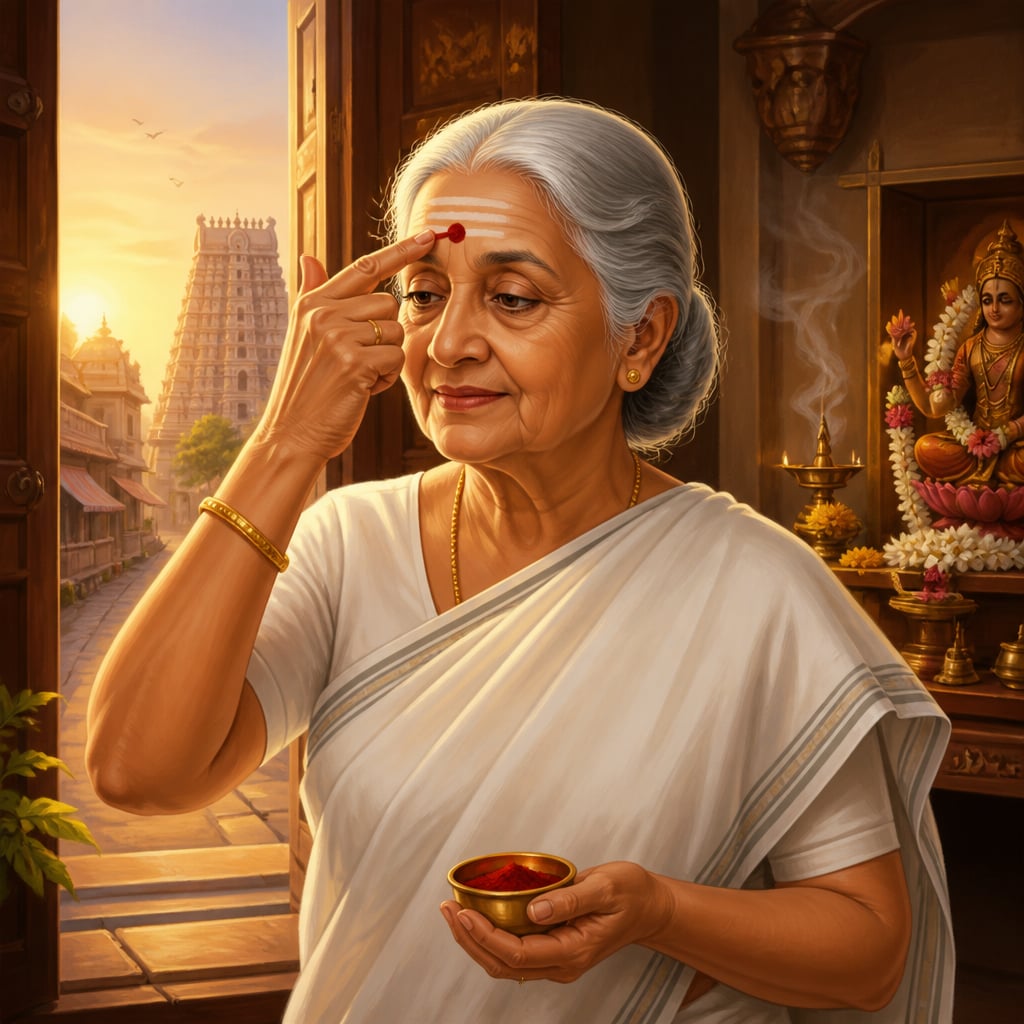
Lakshmi paati at her Madurai doorway applying kumkum

Picture a composite Lakshmi paati in her doorway in Madurai, sometime around 1998, just after her morning bath. Her wet hair is wrapped in a towel. Her cotton sari smells of incense and turmeric. A small brass plate sits on the low altar by the kitchen. On the plate, three things: a tin of red kumkum, a small jar of grey-white vibhuti, and a sliver of yellow gopichandan clay folded inside a banana leaf.

She does not say a word. She presses her thumb into the kumkum, then to the centre of her forehead. She rubs vibhuti between three fingers and draws three horizontal lines just above the kumkum dot. She has done this every morning of every year of her life since her wedding in 1956. When her grandson asks her why, she says, "Because that is what you do."

She is right. She is also keeping the receipts for an operating system older than any country on the map. This lesson is the explanation she did not owe you.

The Forehead Has a Grammar

Walk into any Hindu temple in Tamil Nadu, Bengal, Maharashtra, Punjab, or the Himalayas and read the foreheads. You can tell who someone worships before they say a word.

A devotee of Vishnu wears the urdhva pundra. Two vertical white lines from the brow to the hairline, sometimes joined at the bottom in a U or a Y, with a small line of red kumkum or yellow turmeric inside. The white is gopichandan, a clay scooped from the ponds of Dwarka where Krishna's cowherds once stood. The U represents the foot of Vishnu. The line inside is Lakshmi.
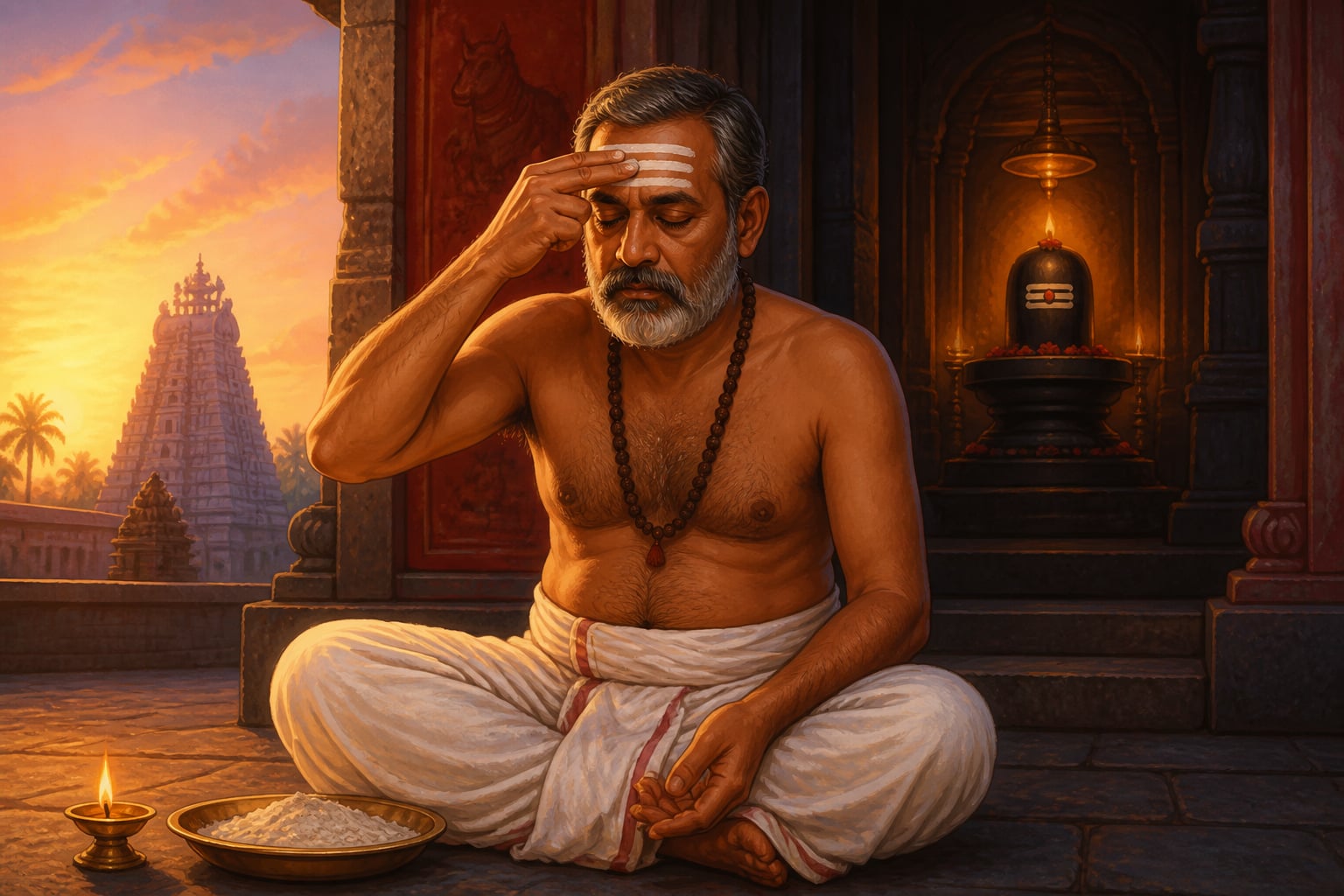
A Shaiva pujari applying tripundra ash at the temple sanctum

A devotee of Shiva wears the tripundra. Three horizontal lines of vibhuti, drawn across the brow with the index, middle, and ring fingers of the right hand. The ash is white. Sometimes a red kumkum dot sits in the centre, the third eye burning through the three lines. South Indian Shaivas, Lingayats in Karnataka, and the wandering sannyasis of Kashi all carry these three lines.

A devotee of Devi wears a single red kumkum dot, the bindi at the brow centre. The Shakta lineage of Bengal and the Devi traditions of Kanyakumari and Vindhyachal mark themselves with this red point alone. Red is Shakti: the energy that births worlds.

There are regional refinements within each style. Tamil Iyengars wear the U with sharp angled tips. Bengali Vaishnavas favour a longer, thinner mark. Maharashtrian Shaivas draw a narrower tripundra than the broader Tamil version. The grammar is the same. The dialect changes.

What the Scripture Actually Says

The forehead is not decorated. It is consecrated.

The Padma Purana, in its chapter on Vishnu worship, instructs the householder:

ऊर्ध्वपुण्ड्रं विना यस्तु कर्म कुर्यात् द्विजोत्तमः। तत्सर्वं विफलं याति विष्णुलोके न गच्छति॥

ūrdhvapuṇḍraṃ vinā yastu karma kuryāt dvijottamaḥ tat sarvaṃ viphalaṃ yāti viṣṇuloke na gacchati

Without the urdhva pundra, even the most learned twice-born's actions bear no fruit, and he does not reach the world of Vishnu.

Padma Purana, Uttara Khanda

For the tripundra, the Brihadjabala Upanishad prescribes the formula. Three lines, three fingers, three sacred fires. The Atharva Shira Upanishad instructs the bhasma snan, the bath of ash. For kumkum, the Lalita Sahasranama describes the goddess herself as kumkumāliptamaulinī: she whose crown is anointed with kumkum. When a devotee touches kumkum to her own brow, she is repeating, in miniature, the act of anointing the Devi.

Three rituals, three texts, three families of practice. The grammar is settled.

What the Marks Mean

The forehead carries the ajna chakra, the third eye, the seat of wisdom. It sits exactly between the brows, where the optic nerves cross and where the pituitary and pineal glands are clustered behind the bone. The yogic tradition calls this point the bhrumadhya. Modern anatomy calls it roughly the same thing without the Sanskrit.

Mark Tradition Material Meaning
Urdhva pundra Vaishnava Gopichandan + kumkum Consciousness ascending to Vishnu
Tripundra Shaiva Vibhuti (sacred ash) The three gunas burnt by the third eye
Kumkum bindi Shakta Turmeric and lime powder Shakti at the seat of wisdom

Why the Body Responds

Lakshmi paati's morning routine is one of the most efficient habit systems ever designed.

The cue is the bath. Every morning, the same. The body is wet, the mind is clean, the day has not yet begun. The brass plate is in the same spot. The hand reaches for it without thinking.

The routine is the application. Thumb to kumkum. Three fingers to vibhuti. The pressure on the brow is firm enough to feel. The whole sequence takes thirty seconds.

The reward is twofold. First, an immediate somatic settling. The brow centre is a known parasympathetic trigger, and pressure there slows the heart and steadies the breath. Second, an identity reward. She sees herself in the small altar mirror with the mark on her brow, and she knows, with no thought required, who she is and whose day she is starting.

This is exactly the cue-routine-reward loop Charles Duhigg describes in The Power of Habit and James Clear in Atomic Habits. It is also the identity-anchoring move Wendy Wood documents in Good Habits, Bad Habits. The most stable habits are the ones tied to a stable self-concept. The mark on the forehead is the most efficient identity anchor a person can carry. It is in front of her own eyes in every mirror and in front of every other person she will speak to that day. The tradition built a habit system that runs through private cue and public accountability at the same time. It took the modern behavioural-design industry forty years to articulate what Hindu mothers were already running.

What the Labs Found

The kumkum on the brow is not just symbolic. A 2012 AYUSH-funded study confirmed that traditional turmeric-based kumkum carries antiseptic properties and offers measurable UV-blocking at the application point. Turmeric (haridra) contains curcumin, which Aggarwal et al at MD Anderson documented at length in BMC Cancer (2007) for its anti-inflammatory and antimicrobial action.

For vibhuti, Pradhan and Ranjekar (2008), publishing in the Journal of Ethnopharmacology, examined the calcined-ash bhasma class of preparations and confirmed antimicrobial and detoxifying properties when correctly prepared. The havan-fire ash that lands on the forehead is part of the same family.

The brow point itself is a focal point for hypothalamic and pituitary regulation. Brown and Gerbarg's work at Harvard on slow breathing and HRV (heart rate variability) consistently shows that pressure and attention at the brow centre activate vagal tone. The ritual is doing measurable work on the nervous system.

The pattern across all three studies is the same. The labs are catching up to what the grandmother already knew.

What the World Calls It Now

Selena Gomez wore a bindi to the 2014 MTV Movie Awards. The Hindu American Foundation and a long list of Indian commentators called it cultural appropriation. Within eighteen months, Etsy was hosting a flourishing market for "third eye crystal stickers" with no Sanskrit attribution. Coachella turned the bindi into festival uniform. The "third eye chakra" became a multi-billion-dollar sub-segment of the global wellness industry, with the original word ajna missing from most of the product copy.

Vibhuti was repackaged as "sacred ash" and sold in thirty-dollar jars by California crystal shops. Native American smudging ceremonies and Burning Man fire rituals were rebranded as "energy clearing", with no acknowledgement that the bhasma snan of the Atharva Shira Upanishad has been doing precisely this for three thousand years.

The pattern has a shape. Mock as superstition. Then dismiss as primitive. Then have one Western researcher rediscover it. Then rebrand and sell. Then, sometimes, fight a patent battle. The neem patent fight (US Patent 5,124,349, 1995) and the turmeric patent fight (US Patent 5,401,504, granted 1995, revoked 1997) are receipts already in the public record. The forehead mark has not yet been patented. Give it time.

What to Call It Yourself

The thing on your brow is not a third eye sticker. It is an urdhva pundra if it is vertical, a tripundra if it is three horizontal lines of ash, a kumkum bindi if it is a red dot. The clay is gopichandan. The ash is vibhuti. The point itself is the ajna.

When the wellness studio next door hands you a chakra-balancing pamphlet, smile. You already know the names. Use them. The grandmother who taught you was right. The labs are catching up. The world is rediscovering fragments of a system you can carry whole.

Modern Echoes

Andrew Huberman, the Stanford neuroscientist whose podcast crosses thirty million downloads a month, has spent the last two years building protocols around morning sunlight, breathwork, and parasympathetic activation. Robin Sharma has sold over twenty million copies of The 5AM Club on the same premise: the first thirty minutes of the morning shape the day. The 2017 Nobel Prize in Physiology or Medicine went to Hall, Rosbash, and Young for circadian biology, vindicating the principle that ritualised morning practice synchronises the body to the cosmos.

Lakshmi paati did not need a Nobel committee. She had a brass plate, a tin of kumkum, and a Tuesday morning. The receipts are on her side. The grandmother is winning the argument she never bothered to start.

Back in the doorway in Madurai, the mark on Lakshmi paati's brow has dried. The sun is up. The kitchen is warm. Her grandson, the one who asked the question, will spend twenty years forgetting and another twenty years remembering. The mark will still be there when he comes home.

Key figures

Adi Shankaracharya

8th century CE (788-820 CE per traditional dating)

Ramanujacharya

11th-12th century CE (1017-1137 CE per traditional dating)

Abhinavagupta

10th-11th century CE (c. 950-1016 CE)

Case studies

Vikramaditya's Coronation Tilak

In the Vikrama tradition (1st century BCE), the royal tilak ceremony is documented as the priest's transfer of divine sanction to the ruler. Kings of the Malava confederation, of which Vikramaditya was the most celebrated, received the coronation tilak before war, before court, and before the formal rajya-abhisheka. The Brihat Katha and later prabandha literature record the ceremony in detail. The mark was drawn from a paste of saffron, sandalwood, and sacred ash mixed in temple water, and was applied by the rajaguru in the presence of the assembled court.

The tilak in the Vikrama coronation is not an ornament. It is the moment when divine sanction crosses from the priest to the king through the ajna chakra. The Manusmriti, Yajnavalkya Smriti, and the Mahabharata Shanti Parva all treat the abhisheka tilak as the ritual that converts a kshatriya into a raja. Without the mark, the man on the throne is a usurper.

The coronation-tilak template established by Vikramaditya's tradition was inherited by every subsequent dharmic kingdom. The Cholas, Pandyas, Vijayanagara emperors, and later Shivaji at Raigad in 1674 all took the mark on the brow as the moment that completed the kingship. The same gesture, in much-reduced form, persists today when temple priests apply tilak to visiting devotees.

The forehead mark is a transfer of sanction from a higher source to the wearer. What looks like a daily decoration began as a coronation device. Every Hindu who applies tilak in the morning is being crowned as the dharmic head of her own day.

The political and corporate worlds still seek 'transfers of legitimacy' through ritualised gestures (oath of office, swearing-in, ceremonial keys). The dharmic tradition built the original.

The Vikrama era, beginning 57 BCE and credited to Vikramaditya, is still the most widely-used calendar across northern India and Nepal more than two thousand years later.

Coachella 2014 and the Selena Gomez Bindi Controversy

On 14 April 2014, at the MTV Movie Awards, Selena Gomez performed wearing a red bindi at her brow centre. Within forty-eight hours, the Hindu American Foundation, the Universal Society of Hinduism, and a long list of Indian commentators had publicly objected. Within eighteen months, Etsy and Sephora-adjacent festival-makeup brands were marketing 'third eye crystal stickers' and 'gem bindis' as Coachella accessories, with no Sanskrit attribution and no acknowledgement of Hindu provenance. The 'third eye chakra' became a multi-billion-dollar sub-segment of the wellness industry, with the original word 'ajna' missing from most product copy.

The bindi in the Hindu tradition is the kumkum-anointed crown of the goddess scaled down to the worshipper's brow. The Lalita Sahasranama makes this explicit. To strip the mark of its scriptural anchor, sell it as 'festival fashion', and rebrand the underlying anatomy as 'third eye chakra' is to perform the exact extraction that the modern wellness industry performs on every dharmic ritual: separate the gesture from its grammar, sell the gesture, leave the grammar behind.

The 2014 episode was inflection. Coachella bindi normalised a market that now generates hundreds of millions of dollars annually in 'gem bindis', 'chakra stickers', and 'third eye jewellery'. The ajna remained the seat of the kumkum, but its name and lineage stayed largely missing from the consumer-facing copy. The Hindu American Foundation continues to track and document these episodes.

Receipts matter. When a practice loses its name in the marketplace, it loses its lineage. The remedy is to use the original Sanskrit (kumkum, bindi, ajna) and to anchor the gesture back to its scripture every time the conversation comes up.

Every coopt names a power. The size of the chakra-products market is the size of the dharmic gift the world is borrowing without attribution.

The global 'wellness chakra' segment, estimated at over four billion dollars in 2024, is built on yogic anatomy whose original Sanskrit terms appear in less than ten percent of product packaging.

AYUSH Ministry Kumkum Antiseptic and UV-Block Study

In 2012, an AYUSH-Ministry funded research study analysed the antimicrobial and ultraviolet-blocking properties of traditional turmeric-based kumkum. The study, conducted under the National Mission on Ayush at AYUSH-affiliated research institutes, applied controlled samples of household kumkum to test substrates and measured both microbial inhibition and UVA/UVB transmission. Parallel literature in *BMC Cancer* (Aggarwal et al, 2007) had already confirmed curcumin's anti-inflammatory and antimicrobial action. The Pradhan and Ranjekar paper in the *Journal of Ethnopharmacology* (2008) had confirmed the antimicrobial properties of correctly-prepared bhasma preparations.

Charaka Samhita, Sushruta Samhita, and the Atharva Veda already prescribed turmeric-based applications and ash-based applications for skin protection and ritual purification. The 6-layer Sanatan Operating System frame is explicit: Layer 5 (Research) is where the modern lab confirms what Layer 1 (Practice), Layer 2 (Scripture), and Layer 3 (Symbolism) had already settled. The study was not discovering anything new. It was producing Layer 5 receipts.

The AYUSH study added a peer-reviewed Indian-government endorsement to a body of literature already documenting turmeric and bhasma efficacy. It did not change practice in a single Indian household. It did, however, give the dharmic tradition a citation it can drop into any conversation where the Western interlocutor demands a journal reference before listening.

The labs are catching up. The dharmic householder need not wait for the citation. She can apply kumkum, vibhuti, and gopichandan as she always has, and reach for the citation only when the room demands one.

Every receipt added to the file makes the next conversation easier. The grandmother is winning the argument she never bothered to start.

Curcumin, the active constituent in haridra and household kumkum, has more than 12,000 indexed peer-reviewed publications on PubMed as of 2024, making it one of the most-studied phytochemicals in medical literature.

Historical context

Vedic origins (c. 1500 BCE) through Bhakti consolidation (8th-13th century CE)

The forehead mark is one of the longest continuous practices in human civilisation. The Atharva Veda contains mantras for the bhasma snan. The Grihya Sutras describe the household application of clay and ash. The Puranas codify the urdhva pundra. The Bhakti acharyas of the 8th to 13th centuries (Shankara, Ramanuja, Madhva, Basavanna, Mirabai) standardise sect-specific marks across the subcontinent. By the medieval period, every village had a tradition transmitted through grandmothers and temple priests in parallel, with the practice surviving across Mughal, Vijayanagara, Maratha, and colonial periods without interruption.

Living traditions

The forehead mark remains the most visible and most resilient samskara of the Hindu body. When the wellness industry hands you a chakra-balancing pamphlet, smile. The mark on your brow is not a third eye sticker. It is an urdhva pundra, a tripundra, or a kumkum bindi. The clay is gopichandan. The ash is vibhuti. The point is the ajna. Use the names. The labs are catching up. The grandmother is winning the argument she never bothered to start.

Reflection

More in Sharira: Body, Identity, Personal Markers

All lessons in Sharira: Body, Identity, Personal Markers · Samskaras: The Sanatan Operating System course