What You Cover, What You Don't
The Cloth, The Threshold, The Color
Why a Hindu covers the head before prayer, removes footwear at the threshold, and dresses in white at a death and saffron at a sankalpa. Three small acts that encode identity, hygiene, and silent communication. Most of which the wellness industry is now selling back as turban-tying classes, barefoot shoes, and capsule wardrobes.
The Cloth on the Head
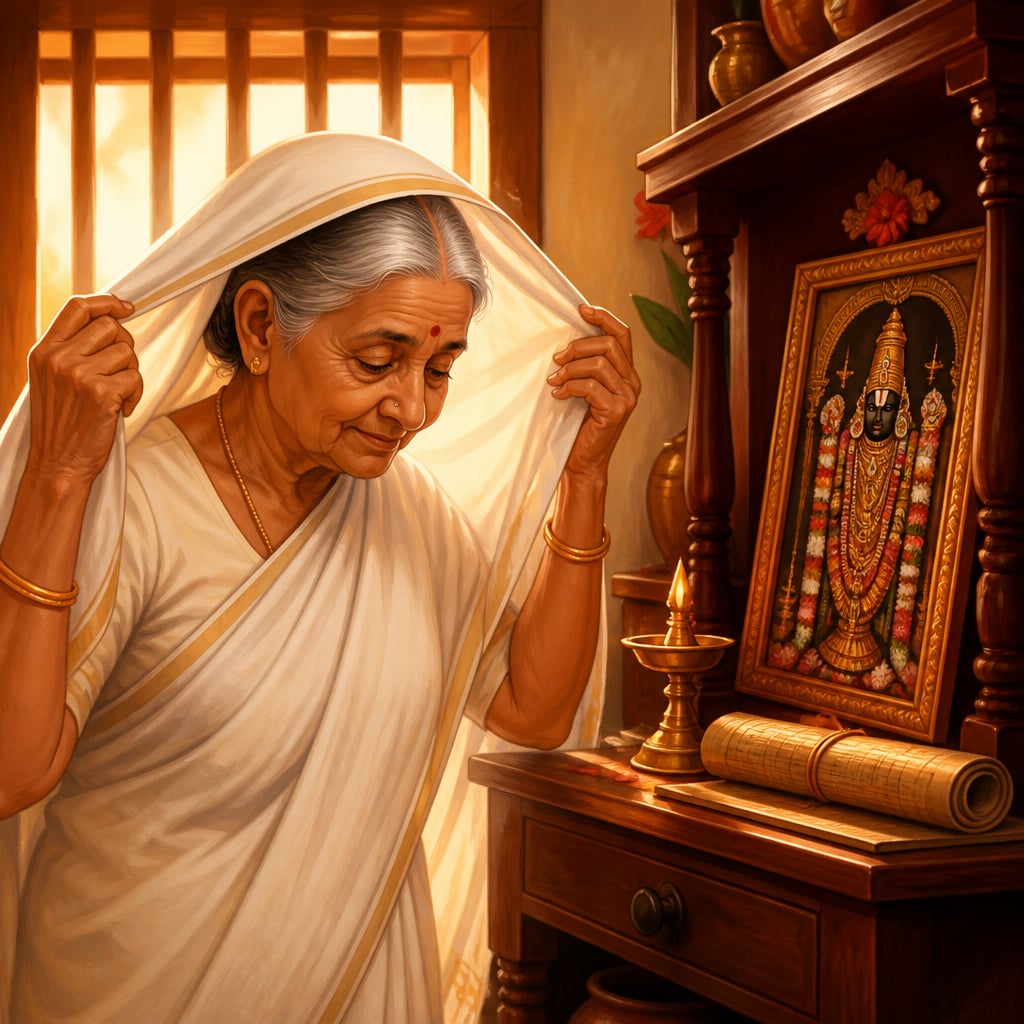
My grandmother kept a soft white uparna folded on the small wooden shelf next to her puja corner. She was eighty when she taught me the rule. Before you light the lamp, before you ring the small ghanta, before you say the first line of the morning prayer, you cover your head. She did not say why. She tapped the folded cloth, then her own hair, then mine. The lesson was a gesture, not a paragraph. If I forgot, she would tap again, gently, and wait.
Forty kilometres south of her village in coastal Andhra, a Sikh family in Vijayawada was teaching its eight-year-old son to tie his first patka. In Jodhpur, a Rajput grandfather was showing his grandson the seven folds of a clan pheta, each fold a different colour for a different ancestor. In a Tirumala queue, a fifty-year-old man was bending to remove his shoes a full kilometre before the temple gate. None of these people thought of themselves as performing the same ritual. They were. The rule has one shape across Bharat, and four hundred local accents.
The Practice, Across Bharat
A covered head, in our tradition, is a vow made visible. The cloth changes by region, but the meaning holds.
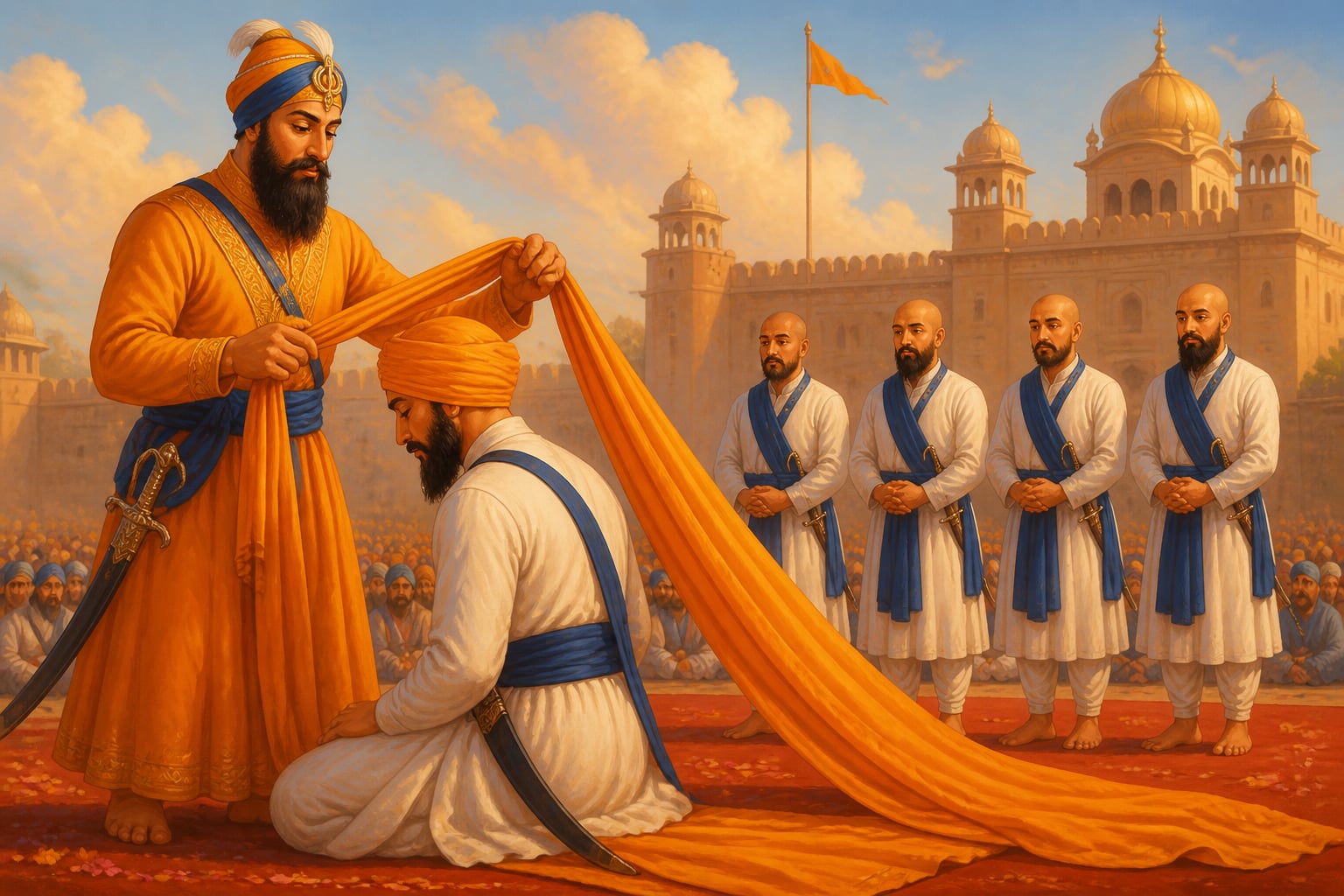
- The Sikh dastar, formalised as the badge of the Khalsa by Guru Gobind Singh at Anandpur Sahib on Baisakhi 1699, is six metres of cotton wrapped around the unshorn kesh. It is one of the panj kakaar, the five articles of the Khalsa covenant.
- The Rajput pheta of Mewar, Marwar, and Dhundhar, often nine metres long, marks clan, season, and occasion. Saffron in war. White at a shraadh. Pink at Holi. Mehrangarh Fort in Jodhpur still runs daily pagdi demonstrations for visitors because the knowledge would otherwise leave with the last living tier.
- The Maratha pheta is shorter, tighter, and worn at weddings, gudi padwa, and political functions in Pune and Nashik.
- The Telugu talapaga and the Tamil talaippa are the lighter southern cousins, common at marriages and at a son's first upanayana.
- For women, the pallu drawn over the head before puja, before elders, and at temple darshan is the same gesture in a softer cloth. In Punjab the chunni. In Bengal the ghomta of the saree. In Rajasthan the long ghoonghat. In Kerala the mundu edge lifted to the crown when entering a Devi temple.
Four cloths. One rule. Sacred space, sacred company, sacred work begin when the head is covered.
What the Scripture Says
The oldest layer of the Vedas already speaks of the ushnisha, the cloth wound around the head, as part of the ritualist's working dress. In the Atharva Veda, garments are described as protective fields, not just covering. Manusmriti 4.45 and 4.66 instruct the householder to cover the head and the shoulders before performing sandhya and before approaching agni. The Apastamba Grihya Sutra is more specific. It tells the brahmachari to keep the head covered while reciting, eating in formal company, and entering the home of an elder. The uttariya, the upper cloth, is one of the basic garments named in the Grihya Sutras, alongside the antarvasa below.
The rule is not Hindu in any narrow sense. The Sikh dastar is a vow. The Muslim topi at namaz is a vow. The Jewish kippa at prayer is a vow. The Christian veil at mass, until the 1960s, was a vow. The shared instinct across the Indic and the Semitic world is the same: the head is the uttamanga, the highest limb. You do not bring it bare into the presence of a higher reality.
The Threshold

The second cloth is what you take off, not what you put on. Padaraksha tyaga, the surrender of footwear at the threshold, is the most quietly universal Hindu act in this country. Step inside a temple, a kitchen, a puja room, a friend's home, even many shops in Varanasi or Madurai, and the chappals come off without a word.
The surface explanation is hygiene. The street is the street. The home is not. But the deeper logic is shaucham, the daily discipline of ritual purity, and the recognition that a threshold is a real boundary between two qualitatively different fields. Apastamba and Baudhayana both treat the act of crossing a threshold as a small samskara in itself. You wash the feet, you remove the paduka, you announce yourself, and only then do you pass.
The modern body responds to this in a way the modern mind has only just understood. Robbins and Hanna at the Concord Hospital sports lab, in a 1987 paper in Medicine and Science in Sports and Exercise, showed that removing footwear sharply improves proprioceptive feedback from the plantar surface. The arch reads the floor. The ankle reads the arch. The spine reads the ankle. The whole body recalibrates. In 2005 a Massachusetts company called Vibram launched a glove-shaped shoe called the FiveFingers, sold it for one hundred and twenty dollars a pair, and built a half-billion-dollar barefoot-running market on the principle that less footwear is better for the foot. The principle was old. The price tag was new.
Baba Ramdev was teaching grass-walking on early-morning television in Haridwar long before the New York Times ran its first piece on grounding. The grandmother who tells you to take off your chappals at the doorway is not enforcing a hygiene rule. She is recalibrating you for the room you are about to enter.
Why the Body Responds
Layer four of the system, the habit architecture, is the part the textbooks usually miss. Each of these acts is a cue, the room or the moment, that triggers a routine, the cover or the removal, that delivers a reward, the slight settling of the nervous system that arrives when the body knows where it is and what it is doing.
For the Sikh boy tying his first patka, the dastar is identity-anchoring in the BJ Fogg sense. Once you wear it, you cannot lie. You cannot duck a fight. You cannot drink in secret. Your covenant is on your head where everyone can see it. James Clear would call this the strongest form of habit: the one that runs on identity, not willpower.
For the woman drawing her pallu before darshan, the small gesture is a Pavlovian cue. The cloth touches the crown, the breath slows, the antahkarana quiets. The same neural shortcut a tea-drinker feels at the first sip of chai. The cue is the cloth.
For the man unstrapping his sandals at Tirumala, the threshold itself becomes a behavioural switch. The street self ends here. The temple self begins here. There is no chance of forgetting which one you are, because the floor is reminding you with every step.
The Color Code
A Hindu reads cloth before the wearer speaks. Two colours carry the most weight.
Shukla, the white. White is the cloth of the brahmachari on his way to gurukulam. White is the cloth at a shraadh and at the chautha. White is what a widow used to wear, though the Vidyasagar reform and the modern Hindu have softened that absolute. White at a death is not mourning in the Western sense. It is shoka shanti, the quietness that follows grief, and the surrender of decoration in the face of a larger truth.
Kashaya, the saffron, bhagwa. Saffron is the cloth of the sannyasi who has walked away from name and address. Saffron is the flag of Hanuman that Shivaji raised over Raigad and that the Maratha confederacy carried to Attock. Saffron is the uparna at a sankalpa, when a man or woman makes a vow they do not intend to break. The colour is the colour of fire, and fire is the witness that does not forget.
Between the two, the rest of the wardrobe carries softer codes. Red at a wedding, green at a Sufi dargah, yellow at Vasant Panchami, black almost never inside a temple. A Telugu grandmother spotting a black saree on a daughter-in-law on Friday will frown without saying a word. The frown is a sentence.
| What the Cloth Says | Without a Word |
|---|---|
| White | Mourning, purity, the brahmachari, surrender |
| Saffron | Renunciation, sankalpa, fire, the warrior of dharma |
| Red | Saubhagya, marriage, Devi |
| Black | Avoid in temples, avoid on auspicious days |
| Yellow | Vasant, Saraswati, harvest |
This is the silent communication system the wellness industry is now monetising as the capsule wardrobe and the colour psychology workshop. The Hindu has been wearing the curriculum for three thousand years.
Modern Echoes
In 2007, Urban Outfitters released what its catalogue called Sikh-Style Turbans as a fashion accessory. The Sikh Coalition organised protests within a week. The product was pulled. In Fall 2018, Gucci's runway show in Milan put dastar-style turbans on white models, sold them at eight hundred dollars each, and called them an aesthetic choice. The Akal Takht released a statement. The dastar, the Coalition wrote, is not a hat. It is a covenant, formalised on a specific date in 1699 at Anandpur Sahib by a specific living guru, and you do not borrow a covenant for a runway.
The wellness world coopts the threshold rule with less ceremony but the same instinct. Vibram FiveFingers, founded by Robert Fliri in 2005, made one hundred and twenty dollars a pair selling barefoot shoes to people whose grandmothers in Punjab and Tamil Nadu had been telling them to walk barefoot indoors all along. By 2012 the brand was earning fifty million dollars a year. The class-action lawsuit that followed (Bezdek v Vibram, settled 2014) was about the marketing claims, not the underlying physiology. The physiology was real. Robbins and Hanna had already shown it in 1987. The Apastamba Grihya Sutra had implied it two thousand years earlier when it told the householder to wash and uncover the foot at the threshold.
The colour code is being repackaged as Pinterest capsule wardrobes and as the dopamine dressing trend that exploded on TikTok in 2022. Both run on the same insight a Hindu grandmother already knows. What you wear sets the body's emotional channel for the day. The difference is that her version was a system, not a vibe.
What to Call It Yourself
Use the words our system already gave us. Dastar, pheta, pagri, patka, talapaga. Uparna, uttariya, pallu, chunni, ghoonghat. Padaraksha tyaga at the threshold, not shoes off. Shukla for white, kashaya or bhagwa for saffron. The vocabulary carries the meaning the English translation drops. Once you say dastar, you cannot mistake it for a hat. Once you say padaraksha tyaga, you cannot reduce it to hygiene. The names are the system in miniature.
Modern Echoes, One Last Pass
A New York stylist runs a five-hundred-dollar workshop on intuitive dressing for emotional regulation. A Mumbai aunty packs a white saree for a chautha, a saffron uparna for a Hanuman Jayanti vow, and a red one for her niece's wedding, and she packs them in the right order, and she pays nobody to teach her this. She did not know there was a workshop. The workshop did not know there was an aunty. The aunty's system is older, cheaper, and works.
Closing
My grandmother tapped the cloth, then her hair, then mine. She did not have the vocabulary of habit architecture or proprioceptive feedback or covenant theory. She did not need it. The cloth was on the shelf. The chappals were at the door. The white saree was folded in the steel almirah for the days that needed it. The system was already in the room.
Key figures
Guru Gobind Singh
Tenth Guru of the Sikhs (1666 to 1708); founder of the Khalsa at Anandpur Sahib on Baisakhi 1699.
Manu
Traditional codifier of Manusmriti, the dharmashastra that prescribes the householder's daily garment and threshold conduct.
Maharana Pratap
Sisodia ruler of Mewar (1540 to 1597); refused submission to Akbar and lived a life that anchored Rajput honour to the saffron pheta.
Case studies
Anandpur Sahib, Baisakhi 1699: The Dastar as Covenant
On 13 April 1699, at Anandpur Sahib in the Shivalik foothills, Guru Gobind Singh called the assembled Sikh sangat and asked for five heads. Five men stepped forward. He initiated them as the Panj Pyare, the first Khalsa, and instituted the panj kakaar: kesh (unshorn hair), kara (steel bracelet), kanga (wooden comb), kachera (cotton drawers), and kirpan (sword). The dastar, wound around the kesh, became the outward seal of the covenant. The Sikh did not wear a turban as costume; he wore it as a visible vow that he could not lie, could not hide, could not duck a fight against tyranny.
The dastar is the Khalsa's reading of an older Indic principle the Atharva Veda already names: the garment is the covenant. The Apastamba's instruction to cover the head before recitation, the Manusmriti's instruction to cover before sandhya, and the Khalsa's instruction to keep the dastar continuously tied are points on a single line. Guru Gobind Singh did not invent the head-cloth; he intensified and codified it for a community whose covenant had to be unmistakable in a contested century.
The Khalsa's visible identity became the basis of one of the most resilient warrior fraternities in Indic history. Three hundred years later, in 2024, more than thirty million Sikhs continue to keep the dastar; the Punjab Schools Education Board still teaches the date and the place; the Akal Takht still issues hukamnamas on the integrity of the kesh and the dastar.
A covenant on the head is harder to break than a covenant in the heart. When the body carries the vow, the body keeps you honest.
The Sikh Coalition estimates that more than ninety-nine percent of orthodox Khalsa Sikh men keep the dastar tied daily; the same survey finds that the dastar has the lowest abandonment rate of any traditional Indian male headcovering in the diaspora.
Robbins and Hanna 1987: What the Bare Foot Already Knew
In 1987, Steven Robbins and Adel Hanna published a study in Medicine and Science in Sports and Exercise (Vol 19, Issue 2) showing that habitually shod runners had measurably reduced proprioceptive feedback from the plantar surface compared to habitually barefoot subjects. They concluded that footwear, by mechanically isolating the sole, dampened the body's reading of the ground and altered the entire kinetic chain from arch to spine. The paper became the most cited single piece of evidence behind the barefoot-running and minimalist-shoe movements that followed.
The Apastamba Grihya Sutra, two thousand five hundred years before Robbins and Hanna, told the householder to wash the feet and cross the threshold barefoot. The verse did not have the language of proprioception, but it had the practice. The Hindu home, the temple, the kitchen, and the puja room were already barefoot zones because the tradition treated the foot as a sense organ, not a stub to be protected by leather.
Vibram FiveFingers launched in 2005 at one hundred and twenty dollars a pair, citing the same physiology Robbins and Hanna had documented. By 2012 the brand was earning fifty million dollars a year. Subsequent biomechanics research (Lieberman et al, Nature 2010) confirmed that habitually barefoot populations show lower rates of repetitive-strain foot injury than habitually shod populations.
The foot is not stupid. It reads the floor when you let it. Padaraksha tyaga at the threshold is not a quaint custom; it is a daily recalibration of the body's ground sense.
The minimalist and barefoot footwear market reached approximately five hundred million dollars globally by 2018, built on a single physiological insight that the Apastamba Grihya Sutra encoded as a one-line rule.
Urban Outfitters 2007 and Gucci 2018: The Dastar as Decoration
In April 2007, Urban Outfitters released a line of accessories its catalogue called Sikh-Style Turbans, sold at fashion-store prices, with no reference to the Khalsa, the kesh, or the panj kakaar. The Sikh Coalition organised an immediate campaign; the items were withdrawn within days. Eleven years later, in February 2018, Alessandro Michele's Gucci Fall 2018 runway in Milan put dastar-style turbans on white non-Sikh models and sold them at roughly eight hundred dollars each. The Akal Takht and the Sikh Coalition again responded; Gucci eventually offered a public statement of regret.
Both incidents stripped the cloth from its covenant. The dastar is not headwear; it is the visible portion of a five-part vow taken at Anandpur Sahib in 1699. The Atharva Veda's principle that a garment is a vow and the Apastamba's principle that the cloth on the head is the cloth on the speech are not aesthetic notes; they are operating instructions. The wellness and fashion industries can rebrand the practice, but they cannot rebrand the vow.
Both campaigns succeeded in pulling the products and prompting public statements. They did not, however, slow the larger pattern. By 2024, the global ethnic-fashion market includes turban-tying classes, designer dastar collections, and Coachella headwraps that read as bindi-2014 all over again. The protests have moved the conversation; they have not yet moved the runway.
A covenant garment cannot be borrowed for an aesthetic. When the world calls the dastar a turban, we say dastar back. The naming is the defence.
A 2019 Diversity Council India survey of South Asian diaspora professionals found that ninety-three percent recognised Urban Outfitters' 2007 incident or Gucci's 2018 show as cooption rather than appreciation; awareness in the wider American consumer base, by the same survey, sat under fifteen percent.
Historical context
Vedic period to early modern Bharat (c. 1500 BCE to 1699 CE)
The codes of head-covering, threshold conduct, and colour discipline ran continuously from the Vedic householder rituals through the Grihya Sutras (c. 600 BCE), the Manusmriti (c. 200 BCE to 200 CE), and the Puranic and medieval period, before being recodified for new conditions by figures like Guru Gobind Singh at Anandpur Sahib in 1699 and the Rajput courts of Mewar and Marwar across the same centuries.
Living traditions
The Sikh Coalition's continuing campaigns against fashion-house cooption (Urban Outfitters 2007, Gucci 2018) have established a public template for naming the dastar as covenant rather than headwear; the Rajasthan Tourism Department's pheta competitions and Mehrangarh's daily tying demonstrations are keeping the regional Rajput cloth-grammar alive past the last master generation; Tirumala continues to enforce padaraksha tyaga as the most widely practiced living threshold-ritual on earth. Use the names: dastar and pheta and pagri and patka, not turban; uparna and pallu and chunni, not scarf; padaraksha tyaga, not shoes off; shukla for white, kashaya or bhagwa for saffron. The modern wellness world is selling barefoot shoes (Vibram FiveFingers, 2005, 120 dollars) and capsule wardrobes and dopamine-dressing classes and turban-tying workshops back to the same people whose grandmothers ran the system free of charge.
- Daily Dastar Tying: Orthodox Khalsa Sikhs tie a fresh dastar over the kesh every morning, usually after the bath and before the first nitnem prayer. The tying takes between five and ten minutes and is one of the most regularly practiced living head-covering rituals in the world.
- Pheta Tying at Mehrangarh: The Mehrgarh Museum Trust at Jodhpur runs daily Rajput pagdi demonstrations and a pheta-tying workshop where visitors learn the Marwari nine-metre fold. Each clan and occasion has a distinct colour: saffron for war, white for shraadh, pink for Holi, deep red for weddings.
- Padaraksha Tyaga at Tirumala: Pilgrims at Tirumala begin removing footwear roughly a kilometre below the Maha Dwaram, walking the final ascent barefoot regardless of weather or stone temperature. The Tirumala Tirupati Devasthanams maintains the tradition as a hard rule for all darshan; cloak rooms hold footwear at multiple points along the ascent.
- Takht Sri Kesgarh Sahib, Anandpur Sahib: The historical site where Guru Gobind Singh founded the Khalsa on Baisakhi 1699. The Takht houses weapons attributed to the tenth Guru and is the canonical pilgrimage site for the dastar covenant.
- Mehrangarh Fort and Museum, Jodhpur: One of the largest forts in Rajasthan; houses the Mehrangarh Museum Trust collection of Rajput pheta, weapons, and royal robes. The fort runs daily live pagdi-tying demonstrations and seasonal workshops where visitors learn the Marwari fold.
- Tirumala Tirupati: The Sri Venkateswara temple at Tirumala enforces strict padaraksha tyaga for all pilgrims; head-covering for women is followed widely though not enforced. The pilgrimage is the world's most visited darshan and the most rigorously practiced living example of threshold ritual.
Reflection
- What is one threshold in your day, the front door, the puja corner, the kitchen, where you currently cross without a pause? What might shift if you began removing footwear, washing the feet, or covering the head before crossing?
- Why do you think Guru Gobind Singh, designing the Khalsa in 1699, chose a continuously tied dastar over a removable hat or an internal vow? What does the choice reveal about the relationship between the body and the promise?
- What does the Hindu and Sikh insistence on covering the highest limb of the body before sacred speech suggest about the relationship between humility and authority?