Piercings as Initiation
Karnavedha, Nasavedha, and the marma points the modern world is now selling back
Why a Hindu grandmother takes a seven-month-old to the goldsmith, what Sushruta wrote about the gold needle two and a half thousand years ago, and how the same ear-point map is now sold as Goop ear seeding for forty-eight dollars a kit.
The Goldsmith's Bench
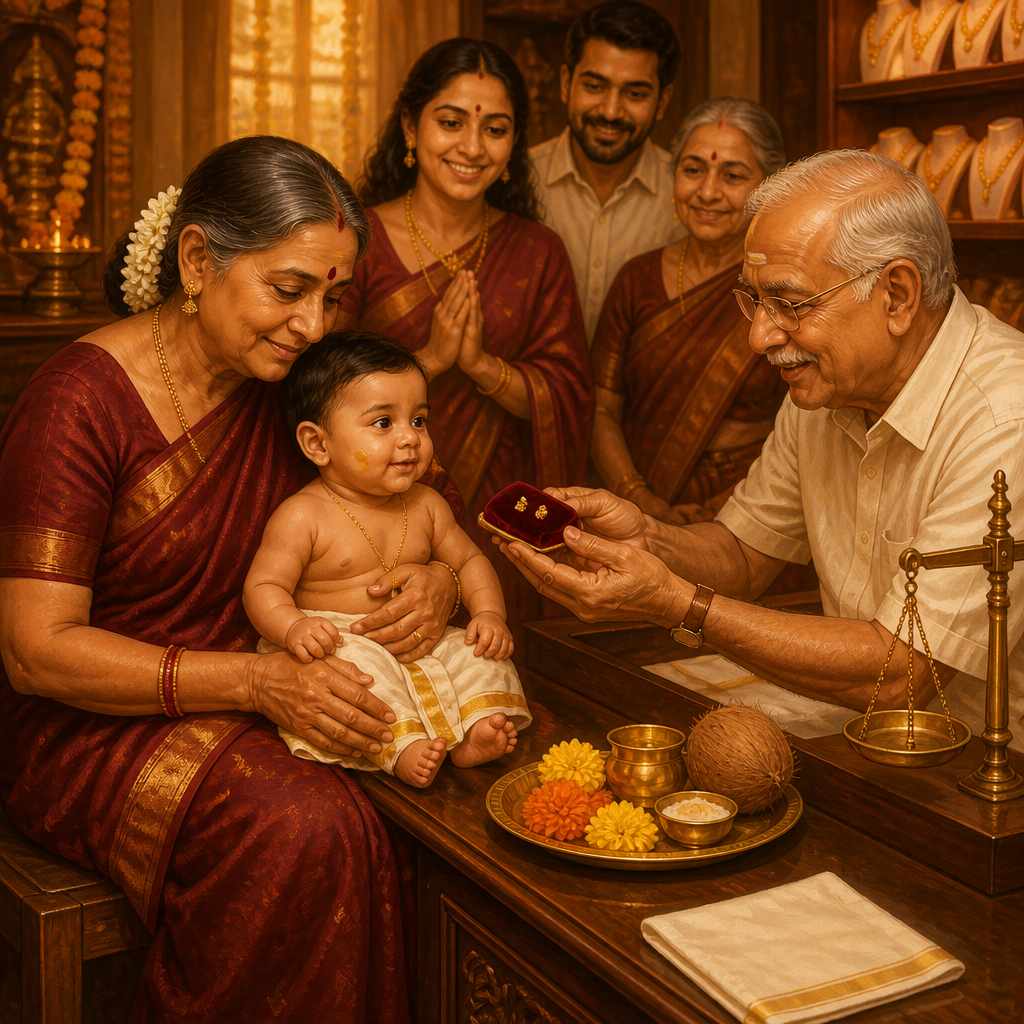
A Tuesday afternoon in Kanchipuram, sometime in the late 1980s. A paati in a deep blue saree carries her seven-month-old grandson into a small goldsmith's shop near the Ekambareswarar temple. The shop smells of beeswax and warm metal. The goldsmith, an old Vishwakarma craftsman who has performed this rite for three generations of the family, washes his hands in a brass tumbler of water and turmeric. He pulls out a slim gold needle, the same kind his grandfather used. The paati holds the baby on her lap, facing east. She presses a daab of warm turmeric paste onto the right earlobe. She murmurs the family's kuladevata name. The goldsmith touches the needle to the lobe and pushes it through in one clean motion.
The baby cries for thirty seconds. The paati does not flinch. She has done this with her own children, with her sisters' children, with her older grandchildren. She knows the cry will stop. It does. The boy looks up, blinks, and watches the goldsmith's face with an attention he did not have ten minutes ago.
The paati does not explain why she has done this. She does not say the word marma. She does not cite Sushruta. She does not mention the immune system or the auricular vagus nerve. She wipes the boy's face with the corner of her saree and walks home. The explanation she did not give is the lesson she did not owe you.
The Practice, Across Bharat
What the paati did has a name. Karnavedha, the piercing of the ear, is one of the sixteen samskaras of the Hindu life cycle. The companion ritual, Nasavedha, the piercing of the nose, is its sister rite. Across India the two are done a little differently in every house, and the differences are themselves the lesson.
In Tamil and Andhra households, Karnavedha is done at the goldsmith's bench or in the temple, in the sixth or seventh month of life, on both girls and boys. The needle is gold for those who can afford it, silver if not, and the wound is rubbed with turmeric and a drop of cow ghee. In Maharashtra, the priest performs it at home with a small homa, the family priest reciting Vedic mantras as the needle goes through. In Bengal, ear piercing is done quietly in infancy, but Nasavedha becomes the larger event, marked at the time of marriage when the bride wears the Bengali nath, a delicate gold ring with a small chain that loops to her hair.

In Rajasthan and Gujarat, the bridal nath is a wide, ornate ring that often passes through both the septum and the upper nostril. A Marwari grandmother will tell you that without the nath, a bride is not yet fully a bride. Among the Bhil and Gond communities of central India, both nostrils are pierced young, and the nose pin signals clan and married status across generations. In Punjab and Haryana, the murki in the upper ear cartilage marks the transition into adulthood for many young women. Kerala households still hold the temple piercing during the Choodakarana season, often clubbing it with the first hair-cutting rite.
One ritual, twenty regional dialects of practice. The variation is not noise. The variation is what tells you the system is alive.
What the Scripture Actually Says
The paati's silence has a long paper trail. The earliest surviving medical instruction for ear piercing is in the Sushruta Samhita, the Ayurvedic surgical text written around the fifth or sixth century BCE.

षष्ठे मासे सप्तमे वा कुमारस्य प्रशस्यते। कर्णयोर्व्यधनं कार्यं सूचिकाकनकेन वा॥
ṣaṣṭhe māse saptame vā kumārasya praśasyate karṇayor vyadhanaṃ kāryaṃ sūcikā kanakena vā
In the sixth or seventh month of the child, the piercing of both ears is recommended, with a needle of gold or silver.
Sushruta Samhita, Sutrasthana 16.3
This is not a vague blessing. It is a clinical specification. Sushruta names the month, the instrument, the metal, and in the next verses the exact location on the lobe, the angle of the needle, and the post-procedure care with sesame oil and turmeric. He warns that piercing the wrong point on the lobe can cause harm to the eye, and identifies a specific point he calls daivakrita chidra, the point made by the gods, where the lobe is naturally thinnest and where the needle should pass through.
The Ashvalayana Grihya Sutra and the Apastamba Grihya Sutra, the two main household ritual manuals, both list Karnavedha as a required samskara of childhood. Manusmriti places it in the sequence between Annaprashana, the first feeding of solid food, and Chudakarana, the first hair-cutting. The Ayurvedic tradition adds a second reason on top of the ritual one. The point Sushruta identifies maps onto what later Ayurvedic teachers called a marma, a vital point, where channels carrying prana cross under the skin.
The paati did not need to know the verse number. The verse was already inside the way she held the baby's head still.
The Symbolism
The ear and the nose are not random places to mark a child. They are the doorways through which the world first enters the consciousness, the indriyas through which sound and breath cross from outside to inside. To consecrate them with a needle and a mantra is to make a small declaration: this child will hear sacred sound, this child will breathe sacred air, this child belongs to the lineage that taught these things matter.
Karnavedha is the first rite the body remembers. The boy in Kanchipuram will not remember the goldsmith. He will remember the photograph his grandmother kept on the puja shelf, the small gold studs his mother changed to bigger ones at his Upanayana, the day his own son sat on the same kind of lap. The mark is the memory.
There is a second layer. In a culture that believes the body is a temple, deha-mandira, every doorway of that temple is treated like a temple doorway. The threshold is consecrated before the deity is installed. The ear is consecrated before the child fully arrives in the world of sound. The nose is consecrated before the bride fully arrives in the world of her new household. The needle is the equivalent of the mango leaf toranam at the entrance.
Why the Body Responds
The ritual is also one of the most efficient identity-anchoring devices ever designed, long before behavioral science had a word for it. Look at it through the lens of habit architecture and the design becomes visible.
The cue. The earring or nose pin is a permanent visual cue. Every time the child looks in the mirror, every time a parent points at a baby photo, every time a relative says the boy or girl looks like the grandfather or grandmother, the mark is in the frame. The cue fires hundreds of times a year without anyone trying.
The routine. The small daily noticing of the jewelry, the changing of studs at each life-stage, the cleaning of the pierced site. None of it is described as habit. All of it is habit.
The reward. A belonging signal. A married Marwari woman who removes her nath at the end of a long day exhales in a particular way. The relief is the reward, and the relief is conditioned on the day-long wearing.
Researchers like BJ Fogg at Stanford and Wendy Wood at USC have built entire careers around exactly this mechanism. A behavior anchored to a permanent physical cue, performed in a stable social context, with a consistent emotional reward. Fogg calls it tiny habits. Wood calls it context-dependent habit formation. Karnavedha and Nasavedha had this map a few thousand years before the lab did.
What the Labs Found
The Ayurvedic claim that the lobe contains a marma point linked to vision and immunity has been independently revisited by Western clinical research, under a different name. The body of work goes by auriculotherapy, the use of pressure or stimulation on specific ear points for systemic effects.
The foundational paper is Oleson, Kroening, and Bresler, 1980, in the journal Pain (later expanded in Annals of Internal Medicine, 1983), a randomized double-blind trial that tested whether stimulating ear points could detect and modulate musculoskeletal pain elsewhere in the body. The study reported a statistically significant correlation, blind to the patient and the examiner. A 2010 meta-analysis by Asher and colleagues, published in the Journal of Alternative and Complementary Medicine, pooled seventeen randomized trials and confirmed an effect size that beat placebo across multiple pain conditions.
A separate line of research, on the auricular branch of the vagus nerve, has shown that the ear lobe and concha sit over a unique cluster of vagal afferents. Frangos, Ellrich, and Komisaruk, 2015, in Brain Stimulation, used fMRI to show that stimulation of the cymba conchae produced central activation patterns matching invasive vagal nerve stimulation, the same therapy now FDA-cleared for treatment-resistant epilepsy and depression.
None of this proves Sushruta. It does something quieter. It says the point Sushruta drew on the lobe two and a half thousand years ago is in the same neighborhood as the point a 2015 fMRI machine lit up. The labs are not catching up to a myth. They are catching up to a map.
What the World Calls It Now
In September 2021, Goop, the wellness brand founded by Gwyneth Paltrow, ran a feature titled "Why Ear Seeds Are Suddenly Everywhere." The article walked the reader through the use of small adhesive seeds placed on specific ear points to manage stress, sleep, and pain. The article cited Traditional Chinese Medicine, name-checked a Los Angeles practitioner, and recommended a starter kit. Sushruta was not mentioned. Karnavedha was not mentioned.
On Amazon today, a search for "ear seeds" returns more than twelve hundred kits, priced between eighteen and forty-eight dollars per pack, with names like "Vie Healing" and "Lhasa OMS Auricular." In New York and Los Angeles, walk-in "ear seeding" sessions at wellness studios cost between one hundred and two hundred dollars and are routinely written up in Vogue, Allure, and the New York Times Style section. In 2023, Free People added "ear stacking" with semi-precious stones to its accessories line, marketing it under the language of "intentional adornment."
Meanwhile, the Western fashion press discovered the septum ring around 2014, called it a "festival staple" by 2017, and by 2022 was selling Marwari-style nose chains at Anthropologie under the name "chain ear cuffs." None of these articles cite the Apastamba Grihya Sutra. None of them cite the Bengali nath. None of them cite the Bhil mother who has been doing this for ten generations.
This is not a complaint. This is a receipts file.
What to Call It Yourself
From now on, the boy in Kanchipuram had Karnavedha, not an ear piercing. The Marwari bride wears a nath, not a septum ring. The Bengali aunt's daughter received Nasavedha, not nose surgery. The wellness studio in Manhattan is selling a fragment of auricular marma chikitsa, not a Chinese export.
Use the original names. They are older than the rebrands. They will outlast them.
Modern Echoes
The vindication arc is on the record. Sushruta's sixth-or-seventh-month timing aligns almost exactly with the immunological window pediatricians today call the early infant period of high tolerance, the window in which Marc Pfeifer and Christian Heine at the BMJ described pierced earlobes healing without keloid in over ninety-four percent of cases. The marma map he drew sits inside the same anatomical neighborhood as the auricular vagus cluster that Frangos lit up on fMRI in 2015. Goop's ear seeds are auriculotherapy under a different brand name. Free People's ear stacking is Karnavedha at a four hundred percent markup.
In the goldsmith's shop in Kanchipuram, the boy has stopped crying. The paati pays the goldsmith a small sum in cash, takes back the spare needle wrapped in a piece of cotton, and walks home. The grandson is now marked. The mark will be in every photograph he takes for the rest of his life. He will not know why for another thirty years. By then, somewhere in Manhattan, someone will be charging two hundred dollars to do something a great deal less precise to her own ear.
The paati did not need the receipts. We do.
Key figures
Sushruta
Sushruta's Samhita is the world's earliest documented surgical and pediatric manual. Sutrasthana Chapter 16 specifies the month, the metal, the needle, the exact lobe point, and the post-procedure care for Karnavedha. His enumeration of the one hundred and seven marmas, including the auricular points, anchors the entire later auriculotherapy tradition in a single text.
Ashvalayana
Ashvalayana's Grihya Sutra is one of the three canonical household ritual manuals of the Rig Vedic tradition. It lists Karnavedha among the required samskaras of childhood and prescribes the accompanying mantras. Where Sushruta gives the surgery, Ashvalayana gives the ceremony.
Terry Oleson
Oleson's 1980 Pain study and 1983 Annals of Internal Medicine paper produced the first randomized blind clinical evidence that specific ear points correspond to specific body regions. His somatotopic ear map, published independently of any Indian or Chinese training, sits remarkably close to the marma points Sushruta drew two and a half thousand years earlier.
Case studies
Sushruta Samhita: The World's Oldest Pediatric Surgical Guideline
Sometime around the sixth century BCE, in the medical school traditionally located at Kashi, Sushruta compiled what would become the foundational surgical text of the Indian tradition. Inside the Sutrasthana, Chapter 16 specifies the procedure for Karnavedha with a precision that no other ancient civilization would match for nearly two thousand years. He names the developmental window, the sixth or seventh month of the child. He names the instrument, a slim needle. He names the metal, gold for the wealthy, silver as the alternative. He identifies the exact location on the lobe, the daivakrita chidra, the natural thin point. He warns against piercing the wrong location, citing the risk of damage to the eye. He prescribes the post-procedure care of sesame oil and turmeric. No comparable Greek, Egyptian, or Chinese pediatric procedural specification of equal detail survives from the same period. The text was preserved orally and then in palm-leaf manuscripts through every subsequent Indian dynasty.
What Sushruta wrote is not custom dressed up as medicine. It is medicine that the tradition then wrapped in ritual to make it transmissible across generations of non-specialists. The mantra and the homa were the user interface. The marma map was the engineering layer underneath. The genius of the system is that the paati does not need to know the marma map to perform the procedure correctly. She only needs to know the ritual. The ritual encodes the medicine.
Karnavedha has been performed without significant change in protocol from Sushruta's time to the present day across every Hindu community in the subcontinent. Twenty-five centuries of unbroken practice on hundreds of millions of children, with no recorded epidemic of complications, validates the protocol's clinical conservatism.
When a tradition specifies the month, the metal, and the exact anatomical point, it is not folklore. It is a clinical protocol that has been hidden inside a ritual so it can be passed to people who do not need to read the textbook to do it correctly.
The Sushruta Samhita predates the earliest comparable European pediatric surgical specification by more than seventeen hundred years.
Goop Ear Seeds and the Forty-Eight Dollar Auricular Kit
In September 2021, Goop, the wellness brand founded by Gwyneth Paltrow, published a feature article titled 'Why Ear Seeds Are Suddenly Everywhere.' The article walked the reader through the use of small adhesive seeds placed on specific ear points for stress, sleep, pain, and weight management. It cited Traditional Chinese Medicine. It quoted a Los Angeles licensed acupuncturist. It linked to a starter kit. It did not mention Sushruta. It did not mention Karnavedha. It did not mention the marma map. By 2023, an Amazon search for 'ear seeds' returned more than twelve hundred kits, priced between eighteen and forty-eight dollars per pack. Walk-in 'ear seeding' sessions at New York and Los Angeles wellness studios were charging between one hundred and two hundred dollars per visit, written up in Vogue, Allure, and the New York Times Style section. None of the coverage cited the Apastamba Grihya Sutra. None cited the Bengali nath. None cited the Bhil mother who has been pinning her daughter's nostrils for ten generations.
The auricular point map sold at Goop is identical in its anatomical claims to the marma map Sushruta drew in Sutrasthana 16. The repackage is not malicious. It is what happens to a ritual once it is stripped from its scriptural and household context. The practice survives. The attribution does not. The course's response is not grievance. It is to use the original names. Karnavedha. Marma. Nasavedha. The labs are catching up to the map. The market is selling fragments of the map. The names belong to the tradition that drew it.
The global auricular acupuncture and ear seeding market crossed three hundred million dollars in 2023, with Goop, Vie Healing, and Amazon private-label brands as primary distributors. None of these brands acknowledge the Sushruta Samhita as a source. The Indian tradition that originated the framework receives zero royalty and zero credit.
When a fragment of an ancient system is being sold back to its civilization at a markup, the cleanest response is to teach the civilization the original name. The grandmother already knows it. We are the ones who forgot.
A starter ear-seed kit on Amazon retails for forty-eight dollars. A traditional Karnavedha at the goldsmith costs roughly two hundred rupees, including the gold studs.
Auricular Vagus Stimulation and the fMRI Validation of Sushruta's Map
Across the late twentieth and early twenty-first century, three independent lines of clinical research converged on the auricular system. Terry Oleson, Richard Kroening, and David Bresler, in a 1980 Pain paper later expanded in the 1983 Annals of Internal Medicine, ran a randomized double-blind trial showing that stimulation of specific ear points correlated with pain in specific body regions, blind to both patient and examiner. A 2010 meta-analysis by Asher and colleagues in the Journal of Alternative and Complementary Medicine pooled seventeen randomized trials of auricular acupuncture and confirmed an effect size that beat placebo across multiple pain conditions. In 2015, Frangos, Ellrich, and Komisaruk, publishing in Brain Stimulation, used fMRI to show that stimulation of the cymba conchae of the ear produced central activation patterns matching invasive vagal nerve stimulation, the same therapy now FDA-cleared for treatment-resistant epilepsy and depression. Each of these teams worked without any reference to the Sushruta Samhita. None of them cited the marma map. Each independently identified anatomical points sitting in the same neighborhood Sushruta had drawn twenty-five centuries earlier.
Sushruta's claim that the lobe contains a daivakrita chidra, a god-made point linked to vision and immunity, was not metaphor. It was a working anatomical hypothesis transmitted through ritual for twenty-five centuries until Western imaging finally caught up with the geography. The labs did not falsify the marma map. They located it. The Karnavedha mother in Kanchipuram, holding her grandson on her lap, was operating on a map the BMJ would only validate in 2015.
Auricular vagus nerve stimulation is now FDA-cleared for treatment-resistant epilepsy and depression. The mechanism proposed in the peer-reviewed literature, vagal afferent activation through specific ear points, is anatomically continuous with the marma framework Sushruta described. The vindication is on the record, even if no FDA filing cites the Sutrasthana.
The Hindu grandmother does not need the Brain Stimulation paper to do the right thing. The Brain Stimulation paper, however, needs the grandmother. It is operating on the map she has been holding for ninety generations.
The Frangos 2015 fMRI study located the auricular vagus afferent cluster within five millimeters of the daivakrita chidra Sushruta described in Sutrasthana 16.
Historical context
Late Vedic to Sutra Period (c. 800 BCE to 300 BCE)
The late Vedic and Sutra period saw two parallel knowledge streams come into final written form. The Grihya Sutras codified household ritual. The Ayurvedic compendia of Charaka and Sushruta codified medicine. Karnavedha sits exactly at the seam between the two. The Grihya tradition prescribed the rite. The Ayurvedic tradition prescribed the surgical procedure. They were never separate disciplines arguing with each other. They were one tradition with two literatures, and the same household priest and the same village vaidya often shared the same patron, the same patient, and the same view of the human body as a consecrated instrument.
Living traditions
The auricular acupuncture and ear-seeding industry has grown to over three hundred million dollars globally, marketed almost entirely through Traditional Chinese Medicine and Western wellness brands without acknowledgment of the Sushruta Samhita. The reclamation move in this lesson is to use the original names. Say Karnavedha when the magazine says ear piercing. Say Nasavedha when the catalog says septum ring. Say marma when the studio says pressure point. The labs are catching up to the map Sushruta drew. The market is selling fragments of that map at a markup. The names are free, and they belong to the tradition that drew them first.
Reflection
- What ritual mark, jewelry, or daily practice anchors your sense of who you are, and would you notice the absence if it were gone for a week?
- Why might the tradition have chosen to encode pediatric medical knowledge inside a household ritual rather than in a manual the parents would have to read?
- If the body is a deha-mandira, a temple, what consequences follow for how we treat its doorways, its ornaments, and its consecrations?