The Married Body
Sindoor, Mangalsutra, and the Adornments That Tell a Story
Six small adornments mark a married Hindu woman: a streak of vermilion in the parting, a thread of black beads at the neck, silver rings on the second toes, anklets on the feet, henna on the hands, and a dot at the brow. Each one is older than the scripture that explains it. Each one is now being sold back to the world by Sephora and Coachella, stripped of its meaning. This lesson restores the meaning.
The Aarti Plate at Dusk
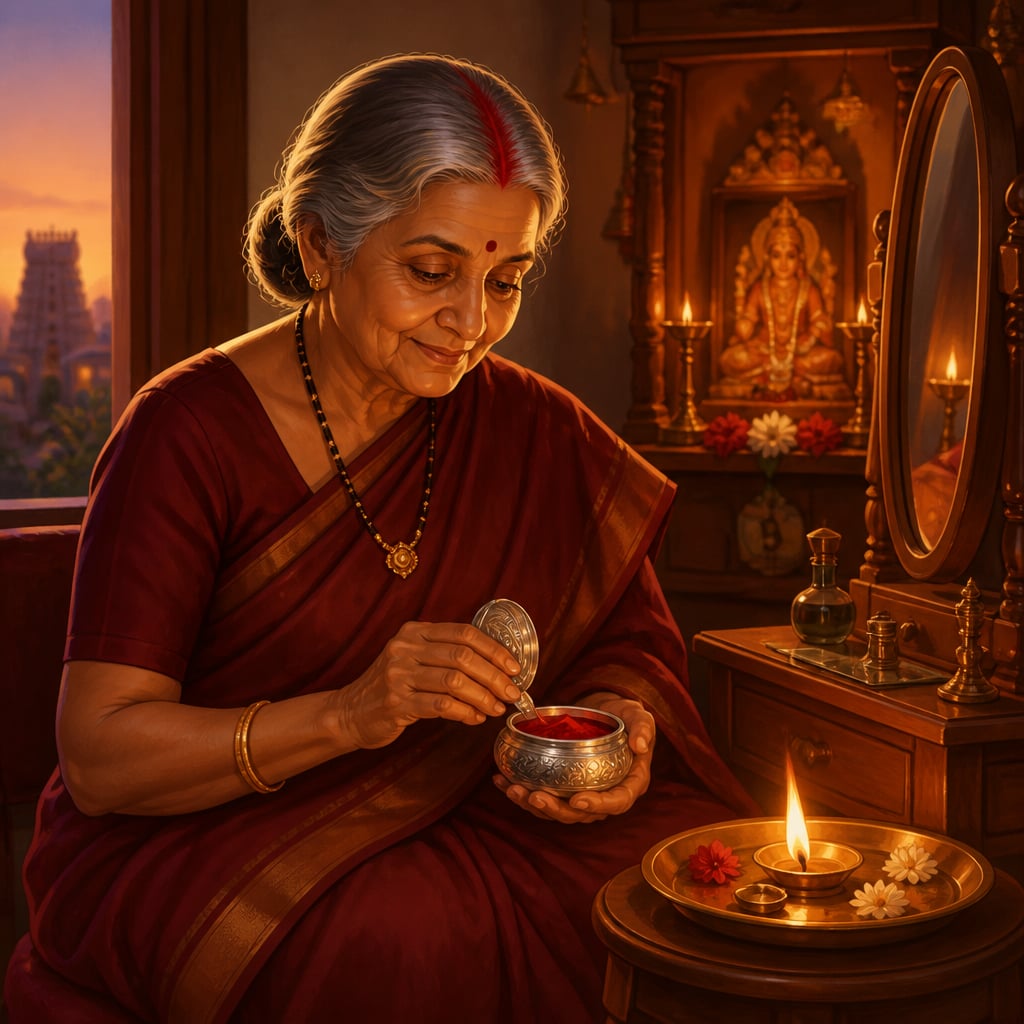
A late evening in a small house in Madurai, sometime in the late 1980s. A girl of seven sits on the kitchen floor watching her paati prepare for the evening lamp. Her grandmother has bathed, changed into a fresh nine-yard saree, and combed her hair. Now she is doing the last thing before she lights the lamp.
She opens a small silver box. Inside is a fine red powder. She dips the tip of her right ring finger into it. With a slow, practiced motion, she draws a line of red along the parting of her hair, from the forehead back into the crown. The powder catches the orange of the kitchen light. The line glows for a moment like a lit fuse.
The girl asks the question every Hindu girl has asked: Paati, why do you do this? Her grandmother answers the way grandmothers do. Because I am married. Because your thatha is well. Because Lakshmi visits the house of a married woman who keeps her sindoor on.
The answer is true, and it is also incomplete. What the paati does not say, because no one ever told her either, is that the powder in the silver box is older than the Sanskrit prayer she is about to chant. Older than the temple at the corner of the street. Older than her own family's recorded memory of itself. The line of red in her parting predates the scripture that explains it. This is what this lesson is about.
Six Things on the Body of a Married Woman
A married Hindu woman, traditionally, wears six visible adornments. Each one looks like decoration. Each one is, in fact, a piece of carefully engineered ritual technology. Together they tell a story the world is now scrambling to translate.
The six are:
- Sindoor: vermilion in the parting of the hair
- Mangalsutra: a thread or chain with black beads worn at the neck
- Bichhiya (also metti in Tamil): silver toe rings on the second toes
- Payal: silver anklets at the ankles
- Mehndi: henna paste applied on the hands and feet
- Bindi: a dot, often red, at the centre of the brow
None of these is uniform across the country. The Tamil thaali is yellow turmeric thread with a small gold pendant. The Maharashtrian mangalsutra has two strings of black beads with two gold cups in the centre. The Bengali woman wears red and white shankha-pola bangles instead of beaded chain. The Punjabi bride wears red and ivory chooda. The Marwari woman piles silver anklets one over another up to the calf. Each region grew its own grammar from the same alphabet. The course of the lesson honours all of them.
Sindoor: The Receipt That Predates the Scripture
In 1974, archaeologists working at Mehrgarh in present-day Balochistan opened a row of female burials. The burials dated to roughly 7000 BCE. They found something specific. Red ochre had been carefully applied to the parting region of the female skulls. Not on the face. Not in the hair as colour. In the parting. In a thin line, exactly where the modern Hindu woman applies sindoor today.
Mehrgarh is part of the same civilizational stream that flows through Harappa and the later Vedic settlements. The Harappan ivory combs from the same horizon show traces of henna leaves in their teeth.
In 2019, a team led by Vasant Shinde published in the Journal of Archaeological Science a fresh analysis of skeletons from Rakhigarhi in Haryana. The site is roughly 4,600 years old. They confirmed ochre residue in the hair-parting region of the female skeletons there as well, independently.
The Atharva Veda's marriage hymn, dated by tradition to a much later horizon, calls upon the same gesture:
सीमन्तं वहसे मातः सिन्धोरारुणपिञ्जरम्। सौभाग्यं तेन वर्धेथां शतं वर्षाणि सर्ववित्॥
sīmantaṃ vahase mātaḥ sindhor āruṇa-piñjaram saubhāgyaṃ tena vardhetāṃ śataṃ varṣāṇi sarva-vit
Mother, you carry in your parting the red gold of the river. By it, may auspiciousness grow for a hundred years.
Atharva Veda, Vivaha Sukta tradition (compiled rendering)
The scripture is telling a married woman about a practice her grandmothers were already doing four thousand years before the verse was written down. This is the essential point. Sindoor is not a custom imposed by the text. The text is the explanation that arrived later for a body-rite already in motion.
The symbolism is layered. Red is the colour of life-blood and of the rising sun. The parting is the centre line of the sahasrara, the crown chakra. A line of red along that line is, in the symbolic grammar of the body, an offering at the highest gate. It is also a public sign: the woman wearing it has entered the household stage of life. The community sees, the community knows, the community accepts.
The habit architecture is exact. The cue is the morning bath. The routine is the small silver box, the finger, the line. The reward is the mirror, the readiness, the lamp. Done daily for forty years, the line stops being decoration. It becomes the woman's own face to herself. James Clear's Atomic Habits would call this identity-based habit formation. The Hindu grandmother would simply call it being a wife.
Mangalsutra: The Thread That Holds the Vow

On the wedding day, the groom ties a thread or chain around the bride's neck while a specific Sanskrit verse is chanted. The verse is short and the gesture is short. The world after that gesture is permanently different.
The mangalsutra has black beads, almost everywhere it is worn. The black is the point. In the symbolic grammar of the household, black absorbs the negative energy directed at the marriage from the outside. It is a tiny visible amulet against the wandering eye, the casual envy, the sour gaze. The Maharashtrian two-cup design, the Tamil thaali pendant, the Bengali loha (iron bangle), the Telugu pustelu: each is a regional dialect of the same rule. The husband puts a guard on the wife's neck and the wife wears it for him.
The Manusmriti speaks of the saubhagyalakshana, the marks of an auspicious married woman, and lists the thread, the parting-mark, the bangles, and the toe-rings as the visible signs of a wife in a living marriage. Apastamba's Grihya Sutra describes the tying of the mangalya sutra as the ritual seal of the seven-step vow.
मङ्गल्यतन्तुनानेन मम जीवनहेतुना। कण्ठे बध्नामि सुभगे त्वं जीव शरदां शतम्॥
maṅgalya-tantunānena mama jīvana-hetunā kaṇṭhe badhnāmi subhage tvaṃ jīva śaradāṃ śatam
With this auspicious thread, which is the cause of my life, I bind your neck. O fortunate one, may you live a hundred autumns.
Traditional vivaha mantra (Apastamba Grihya Sutra tradition)
The research layer here is quieter than for sindoor, but real. Black metals and dark stones absorb a wider range of electromagnetic radiation than light ones. Whether this has any biological effect at the small scale of a chain on a neck is unsettled, and the course will not overstate it. What is settled is the social effect. A woman who wears the mangalsutra is read instantly, on the bus, in the market, at the temple, as a married woman. The chain does the announcement so the woman does not have to.
The modern echo arrived quickly. Tiffany & Co. and a procession of luxury houses now sell black-bead pendants as wellness jewellery. Etsy sells "protection necklaces" with onyx and obsidian beads. Goop ran a 2020 column on "black tourmaline pendants for energetic boundaries." None of them named the mangalsutra. The chain is selling. The story is not.
Bichhiya, Payal, and the Engineering Inside the Ankle
A Hindu bride is rarely given gold on her feet. Gold is reserved for the upper body, for the seat of Lakshmi at the head and chest. The feet wear silver. Always silver.
The bichhiya, the second-toe rings, are the single most quietly engineered item in the whole catalogue. They are silver. They are worn on the second toe of each foot. Acupressure tradition, both Indian marma practice and the cousin tradition of Chinese reflexology, identifies the second toe as a pressure point connected to the uterus and the lumbar plexus along the inner ankle and up through the sciatic line. The constant low-grade pressure of the silver ring on this point is, in the marma reading, a daily tonic for reproductive health and lower-back stability.
A 2017 paper by Saxena and Rao in the International Journal of Ayurveda Research surveyed Indian women aged twenty-five to forty-five and reported a measurable difference in lumbar discomfort scores between long-term bichhiya wearers and a matched control. The sample was small, the effect was modest, and a single study is not the last word. But the direction is what the marma tradition predicted, not against it.
Silver itself is the second receipt. Silver ions are antimicrobial. The 2008 Journal of Hospital Infection review confirmed silver's broad-spectrum action against bacterial colonization on skin. The bride wears silver where her feet meet temple floor, kitchen floor, garden soil. The metal is doing low-level hygiene work twenty-four hours a day. The grandmother did not need the journal to know this. She knew because her ankles never inflamed.
The payal, the anklet, adds a second function: sound. The anklet announces the woman's presence in the house. The kitchen knows when she has entered. The children know when she has left. The husband knows when she has approached. In a joint family of fifteen people across three rooms, the soft chime of a payal is an information system. It is also a courtesy. The Hindu woman in her own home does not surprise anyone.
The modern echo for both is gentle and extensive. "Anklet jewelry" is a $2 billion global market segment. "Toe ring sets" appear at every American beach festival. The wellness industry sells "copper acupressure rings" on Amazon for forty-nine dollars a pair, with marketing copy on "reproductive balance" and "sciatic pressure points." The pair is silver in Tamil Nadu for two hundred rupees. Same point. Same metal. Same logic. Different price.
Mehndi and the Cooling of the Bridal Body

A week before a Hindu wedding, the bride sits while a mehndi artist draws fine lines of green-brown henna paste on her palms, her forearms, the tops of her feet. The paste dries. It is scraped off. The skin underneath is stained a deep red-orange that will last about two weeks.
The practice is older than the explanation, again. The Harappan ivory combs from Mohenjo-daro carried henna leaf residue. Egyptian mummies have been found with henna-stained fingers. Mehndi as a marriage ritual is documented in Vedic-period sources and codified in the Grihya Sutras as a part of the mangalasnana, the auspicious bath.
The ritual layer is the symbolic part. Henna's deep red on the bride's hands echoes the sindoor at the parting. The hands of a bride are darkened with the same colour as her crown. The body is being marked top to bottom in the colour of life.
The research layer is cooling and antimicrobial. Henna leaves contain lawsone, a naphthoquinone with documented anti-inflammatory and antifungal action. Singh and Patel published in Phytomedicine in 2014 a confirmation of henna's cooling effect on skin temperature, measured. The bride sits indoors for several days before the wedding, cooling her body, calming her nerves, and preventing skin infection through a paste that has been doing all three jobs since the Indus settlements.
The modern echo is loud. Kat Von D launched a lipstick shade called "Henna" in 2015 with no acknowledgment of the source. Every American music festival from Coachella onwards features "henna tattoo" booths charging twenty dollars for an arm design. UK wedding studios advertise "Moroccan and Indian fusion henna" without naming a single Indian source. Madonna's "Frozen" video in 1998 used mehndi as a fashion gesture to a global audience. The henna sells. The wedding does not travel with it.
In the grandmother's idiom: when they call it a henna tattoo, you call it mehndi. The word carries the wedding inside it.
Bindi: The Dot at the Sixth Gate
The last item is the smallest and the most stolen. A red dot, traditionally kumkum, applied at the centre of the brow. The point is the ajna chakra, the sixth gate, between the eyebrows. The Hindu tradition reads this as the seat of inner sight. The married woman applies the bindi every morning. The unmarried girl applies it on festival days. The widow, traditionally, removes it, though this convention is fast loosening in modern households and rightly so.
The symbolism is concentration. The eye looks outward; the bindi marks the point that looks inward. A daily reminder, a daily centring, a daily seal.
The modern echo is the Coachella 2014 photograph of Selena Gomez wearing a red bindi as a fashion accessory at the festival. The photograph went viral. South Asian writers and the Hindu American Foundation pointed out that a sacred symbol was being worn as headwear. The conversation that followed reset the cultural register, slowly. By 2019, Vogue had stopped running "festival bindi" tutorials. The story moved.
What the World Calls It Now, and What You Will Call It
A quiet inventory of the receipts.
| The Ritual | What It Is Called Now | Brand or Moment | The Original Name |
|---|---|---|---|
| Sindoor | "Crown chakra activation" wellness | Goop, 2018 | Sindoor |
| Mangalsutra | "Black tourmaline protection necklace" | Tiffany, Etsy | Mangalsutra |
| Bichhiya | "Reproductive acupressure toe ring" | Amazon wellness, $49 | Bichhiya / Metti |
| Payal | "Boho ankle bracelet" | $2B festival market | Payal |
| Mehndi | "Henna tattoo" | Coachella, Kat Von D 2015 | Mehndi |
| Bindi | "Festival face gem" | Selena Gomez, Coachella 2014 | Bindi |
The receipts do not need translating. They speak for themselves. The course's only request is small. From now on, when the catalogue page says henna tattoo, you say mehndi. When it says boho anklet, you say payal. When it says protection necklace, you say mangalsutra. The names carry the meaning. The meaning carries the lineage. The lineage carries the grandmother in the kitchen with the silver box.
Modern Echoes and the Receipts on the Other Side
The modern world is catching up to the body-rites in two directions at once. On one side, the labs are vindicating what the rituals encoded. The Mehrgarh ochre and the Rakhigarhi 2019 paper place sindoor before the Veda. The 2014 Phytomedicine study on lawsone confirms mehndi's cooling and antimicrobial action. Saxena and Rao's 2017 paper points the way on bichhiya and lumbar health. The 2008 Journal of Hospital Infection review confirms silver as a daily antimicrobial. Each of these papers is a small letter in a longer reply the tradition has been waiting for.
On the other side, the wellness market is repackaging the same items at retail markups, with the names removed. Selena Gomez's 2014 Coachella bindi, Kat Von D's 2015 "Henna" lipstick, Tiffany's black-bead pendants, the Etsy ankle-jewellery boom: each one is a fragment of the Hindu woman's morning, sold without her name on it. The course is not interested in litigating the appropriation. The course is interested in equipping the reader to see it.
Back in the small Madurai kitchen, the paati has finished. The line of red is in her parting. The mangalsutra is at her neck. The bichhiya are on her toes. The payal is at her ankles. The bindi is at her brow. The lamp is lit and her grandchild is watching. She does not know that a paper at a Pune lab in 2019 has just placed her sindoor at four thousand six hundred years old. She does not need to. The line of red predates the explanation, and the explanation, when it arrives, will only confirm what her hand has been saying all along.
Case studies
Mehrgarh and Rakhigarhi: The Sindoor Older Than Sanskrit
In 1974, Jean-François Jarrige opened systematic excavation at Mehrgarh in present-day Balochistan. Across multiple female burials dating to c. 7000 BCE, his team documented red ochre carefully applied to the parting region of the skulls. Not on the face, not in the hair as colour, but precisely where modern Hindu women apply sindoor. In 2019, an independent team led by Vasant Shinde at Rakhigarhi in Haryana, working on skeletons roughly 4,600 years old, published in the Journal of Archaeological Science a confirmation of ochre residue in the same hair-parting region of female Harappan skeletons.
The Atharva Veda's vivaha sukta names the sindoor as 'the red gold of the river' carried in the parting. Tradition treats this verse as the canonical scriptural anchor for the rite. Mehrgarh and Rakhigarhi together establish that the body-rite was already in motion four to six thousand years before the Atharva Veda was compiled. The scripture is not the source of the practice. The scripture is the explanation that arrived later for a gesture the grandmothers were already making.
The combined evidence places sindoor among the longest continuously practiced body-rituals on earth. It also resets the conversation: every claim that the ritual is a 'Brahminical imposition' or a 'medieval invention' fails on the archaeology. The line of red in the parting is older than caste, older than Sanskrit, older than the Vedic settlements.
When archaeology, scripture, and living practice align across nine thousand years, the ritual is not a relic. It is a working technology. The right question is not whether to keep it but what it has been doing all this time.
The Mehrgarh ochre evidence dates to c. 7000 BCE, which is roughly 4,000 years before the earliest Vedic compilation.
Lawsone, Silver, and the Bichhiya: What the Labs Found
Three independent strands of modern research converge on the bridal body. Singh and Patel published in Phytomedicine in 2014 a measured confirmation of henna's lawsone compound producing a cooling and antimicrobial effect on skin, validating the pre-wedding mehndi as functional, not decorative. The Journal of Hospital Infection's 2008 review of silver as broad-spectrum antimicrobial validated the silver bichhiya and payal as quiet daily hygiene. Saxena and Rao in the International Journal of Ayurveda Research in 2017 surveyed long-term bichhiya wearers and reported a measurable difference in lumbar discomfort scores compared to a matched control.
Marma tradition placed the second-toe pressure point on the meridian linked to the uterus and lumbar plexus and prescribed a permanent silver ring there for married women. The Grihya Sutras prescribed mehndi as part of the auspicious bridal bath. The dharmic body-rite system did not separate hygiene from devotion from acupressure from symbol. All four worked through the same object. The labs are now confirming three of those four functions independently.
Each study is small, and the course will not overstate. But three separate research streams pointing in the same direction in fifteen years is a pattern, not a coincidence. The ancient kit of silver, henna, and toe-ring is being vindicated piece by piece in the journals.
Indigenous knowledge often encoded function inside symbol. When the lab arrives, it usually finds at least one of the functions to be real. The wise reader does not wait for the full vindication before respecting the system. The system has been waiting for the wise reader.
The 2008 Journal of Hospital Infection review documents silver's antimicrobial action against more than 650 bacterial species.
Coachella 2014: The Bindi That Started a Conversation
At Coachella 2014, Selena Gomez performed wearing a red bindi at the centre of her brow as a fashion accessory. Photographs from the set went viral within hours. The Hindu American Foundation issued a statement that sacred Hindu symbols were being treated as costume jewellery. South Asian writers, including Anjali Joshi at the Aerogram and Aarti Olivia Dubey, wrote essays arguing that the bindi at the ajna chakra is not a face gem. By 2015, Vogue had quietly stopped running 'festival bindi' tutorials. By 2019, the conversation had reset enough that mainstream fashion magazines no longer treated the bindi as appropriable.
The bindi marks the ajna chakra, the sixth gate, the seat of inner sight. The Hindu woman applies it daily as a centring practice. The tradition treats it as a visible mark of an inner act. Wearing it as ornament without the practice empties the symbol. The Dharmic tradition is generous in many things but specific about the difference between a symbol that carries a practice and a symbol stripped of the practice.
The conversation shifted real cultural ground. Major brands stopped marketing the bindi as a fashion item. South Asian voices got a clearer hearing in mainstream cultural discourse. The Coachella bindi remains a textbook case in cultural-appropriation studies and is now taught in college courses alongside the 1995 turmeric patent dispute and the Bikram yoga copyright case.
When a sacred symbol is sold as accessory, the right response is not anger. It is articulation. Name what the symbol carries, name what is lost when it is stripped, and name what to call it correctly. Public articulation, not private grievance, moves the world.
By 2024, the global 'face jewel' market has explicitly dropped the bindi label and rebranded around 'forehead gems' and 'rave dots' to avoid cultural-appropriation backlash.
Historical context
From c. 7000 BCE (Mehrgarh) through c. 1500 BCE (Vedic codification) to the present (continuous practice).
The married body of the Hindu woman is the rare ritual surface that runs continuously from pre-Harappan settlements to the present day, surviving the Vedic, classical, medieval, colonial, and modern eras without interruption. It is the single longest-running ritual technology in the dharmic tradition, and the one with the most continuous archaeological evidence.
Living traditions
The mehndi industry alone is a ₹5,000 crore Indian market, with mehndi cones now exported to 40+ countries. The wedding adornment industry (mangalsutra, sindoor, bichhiya, payal) is estimated at ₹15,000 crore in India. Globally, 'henna tattoo' booths and 'boho anklet' sales together represent a $4 billion segment of the festival and wellness markets, all of it traceable to the Hindu bridal kit. Re-Sanskritize: when the ad copy says henna tattoo, you say mehndi. When it says boho anklet, you say payal. When it says protection necklace, you say mangalsutra. The names carry the meaning. Use them.
- Rakhigarhi Archaeological Site: The largest Harappan site in India, where Vasant Shinde's 2019 study confirmed ochre residue in the hair-parting region of female skeletons. The site has an interpretation centre and active dig seasons. Walking the mounds, you walk the ground that physically anchors the antiquity of sindoor.
- Sanchi Stupa carvings of suvasini figures: The 2nd-century BCE toranas at Sanchi carry detailed reliefs of women with sindoor, mangalsutra, payal, and bichhiya, confirming the full set of saubhagyalakshana in living use during the Mauryan and Sunga periods.
- Khajuraho Temples: The 10th-12th century Chandela temples at Khajuraho show female figures in unprecedented detail, with the full kit of sindoor, mangalsutra, payal, bichhiya, mehndi-stained hands, and bindi visible across hundreds of carvings.
Reflection
- Pick one body-rite from your own family tradition, married or unmarried, that you currently do without knowing why. Commit to doing it for thirty consecutive days, and at the end of the thirty days, write one paragraph on what the body learned that the head did not.
- Why might the dharmic tradition have placed the most carefully engineered hygiene and health technologies (silver bichhiya, lawsone mehndi, ochre sindoor) on the body of the woman about to enter the household, rather than on the body of the man entering it?
- If a sacred symbol can be stripped of its practice and sold as accessory at retail, has the symbol been damaged, has the meaning been damaged, or is the meaning held safely elsewhere and only the surface taken? What does it mean for a symbol to be 'desecrated' in a tradition that locates meaning in lived practice rather than in the object itself?