The Thread, The Tuft
Yajnopavita and Shikha: the two threads that bind the Hindu body to vow and to vertex
Two of the most visible markers of a Hindu body are not jewellery and not fashion. The sacred thread (yajnopavita) on the shoulder and the small tuft of hair (shikha) on the crown of the head are vows worn outside the skin. This lesson unpacks both: what they are, what scripture says, what the symbolism means, why the body and mind respond to them, what the labs are now finding, and what the global fashion industry has been quietly selling under different names.
A Grandfather Who Will Not Sit for Tea
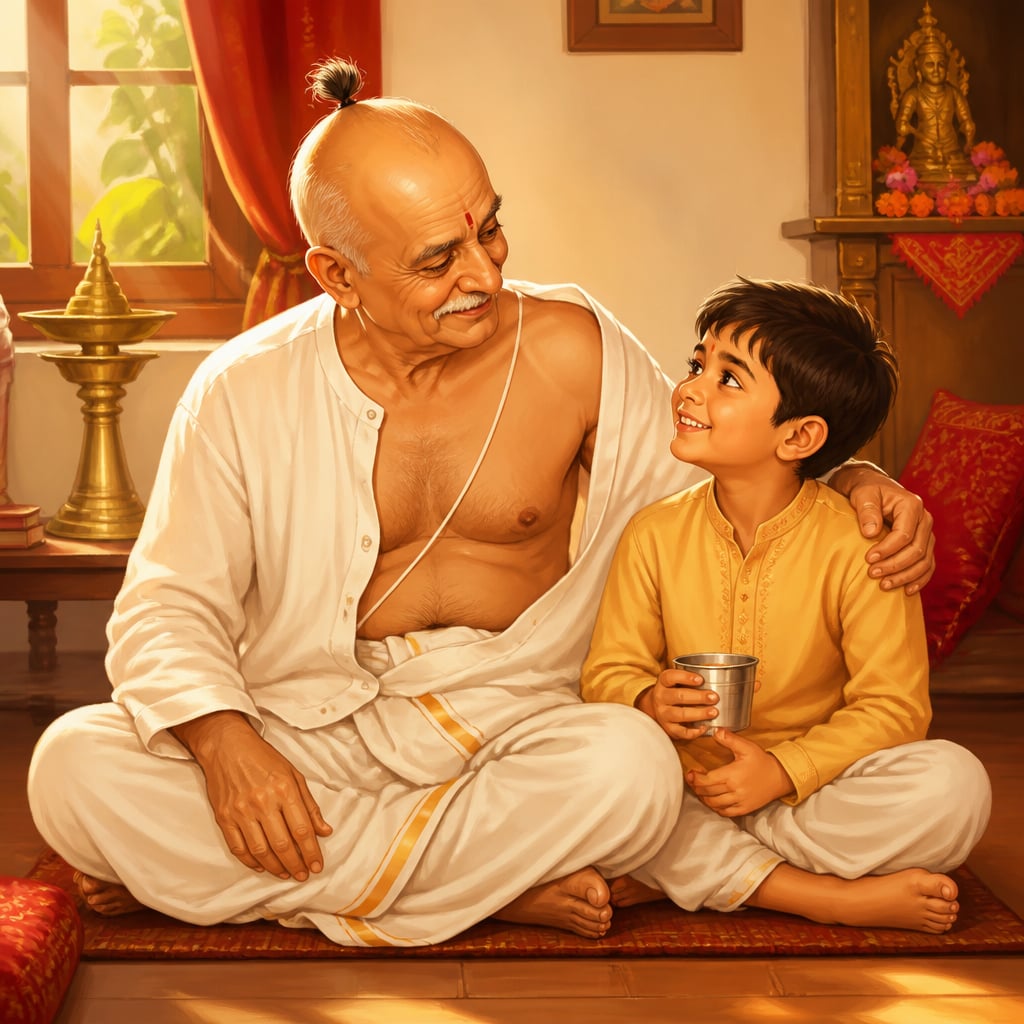
In a small house in Pune, a grandson visits his ajoba on a Sunday afternoon. The boy is twenty four, in jeans and a hoodie, back from a job in Bangalore. The grandfather is in a soft cotton kurta, the top buttons open. On the boy's third question about the family, he notices it for the first time, properly. A thin off white thread loops over the old man's left shoulder, crosses the chest, and disappears under the right arm. The boy has seen this thread on his father, on his uncles, on photos of his great grandfather. He has never asked what it is. His ajoba sees the look and laughs. He says only one thing. He says, this is my real address. Then he refuses to sit for tea until he has had a wash, because his thread is his and he keeps it clean.
The boy goes home that night and asks his father. His father shrugs and says, your dadaji and his vows. That is all. The boy is left holding a question. What is the thread? Why does it have an address? And why is there always a small extra knot of hair on the crown of his cousin's head when he comes back from his Upanayana, a small island of length in the middle of an otherwise ordinary haircut?
This is the lesson the grandfather did not owe him.
The Practice, Across India
The sacred thread is called the yajnopavita. In daily speech it is the janeu in the north and the poonal or jandhyam in the south. It is not one cord. It is three cords twisted together, then knotted, then worn slung from the left shoulder across the chest, the way a bandolier is worn. Married men wear a doubled six strand version after their wedding. The thread is changed once a year on Shravana Purnima, the day many North Indian families call Raksha Bandhan and Tamil and Telugu families call Avani Avittam, when the entire community of those who wear the thread bathes, chants, and replaces the old thread with a new one. Boys receive their first thread at the Upanayana ceremony, traditionally between ages eight and twelve, the second of the two birth thresholds Hindu civilisation marks. The first birth is from the mother. The second is from the guru, when knowledge is given. The thread marks the second birth.
The shikha is the small tuft of hair retained on the crown of the head, at the vertex, when the rest of the head is shaved or cut. In the Chudakarana samskara around age three, and later at the Upanayana, the head is shaved clean except for this single circle of hair, kept long. Brahmins, traditional priests, sannyasis after their ochre robes, the disciples of Adi Shankara, the Madhva and Sri Vaishnava acharyas, the Nambudiris of Kerala who tie it forward, the Iyengars of Tamil Nadu who tie it back, all keep the shikha. So did Chanakya, who, by the testimony of the Sanskrit play Mudrarakshasa, untied his shikha as a vow before defeating Dhanananda and refused to retie it until the throne of Magadha had passed to his student Chandragupta Maurya. The shikha as an irreversible vow is the most dramatic political use of a haircut in recorded history.
The varna context of these two markers must be named honestly. Historically, the Upanayana and the thread were given to the three twice born varnas: brahmana, kshatriya, vaishya. Many shudra communities, women, and others were excluded from the formal ceremony. From the nineteenth century onward, reform movements such as Dayananda Saraswati's Arya Samaj universalised the Upanayana, performing thousands of ceremonies for boys of every varna and for girls. Many contemporary lineages now offer the thread to anyone who undertakes the discipline. The course names this evolution because the receipts demand honesty. The thread was once restricted. It has been opened, repeatedly, by Hindus themselves.
The Scripture Says

The foundational mantra recited as the thread is placed over the boy's shoulder is from the Yajurveda. Yajnopavitam paramam pavitram, prajapater yat sahajam purastat. The thread is supreme purity. It was born with Prajapati at the very beginning. The wearer prays for long life, strength, splendour, and the right to wear it through every act of his life. The mantra is short. The grammar is dense. The meaning is total: the thread was there at creation, and putting it on aligns the wearer with the order that holds creation together.
The procedure of the Upanayana is laid down in the Grihya Sutras. The Apastamba Grihya Sutra prescribes the timing, the materials of the thread, the orientation, the questions asked of the boy, and the moment of placement. The Manusmriti specifies the timing of the ceremony by varna, eight for brahmana, eleven for kshatriya, twelve for vaishya, with later windows treated as samskara debt to be repaid through penance. These texts are why a Hindu priest in Hyderabad in 2026 ties the thread the same way a priest in Varanasi tied it in 600 BCE. The continuity is not folklore. It is procedural code, transmitted unbroken.
The shikha has its own scripture. The Smriti texts describe it as the seat of Brahma, the vertex of the head where the highest energetic centre, the sahasrara, opens. The Sushruta Samhita identifies the same region as the adhipati marma, a vital point whose injury is fatal, demanding that it be protected and oriented. The shikha is the marker of that protection.
The Symbolism
The three strands of the thread mean three things at once, and all three are taught to the boy at his Upanayana. The first interpretation is the three debts of every life, debts owed to the rishis whose knowledge made you, to the pitrs whose lineage produced you, and to the devatas whose order sustains you. The second is the three goddesses, Saraswati, Lakshmi, and Parvati, whose favour the thread invokes. The third is the three goals of life that hold the householder to the centre, dharma, artha, and kama, with the thread visible against the chest as a reminder that wealth and pleasure must stay roped to ethics. The knot at the join is called the brahmagranthi, the knot of the absolute. After marriage, the cord is doubled to six strands, three for the man and three for his wife, the household now a single circuit.

The shikha is identity by location. It is placed precisely above the brahmarandhra, the crown opening, and tied tight. The hair below is shorn so that the only growth left points upward, marking the soul's direction of release. To untie it is to declare a vow not yet kept. To tie it is to declare a self under discipline. When a sannyasi takes formal renunciation, he cuts off even the shikha, because the vow of renunciation is a vow that cancels all earlier vows. The hair is data. Every length is a message.
Why the Body Responds
Layer four, the habit architecture, is where these two rituals shine. Identity anchoring is the deep mechanism. The thread is on the body twenty four hours a day. It is not a watch the wearer can take off and forget. It travels into the bath, into sleep, into the office. Every time the wearer reaches across his chest, his hand grazes the cord. Every time he eats, washes, prays, he is reminded by touch alone of what he is. Behavioural scientists call this an identity based habit, the strongest kind. James Clear in Atomic Habits writes that habits anchored to who you are, not to what you want, are the only habits that survive willpower fatigue. The thread is the oldest known wearable identity device. The Apple Watch markets itself as your second self. The yajnopavita has been the second self for three thousand years.
The shikha works through a different lever, embodied cognition. The vertex is sensitive. A small tuft of hair at the crown is a constant low grade tactile reminder, easy to ignore most of the time but instantly available when the wearer touches it. Traditional students were told that when concentration faltered during recitation, they should touch the shikha and refocus. The placement is also the precise crown chakra location described in Patanjali's Yoga Sutras as the seat of upper consciousness. The acupressure tradition of East Asia identifies the same point as Bai Hui, governing vessel point twenty, and uses it routinely for cognitive alertness. The body has been treated as one map by every serious tradition that studied it. The shikha is the Hindu marker of that map.
The annual replacement of the thread on Avani Avittam is a calendar trigger as elegant as any modern habit cue. Once a year, every wearer in the family does the same thing on the same day, wades into a river, chants together, and comes home with a fresh cord. The whole community is the cue. The whole community is the reward. The ritual cannot be performed alone. The behaviour locks itself in through social accountability the way Wendy Wood describes in Good Habits Bad Habits.
What the Labs Found
The research layer is sparser for the thread itself, because cotton on skin is not exotic enough to attract grant money. But the shikha has had its day in the lab. Liu and colleagues, writing in Neurological Research in 2018, mapped the GV20 acupoint, which sits exactly where the shikha is tied, and showed that stimulation of this point correlates with measurable changes in cognitive alertness and frontal lobe activation. Earlier work going back to Schroeder and Schuckow's 1994 acupuncture studies had already established GV20 as a reliable point for attention regulation. The Sushruta Samhita's identification of the adhipati marma at the same vertex is not metaphor. The anatomy was being read accurately three thousand years ago. The lab is now writing the same map in different ink.
What the World Calls It Now
The thread is the shape that cannot quite be coopted, because a cord across the chest looks too odd to fashion buyers. But the shikha has been coopted, openly and at scale. In 2014, the GQ piece titled The Man Bun is the New Beehive launched the global man bun trend. Hipsters in Brooklyn, footballers in Madrid, stockbrokers in Singapore, all tied a knot of hair on the crown of their heads and called it Japanese samurai or Western hipster. Lululemon began selling an eight dollar accessory called a man bun holder. By 2019 the trend had cycled through every major fashion magazine. Not one of them mentioned the shikha. The samurai chonmage, itself almost certainly influenced by Buddhist transmission from India, got more credit than the original. The course names this calmly. We are not angry that the world rediscovered the topknot. We simply note that the topknot was already named, and the name was shikha, and the placement was not aesthetic, it was anatomical.
The sacred thread has its own rebrand, quieter and slower. The wellness jewellery industry now sells body cords of cotton and copper called sacred geometry threads, energy threads, and shoulder cords, marketed as anchoring devices for daily intention. They are sold at fifty to two hundred dollars depending on the metal. They are nearly identical in shape to the yajnopavita. The intention layer has been bolted on after the fact, because the original intention layer, the prayer over the thread at Upanayana, has been left out of the box.
What to Call It Yourself
From this lesson onward, when you see a man with a thread across his chest, call it the yajnopavita. When you see a knot of hair on a crown, call it the shikha. When the magazine calls it a man bun, smile and use the older word. The world is allowed to rediscover. We are allowed to remember.
Key figures
Chanakya
Brahmin scholar, statesman, author of the Arthashastra; mentor and chief minister to Chandragupta Maurya · 4th century BCE
Chanakya, also called Kautilya and Vishnugupta, taught at Takshashila, mentored Chandragupta Maurya from boyhood, and engineered the overthrow of the Nanda dynasty to install the Mauryan Empire. He authored the Arthashastra, the foundational Indian treatise on statecraft, economics, and governance. His personal observance of Hindu ritual was as exacting as his political planning, and his use of the shikha as a public vow has become the most quoted single instance of ritual in Indian political history.
The Sanskrit play Mudrarakshasa records that Chanakya untied his shikha as a vow before defeating the Nanda king Dhanananda and refused to retie it until Chandragupta sat on the throne of Magadha. The shikha is here not ascetic decoration. It is identity performance tied to political commitment. A small tuft of hair becomes a public ledger of an unfinished obligation. The fact that Chanakya is remembered for both an empire and a haircut is not an accident. It is a precise demonstration of how Hindu civilisation has always treated the body as the seat of vow.
Dayananda Saraswati
Founder of the Arya Samaj; reformer who universalised the Upanayana ceremony across varna and gender · 1824 to 1883 CE
Dayananda Saraswati founded the Arya Samaj in Bombay in 1875 with a programme of returning Hinduism to its Vedic foundations. Reading the Manusmriti and the Upanishads carefully, he concluded that the historical restriction of Upanayana to the three upper varnas was a later social development, not a textual mandate. The Arya Samaj began performing public Upanayana ceremonies for boys and girls of every varna, often in mass gatherings of hundreds at a time. The movement's universalised Upanayana is now standard in millions of Arya Samaj households worldwide and has influenced many other lineages.
Dayananda is the bridge between the historical thread and the modern thread. Without his reform, the lesson would have to present the yajnopavita as a closed practice. Because of his reform, it can be presented as an open one, with the receipts of an opening that Hindus performed on themselves, not because of external pressure but because of internal scriptural argument. The thread today is wider than the thread of 1800 because Hindus chose to widen it.
Adi Shankara
Advaita Vedanta acharya, founder of the four Shankara mathas, lifelong wearer of both the thread and the shikha · 8th century CE
Adi Shankara consolidated the Advaita Vedanta darshana, established the four mathas at Sringeri, Dwarka, Puri, and Jyotirmath, and wrote commentaries on the Brahma Sutras, Upanishads, and Bhagavad Gita that remain canonical. Born in Kalady in Kerala, his life observance of the shikha and yajnopavita made him the visible model of the disciplined sannyasi who has not yet renounced the marks of dvija status.
Shankara complicates the simple story that sannyasis renounce all marks. He kept the thread and the shikha through his entire life as an acharya. Only at the moment of formal renunciation, the paramahamsa stage, are these marks removed in some sannyasi orders. The shikha as kept by the Shankaracharyas, by the Madhva acharyas, by the Sri Vaishnava jiyars, and by traditional Vedic students today is therefore a continuous unbroken transmission going back at least twelve hundred years.
Case studies
Chanakya's Shikha Vow: A Haircut That Toppled an Empire
The Sanskrit political drama Mudrarakshasa, composed by Vishakhadatta around the 4th to 6th century CE based on still earlier oral traditions, opens with one of the most arresting images in Indian political theatre. Chanakya, the brahmin scholar from Takshashila, has been publicly humiliated by Dhanananda, the last king of the Nanda dynasty at Pataliputra. In court, in the presence of his guests, the king has Chanakya thrown out and his shikha untied as a final insult. Chanakya leaves the assembly hall holding his loosened tuft in his hand. He takes a vow in front of the court. He will not retie this shikha until the Nanda dynasty is destroyed and a king of his own choosing sits on the throne of Magadha. The play tracks the next decade. Chanakya identifies a young man of unclear birth, Chandragupta, trains him at Takshashila, builds a coalition of disaffected princes, raises an army, and over years of subterfuge and battle, brings down the Nandas. Only on the day Chandragupta is anointed Maurya emperor does Chanakya retie his hair. The shikha goes back up. The empire has changed hands. The vow is closed.
In the Hindu imagination, the body is the most reliable ledger of vow because the body cannot lie. A written oath can be hidden, a spoken oath can be denied, but a man walking through a city with his hair untied is broadcasting an unfinished obligation to everyone who sees him. The shikha as Chanakya wore it during those years was a permanent advertisement of incompleteness. Every meal he ate, every meeting he chaired, every soldier he recruited, the loosened tuft was the first thing visible. This is identity anchoring at the highest stakes the world has ever seen, an entire kingdom riding on a man's refusal to comb his own hair.
Chandragupta Maurya was anointed at Pataliputra around 321 BCE, founding the dynasty that would, under Ashoka, span the largest contiguous land area in the ancient world. Chanakya served as his chief minister, codified the Arthashastra, and is now read at West Point and at the Indian Civil Services academy. The shikha was retied. The empire was real. The vow had a body and the body kept it.
A small tuft of hair is not a small thing. When a public vow is mapped onto the body, the body becomes the calendar of the commitment. The Hindu refusal to separate symbol from substance is at its sharpest in the shikha. You cannot have a shikha and not mean it, because the moment you tie it or untie it, the world reads the answer.
The Indian armed forces today retain the practice of regimental commitments visible on the body, beards, turbans, threads, and tilaks worn during operations. Officers will name the practice as a continuation of the same logic Chanakya enacted: a vow visible on the body holds the holder accountable to the unit, to the country, and to the self. The shikha is the source code.
Mudrarakshasa, Act 1, scene of the loosened shikha. The play is dated by most scholars to the late Gupta period, between the 4th and 6th centuries CE, and is preserved in a continuous manuscript tradition. Chanakya's career is dated to roughly 350 to 275 BCE.
GV20 and the Vertex: What the Lab Found at the Spot the Shikha Marks
In 2018, Liu and colleagues published a study in Neurological Research mapping cortical responses to stimulation of the GV20 acupoint, also known as Bai Hui in the East Asian acupressure tradition, located at the precise vertex of the human skull. Using a combination of functional near infrared spectroscopy and standardised attention tasks, the team showed that GV20 stimulation produced measurable increases in prefrontal cortex oxygenation and improved performance on attention regulation tasks. The result was not a one off. Earlier studies going back to Schroeder and Schuckow's 1994 acupuncture work on attention had already established GV20 as a reliable cognitive point. Subsequent fMRI studies, including Park and colleagues in 2009, had localised the vertex stimulation effect to default mode network changes consistent with focused attention states.
The Sushruta Samhita, dated between the 6th and 3rd centuries BCE, identifies the same vertex region as the adhipati marma, the sovereign vital point, whose injury is fatal and whose protection is central to surgery and to ritual alike. The Yoga Sutras and the Hatha Yoga texts identify the same point as the locus of the sahasrara crown chakra and the brahmarandhra crown opening. The shikha is tied directly above this point. Tradition has been telling Hindus for at least two and a half thousand years that the crown of the head is anatomically and energetically special. The lab is now telling everyone else.
The acupressure tradition's mapping of GV20 is now standard in clinical literature on attention and concentration. Wellness companies sell GV20 head massagers for cognitive clarity at thirty to fifty dollars on Amazon. Meditation teachers in Silicon Valley instruct students to direct attention to the crown. None of these settings name the shikha. The point on the head is on the world map. The Hindu marker on that point is not yet on the wellness map. The course is the receipt that closes the gap.
The traditional placement of the shikha is not aesthetic. It is anatomical. A tuft of hair tied at the highest cognitive activation point on the human skull functions as a permanent low grade sensory anchor for that point, available to the wearer's hand any time concentration needs a cue. The lab has now confirmed what the Sushruta Samhita said. The thirty thousand peer reviewed acupuncture papers on GV20 are downstream of one ancient verse.
The next time a meditation app instructs a user to feel the top of the head, or a wellness teacher places a finger at the crown, what is being touched is the same point the shikha is tied above. The Hindu civilisation built a wearable always on bookmark for this point three thousand years ago. The world is rediscovering the bookmark one peer reviewed paper at a time.
Liu et al, 2018, Neurological Research, on GV20 and prefrontal cortex activation. Schroeder and Schuckow, 1994, on GV20 and attention. Sushruta Samhita, Sutrasthana, identification of adhipati marma at the vertex. The literature is not obscure. PubMed returns more than four thousand papers on GV20.
The Man Bun Moment: How the Shikha Became a Lululemon Accessory
In 2014, GQ magazine published a piece titled The Man Bun is the New Beehive. Within six months, every major lifestyle outlet had run a man bun explainer. Brad Pitt wore one. David Beckham wore one. Jared Leto wore one. The trend was attributed in roughly equal measure to Japanese samurai chonmage, Brooklyn hipster culture, and a vague mention of yoga. Lululemon launched a product called the Man Bun Holder, a small fabric scrunchie marketed at male yoga practitioners, retailing at eight United States dollars. By 2016, the global hair accessory market for top knots was estimated by one trade publication at over three hundred million dollars annually. By 2019, the man bun had become so ubiquitous that GQ ran a follow up piece titled The Man Bun is Over. Through five years of continuous global coverage across Vogue, Esquire, GQ, the New York Times Style section, and a thousand fashion blogs, the word shikha was mentioned essentially nowhere.
The shikha is the original topknot. Brahmins, Vedic students, sannyasis, and traditional priests have worn a small tuft of long hair on the crown of an otherwise short head for at least three thousand years. The samurai chonmage itself most likely reached Japan through Buddhist monastic transmission from Indian and Chinese sources, with the underlying anatomical logic identical to the shikha. The Hindu version names the point, prescribes the placement, anchors a mantra, and connects the body to the sahasrara. The fashion version is a knot. The fashion version is therefore a fragment of the shikha with the system removed and the price tag added.
The man bun trend earned hundreds of millions of dollars across hair accessories, salon styling, and product placement between 2014 and 2019. Hindu civilisation, which originated the topknot, received zero credit. This is not a complaint, it is a receipt. The course's job is to keep the receipt visible. The grandmother is calm. The shikha was always there. The world is allowed to rediscover it. The world is also allowed to learn the older name.
When a wellness or fashion industry rediscovers a Hindu marker, it generally renames it, sells it, and forgets where it came from. This is not malice. It is market logic. The defence is not anger. The defence is naming. Use the older word. Tell the story. The receipts speak for themselves once they are placed on the table.
The man bun is the most recent global rediscovery of the shikha and probably not the last. Each time it returns under a new name, the Hindu wearer gets the chance to smile, name the older word, and watch the shape of the conversation change. The world remembers the topknot. The course remembers the shikha.
GQ, August 2014, The Man Bun is the New Beehive. Lululemon Man Bun Holder, eight United States dollars at launch. GQ, 2019, The Man Bun is Over. Hair accessory trade publications estimating top knot market value at three hundred million dollars annually at peak.
Historical context
Vedic to Mauryan period: c. 1500 BCE codification of Yajnopavita mantras in the Yajurveda, c. 700 BCE composition of the Grihya Sutras systematising the Upanayana, 4th century BCE political use of the shikha by Chanakya, 19th century CE Arya Samaj universalisation.
Living traditions
The thread and the tuft are alive in tens of millions of Hindu households today, worn daily, replaced annually, taught from grandfather to grandson without interruption.
The yajnopavita and the shikha live on in tens of millions of households worldwide. Every Avani Avittam morning, every father teaching a son to fold the thread before a bath, every traditional priest tying the small tuft after a tonsure, is the system functioning exactly as designed. The vocabulary is the discipline. From this lesson onward, when you see a thread across a chest, call it the yajnopavita. When you see a knot of hair on a crown, call it the shikha. When the magazine calls it a man bun, smile and use the older word. The world is allowed to rediscover. We are allowed to remember.
- Avani Avittam and Upakarma: the Annual Thread Change: On Shravana Purnima, the full moon of the month of Shravana in July or August, the entire community of yajnopavita wearers across India performs Upakarma. The day begins with a ritual bath, ideally in a river. The old thread is removed with a mantra of release. A new thread of three twisted strands is consecrated, blessed by priests, and tied with the Yajnopavita mantra. A long passage of the Veda is recited as a renewal of study. In Tamil and Telugu families the day is called Avani Avittam. In the north it overlaps with Raksha Bandhan. The same mantra is chanted in Sanskrit on the same day in Kanyakumari, Pune, Varanasi, and Edison New Jersey, by Hindus speaking eight different mother tongues.
- Chudakarana and the First Shikha: Chudakarana, the first hair shaving samskara, is performed between the first and third year of life. The child's head is shaved clean at a temple, a riverbank, or at home, with a small circle of hair retained at the crown. This first shikha is the child's introduction to the discipline of identity. In Tamil tradition the ceremony is called Mottai Adithal at Tirupati or at Palani, and the shaved hair is offered to the deity. The retained tuft is washed, oiled, and tied. Many traditional families maintain this shikha through childhood, supplemented later at Upanayana.
- Sringeri Sharada Peetham: One of the four mathas established by Adi Shankara, the southern seat of Advaita Vedanta. Visiting Sringeri allows the pilgrim to see a continuous tradition where every acharya, including the current Jagadguru Shankaracharya of Sringeri, wears the shikha and the yajnopavita exactly as Shankara did twelve hundred years ago. The matha conducts mass Upanayana ceremonies open to the community, and runs Veda pathashalas where boys still receive the thread at the canonical age.
- Tirumala Tirupati Devasthanams: The Temple of Tonsure: Tirumala is the largest centre of Hindu hair offering on earth. Around twenty five million pilgrims have their heads shaved annually as offerings to Lord Venkateswara. The hair is collected, sorted, and auctioned, generating roughly thirty to forty crore rupees per year for the temple, used for pilgrim welfare, free meals, and education. Most Chudakarana ceremonies and many adult vows of tonsure happen here. The retained shikha for those who keep one is tied carefully back into place after the rest of the head is shaved.
Reflection
- If you were asked tomorrow to wear, on your body, twenty four hours a day, a single visible marker of who you are and what you have committed to, what would it be? And how would your life change if you could not take it off?
- Chanakya untied his shikha as a public vow and refused to retie it for years. What is one commitment in your life right now that would be served by being made visible to the people around you, and what would the equivalent of an untied shikha look like for you?
- The Arya Samaj universalised the Upanayana by rereading Manu, not by leaving Hinduism. What does it look like, in your own family or community, to widen a discipline without diluting it? Where might you be tempted to leave a tradition, when the more useful move is to read its sources more carefully?