Yajña: Collective Rituals
How Shared Practice Creates Lasting Bonds
Yajña is the Vedic technology for creating and sustaining collective bonds across generations. More than religious ritual, it is a systematic practice of exchange, offering, and reciprocity that transforms individuals into community. This lesson explores how structured, repeated collective actions create the 'we' that endures beyond any individual lifetime.
The boy was only seven, but he had a role. His father poured the ghee; his grandfather recited the mantra; his grandmother had prepared the offerings before dawn. Even the youngest, barely walking, was held close to feel the fire's warmth on her face. Four generations around one flame. The yajna had been performed on this ground for longer than anyone could remember. Great-great-grandfathers had poured ghee here; great-great-grandchildren would do the same. And in that moment, past and future collapsed into a single present, the offering, the fire, the family bound across time. This is yajña: the practice that makes community outlast any individual life.
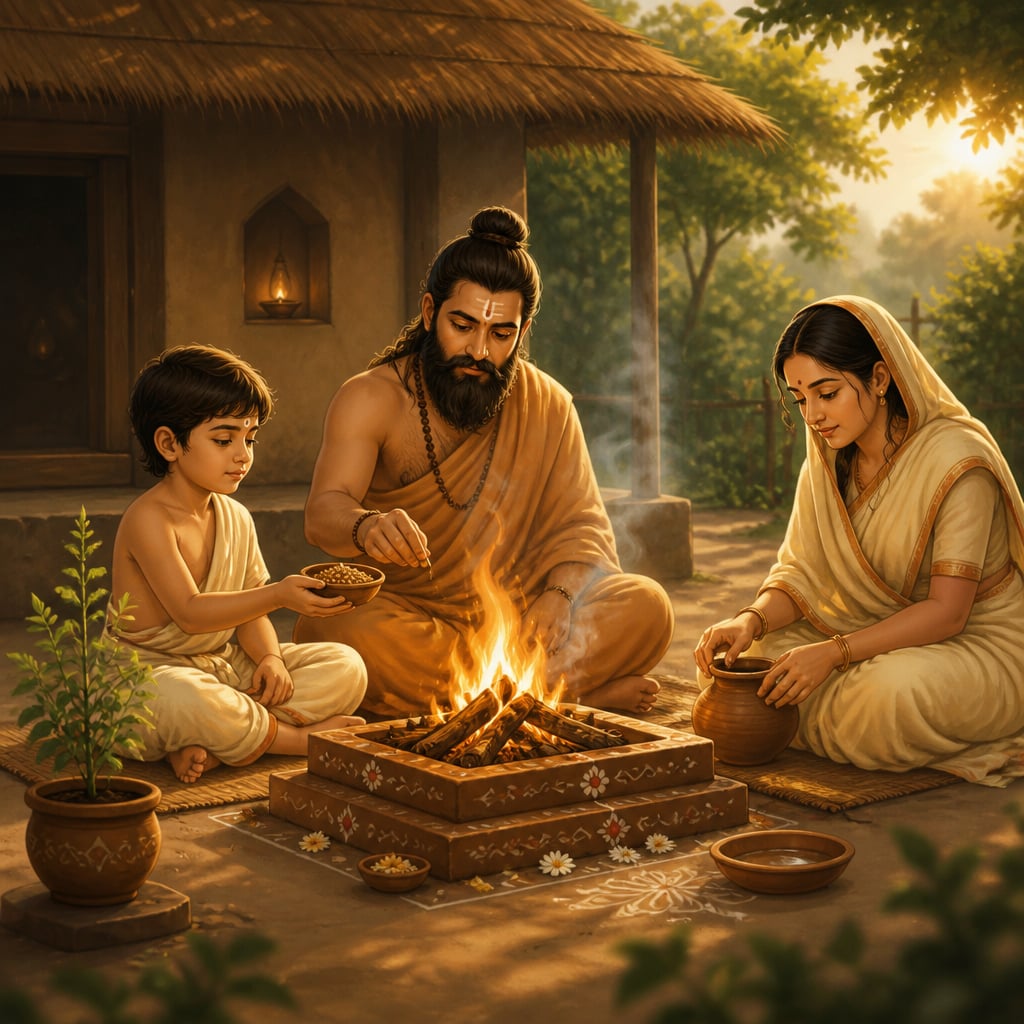
Beyond Religion: Yajña as Social Technology
We explored why collective action matters (saṅgha-śakti) and how groups synchronize (through tāla). Now we ask: what practice sustains collectives across generations? The Vedic answer is yajña, structured, repeated ritual that transforms individuals into an enduring 'we.'
The word yajña comes from the root yaj, meaning 'to worship, to sacrifice, to offer.' But the deeper meaning is exchange. In yajña, humans offer to the Devas; the Devas return blessings. This principle of reciprocal giving creates bonds that persist.
The Bhagavad Gita makes this explicit:
"देवान्भावयतानेन ते देवा भावयन्तु वः। परस्परं भावयन्तः श्रेयः परमवाप्स्यथ॥" "By this [yajña], nourish the Devas, and the Devas will nourish you. Nourishing each other, you shall attain the highest good."
The key word is parasparam, mutual. Yajña is not one-way worship but a cycle of exchange. And this cycle, repeated across generations, creates the social fabric that holds communities together.
What the Mantras Reveal
The very first verse of the Rig Veda invokes Agni, not as a god to be feared but as a priest who mediates the collective offering:
"अग्निमीळे पुरोहितं यज्ञस्य देवमृत्विजम्। होतारं रत्नधातमम्॥" "I praise Agni, the purohita (household priest), the divine priest of the yajña, the invoker, the bestower of treasures."
Word by word:
- Agnim, Agni, the sacred fire
- Īḷe, I praise, I invoke
- Purohitam, the one placed in front, the representative
- Yajñasya, of the yajña, of the collective offering
- Devam ṛtvijam, the divine priest who serves the seasons/cycles
- Hotāram, the invoker, the caller
- Ratnadhātamam, the greatest bestower of treasures
Agni is not a distant deity but a mediator, present in every home, receiving offerings and carrying them upward. When every household lights Agni and makes offerings, they participate in a collective act that transcends individual homes. The fire connects them.
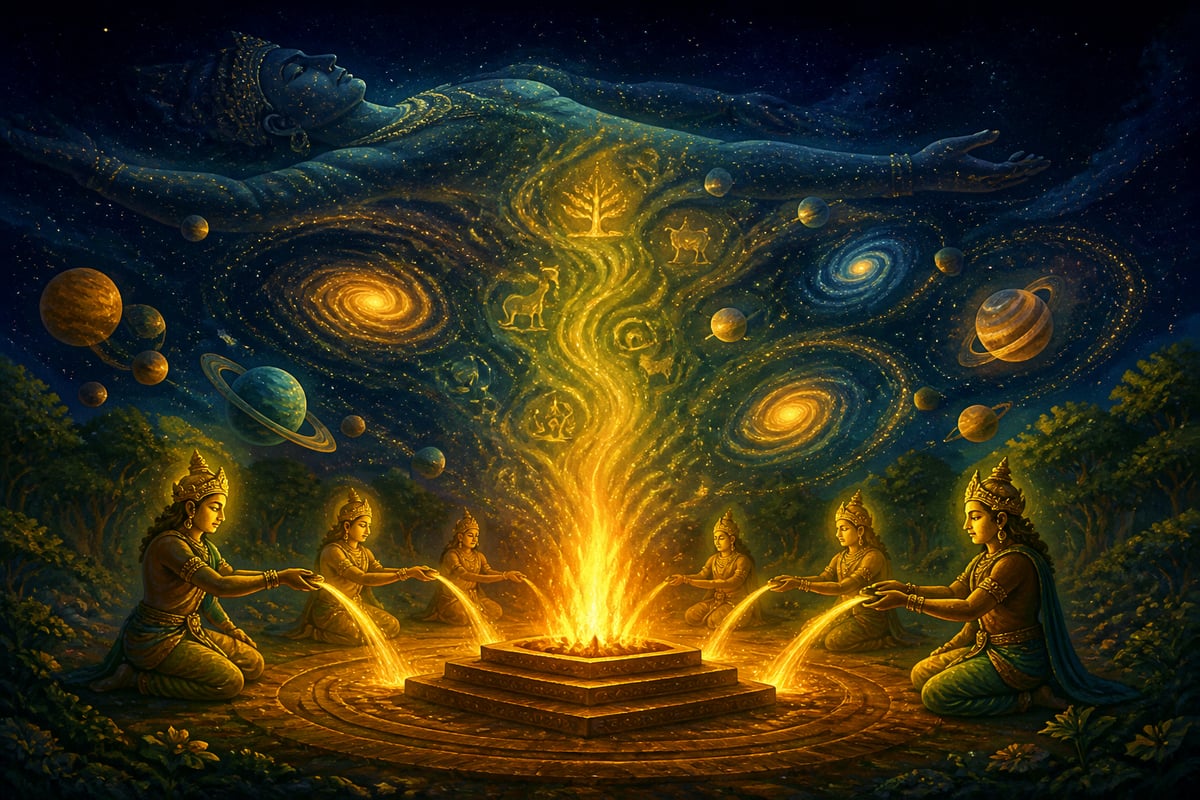
The Purusha Sukta (RV 10.90) takes this further, describing the universe itself as emerging from a cosmic yajña:
"यज्ञेन यज्ञमयजन्त देवास्तानि धर्माणि प्रथमान्यासन्" "With yajña the Devas performed yajña; these were the first dharmas."
The circularity is intentional: yajña creates yajña. The first act of creation was a collective offering. Dharma itself, the order that holds reality together, emerged from ritualized exchange. The Rishis understood that communities are not natural; they are constructed through repeated practice.
Traditional Interpretations
Sayanacharya emphasizes the precision of yajña: specific mantras, specific offerings, specific roles, specific timing. This precision is not mere formalism but technology. Just as a machine requires correct assembly to function, yajña requires correct performance to achieve its effects. The sixteen priests of the soma sacrifice each have irreplaceable roles, the ritual cannot proceed if any is missing.
Sri Aurobindo interprets yajña psychologically. In The Secret of the Veda, he suggests that outer yajña reflects inner sacrifice: the offering of lower impulses to higher purpose, the transformation of selfish desire into collective service. The fire is consciousness; the offering is ego; the rising smoke is aspiration. When a community performs yajña together, they collectively discipline their individual desires toward shared purpose.
Both readings are valid. Yajña is simultaneously outer practice (binding the community) and inner discipline (transforming the individual). The two reinforce each other: communal ritual shapes individual character; shaped individuals sustain communal ritual.
Correcting a Misconception
Colonial-era scholars often dismissed Vedic ritual as 'primitive magic', attempts to manipulate gods through mechanical offerings. This completely misses the social function.
Yajña creates what sociologist Émile Durkheim would later call collective effervescence, the heightened sense of connection that emerges when groups engage in shared, rhythmic, emotionally charged activity. The content of the ritual matters less than its form: repeated, collective, structured, meaningful.
Every successful community develops practices that function like yajña:
- National holidays with shared rituals (parades, feasts, ceremonies)
- Religious gatherings with structured liturgy
- Corporate retreats with team-building exercises
- Sports events with pre-game rituals and shared cheering
These are not superstition. They are social technology. The Rishis developed yajña as a systematic practice for creating and renewing collective bonds. Modern organizations reinvent the same principle, often without recognizing its ancient roots.
Modern Resonance: Demo Day as Yajña

Every year, hundreds of startups gather for Y Combinator's Demo Day. Founders who spent months building in isolation now present to investors, mentors, and fellow founders. The structure is ritualized: each startup gets exactly the same time, follows the same format, presents to the same audience.
This is yajña in Silicon Valley.
The elements map precisely:
- Offering (havis): The founders offer their work, months of effort, distilled into minutes
- Fire (agni): The intense attention of the audience, consuming and transforming the offering
- Priests (ṛtvij): YC partners who structure and mediate the ritual
- Reciprocity (parasparam): Investors offer capital; founders offer equity; both are transformed
- Community binding: Founders who present together form lifelong bonds, the 'batch' becomes identity
Paul Graham, YC's founder, understood intuitively what the Rishis codified: shared ritual creates lasting community. The startups that present together remain connected for decades. The ritual creates a 'we' that transcends individual companies.
Other tech ecosystems have copied the form: TechStars Demo Day, 500 Startups Demo Day, countless accelerator graduation ceremonies. The ritual works because it transforms individual founders into a cohort, a collective identity forged through shared practice.
Adam Grant's research on 'givers' in organizations shows that those who give without immediate expectation of return ultimately outperform 'takers' and 'matchers', but only in cultures that reciprocate. Yajña cultures sustain givers; extractive cultures burn them out.
Companies like Costco and Southwest Airlines create 'yajña cultures', treating employees well generates employee commitment, which generates customer loyalty, which generates profit, which funds employee treatment. The cycle is self-reinforcing.
Yajña is a reinforcing feedback loop: A gives to B, B gives to C, C gives to A, each round strengthening the cycle. In systems terms, it's a 'virtuous cycle' that creates community resilience. The opposite, extraction without return, is a degenerative cycle that eventually exhausts the system.
Research on 'ritual' by Francesca Gino (Harvard) shows that shared rituals reduce anxiety, increase group cohesion, and improve performance, even when participants don't believe in the ritual's meaning. The form matters more than the content.
Successful organizations develop distinctive rituals: Amazon's 'working backwards' memos, Bridgewater's 'radical transparency' meetings, Zappos's culture book. These function as yajña, repeated practices that create and maintain organizational identity.
Rituals are 'community infrastructure', as essential as roads or communication networks. When ritual infrastructure erodes (fewer family dinners, fewer community gatherings), social fabric weakens. Societies invest in physical infrastructure; they should equally invest in ritual infrastructure.
A word of caution as we explore these teachings: Understanding yajña as social technology (not merely religious ritual) reveals its continuing relevance. Every organization needs practices that create collective identity, bind members across time, and establish cycles of reciprocity. The Rishis developed sophisticated solutions that modern institutions reinvent, often less effectively. Studying yajña offers templates for community-building that have been tested for millennia.
Your Path Forward
What rituals bind the communities you belong to? Every family, team, organization, and society has practices that function as yajña, repeated, collective actions that renew bonds and transmit identity across time.
Examine your communities:
- Family: What recurring practices create 'us'? Weekly dinners, annual reunions, birthday rituals?
- Work: What shared practices bind the team? All-hands meetings, project kickoffs, celebration rituals?
- Friendships: What repeated activities maintain connection? Regular calls, annual trips, shared hobbies?
Where ritual is absent, community erodes. Where ritual persists, community endures, even when individuals come and go.
Consider introducing or strengthening one collective ritual this month. It need not be religious. It could be:
- A weekly family dinner with consistent structure
- A team retrospective with predictable format
- A monthly gathering with friends for shared activity
The Rishis knew that community is not automatic, it is practiced into existence. Yajña is the practice.
In the next lesson, we will explore what happens when collective harmony breaks down, and how the Vedic tradition approaches conflict and repair.
Case studies
Demo Day: Silicon Valley's Yajña
Since 2005, Y Combinator has held Demo Day twice yearly, a ritualized gathering where each startup batch presents to investors. The format is precise: each company gets exactly the same time (originally 10 minutes, now 2 minutes), the same stage, the same audience structure. Founders who have been building in isolation for three months now offer their work publicly. Investors who attend become obligated to respond. The event transforms individual startups into a cohort, a collective identity that persists for decades.
Demo Day functions as yajña through its core elements: - **Havis (offering)**: Founders offer their work, months of effort distilled into minutes of presentation - **Agni (fire)**: The intense attention of investors, consuming and evaluating each offering - **Ṛtvij (priests)**: YC partners who structure the ritual, set the format, and mediate between founders and investors - **Paraspara-bhāvana (mutual nourishment)**: Investors offer capital and guidance; founders offer equity and potential; both are transformed - **Bandha-karma (binding practice)**: The 'batch' becomes permanent identity, founders refer to themselves as 'W19' or 'S21' for decades, attending each other's events, investing in each other's companies Paul Graham intuited what the Rishis codified: structured collective offering creates lasting community.
Y Combinator has funded over 4,000 startups with combined valuation exceeding $600 billion. But the numbers miss the deeper outcome: Demo Day created a self-reinforcing community. Alumni help current batch; current batch will help future batches. The yajña cycle continues. Other accelerators have copied the format precisely because the ritual works, it transforms individuals into community.
Collective ritual creates collective identity. The content (startup pitches) could be delivered via video; the ritual (shared offering in structured format) cannot. Demo Day's genius is not the pitches but the gathering, the yajña that makes strangers into 'batch-mates' for life.
Startup accelerators (Techstars, 500 Startups), MBA cohort models, and even military boot camps all use the same formula: shared intense experience in structured format creates bonds that outlast the program. Alumni networks are most valuable when built through collective ritual, not just shared credential.
YC batch alumni invest in each other's companies at 3x the rate of random startup connections. The ritual creates bonds that persist into the most material form: capital commitment.
Rath Yatra: Collective Ritual at Civilizational Scale
Every year since at least the 12th century, millions gather in Puri for the Rath Yatra, the chariot festival of Jagannath. Three massive chariots, each requiring thousands of devotees to pull, carry the deities through the streets. The ritual is remarkably democratic: during the yatra, caste distinctions are suspended; anyone can help pull the ropes. Kings have historically swept the road before the chariots alongside commoners. The ritual creates, for its duration, a community of equals united in shared physical effort.
The Rath Yatra embodies yajña principles at scale: - **Collective havis**: The physical effort of pulling the massive chariots is the offering, devotees literally give their strength - **Paraspara-bhāvana**: Devotees offer effort; the deity offers darshan (sacred viewing); both are transformed - **Temporal binding**: Families have pulled the same ropes for centuries; children watch parents and grandparents; the ritual connects generations - **Identity creation**: Participants become 'those who pulled the rath', a collective identity that transcends caste, region, and even religion (non-Hindu visitors sometimes join) The chariots could theoretically be pulled by machines or elephants. The point is not efficiency but participation, the collective physical act creates collective identity.
The Rath Yatra has continued unbroken for over 800 years, surviving political upheavals, foreign invasions, and natural disasters. It has spread globally, Rath Yatras now occur in London, New York, and dozens of other cities. The English word 'juggernaut' (unstoppable force) derives from 'Jagannath', the ritual became synonymous with irresistible collective movement.
The most resilient collective rituals involve physical participation, temporary equality, and multi-generational transmission. The Rath Yatra has all three, which is why it has outlasted empires that tried to suppress it.
Community marathons, pride parades, and protest marches all demonstrate the same principle: physical participation in collective movement creates solidarity that no amount of online engagement can match. Social movements that include embodied collective action consistently build stronger and more durable coalitions than those that remain purely digital.
The Puri Rath Yatra draws 1-2 million pilgrims annually. Each chariot stands 45 feet tall and requires 4,200 meters of rope and the collective effort of thousands to pull. The festival has continued unbroken for over 800 years, making it one of the world's oldest continuously observed public rituals.
Reflection
- What rituals bind your family or closest community? Have any been lost in recent generations? What effect has that loss had on cohesion?
- The Purusha Sukta says 'with yajña the Devas performed yajña', creation itself was ritual. What might it mean that community requires practice to come into existence, rather than forming naturally?
- If the form of ritual matters more than its content (as research suggests), what distinguishes meaningful ritual from empty formalism? When does practice create community, and when is it mere routine?