Tāla: Shared Rhythms
How Rhythm Creates Alignment Faster Than Words
The Rishis discovered that groups synchronize through shared rhythm more effectively than through verbal agreement. From the dawn fire ritual to the cosmic cycles of seasons, tāla, the underlying beat of collective life, creates alignment at a level deeper than thought. This lesson explores how rhythm becomes the invisible infrastructure of community.
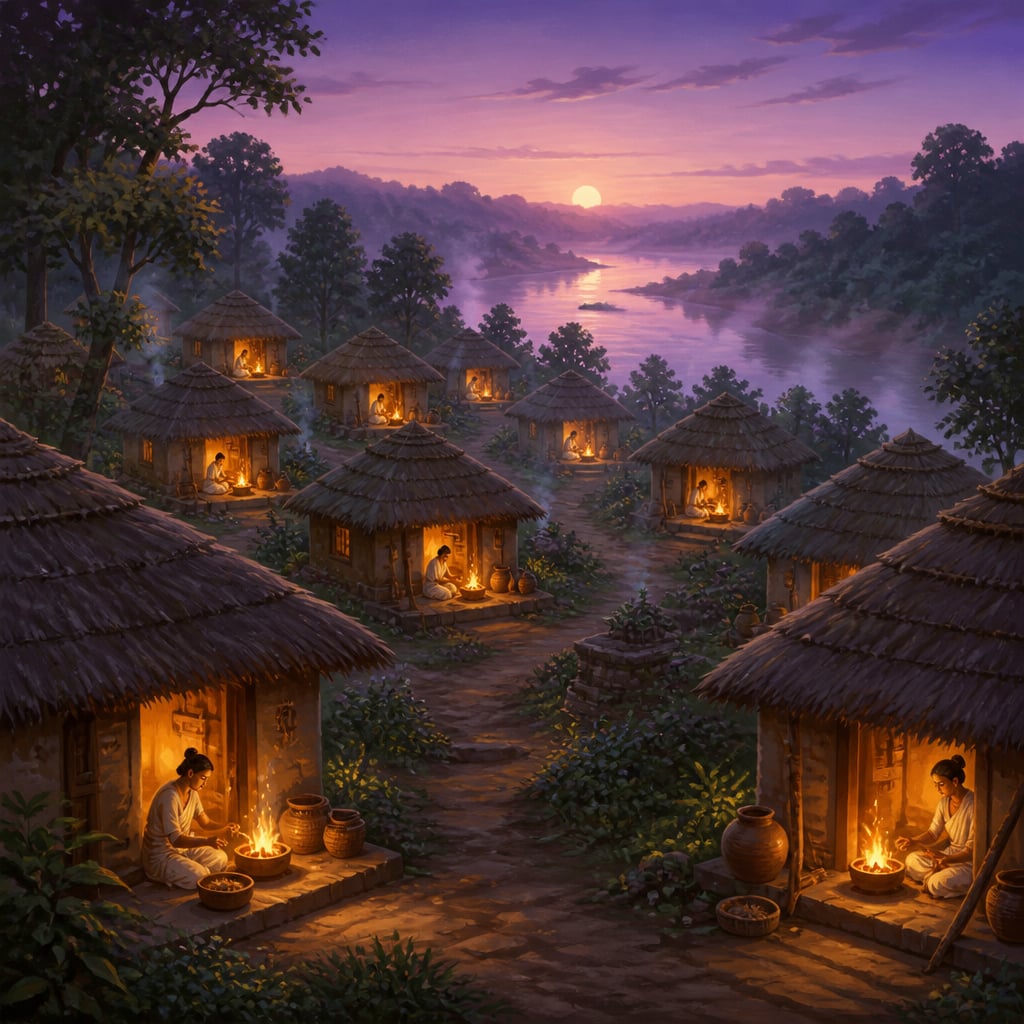
Before the first light touched the horizon, fires sparked across the settlement, not one after another, but simultaneously. A dozen priests, separated by hundreds of paces, acted as one. They shared no signal, no shout across the darkness. They shared something more precise: rhythm. Each had counted the same stars, tracked the same slow wheel of the night sky, felt the same interval building toward dawn. When the moment came, they moved together, not because they had agreed, but because they had synchronized. The Rishis called this invisible beat tāla: the pulse that makes the many move as one.
The Discovery of Collective Rhythm
In the previous lesson, we explored why collective action matters, the power that emerges when individuals align. But how does alignment actually happen? Verbal agreement is slow, fragile, and limited by language. The Rishis discovered something more fundamental: shared rhythm synchronizes faster and deeper than shared words.
This insight pervades the Rig Veda. The hymns are not prose but chandas, metered verse, built on rhythmic patterns. The rituals are not random sequences but precisely timed, coordinated by celestial rhythms. Even the cosmos itself is described as a great wheel (cakra) turning in eternal cycle.
The famous verse from the Asya Vāmasya Sūkta declares:
"द्वादशारं नहि तज्जराय वर्वर्ति चक्रं परि द्यामृतस्य" "The twelve-spoked wheel of cosmic order turns unceasingly around the heavens."
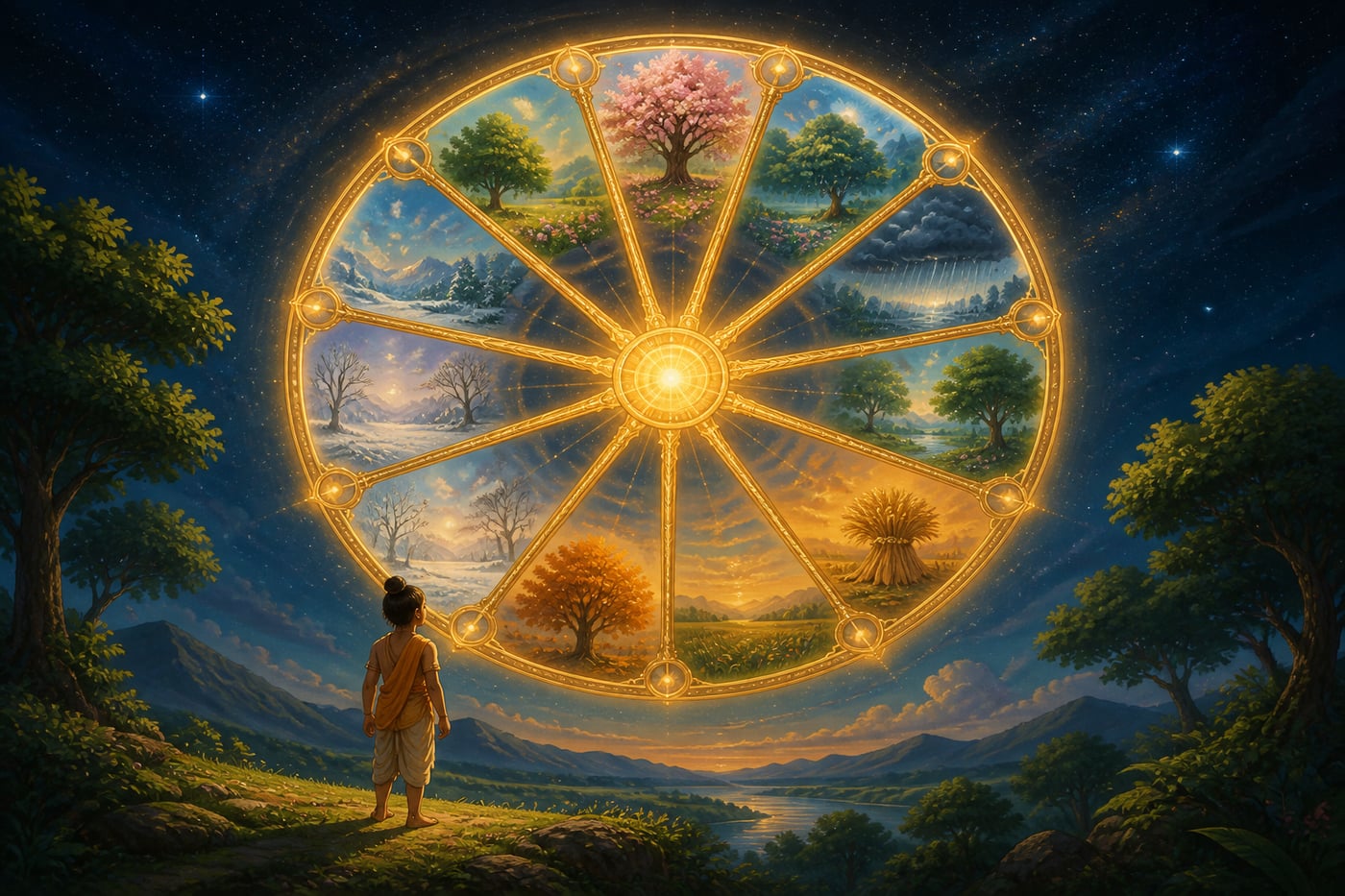
The twelve spokes are the months; the wheel is time itself. But the deeper teaching is this: everything that exists participates in this cosmic rhythm. The sun rises and sets. Seasons turn. Rivers swell and recede. To align with cosmic order (Ṛta) is to align with its rhythm.
What the Mantras Reveal
The Rig Veda's emphasis on rhythm appears in its very structure. Consider the Gāyatrī meter, three lines of eight syllables each, the most sacred rhythmic pattern:
"तत्सवितुर्वरेण्यं भर्गो देवस्य धीमहि धियो यो नः प्रचोदयात्" "We meditate on the glorious light of the divine Savitṛ; may it inspire our thoughts."
The content is profound, but the form is equally important. The Gāyatrī meter creates a specific rhythmic pulse, 8-8-8, that the chanter embodies. When thousands chant together in this meter, they don't just think the same thought; they breathe the same rhythm, pulse the same beat.
Word by word, the verse reveals its rhythmic teaching:
- Tat (that), the cosmic reality
- Savituḥ (of Savitṛ, the sun), the celestial timekeeper
- Vareṇyam (most excellent), worthy of alignment
- Dhīmahi (may we meditate), the practice of attunement
The sun is not just light; it is the master rhythm that all earthly rhythms follow. To meditate on Savitṛ is to align oneself with the cosmic beat.
Another verse explicitly connects rhythm to collective harmony:
"समानी प्रपा सह वो अन्नभागः समाने योक्त्रे सह वो युनज्मि" "Common be your water, common your food share; I yoke you together in a common bond."
The word samāne yoktre (in a common yoke) evokes oxen pulling together, which only works if they walk in rhythm. The yoke is not just physical connection but rhythmic coordination.
Traditional Interpretations
Sayanacharya emphasizes the practical dimensions of Vedic rhythm. He notes that ritual timing was precise to the muhūrta (48-minute period), with specific rituals for dawn (prātaḥ), midday (madhyāhna), and dusk (sāyam). This wasn't arbitrary scheduling but alignment with cosmic rhythms. The Agnihotra (fire offering) at dawn and dusk synchronizes human action with the sun's rhythm.
Sri Aurobindo reads deeper. In The Secret of the Veda, he suggests that rhythm operates at the level of consciousness itself. When groups share rhythm, their citta (mind-stuff) begins to oscillate together, creating a collective mental field. This explains why chanting in groups produces effects different from solitary practice, the synchronized rhythm creates a shared consciousness.
Neuroscience is now confirming this. Research on group drumming and chanting shows that participants' brainwaves begin to synchronize, a phenomenon called "neural entrainment." The Rishis discovered through practice what modern science measures with EEG.
Correcting a Misconception
Modern efficiency thinking often treats rhythm as constraint, the assembly line's mechanical repetition, the punishing pace of quotas. This reduces rhythm to mere timing, ignoring its deeper function.
The Vedic understanding is different. Tāla is not imposed from outside but emerges from within. The twelve-spoked wheel turns because of cosmic order (Ṛta), not because a manager decreed it. When humans align with natural rhythms, sleep with night, activity with day, rest with seasons, they experience not constraint but flow.
The difference is crucial:
- Imposed timing: Mechanical, exhausting, dehumanizing
- Shared rhythm: Organic, energizing, connecting
The Rishis did not schedule rituals by clock but by celestial observation, aligning human rhythm with cosmic rhythm rather than against it.
Modern Resonance: Kumbh Mela's Impossible Coordination
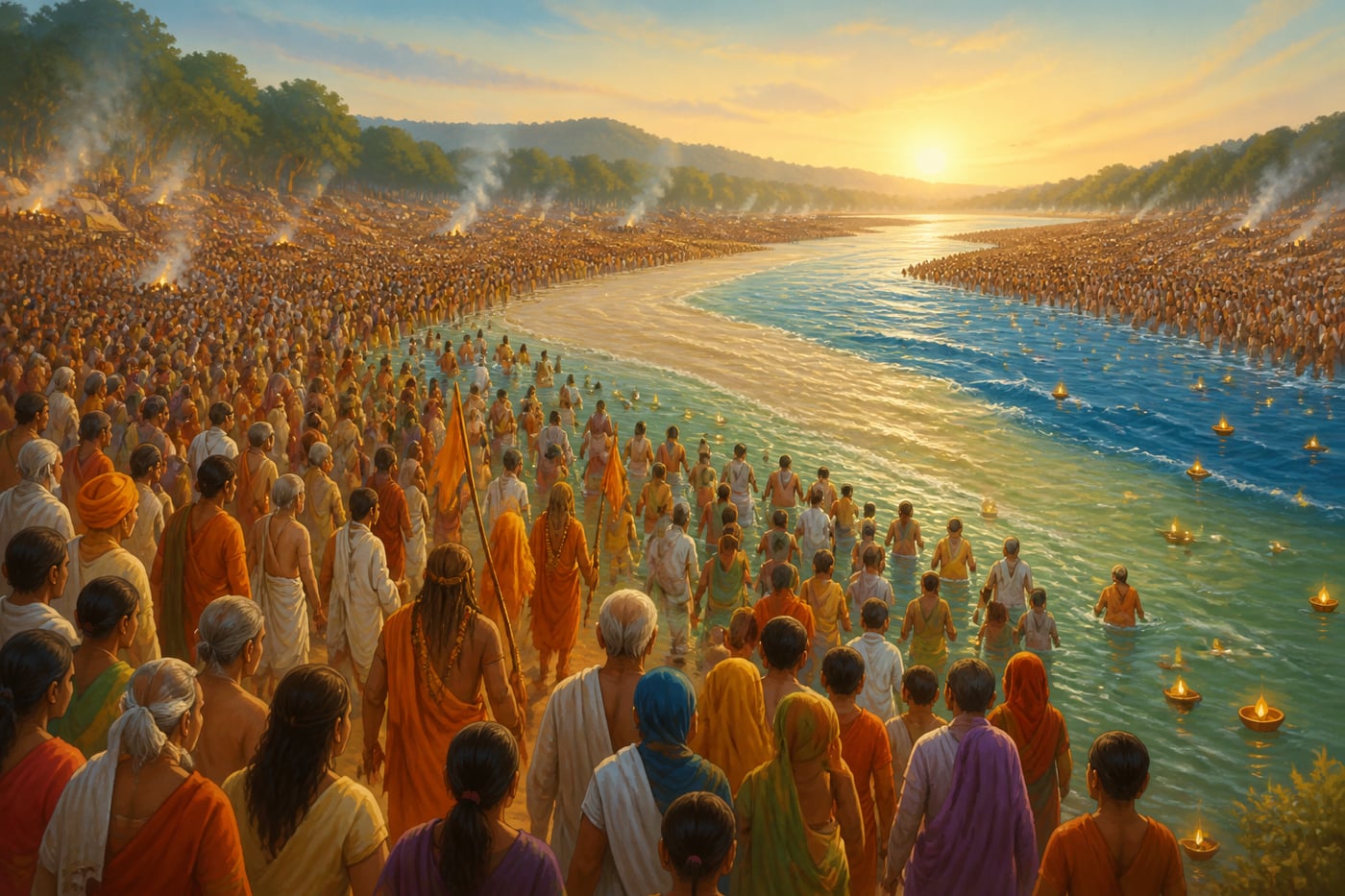
Every twelve years, the Kumbh Mela draws over 200 million pilgrims to the confluence of sacred rivers. In 2019, 50 million people bathed at Prayagraj on a single day, Mauni Amavasya. How does such a gathering avoid catastrophe? There is no single command center, no central planner directing 200 million individuals.
The answer is shared rhythm.
The Kumbh operates on nested rhythmic cycles:
- Cosmic rhythm: The mela occurs when Jupiter enters specific zodiac positions, celestial timing that repeats every 12 years
- Daily rhythm: Specific akharas (monastic orders) have designated bathing slots, creating a predictable flow
- Hourly rhythm: Within each slot, sub-groups move in waves, self-organizing through implicit timing
- Social rhythm: Families, villages, and communities move together, their internal rhythms nested within larger patterns
No central authority could coordinate 200 million people. But shared rhythm makes it possible. Pilgrims know when to move not because someone tells them but because they've internalized the pattern. This is tāla at civilizational scale, the same principle the Rishis applied to sixteen priests performing yajna.
The Kumbh proves that very large groups can coordinate effectively without hierarchy, but only when they share rhythm.
Research on 'behavioral synchrony' (Hove & Risen, 2009) shows that people who move in rhythm together report feeling more connected and cooperate more effectively afterward. The body's synchronization creates psychological bonding.
Military units march in step, choirs rehearse in time, and successful teams develop shared rhythms. Jeff Bezos's 'two-pizza teams' at Amazon meet at consistent times, rhythm precedes agenda.
Complex systems self-organize around rhythms. Traffic flows, market cycles, and ecosystem dynamics all exhibit rhythmic patterns. Organizations that align with natural rhythms (quarterly cycles, daily standups) outperform those with chaotic scheduling.
Circadian rhythm research shows that humans have nested biological clocks: ultradian rhythms (90-minute cycles) within circadian rhythms (24-hour cycles) within infradian rhythms (monthly, seasonal). Disrupting any level affects the others.
Effective organizations have nested rhythms: daily standups within weekly sprints within quarterly planning within annual cycles. Each level coordinates its scope; alignment between levels creates coherence. The Kumbh Mela operates exactly this way.
Panarchy theory in ecology describes how ecosystems operate across scales, fast dynamics nested within slow dynamics. Stable systems maintain alignment across scales. When rhythms at different scales conflict, the system destabilizes.
A word of caution as we explore these teachings: Understanding Vedic rhythmic practice reveals an alternative to hierarchical coordination. Modern organizations often assume that coordination requires command. The Rishis demonstrated that shared rhythm enables coordination at scale without authority, a model increasingly relevant as organizations become more distributed and less hierarchical. The principles underlying Kumbh Mela, temple drums, and Vedic ritual offer templates for coordination in a networked age.
Your Path Forward
The Rishis embedded rhythm into daily life: the Sandhyā prayers at dawn, noon, and dusk; the seasonal festivals; the weekly fasts. These weren't arbitrary rules but synchronization practices, ways of keeping individual rhythms aligned with cosmic and community rhythms.
This week, notice the rhythms you already share:
- Does your family eat together at consistent times?
- Does your team have regular check-ins, or is scheduling chaotic?
- Do you have practices that align you with natural rhythms, morning sunlight, evening wind-down?
Where rhythm is shared, coordination becomes effortless. Where rhythm is absent, every interaction requires negotiation.
Consider introducing one shared rhythm into a group you belong to. It could be as simple as a standing weekly call at the same time, or a daily check-in ritual. Watch how quickly alignment improves when rhythm is established.
In the next lesson, we will explore the most powerful rhythmic practice the Rishis developed: collective ritual, how structured, repeated actions create bonds that endure across generations.
Case studies
Kumbh Mela: 200 Million Pilgrims, No Central Command
The 2019 Kumbh Mela at Prayagraj drew over 240 million pilgrims across 49 days. On the peak bathing day (Mauni Amavasya), over 50 million people converged on the Sangam, the confluence of the Ganga, Yamuna, and mythical Saraswati. By any conventional analysis, this gathering should be a logistical nightmare. There is no single organizer, no central command center, no authority directing 240 million individuals. Yet the mela operates with remarkable order.
The Kumbh demonstrates nested rhythms (samavāya-tāla) at civilizational scale: - **12-year cosmic rhythm**: The mela occurs when Jupiter enters Aquarius, an astronomical cycle that repeats precisely. Millions know the pattern. - **Daily rhythm**: Each of the 13 akharas (monastic orders) has designated bathing times. Naga sadhus bathe at dawn; Vaishnava akharas follow. The pattern is known for centuries. - **Sectoral rhythm**: Within each time slot, different groups (by region, lineage, village) have implicit ordering. First-timers follow elders who know the pattern. - **Family rhythm**: Individual families move in small clusters, their internal rhythm nested within larger patterns. No central authority coordinates 240 million people. Shared rhythm makes coordination possible, each person internalizes the pattern and moves accordingly.
Despite its scale, the 2019 Kumbh recorded remarkably few incidents. The mela generated ₹1.2 lakh crore in economic activity and employed 700,000 people in temporary infrastructure. UNESCO recognized Kumbh Mela as an Intangible Cultural Heritage of Humanity, noting its self-organizing character.
Very large groups can coordinate without hierarchy when they share rhythm. The Kumbh's 'infrastructure' is not primarily physical but rhythmic, patterns internalized across generations, allowing millions to move as one.
Music festivals like Burning Man, sports events like the Indian Premier League, and religious gatherings like the Hajj all demonstrate that shared rhythm enables mass coordination without proportional increases in control infrastructure. Event designers who build rhythmic structure into large gatherings consistently report fewer incidents than those who rely primarily on security personnel.
The 2019 Kumbh deployed only 30,000 police for 240 million visitors, a ratio of 1:8,000. By comparison, New Year's Eve in New York deploys 1 officer per 30 attendees. Shared rhythm reduces the need for external control.
Temple Drums: The Rhythm of Civilizational Coordination
Before mechanical clocks, how did Indian villages coordinate daily life? The answer reverberates in temple drums. The *nagara* (large temple drum) and *mridanga* were not merely musical instruments but communication systems. Specific rhythmic patterns signaled different events: dawn prayers, noon break, danger approaching, festival beginning, funeral procession.
Temple drums embodied the Vedic understanding that rhythm coordinates faster than words: - **Standardized patterns**: Each signal had a recognized rhythm, farmers in distant fields knew by the beat what was happening in the village - **Nested in cosmic rhythm**: The drum patterns aligned with solar position, dawn drums, noon drums, dusk drums synchronized village life with celestial rhythm - **Collective entrainment**: Hearing the same drum, villagers entrained to the same beat, their actions coordinated not by command but by shared pulse The temple was the rhythmic center of the village, its drums the heartbeat of collective life. The priest who beat the drum was not giving orders but providing rhythm, enabling coordination without hierarchy.
This system coordinated agricultural societies across India for millennia. Farmers knew when to pause, when to gather, when to prepare for worship, all through rhythmic signals that required no literacy, no common language, no central authority. The system was resilient: even when political power changed, temple rhythms continued.
Rhythm is the original wireless communication, carrying coordination across distance without wires or words. The Rishis understood that shared beat creates shared action.
Shared temporal rhythms still coordinate modern life, from the school bell to the market opening, from the call to prayer to the factory whistle. The shift to remote work revealed how much office life depended on shared rhythmic cues. Teams that replaced physical co-presence with deliberate shared rhythms (daily video standups, synchronized focus hours) maintained cohesion better than those that went fully asynchronous.
Temple drum systems coordinated villages across distances of 5-10 km without any written schedule. The Thanjavur Brihadeeswara Temple maintained a daily rhythm of 6 drum sequences marking prayer times, market hours, and agricultural work shifts for over 1,000 years.
Reflection
- What shared rhythms hold your family or team together? Regular meals, weekly meetings, annual gatherings? Where is rhythm strong, and where has it broken down?
- The Rishis aligned human rhythm with cosmic rhythm, dawn prayers with sunrise, festivals with seasons. How aligned is your daily rhythm with natural cycles? Do you live with the sun or against it?
- If rhythm coordinates more effectively than verbal agreement, what does this suggest about the nature of collective consciousness? Is there a level of connection that operates below conscious thought?