Svadharma: Belonging Without Conformity
How Individuals Flourish Within Collective Life
The Vedic tradition does not demand uniformity, it recognizes that the collective is strengthened by diversity of roles, perspectives, and gifts. Svadharma (one's own path) is not opposed to saṅgha (collective) but essential to it. This lesson explores how individuals maintain authentic expression while fully participating in community.
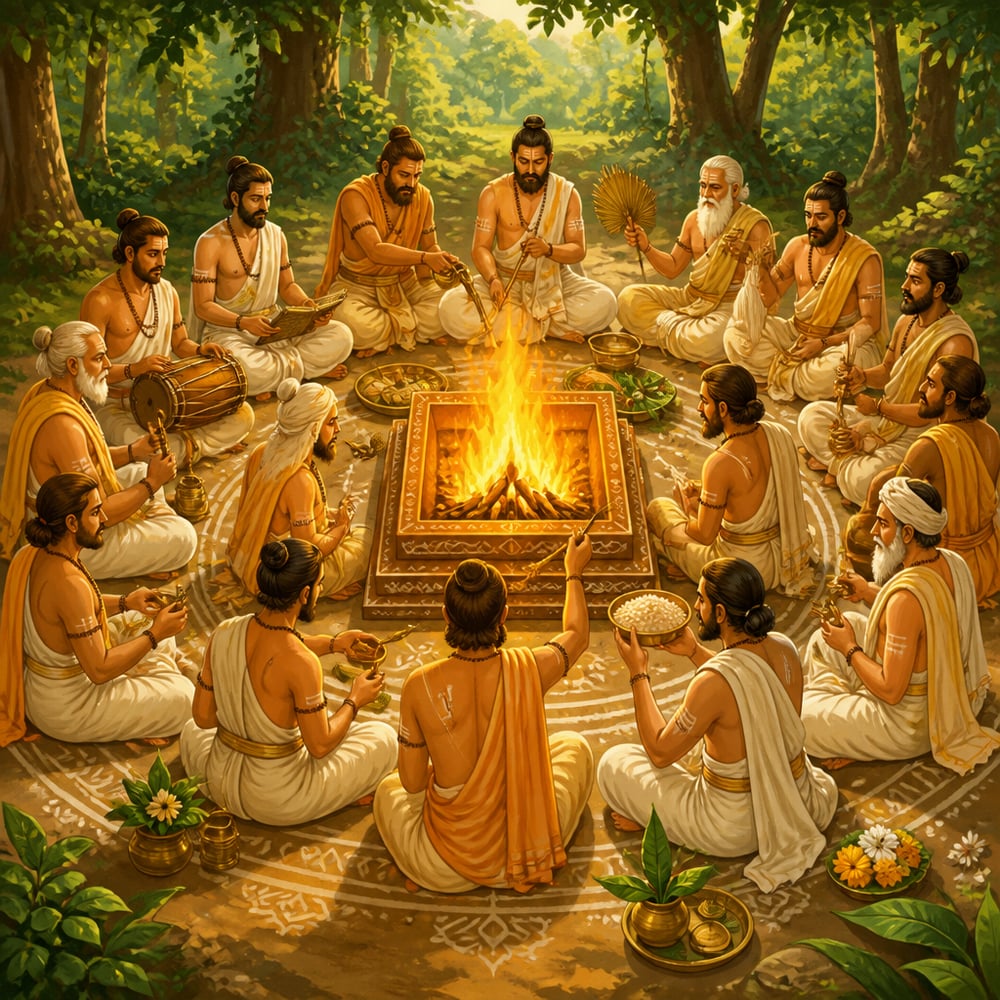
Sixteen priests stood around the fire, but no two performed the same action. The hotri chanted mantras while the adhvaryu measured the soma. The udgatri sang melodies while the brahman watched in silence, ready to correct any error. Each had different training, different skills, different voices, yet together they created what none could create alone. The yajna did not demand they become the same. It demanded they become more fully themselves. The collective needed not sixteen identical priests but sixteen distinct excellences, each contributing what only they could contribute. This is the Vedic wisdom of svadharma: your path is yours, and the collective needs precisely that.
The False Dilemma
Modern thinking often presents a stark choice: conform to the group or assert your individuality against it. Be a team player or be authentic. Belong or be yourself.
The Vedic tradition dissolves this false dilemma. Svadharma, one's own dharma, one's unique path, is not opposed to collective participation. It is what makes collective participation valuable. A yajna with sixteen identical priests would be sixteen times redundant. A yajna with sixteen distinct specialists creates emergent power no individual could access.
The Bhagavad Gita makes this explicit:
"श्रेयान्स्वधर्मो विगुणः परधर्मात्स्वनुष्ठितात्। स्वधर्मे निधनं श्रेयः परधर्मो भयावहः॥" "Better is one's own dharma, though imperfectly performed, than the dharma of another well performed. Better is death in one's own dharma; the dharma of another is fraught with danger."
This is not individualism, 'do whatever you want.' It is recognition that the collective needs your particular gift, not a pale imitation of someone else's. When you abandon svadharma to conform, you don't strengthen the collective, you weaken it by removing what only you could contribute.
What the Mantras Reveal
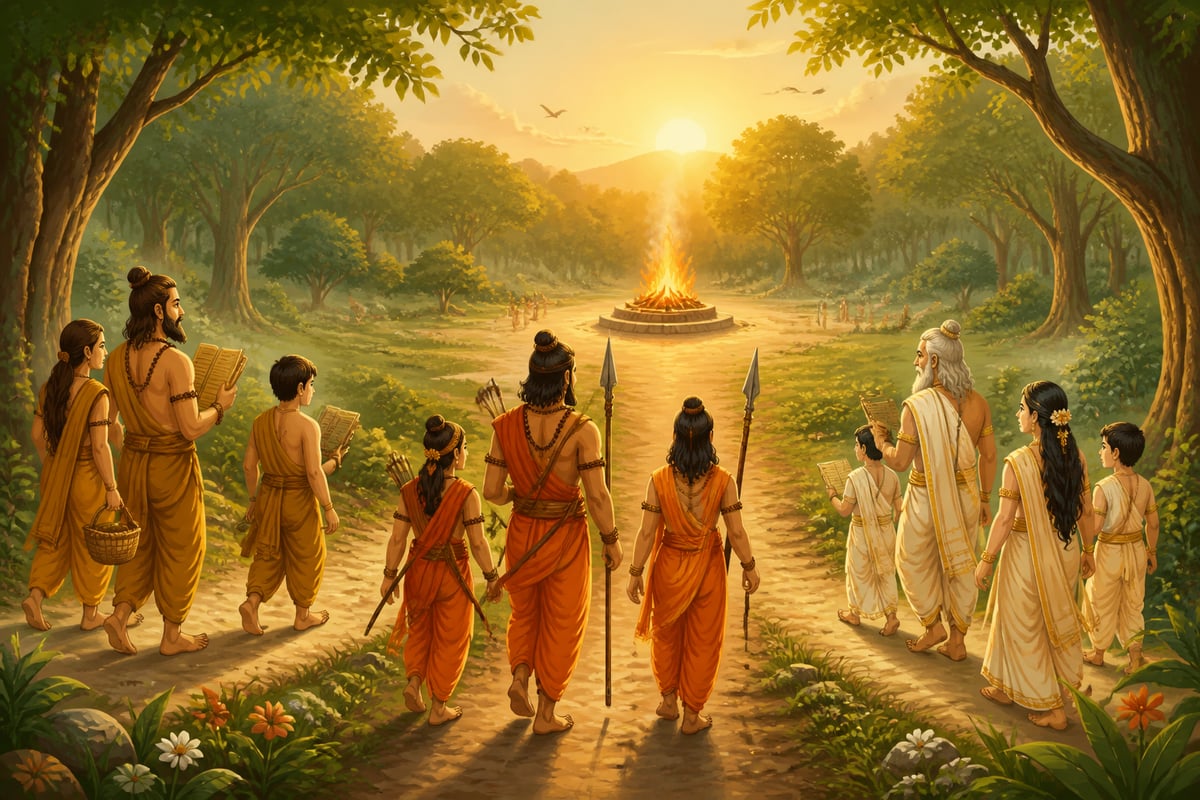
The Rig Veda itself demonstrates svadharma in its very composition. The hymns come from different Rishi families, Vasiṣṭhas, Viśvāmitras, Bharadvājas, Atris, each with distinct styles, emphases, and approaches. The Veda doesn't homogenize these voices; it preserves their distinctiveness while collecting them into a unified whole.
Consider the different approaches to Agni:
- The Vasiṣṭhas emphasize Agni's priestly role
- The Viśvāmitras highlight Agni's protective power
- The Bharadvājas focus on Agni's cosmic dimensions
All are speaking of the same fire, yet each family's svadharma, their particular angle of vision, adds something the others don't. The Veda is richer for this diversity.
The Gita elaborates further:
"स्वे स्वे कर्मण्यभिरतः संसिद्धिं लभते नरः" "Each person, devoted to their own work, attains perfection."
Word by word:
- Sve sve, in one's own, in one's own (emphatic repetition)
- Karmaṇi, in work, in action
- Abhirataḥ, engaged, devoted, delighting in
- Saṃsiddhim, perfection, complete success
- Labhate, obtains, achieves
- Naraḥ, a person
The path to perfection is not through conforming to another's work but through delighting in your own. The word abhirata suggests not mere duty but genuine engagement, finding joy in the work that is authentically yours.
Traditional Interpretations
Sayanacharya interprets svadharma practically. The sixteen priests of the soma yajna each have specific training and specific roles. The hotri cannot perform the adhvaryu's functions, nor vice versa. Attempting to do so would ruin the ritual. The collective works precisely because each member stays in their lane while coordinating with others.
Sri Aurobindo reads deeper. In Essays on the Gita, he suggests that svadharma is not merely social role but soul-expression, the unique way each consciousness manifests the divine. When you find and follow your svadharma, you're not just filling a function; you're expressing something of ultimate reality that only you can express. The collective is enriched not by conformity but by this multiplicity of expressions.
Both readings matter. Practically, collectives need diverse specialists who excel in their domains. Spiritually, the universe expresses itself through irreducible individual perspectives. In either case, conformity diminishes rather than strengthens the whole.
Correcting a Misconception
Svadharma is sometimes misread as rigid birth-role prescription, 'stay in the work you inherited.' This is a distortion. The deeper teaching is about authentic expression, not social immobility.
The Gita's context is revealing: Arjuna's svadharma is to fight, but this isn't because he was born Kshatriya. It's because fighting (in this specific situation) is what his deepest nature calls him to do, what the situation demands, and what his training has prepared him for. Svadharma is found at the intersection of:
- Svabhāva (inherent nature): What are you genuinely drawn to?
- Adhikāra (qualification): What are you capable of?
- Kāla (time/context): What does this moment require?
A person's svadharma may evolve as they develop. The student's svadharma differs from the householder's, which differs from the renunciate's. Svadharma is not static assignment but dynamic alignment with what you are genuinely called to contribute.
Modern Resonance: Pixar's Creative Collective

Pixar Animation Studios has produced some of the most successful and critically acclaimed films in history, Toy Story, Finding Nemo, Inside Out, Coco. Their creative process embodies svadharma within saṅgha.
The Braintrust Model: Pixar's central creative institution is the 'Braintrust', a group of senior directors and storytellers who review films in development. The Braintrust embodies collective wisdom, but with a crucial principle: feedback is given, but the director decides.
Ed Catmull, Pixar's co-founder, explains: "The Braintrust has no authority. The director does not have to follow any of the suggestions." This protects svadharma, the director's unique vision, while still benefiting from collective wisdom.
How It Maps to Vedic Principles:
- Svadharma protected: Each director has their own vision, style, and approach. Pete Docter's films (Up, Inside Out) feel different from Brad Bird's (The Incredibles, Ratatouille). Pixar doesn't homogenize.
- Saṅgha engaged: Directors actively seek Braintrust feedback. The collective identifies problems the individual might miss. But the collective serves the individual vision, not the reverse.
- Diversity as strength: Pixar deliberately cultivates different voices. Their films about robots (WALL-E), emotions (Inside Out), and Mexican culture (Coco) come from directors with different backgrounds and sensibilities.
The result: films that are both intensely personal (expressing a director's svadharma) and collectively refined (benefiting from saṅgha wisdom).
Mihaly Csikszentmihalyi's research on 'flow' shows that people perform best and feel most alive when engaged in activities matching their skills and interests. This is abhirata, the absorption that comes from aligned action. The Gita anticipated flow psychology by millennia.
Marcus Buckingham's strengths-based management research shows that teams perform better when members work in their areas of strength rather than constantly addressing weaknesses. This is organizational svadharma, each person contributing their best.
Requisite variety in systems theory: a system needs internal diversity to match the complexity of its environment. Organizations of uniform members cannot adapt to varied challenges. Svadharma diversity creates adaptive capacity.
Research on 'authenticity' in organizations (by Adam Grant and others) shows that people who express their genuine selves at work report higher satisfaction and perform better. The cost of 'covering', hiding authentic traits to conform, is measurable in engagement and productivity.
The Pixar Braintrust model explicitly protects director vision: feedback is given, but the director decides. This ensures collective wisdom serves individual vision rather than homogenizing it. The result is films that are both personal and refined.
Monocultures are fragile. Whether in agriculture, finance, or organizations, systems with low diversity are vulnerable to shocks. Diversity, including diversity of perspective and approach, creates resilience.
A word of caution as we explore these teachings: Modern organizations struggle with the individuality-conformity tension. Either they demand conformity (losing creative distinctiveness) or they celebrate individuality without integration (losing collective coherence). The Vedic model offers a third way: harmonized diversity, where distinct contributions are coordinated toward shared purpose. This is the path to both individual fulfillment and collective excellence.
Your Path Forward
The challenge of svadharma within saṅgha is personal: How do you maintain authentic expression while genuinely participating in collective life? The answer is not to choose one over the other but to find where they reinforce each other.
This week, reflect on these questions:
- What is your svadharma in the collectives you belong to? What do you contribute that others cannot? Where is your genuine engagement, not just your compliance?
- Where have you abandoned svadharma for conformity? Are there places where you've suppressed your authentic contribution to fit in? What has the collective lost?
- Where have you used 'authenticity' to avoid collective responsibility? Svadharma is not excuse for non-participation. It's a specific contribution to a larger whole.
The Rishis knew that collectives don't need uniformity, they need harmonized diversity. The yajna works not despite having sixteen different priests but because of it. Your svadharma is your gift to the collective. Finding it, developing it, and offering it is the path to belonging without conformity.
In the next lesson, we will explore how to sustain communities across time, the practices and institutions that allow collectives to persist beyond any individual member.
Case studies
Pixar's Braintrust: Protecting Vision Within Collective
Pixar Animation Studios has produced an unprecedented string of creative and commercial successes: *Toy Story*, *Finding Nemo*, *The Incredibles*, *Up*, *Inside Out*, *Coco*. Their creative process is intensely collaborative, yet each film bears a distinct creative vision. How does Pixar balance collective wisdom with individual voice?
Pixar's 'Braintrust' embodies svadharma within saṅgha: **Svadharma Protected:** - Each director has their unique vision and style. Pete Docter's emotional depth differs from Brad Bird's action precision differs from Lee Unkrich's narrative complexity. - The Braintrust rule: 'The director does not have to follow any suggestions.' This protects svadharma even when the collective disagrees. - Pixar actively cultivates different voices, they don't want directors who all make the same film. **Saṅgha Engaged:** - Directors actively seek Braintrust feedback. They *want* the collective's input. - The collective often sees problems the individual cannot. Ego is subordinated to the work. - But the collective serves the director's vision, it doesn't replace it. **Harmonized Diversity:** - Pixar's films share production quality but not creative voice. - The studio's strength is precisely this diversity within shared commitment to excellence. - They've explicitly rejected the 'house style' that homogenizes other studios.
Pixar's films have grossed over $14 billion worldwide and won 23 Academy Awards. More significantly, they've maintained creative distinctiveness across decades. Each film feels like a personal statement, yet each benefits from collective refinement. The model proves that svadharma and saṅgha reinforce each other.
The highest creative achievement comes not from suppressing individual vision for group consensus, nor from ignoring collective wisdom for individual ego, but from their integration. The Braintrust serves the director; the director welcomes the Braintrust. This is harmonized diversity.
The most innovative companies, from Apple under Steve Jobs to Bridgewater Associates under Ray Dalio, maintain a version of this balance: strong individual vision subjected to rigorous collective feedback. Organizations that tip too far toward consensus produce mediocrity; those that tip too far toward individual authority produce blind spots. The sweet spot is structured creative tension.
Pixar's first 21 films averaged 89% on Rotten Tomatoes and $620 million worldwide. No other studio maintains both critical and commercial success at this level. The svadharma-saṅgha balance produces results individual genius or committee thinking cannot.
Shivaji's Ashta Pradhan: Eight Paths, One Kingdom
When Chhatrapati Shivaji Maharaj established the Maratha Empire in the 17th century, he faced a governance challenge: how to administer a growing kingdom efficiently while preventing any single minister from accumulating excessive power. His solution, the Ashta Pradhan (Council of Eight), embodied svadharma within collective governance.
The Ashta Pradhan demonstrates harmonized diversity in governance: **Eight Distinct Svadharmas:** 1. **Peshwa** (Prime Minister): Overall administration and affairs of state 2. **Amatya** (Finance Minister): Revenue and accounting 3. **Mantri** (Home Affairs): Correspondence and record-keeping 4. **Sachiv** (Royal Secretary): Drafting royal correspondence 5. **Sumant** (Foreign Affairs): Diplomatic relations 6. **Senapati** (Military Commander): Army and defense 7. **Nyayadhish** (Chief Justice): Legal and judicial matters 8. **Panditrao** (Religious Affairs): Spiritual guidance and religious matters Each position had clear adhikāra (qualification), specific expertise required for the role. Ministers excelled in their domains rather than being generalists. **Collective Governance:** - No single minister could dominate; each had distinct jurisdiction - Major decisions required collective deliberation - The king (Shivaji) coordinated but didn't micromanage **Dynamic Balance:** - Individual excellence within role (svadharma) - Coordination across roles (saṅgha) - Shared commitment to the kingdom's welfare (dharma)
The Ashta Pradhan system enabled the Maratha Empire to expand rapidly while maintaining administrative coherence. The separation of powers prevented tyranny; the integration of specialists enabled competence. The system outlasted Shivaji, continuing through the Peshwa era for over a century.
Effective governance requires both distinct expertise (svadharma) and collective coordination (saṅgha). The Ashta Pradhan avoided both extremes: centralized autocracy (where one person decides everything) and diffuse chaos (where no one coordinates). Eight distinct paths, one unified purpose.
Modern corporate governance faces the identical challenge: how to distribute authority across specialized functions (finance, operations, marketing, technology) while maintaining unified strategic direction. Companies with clear functional ownership and strong cross-functional coordination consistently outperform those with either siloed departments or centralized decision-making.
Shivaji's Ashta Pradhan (Council of Eight) divided governance into 8 specialized ministries, from finance (Amatya) to foreign affairs (Sumant). This distributed structure enabled the Maratha Empire to administer a territory spanning 4.1% of the world's total land area at its peak.
Reflection
- In the collectives you belong to (family, work, community), what is your unique contribution, the gift only you can offer? Where have you suppressed this to conform?
- The Gita says following svadharma, even imperfectly, is better than perfectly performing another's dharma. What does it mean that your 'imperfect' authentic expression is more valuable than perfect imitation?
- If collectives are strengthened by diversity (not uniformity), what are the limits? When does 'diversity' become fragmentation? What holds the different svadharmas together into a coherent saṅgha?