Paripālana: Sustaining Communities
How Collectives Persist Across Generations
Communities are born, but they must be sustained. This lesson explores how collectives persist beyond any individual lifetime, through lineage transmission (paramparā), institutional structures, knowledge preservation, and practices of renewal. It synthesizes the chapter's themes: collective power must be sustained across time to achieve its full potential.
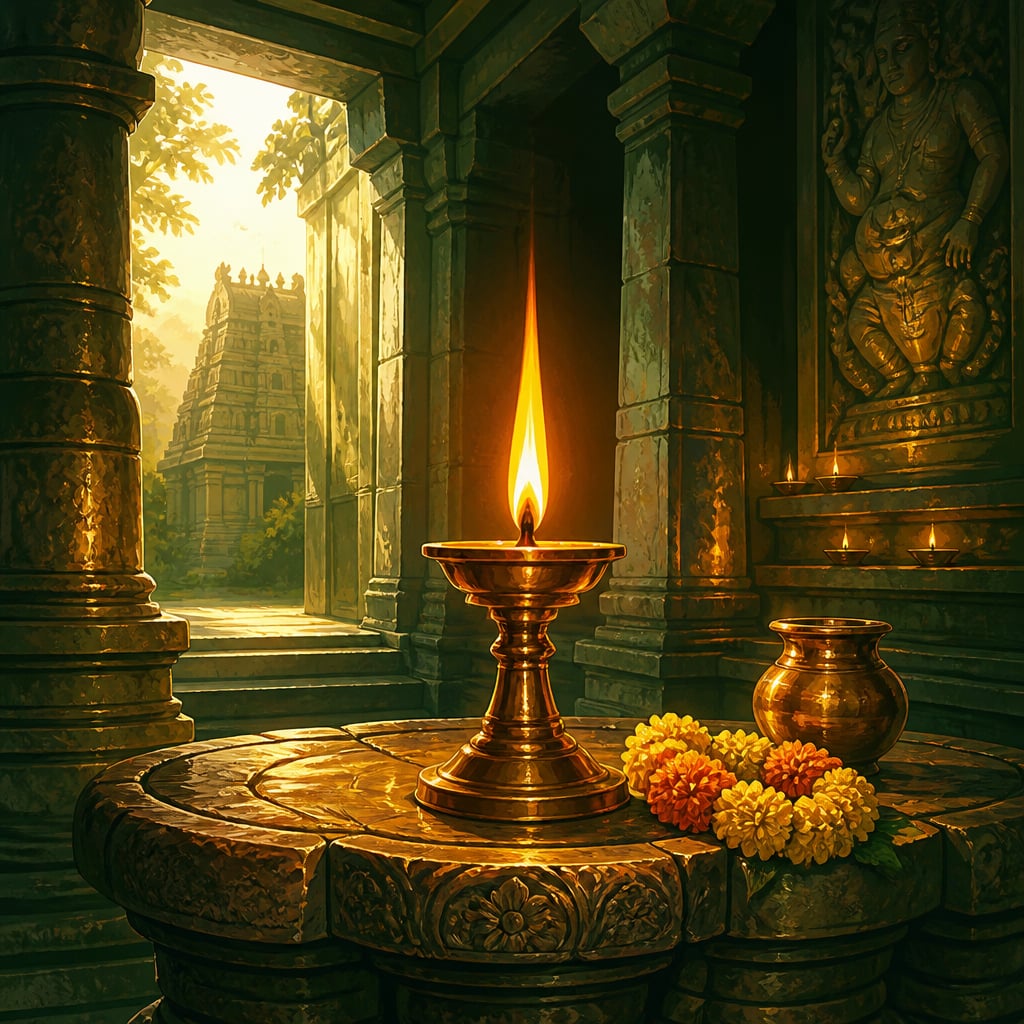
The fire had burned in that temple for four hundred years. Not the same flame, of course, but never extinguished. Each morning, a priest added fuel and recited mantras his father had taught him, which his father's father had taught before that. The knowledge of how to tend the fire, which offerings to make, which prayers to chant, all passed through an unbroken chain from master to student. The community that gathered around that fire had changed entirely: not one person from four centuries ago remained. Yet it was somehow still the same community. The fire connected them to ancestors they had never met and descendants yet unborn. This is paripālana: the art of sustaining what was built.
The Challenge of Time
We've explored how collectives form, synchronize, bond, navigate conflict, and honor diversity. But all of this means little if the community cannot persist. Time is the ultimate test. Every collective faces mortality, not just of individual members but of the collective itself.
The Rishis understood this deeply. They built not just for their generation but for millennia. The Vedas were composed around 6000 BCE and continue to be chanted today. The traditions they established, the rituals, the knowledge systems, the institutional structures, have survived empires, invasions, and civilizational upheavals.
How? Through deliberate practices of paripālana, sustenance, maintenance, preservation. The collective doesn't persist automatically; it must be actively maintained.
What the Mantras Reveal
The Rig Veda itself is a testament to sustained transmission. The hymns include instructions for their own preservation:
"इमं मे गङ्गे यमुने सरस्वति शतद्रु स्तोमं सचता परुष्ण्या" "O Ganga, Yamuna, Sarasvati, Shutudri, come to this hymn with Parushni."
The invocation of rivers, which still flow today, roots the hymn in a landscape that transcends individual lives. By connecting to the eternal, the hymn becomes eternal.
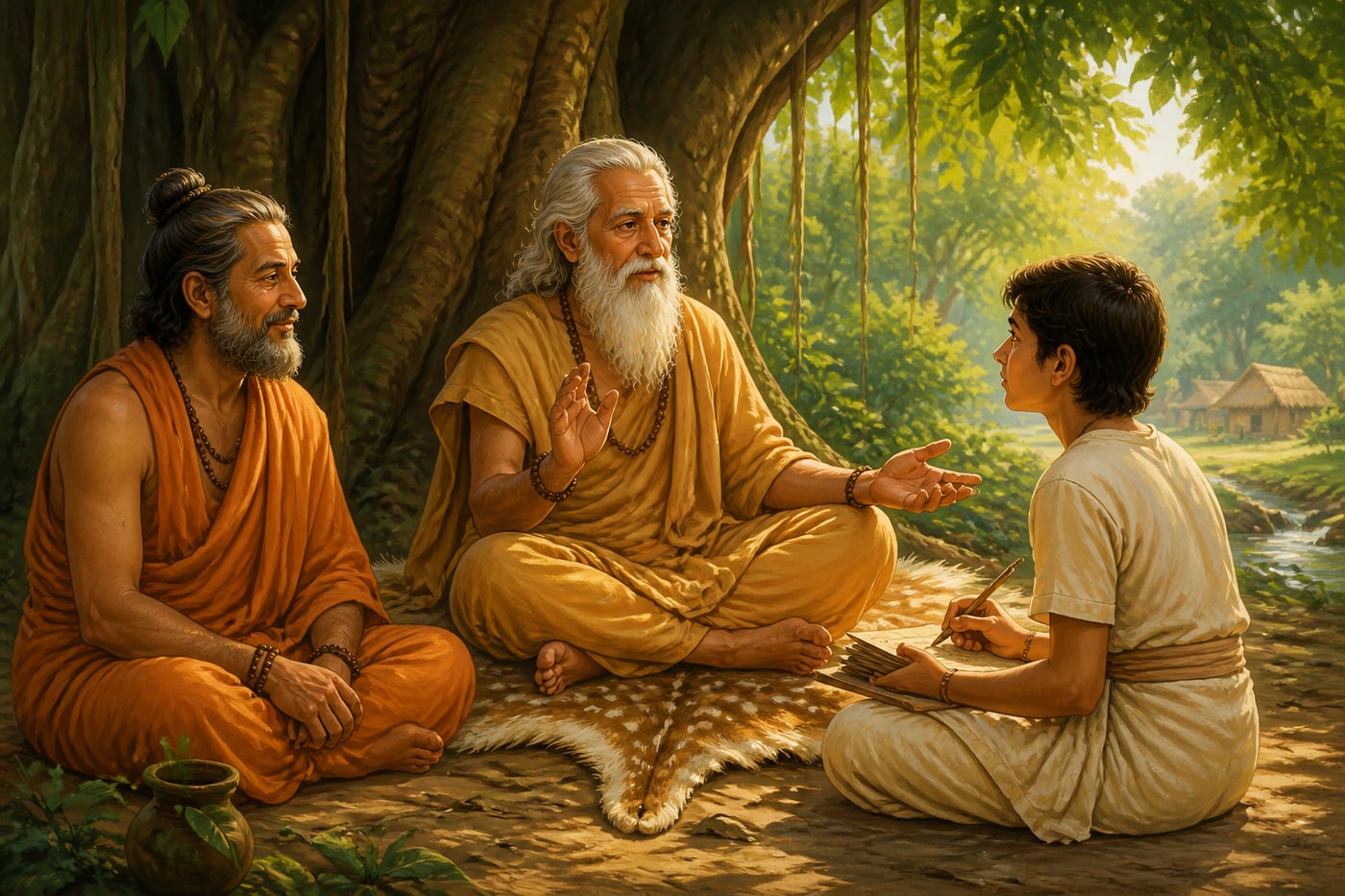
More importantly, the Vedic tradition developed the guru-shishya paramparā (teacher-student lineage) as the mechanism for transmission:
"आचार्यवान् पुरुषो वेद" "One who has a teacher knows."
This Upanishadic statement establishes that knowledge is not just information but transmitted relationship. You cannot simply read the Vedas; you must receive them from one who received them before. This creates an unbroken chain, paramparā, that sustains the tradition across centuries.
The Gita addresses institutional continuity directly:
"एवं परम्पराप्राप्तमिमं राजर्षयो विदुः" "Thus handed down in succession (paramparā), the royal sages knew this."
Word by word:
- Evam, thus, in this way
- Paramparā, succession, lineage, chain
- Prāptam, received, obtained
- Imam, this (teaching)
- Rāja-ṛṣayaḥ, royal sages
- Viduḥ, knew, understood
The teaching existed before any single teacher; it will exist after. Each generation receives, embodies, and transmits. The individual is the vessel; the lineage is the river.
Traditional Interpretations
Sayanacharya emphasizes the practical mechanisms of Vedic transmission: the rigorous training of students, the multiple levels of mastery (learning, understanding, teaching), the role of the ashram as institutional container. The Vedas survived not by accident but through carefully designed systems of preservation.
Sri Aurobindo sees paramparā as more than cultural mechanism. In The Life Divine, he suggests that spiritual knowledge passes through subtle channels beyond mere words. The guru transmits not just information but realization, something that cannot be fully conveyed in writing. This is why living lineage is essential: some knowledge can only pass person to person.
Both dimensions matter. Practically, institutions preserve structure. Spiritually, relationships transmit essence. Sustainable communities need both, the outer container and the inner transmission.
The Three Pillars of Sustainability
The Dharmic tradition identifies three interconnected mechanisms for sustaining communities across time:
1. Paramparā (Lineage Transmission) Knowledge and practice pass from teacher to student in an unbroken chain. Each generation receives fully, adds their understanding, and transmits completely. The chain must never break, once lost, some knowledge cannot be recovered.
2. Saṃsthā (Institutional Structure) Temples, mathas, gurukulas, family systems, these are containers that persist beyond any individual. They hold the forms, maintain the properties, and provide the context for practice. Institutions can be renewed; they don't depend on any single person.
3. Smṛti (Living Memory) Not just written memory (texts) but embodied memory (practice). The community remembers through doing, not just knowing. The festivals celebrated, the rituals performed, the stories told, these are how the past stays present.
All three must work together. Paramparā without saṃsthā lacks container. Saṃsthā without smṛti becomes empty form. Smṛti without paramparā cannot renew. Sustainable communities cultivate all three.
Correcting a Misconception
'Tradition' is often opposed to 'innovation', as if sustaining the past means freezing it. The Dharmic understanding is different: true tradition is living adaptation, not rigid preservation.
The Vedas themselves evolved. Later Vedic literature differs from earlier. The Upanishads reinterpret Vedic ritual psychologically. The Puranas translate Vedic wisdom into accessible stories. Each era finds new forms for eternal truths.
The key distinction is between essence and form. The essence (the core teaching, the fundamental insight) must be preserved. The forms (the specific practices, the cultural expressions) can and should adapt. Communities that confuse essence with form either fossilize (clinging to obsolete forms) or dissolve (abandoning essence along with forms).
The art of paripālana is discerning what must never change from what must continuously change.
Modern Resonance: Family Business as Paramparā
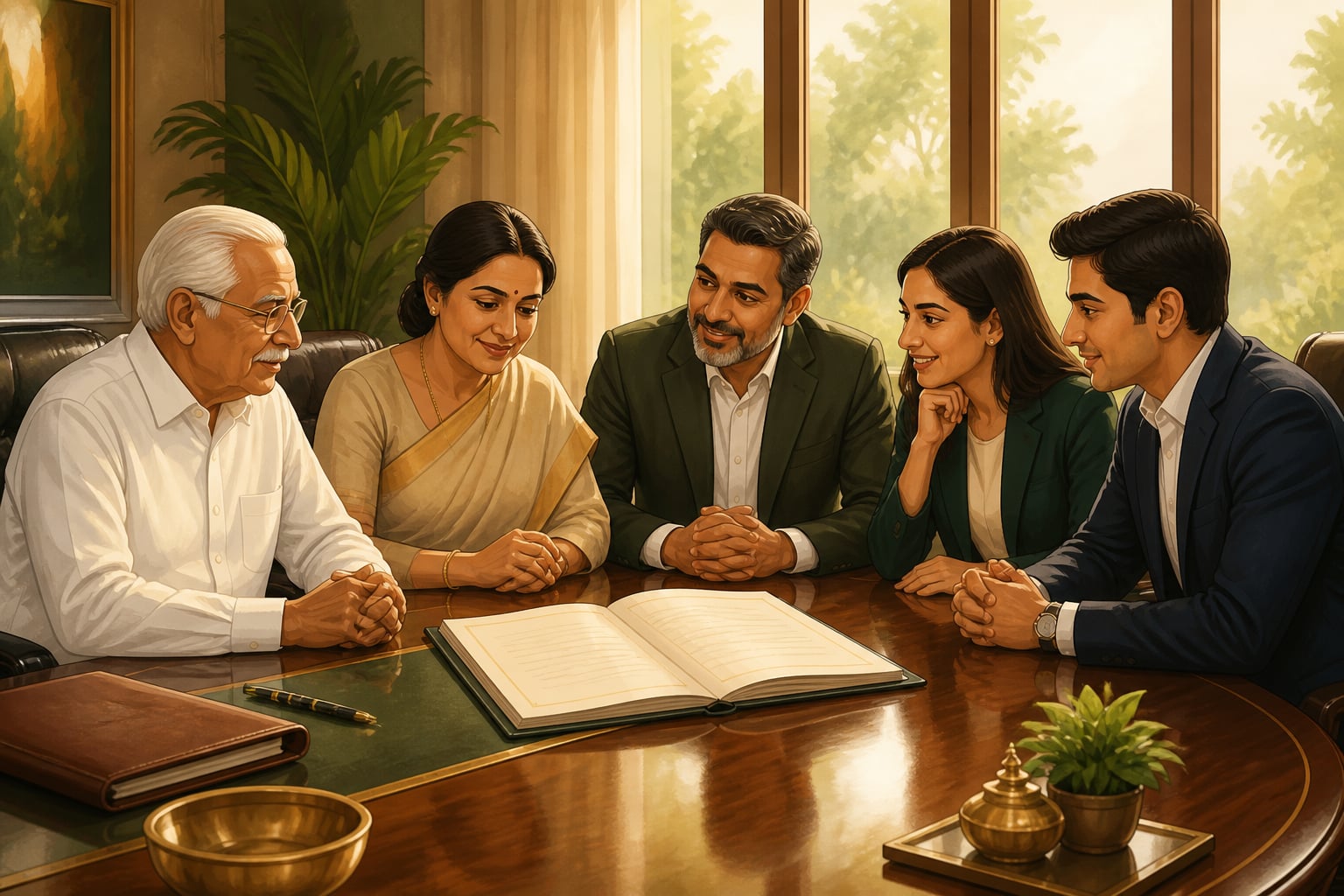
India's family business groups offer remarkable examples of institutional sustainability. The TVS Group, founded in 1911, and the Murugappa Group, founded in 1900, have both thrived for over a century, maintaining family ownership while adapting to radically changed economic conditions.
Their sustainability practices mirror the three pillars:
Paramparā (Leadership Succession):
- Both groups have explicit processes for grooming next-generation leaders
- Young family members work across business units before taking senior roles
- The previous generation mentors while the next generation leads
- Succession is planned decades in advance, not crisis-driven
Saṃsthā (Institutional Structure):
- Family constitutions codify decision-making processes
- Boards include independent directors to prevent insularity
- Trusts separate family assets from business assets
- Holding structures prevent fragmentation across generations
Smṛti (Living Values):
- Both groups emphasize values explicitly, TVS's 'trust' value, Murugappa's 'integrity' focus
- New ventures are evaluated against traditional values, not just returns
- Stories of founders are actively told to new generations
- Community involvement maintains connection to founding purpose
The result: businesses that have survived independence, liberalization, globalization, and digitization, each generation adapting forms while preserving essence.
Developmental psychology research shows that 'mentorship' produces outcomes that training alone cannot. The relationship between mentor and mentee transmits tacit knowledge, the unwritten 'how' that no manual captures. This is the psychological reality behind paramparā.
Jim Collins's research on companies that thrive for decades finds a common pattern: 'Level 5 leaders' who develop successors rather than monopolize power. They build institutions that outlast them. This is corporate paramparā, leadership as lineage, not individual brilliance.
Organizations with 'knowledge management' systems often find that the most critical knowledge can't be documented. It lives in relationships and practices. When key people leave without transmitting, capability is lost forever. Paramparā is the solution.
Research on social movements shows that movements with strong institutional structures (organizations, membership, property) persist; those relying only on charismatic leaders fade when the leader goes. Structure outlasts personality.
Drucker observed that great leaders 'think institution', they build systems, not just teams. The founder's job is to make themselves replaceable by building what doesn't need them. This is the leader as institution-builder.
Institutions are 'stabilizing structures' in systems terms, they resist perturbation and maintain function despite environmental changes. Well-designed institutions absorb shocks that would destroy informal groups.
A word of caution as we explore these teachings: Modern institutions often think in quarterly cycles, not centuries. The Dharmic tradition offers hard-won wisdom about what enables communities to persist across generations: paramparā for transmission, saṃsthā for structure, smṛti for memory. Whether building a company, a community, or a family, these principles apply.
Your Path Forward
Every community you belong to faces the sustainability question: Will it outlast its current members? Will what you're building persist?
This week, examine the communities you value:
- Paramparā: Who are the teachers? Who are the students? Is knowledge being transmitted, or will it die with the current generation?
- Saṃsthā: What structures hold the community? Are they robust enough to survive leadership changes, conflicts, or external pressures?
- Smṛti: What do you practice together that keeps memory alive? What stories do you tell? What rituals do you maintain?
Where any pillar is weak, the community is vulnerable. Consider what you can do to strengthen the weakest pillar.
The Rishis built for eternity. They succeeded not through wishful thinking but through deliberate design. Your communities can do the same, if you attend to paripālana.
In the final lesson, we will bring all these teachings into the present moment, exploring how Vedic wisdom about collective life applies to the challenges of 2026 and beyond.
Case studies
Family Business Dynasties: Murugappa and TVS as Living Paramparā
India's family business groups face a unique sustainability challenge: maintaining family control while professionalizing management, preserving founding values while adapting to new economies. The Murugappa Group (founded 1900, ₹50,000 crore revenue) and TVS Group (founded 1911, ₹80,000 crore revenue) have both succeeded for over a century, now in their fourth and fifth generations. How have they sustained across such radical change?
Both groups embody the three pillars of paripālana: **Paramparā (Lineage Succession):** - Both have formal 'next-gen' programs where young family members rotate through businesses before taking leadership - Elders serve as mentors and board members, transmitting tacit knowledge - Succession is planned decades in advance, not crisis-driven - The Murugappa Group's 'Chettinad values' and TVS's 'trust' principle are explicitly taught to each generation **Saṃsthā (Institutional Structure):** - Family constitutions codify decision-making, conflict resolution, and ownership transition - Professional boards with independent directors prevent insularity - Holding company structures prevent fragmentation across generations - Family councils separate family governance from business governance **Smṛti (Living Memory):** - Founder stories are actively told, AM Murugappa Chettiar's values, TV Sundaram Iyengar's philosophy - New ventures are evaluated against founding values, not just financial returns - Community involvement (temples, trusts, schools) maintains connection to origins - Annual family gatherings reinforce shared identity
Both groups have thrived through independence, license raj, liberalization, globalization, and digitization. The Murugappa Group now spans finance, sugar, fertilizers, cycles, and abrasives. TVS encompasses automobiles, components, finance, and electronics. Each generation adapted forms while preserving essence, exactly the paripālana balance the tradition prescribes.
Sustainability requires all three pillars. Lineage alone (without institutions) creates succession crises. Institutions alone (without values) become soulless. Values alone (without transmission) fade. The family businesses that persist attend to all three.
The average S&P 500 company lifespan has fallen below 20 years, suggesting that most modern corporations lack the multi-generational sustainability these family businesses achieved. The growing interest in 'steward ownership' models (like Bosch, Zeiss, and Patagonia's trust structure) reflects recognition that long-term institutional health requires something beyond quarterly profit maximization.
Studies show 70% of family businesses don't survive to the second generation; 90% don't reach the third. Murugappa and TVS are in their fourth and fifth generations. Their survival rate is statistically extraordinary, and attributable to deliberate paripālana practices.
Temple Agama Traditions: A Thousand Years of Daily Practice
South Indian temples maintain ritual traditions (āgama) that have continued daily for over a thousand years. The Brihadeeswara Temple at Thanjavur, consecrated in 1010 CE by Rajaraja Chola I, continues the same worship patterns established at its founding. The Ranganathaswamy Temple at Srirangam has an even longer continuous history. How has such extraordinary continuity been achieved?
The āgama traditions exemplify paripālana in practice: **Paramparā (Lineage Transmission):** - Priest families (archakas) maintain hereditary succession, son learns from father - Training begins in childhood, with full qualification taking 12+ years - Complex rituals requiring thousands of mantras are transmitted orally and through practice - The lineage carries not just knowledge but adhikāra (qualification) to perform **Saṃsthā (Institutional Structure):** - Temples own land (devadāna) whose income funds daily operations - Temple administration (devasthānam) provides continuity beyond any individual - Texts (āgama śāstras) document procedures, but living priests interpret them - Royal patronage (historically) and now state/trust management provide external support **Smṛti (Living Memory):** - The rituals themselves are smṛti, embodied memory performed daily - Festival calendars (utsava) maintain annual rhythms unchanged for centuries - Temple architecture encodes cosmological memory in stone - Oral traditions (sthala purāṇas) maintain temple-specific narratives
Temples like Brihadeeswara have maintained their ritual core for over 1,000 years despite Chola decline, Pandya conflicts, Vijayanagara expansion, Nayak rule, Maratha governance, British colonization, and Indian independence. The political superstructure changed repeatedly; the ritual infrastructure persisted.
The most resilient institutions combine multiple sustainability mechanisms. The āgama traditions don't rely on a single factor, they have hereditary priesthood (paramparā), land endowments (saṃsthā), and daily ritual (smṛti). Redundancy across pillars creates exceptional durability.
UNESCO's Intangible Cultural Heritage program and Japan's Living National Treasures designation attempt to formalize what temple agama traditions achieved organically: multi-mechanism preservation of irreplaceable practices. The institutions that survive centuries are those that build redundancy into their transmission, never relying on a single person, document, or funding source.
The Brihadeeswara Temple at Thanjavur has maintained daily rituals continuously since its consecration in 1010 CE, surviving rule by 7 different dynasties and colonial powers. Its inscriptions record endowments from over 400 donors across 5 centuries, showing multi-generational institutional commitment.
Reflection
- In the communities you belong to, who is doing the paripālana? Who is training the next generation? Maintaining the institutions? If you can't identify these people, what does that suggest?
- What have you received through living transmission, knowledge that couldn't have come from books alone? To whom are you transmitting this? If the chain breaks at you, what is lost?
- The tradition distinguishes essence (sāra) from form (rūpa). In any tradition you value, what is the essence that must never change? What are the forms that could (or should) adapt?