Vivāda: Conflict and Repair
How Communities Navigate Rupture Without Dissolution
Every collective faces conflict, disagreements, power struggles, broken trust. The Vedic tradition does not pretend harmony is permanent; it develops sophisticated practices for navigating conflict and restoring relationship. This lesson explores how communities handle rupture while preserving the bonds that make collective life possible.
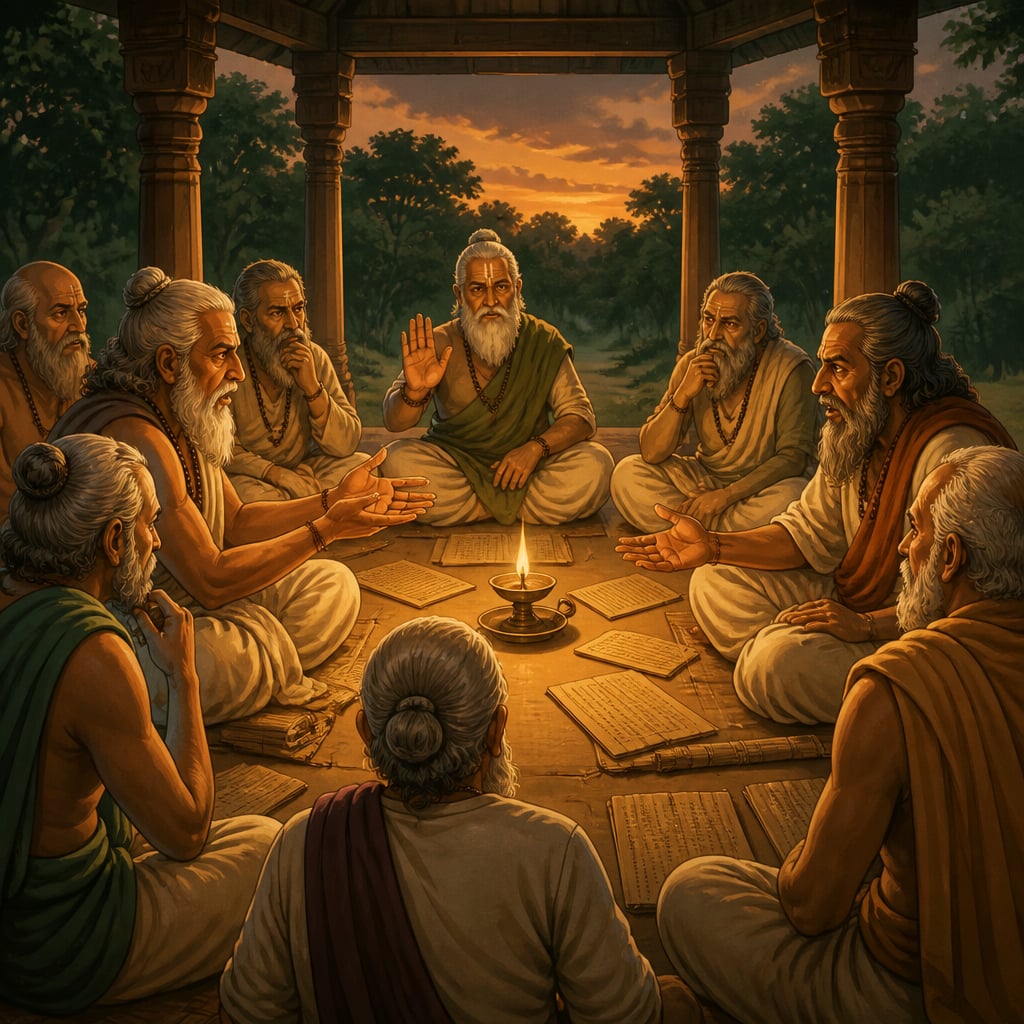
The debate had lasted three days. Two factions of the sabha stood opposed, one demanding war against the neighboring clan, the other insisting on negotiation. Voices had risen to shouting; old alliances had fractured; men who had fought side by side now stood across the fire from each other. Yet no one had walked away. No one had drawn weapons. Because both sides knew something deeper than their disagreement: the assembly itself was more precious than any single decision. They would find resolution, or they would keep talking until they did. The Rishis called this capacity for sustained conflict without dissolution vivāda-kṣamā: the ability to bear dispute without breaking.
The Inevitability of Conflict
The previous lessons presented an idealized picture: saṅgha creates collective power, tāla synchronizes action, yajña binds across generations. But reality is messier. Every collective that lasts long enough will face conflict. People disagree. Interests diverge. Trust breaks. Power shifts.
The Vedic tradition does not pretend otherwise. The Rig Veda itself contains hymns of rivalry between priestly families, disputes over cattle, conflicts between clans. The Mahābhārata, the great epic that emerges from Vedic culture, is entirely a story of family conflict escalating to civilizational war.
But what distinguishes healthy communities from fragile ones is not the absence of conflict but the capacity to navigate it. The Rishis developed frameworks for this navigation.
What the Mantras Reveal

One of the most remarkable hymns in the Rig Veda is addressed to Varuṇa, the god of cosmic order, but also of moral law and forgiveness. The Rishi Vasiṣṭha speaks with striking vulnerability:
"यच्चिद्धि ते विशो यथा प्र देव वरुण व्रतम्। मिनीमसि द्यविद्यवि" "Whatever law of yours, O divine Varuṇa, we have violated day after day..."
The Rishi continues:
"मा नो वधाय हत्नवे जिहीळानस्य रीरधः। मा हृणानस्य मन्यवे" "Do not deliver us to death, to the weapon of one angered, to the wrath of the offended."
This is remarkable: a Vedic hymn acknowledging wrongdoing and asking for forgiveness. It establishes a pattern:
- Acknowledgment of violation (minīmasi, we have violated)
- Appeal to the wronged party (varuṇa, who maintains order)
- Request for restoration rather than punishment
The hymn does not demand forgiveness; it asks for it. This humility is essential to repair.
Another verse explicitly addresses how to restore broken relationships:
"सं गच्छस्व सं वदस्व सं वो मनांसि जानताम्" "Come together again, speak together again, let your minds know each other again."
The repetition of sam (together, again) acknowledges that unity has been broken and must be rebuilt. Repair is not automatic, it requires renewed effort at all three levels: action, speech, and mind.
Traditional Interpretations
Sayanacharya notes that Vedic society had formal institutions for dispute resolution. The sabhā (council of elders) and samiti (broader assembly) served not just for collective decision-making but for adjudicating conflicts. The presence of structured forums meant that disputes had a place to go, they didn't fester in informal resentment or explode in unstructured violence.
Sri Aurobindo reads the Varuṇa hymns as addressing inner conflict as much as outer. The moral law (ṛta) that Varuṇa upholds is violated not just in external actions but in internal states, anger, jealousy, resentment. Repair requires not just behavioral change but psychological transformation. True reconciliation happens when the manas (mind) genuinely releases the grievance.
Both dimensions matter. Outer institutions provide containers for conflict. Inner work transforms the conflicting parties. Sustainable repair requires both.
The Dharmic Approach to Conflict
The tradition offers a distinctive framework for navigating conflict:
1. Sāma (Conciliation): First, attempt to resolve through dialogue and persuasion. Most conflicts arise from misunderstanding or misaligned expectations. Speaking together (saṃ vada) often reveals that the conflict is smaller than it appeared.
2. Dāna (Generosity): If dialogue fails, consider what you can give. Sometimes conflict persists because one party feels unrecognized or under-resourced. Generosity can dissolve resentment that argument cannot touch.
3. Bheda (Differentiation): If the first two fail, consider whether the collective needs to divide. Not all conflicts can be resolved. Sometimes the dharmic path is separation, allowing each faction to pursue its own way rather than forcing false unity.
4. Daṇḍa (Consequence): Only as a last resort, use force or penalty. This is not preferred but acknowledged as sometimes necessary when the collective's core interests are threatened.
This sequence, sāma, dāna, bheda, daṇḍa, appears in the Arthaśāstra and becomes foundational to Indian political thought. The key insight: not all conflicts should be forced to resolution. Sometimes the healthiest outcome is structured separation with preserved mutual respect.
Correcting a Misconception
Modern conflict resolution often aims for 'win-win' solutions where everyone gets what they want. This is sometimes possible, but the Dharmic tradition is more realistic: some conflicts involve genuine trade-offs. Not everyone can win. Resources are limited. Positions are incompatible.
The goal is not always resolution but preservation of relationship across difference. The two factions in the sabha may never agree on war versus negotiation. What they can agree on is: we will not destroy each other over this disagreement. We will find a way to move forward that both sides can live with, even if neither is fully satisfied.
This is the essence of vivāda-kṣamā: bearing dispute without breaking the larger whole.
Modern Resonance: Coalition Dharma
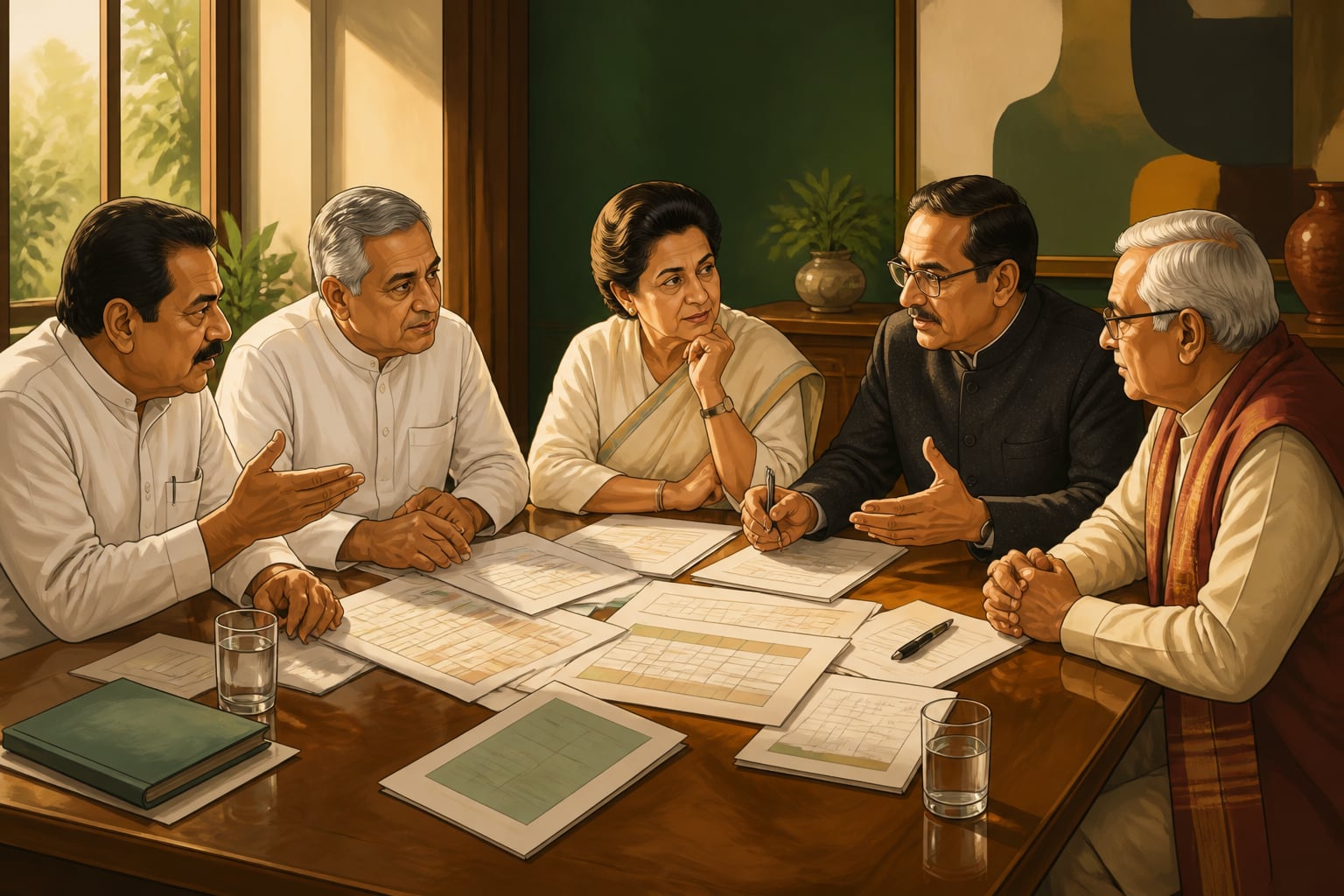
Indian democracy offers a living laboratory in conflict and repair. With dozens of political parties representing diverse interests, regional, caste-based, ideological, no single party can govern alone. Coalition-building is essential.
The 2004 UPA and 2014/2019 NDA formations demonstrate vivāda-kṣamā at national scale:
The Process Mirrors Dharmic Sequence:
- Sāma: Extensive negotiations between parties with conflicting interests, seat-sharing, ministerial berths, policy compromises
- Dāna: Major parties 'give' seats to smaller allies, ceding winnable constituencies to maintain coalition cohesion
- Bheda: Some parties remain outside the coalition by choice, acknowledging that forced unity would be worse than structured opposition
- Daṇḍa: When coalition partners defect, there are consequences, loss of ministerial positions, isolation in future negotiations
What Makes It Work:
- Shared framework: All parties accept democratic rules, even when they lose
- Repeated interaction: The same parties negotiate again and again, creating incentive for fair dealing
- Multiple levels: National coalitions, state alliances, and local arrangements create layered interdependence
- Face-saving mechanisms: Joint press conferences, common minimum programmes, and rotation agreements allow parties to yield without appearing to surrender
The result is governance through managed conflict. No party gets everything it wants. Many parties get something. The system endures because the alternative, winner-take-all or perpetual gridlock, would be worse for everyone.
Harriet Lerner's 'Why Won't You Apologize?' identifies the key elements of effective apology: acknowledgment without excuse, understanding impact, and commitment to change. The Varuṇa hymn models all three, ancient wisdom confirmed by modern relationship research.
Leaders who acknowledge mistakes maintain more trust than those who appear perfect. Research by Amy Edmondson (Harvard) shows that 'psychological safety', which enables acknowledgment, correlates with team performance. Modeling vulnerability creates safety for others.
Acknowledgment breaks escalation cycles. In conflict systems, each party typically waits for the other to acknowledge first. Someone must break the pattern. The Varuṇa hymn shows how: unilateral acknowledgment, without demanding reciprocity as precondition.
Family therapist Virginia Satir emphasized that families need regular 'family meetings', structured time when difficult topics can be raised safely. Without such forums, conflicts fester in informal resentment or explode in unstructured confrontation.
Ray Dalio's 'radical transparency' at Bridgewater includes structured forums for disagreement: recorded meetings, issue logs, believability-weighted voting. The structure allows conflict without chaos.
Conflicts need 'containers', boundaries that allow the conflict to be held without spilling into everything. A team retrospective is a container. A mediation session is a container. Without containers, conflict becomes all-consuming.
A word of caution as we explore these teachings: Modern organizations and societies often lack structured approaches to conflict. Either they suppress conflict (creating resentment) or they let it escalate (creating destruction). The Dharmic tradition offers a middle path: structured forums, sequential strategies, and the goal of relationship preservation even when resolution is impossible. These are tested technologies for a challenge every collective faces.
Your Path Forward
Conflict is not a sign that your community has failed. It is a sign that your community contains real people with real differences. The question is not how to avoid conflict but how to navigate it without destroying what you've built together.
This week, examine a current or recent conflict in a community you belong to:
- Has there been acknowledgment of harm from all parties, or only accusation?
- Is there a structured forum for the conflict, or is it playing out in informal channels?
- Have you tried the sequence: sāma (dialogue), dāna (generosity), bheda (separation if needed)?
- What would preservation of relationship across difference look like, even if full resolution is impossible?
The Rishis knew that harmony is not the natural state, it is achieved, lost, and rebuilt, over and over. Vivāda-kṣamā, the capacity to bear conflict without breaking, is what allows the cycle to continue.
In the next lesson, we will explore a subtler challenge: how individuals maintain their distinctiveness within collective life, belonging without conformity.
Case studies
Coalition Dharma: Conflict and Repair in Indian Democracy
Indian democracy presents a constant challenge: with 30+ major parties representing diverse interests, regional, caste-based, ideological, linguistic, no single party can govern alone. Since 1989, every central government has been a coalition. These coalitions bring together parties that disagree on fundamental issues: economic policy, social justice, foreign relations, even national identity. Yet governance continues. How?
Indian coalition politics embodies the sāma-dāna-bheda-daṇḍa sequence: **Sāma (Conciliation):** - Extensive pre-election negotiations between potential allies - Common Minimum Programmes that identify shared ground - Coordination committees for ongoing dialogue **Dāna (Generosity):** - Major parties 'gift' seats to smaller allies, sacrificing potential wins for coalition stability - Ministerial berths distributed to maintain partners' stake in government survival - Policy compromises that cost the major party but keep allies committed **Bheda (Structured Separation):** - Some parties choose to remain outside, acknowledging that alliance would require unacceptable compromise - 'Outside support' arrangements where parties support government without joining it - Recognition that not every party can or should be included **Daṇḍa (Consequence):** - Defecting allies face exclusion from future coalitions - Withdrawal of support can topple governments, a credible threat that enforces cooperation
Despite constant conflict and frequent predictions of collapse, Indian democracy has maintained stable governance through coalition management. The 2019 NDA included parties with contradictory positions on economic policy, federalism, and social issues, yet governed effectively. The system demonstrates vivāda-kṣamā at national scale: the capacity to bear persistent conflict without dissolution.
Governance through managed conflict is possible when all parties share commitment to the larger system. Indian coalition partners disagree on almost everything except one thing: they prefer coalition government to no government or civil war. This shared commitment to the collective's survival enables navigation of even bitter disputes.
The European Union operates on a similar principle: member states with deep disagreements on immigration, fiscal policy, and sovereignty maintain alignment because they share commitment to the larger project. Organizations that invest in shared purpose before addressing specific disagreements navigate conflict more effectively than those that try to resolve disputes without first establishing common ground.
Since 1989, India has had 10 Prime Ministers from 4 different parties, governing through coalitions of 10-40 parties each. Despite constant negotiation and frequent crises, no coalition has collapsed into violence. The system works.
Ramanuja's Bridge: Reconciling Rival Traditions
In 11th-12th century South India, religious conflict between Shaiva and Vaishnava traditions threatened social coherence. Disputes over temple control, theological supremacy, and community identity created bitter rivalries. Some families had been divided for generations. Into this conflict stepped Ramanuja (1017-1137 CE), a philosopher-saint who would develop approaches to reconciliation that reshaped Hindu tradition.
Ramanuja's reconciliation embodied dharmic conflict principles: **Sāma (Dialogue and Understanding):** - Rather than dismissing rival traditions, Ramanuja studied them deeply - He engaged Shaiva scholars in philosophical debate, treating them as worthy interlocutors - He acknowledged what was valuable in positions he ultimately rejected **Dāna (Generous Inclusion):** - His Vishishtadvaita philosophy included elements from multiple traditions - He welcomed disciples from various backgrounds, including formerly Shaiva families - He explicitly included castes historically excluded from spiritual community **Bheda (Maintaining Distinctiveness):** - He did not pretend that all traditions were identical - He maintained clear Vaishnava identity while respecting Shaiva traditions - Difference was acknowledged, not erased, but difference need not mean enmity **Relationship Preservation:** - Even in disagreement, he modeled respect for opponents - His philosophical critiques were rigorous but not hostile - He created space for traditions to coexist without requiring uniformity
Ramanuja's approach created a model for religious coexistence that influenced centuries of Hindu tradition. The Sri Vaishnava community he founded became one of Hinduism's most influential lineages. More importantly, his example demonstrated that philosophical disagreement could coexist with mutual respect, that vivāda need not become violence.
Reconciliation does not require erasing difference. Ramanuja maintained strong Vaishnava identity while creating bridges to other traditions. The key was treating opponents as worthy interlocutors, disagreeing with their positions while respecting their persons.
Interfaith dialogue initiatives, corporate merger integrations, and international diplomatic frameworks all face the same challenge Ramanuja addressed: building bridges between groups with genuine differences. The most successful approaches maintain distinct identities while creating shared spaces for exchange, rather than demanding that one side assimilate into the other.
Ramanuja established 74 monastic centers (simhasanadipatis) across South India to propagate Vishishtadvaita philosophy. His commentaries on the Brahma Sutras and Bhagavad Gita created an intellectual framework that bridged Shaiva and Vaishnava thought, influencing over 900 years of Hindu theology.
Reflection
- Think of a conflict in a community you belong to. Has there been genuine acknowledgment of harm by all parties, or mostly accusation? What would acknowledgment (without excuse) look like from your side?
- The tradition distinguishes between forgiving (kṣamā) and forgetting. What might it mean to genuinely release the demand for revenge while still remembering harm, to forgive without erasing what happened?
- The sāma-dāna-bheda-daṇḍa sequence includes 'bheda' (separation) as a legitimate outcome. When is structured separation more dharmic than forced unity? When should communities divide rather than maintain toxic togetherness?