Relevance in 2026 and Beyond
Building Resilient Communities in the Age of Isolation
How the Vedic teachings on collective action, shared rhythms, and community resilience apply to modern life, from remote work cultures to civic engagement to building lasting institutions.
The Loneliness Paradox
You're more connected than any human in history. You have 847 LinkedIn connections, 2,000 Instagram followers, and a Slack workspace with 300 colleagues. Yet when you need someone to pick you up from the airport or watch your dog for a weekend, the list shrinks to maybe five people. Three if you're honest.

This isn't a personal failure. It's a structural one. We've built systems optimized for individual convenience that systematically dismantle collective capacity. And now, facing challenges that no individual can solve, climate change, AI governance, democratic erosion, we're discovering that we've forgotten how to act together.
The Modern Challenge: Collective Action in an Individualist Age
The numbers are stark. Robert Putnam's ongoing research shows that since 2000, participation in community organizations has declined another 25%. The average American now has fewer close friends than at any point since researchers started measuring. In India, despite cultural emphasis on joint families, nuclear households increased from 52% to 64% between 2001 and 2021.
The workplace tells the same story. The shift to remote and hybrid work, accelerated by COVID and now permanent for millions, has created what Microsoft's 2024 Work Trend Index calls "collaboration debt": the invisible erosion of shared context, spontaneous problem-solving, and institutional knowledge that happens when people rarely share physical space.
We see the consequences everywhere. OpenAI's November 2023 board crisis revealed an organization where the board and employees had so little shared context that a CEO firing triggered near-total organizational collapse within hours. Twitter's post-acquisition chaos showed what happens when collective knowledge walks out the door. The Indian Premier League's 2024 governance disputes exposed how even successful institutions can fracture when individual interests overwhelm collective identity.
The question isn't whether we need collective capacity. The question is how to build it when every incentive points toward individual optimization.
The Ancient Insight: What the Rishis Understood About Collectives
The Rig Veda's Saṃjñāna Sūkta (RV 10.191) opens with a deceptively simple vision: "Come together, speak together, let your minds be of one accord." But across this chapter, we've seen that Vedic collective wisdom goes far deeper than calls for unity.
The Rishis understood that collectives aren't natural. They're constructed. They require specific infrastructure: shared rhythms (tāla) that synchronize action without requiring constant coordination. Collective rituals (yajña) that create shared identity and emotional bonding. Mechanisms for conflict and repair (vivāda-śānti) that acknowledge disagreement as normal rather than catastrophic. Clear roles that allow individual excellence to serve collective purpose (svadharma). And deliberate practices of transmission (paripālana) that sustain communities across generations.
This isn't idealistic. It's architectural. The Vedic view treats community-building like building a house: it requires design, materials, skilled labor, and maintenance. You don't get a house by wishing for shelter.
The Bridge: Ancient Infrastructure for Modern Collectives
In Remote Work Cultures
The Vedic emphasis on shared rhythms offers a prescription for distributed teams: create temporal anchors. GitLab, the fully-remote company with 2,000+ employees across 65 countries, has institutionalized what they call "informal communication practices", virtual coffee chats, random pair calls, and company-wide "Group Conversations." These aren't optional niceties; they're the tāla that keeps a dispersed organization synchronized.
The lesson isn't "return to office." It's that shared rhythms must be deliberately designed when they don't occur naturally. Automattic (WordPress) schedules annual in-person gatherings not for meetings but for relationship-building. These function exactly like the periodic melas and festivals that held pre-modern Indian communities together.
In Leadership and Management
The Ashta Pradhan model, eight ministers with distinct domains, solved a problem that modern organizations still struggle with: how to maintain collective coherence while enabling individual excellence. The answer was clear role definition with mandatory interdependence. No minister could succeed alone; their domains were deliberately designed to require coordination.
Compare this to the OpenAI crisis: a board with unclear authority, executives with undefined relationships to governance, and employees with no formal voice. The Vedic framework would call this a svadharma failure, not that individuals lacked excellence, but that their roles didn't compose into collective capacity.
In Civic and Political Life
India's coalition politics, often mocked for instability, actually demonstrates Vedic wisdom about disagreement. The sāma-dāna-bheda-daṇḍa framework assumes that conflict is normal and provides escalation paths. When the INDIA alliance formed in 2023-24, bringing together ideologically diverse parties, they weren't discovering something new, they were rediscovering what the Ramanuja tradition showed in the 11th century: collective identity can accommodate theological differences if the ritual infrastructure is strong enough.
The failure mode isn't disagreement; it's the absence of repair mechanisms. American political dysfunction isn't caused by polarization (which has existed before) but by the collapse of cross-party relationships, shared social spaces, and informal conflict-resolution channels.
In Building Lasting Institutions
The temple agama traditions that have sustained Hindu institutions for millennia encode something crucial: knowledge must be transmitted through practice, not just documentation. Wikipedia's volunteer community understands this, their extensive training programs, mentorship systems, and cultural transmission create what the Vedic tradition would call paramparā.
Contrast this with organizations that treat knowledge as information rather than practice. They write comprehensive wikis that nobody reads, create onboarding documents that don't convey culture, and wonder why institutional memory evaporates with each departing employee.
Addressing Skepticism: When This Doesn't Apply
The Vedic collective model has real limitations. It emerged in a world of stable communities, long-term relationships, and shared cultural assumptions. In our world of job mobility, geographic transience, and cultural diversity, not all of its assumptions hold.
Specifically: the emphasis on shared identity can become exclusionary. The role-based framework can calcify into caste. The ritual practices can become hollow performance. These aren't hypothetical risks, they're historical realities that caused immense suffering.
The question isn't whether to adopt Vedic collective wisdom wholesale, that would be both impossible and unwise. The question is which architectural insights transfer: the deliberate design of synchronization mechanisms, the acknowledgment that conflict is normal, the investment in transmission practices, the balance between individual role and collective purpose.
Modern research largely validates these specific mechanisms while rightly rejecting the exclusionary social structures in which they were historically embedded.
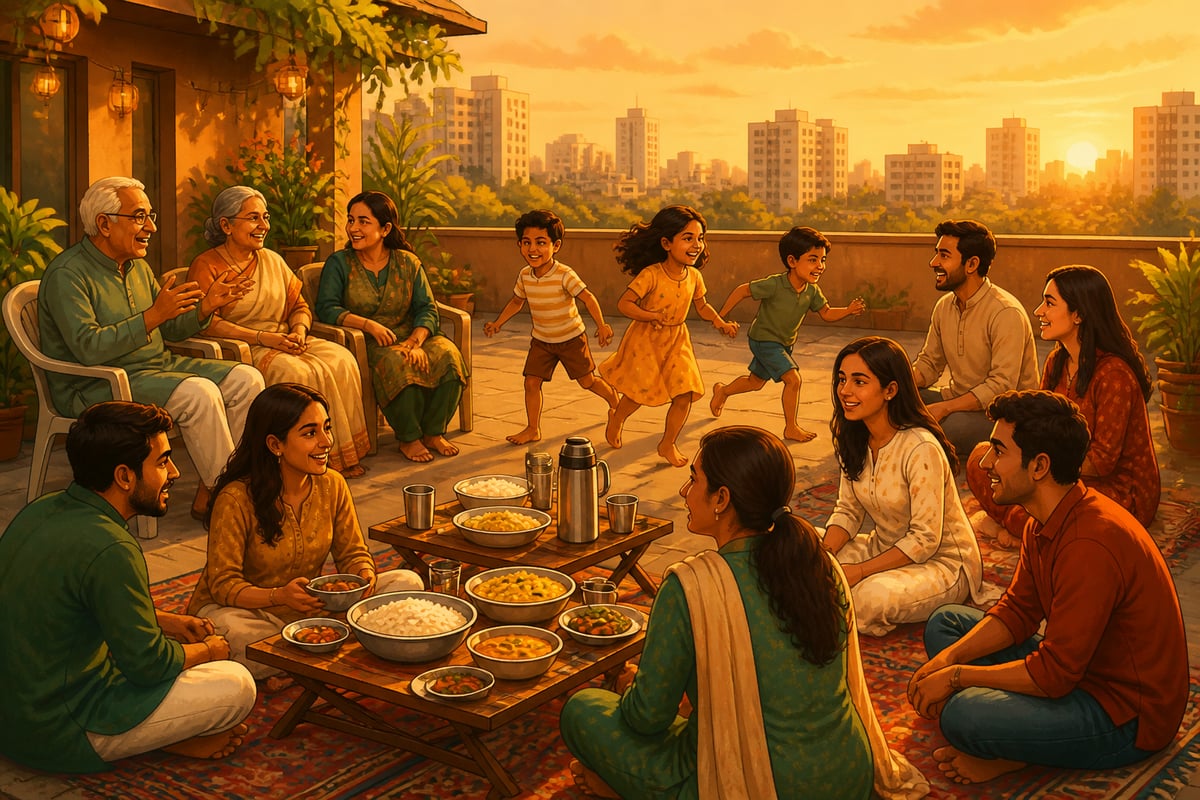
Call to Practice: Where to Begin
Building collective capacity starts small:
Audit your rhythms: What regular practices connect you to others? If none, start one. A weekly call with a friend. A monthly community gathering. Consistency matters more than frequency.
Design for repair: The next time conflict arises in a group you're part of, notice whether repair mechanisms exist. If not, propose one, even something as simple as a check-in process.
Invest in transmission: Whatever you know, teach to someone. Whatever community you're part of, identify what needs to be passed on and to whom.
The Rishis knew something we're relearning: individuals can't solve collective problems individually. But collectives don't happen by accident. They're built, maintained, and renewed through deliberate practice. The infrastructure is ancient. The construction is up to you.