Saṅgha: Why Collective Action Matters
The Vedic Understanding That We Rise Together
The Rig Veda presents collective action not as mere cooperation but as a fundamental principle of cosmic order. From the multi-priest yajna to the communal composition of hymns, the Rishis understood that individual effort gains power only when synchronized with others. This lesson explores why the Vedic tradition places sangha, coming together, at the heart of effective action.
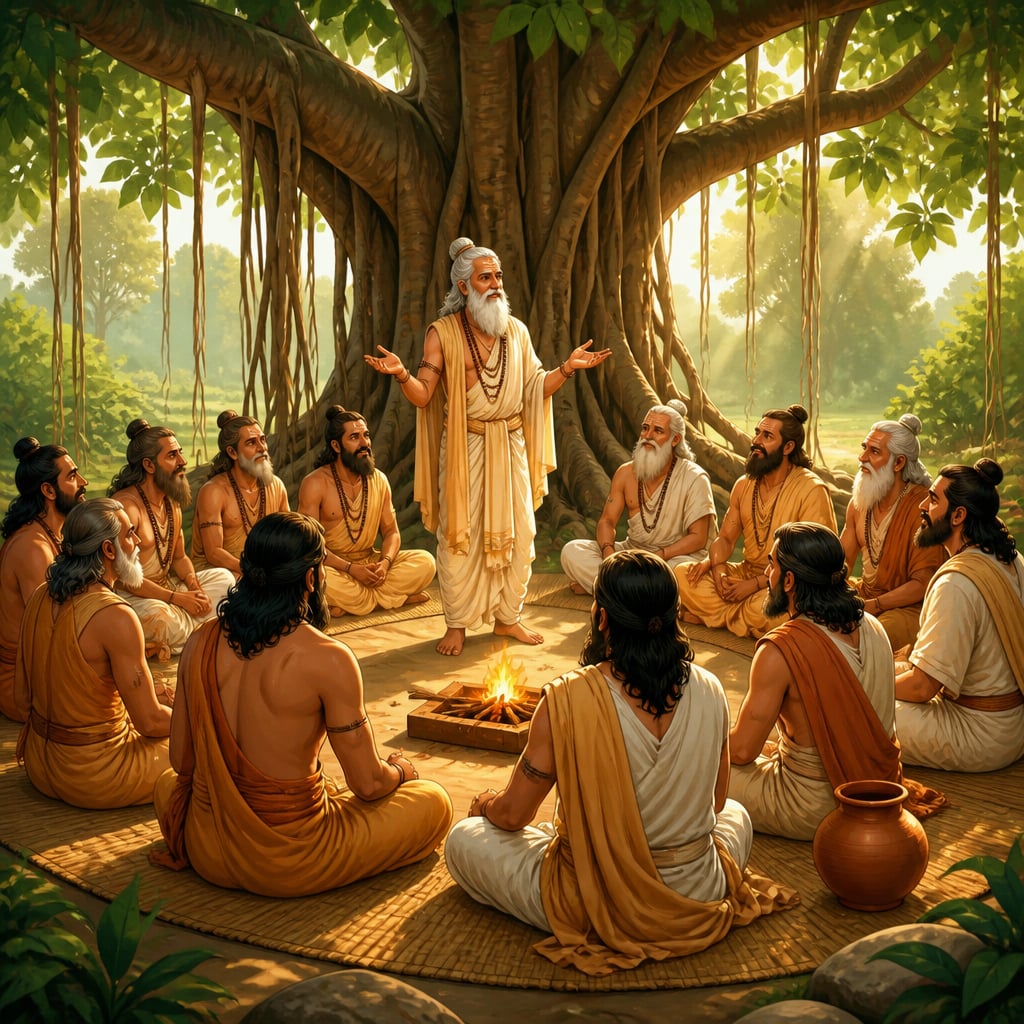
The hotri priest raised his voice, but he did not act alone. To his left, the adhvaryu measured the soma stalks with practiced hands. Behind him, the udgatri began the melodic chant that would carry the offering upward. At the fire's edge, the brahman sat in watchful silence, ready to correct any error before it could disrupt the cosmic exchange. Sixteen priests in all, each with a precise role, none replaceable. The yajna could not proceed with fifteen. And in that moment, as the chant rose, the fire crackled, and the soma flowed, something greater than any individual emerged. The Rishis called this saṅgha: the power that arises when separate become one.
The Vedic Discovery
The Rig Veda is not the work of a single genius. It is the accumulated wisdom of countless Rishis across generations, clans, and regions, composed, remembered, and transmitted through collective effort. The very existence of the Vedas proves their central teaching: great things require many hands.
But the Rishis went further. They observed that collective action wasn't just practically necessary, it was cosmically powerful. When humans aligned their efforts, something qualitatively different emerged. The whole became more than the sum of its parts.
This insight appears most clearly in the Saṃjñāna Sūkta (RV 10.191), the hymn of unity:
"सं गच्छध्वं सं वदध्वं सं वो मनांसि जानताम्" "Come together, speak together, let your minds move in harmony."
Notice the precision: saṃ gacchadhvam (move together), saṃ vadadhvam (speak together), saṃ vo manāṃsi (think together). The Rishi identifies three levels of alignment, action, speech, and thought. True saṅgha requires all three.
What the Mantras Reveal
The Saṃjñāna Sūkta continues with striking imagery:
"समानो मन्त्रः समितिः समानी समानं मनः सह चित्तमेषाम्" "Common be your intention, common your assembly, common your mind, united your thoughts."
Word by word:
- Samāna (common, equal), not hierarchy but equality of purpose
- Mantraḥ (intention/sacred speech), shared commitment, not mere agreement
- Samitiḥ (assembly), physical gathering, not just abstract unity
- Cittam (thought/consciousness), the deepest level, beyond words
The Rishi understood what modern organizational psychologists call "psychological safety" and "shared mental models", but framed it as a cosmic principle. When minds truly align, the group accesses a collective intelligence unavailable to any individual.
The hymn concludes with a command:
"समानी व आकूतिः समाना हृदयानि वः" "Let your aims be common, and your hearts be of one accord."
Ākūti (aim/aspiration) points forward; hṛdaya (heart) points inward. Collective action requires both external alignment (same goals) and internal resonance (same values). This is why groups with shared purpose but conflicting values eventually fracture.
Traditional Interpretations
Sayanacharya interprets the Saṃjñāna Sūkta as a practical guide for assemblies, how clans, villages, and kingdoms should conduct collective decisions. He emphasizes the samiti (assembly) as the institution where collective wisdom emerges. Vedic society was not autocratic; it deliberated.
Sri Aurobindo reads deeper. In The Secret of the Veda, he suggests that saṅgha reflects a spiritual principle: the individual self (ātman) is not separate from the collective self. What appears as "many" is actually "one" manifesting through diversity. When humans recognize this underlying unity, their cooperation becomes effortless, not coordination by agreement, but synchronization by shared being.
Both interpretations matter. The practical: assemblies work better when minds align. The spiritual: alignment becomes possible when we recognize our deeper connection.
Correcting a Misconception
Western individualism often frames collective action as a sacrifice of individual freedom. You give up autonomy to gain group benefits. The Rig Veda inverts this entirely.
In the Vedic view, the isolated individual is diminished, not free. Just as a single note is not music, a single person acting alone cannot access the full range of human power. Saṅgha does not limit the individual, it amplifies them.
Consider the sixteen-priest yajna. The hotri who chants the mantras is not subordinate to the group. He is enabled by the group. Without the adhvaryu preparing the offerings, without the udgatri maintaining the melody, without the brahman correcting errors, the hotri's voice would be meaningless sound. Each priest is most powerful precisely because the others are present.
Modern Resonance: When Collectives Outperform
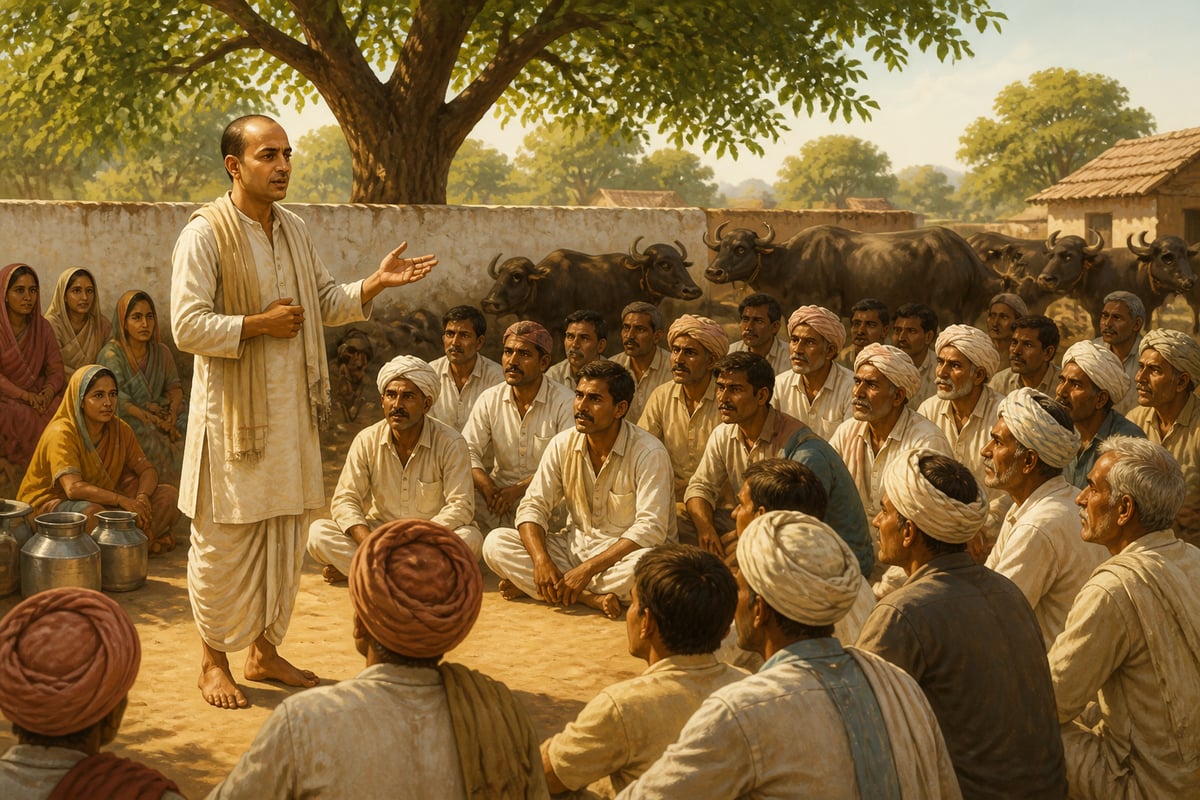
In 1946, a young Sardar Vallabhbhai Patel addressed dairy farmers in Gujarat's Kaira district. Middlemen were exploiting them, buying milk cheap, selling dear. Patel's solution was not government intervention or individual bargaining. It was saṅgha: farmers organizing themselves.
What emerged was Amul, the Anand Milk Union Limited. Today, Amul is managed by over 3.6 million milk producer members, processes 26 million liters of milk daily, and generates over ₹72,000 crore in annual revenue. It transformed India from a milk-deficit nation to the world's largest milk producer.
But the numbers miss the deeper lesson. Amul works because it embodies the Saṃjñāna Sūkta's principles:
- Saṃ gacchadhvam (come together), farmers physically organize into village cooperatives
- Saṃ vadadhvam (speak together), decisions made in collective assemblies, not by distant managers
- Saṃ vo manāṃsi (minds aligned), shared purpose of farmer welfare, not just profit
Dr. Verghese Kurien, who built Amul, explicitly rejected the Western corporate model of centralized control. He trusted the collective intelligence of farmers who understood their own needs. This is Vedic systems thinking applied to modern economics.
Research by Robb Willer (Stanford) shows that groups with shared 'mental models', common understanding of how things work, outperform groups with only shared goals. The Vedic insight that minds must align, not just actions, is confirmed by organizational psychology.
Patrick Lencioni's 'The Five Dysfunctions of a Team' identifies 'lack of commitment' as stemming from insufficient buy-in, people agreeing in words but not in minds. The Saṃjñāna Sūkta's three-level model diagnoses this precisely: alignment in speech without alignment in manas.
Complex systems require 'coherence', parts not just connected but synchronized in timing and purpose. A flock of starlings moves as one not through central command but through local alignment rules. The Vedic yajna operated similarly: each priest aligned with adjacent priests, creating emergent coordination.
Self-Determination Theory (Deci & Ryan) shows that motivation requires both autonomy (internal values = hṛdaya) and competence directed toward goals (external aims = ākūti). Groups that provide only one dimension fail to sustain engagement.
Simon Sinek's 'Start With Why' argues that organizations fail when they align on 'what' (product) but not 'why' (purpose). The Vedic formulation is more complete: align both the forward-looking aim AND the inward-felt heart.
Donella Meadows identified 'goals of the system' as a high leverage point, but noted that changing goals without changing values (paradigms) produces shallow change. Ākūti without hṛdaya is unsustainable.
A word of caution as we explore these teachings: Understanding Vedic collectivism challenges the assumption that individualism is progress and collectivism is primitive. The Rishis developed a nuanced model where individuals flourish through, not despite, their participation in aligned groups. This offers an alternative to both atomistic individualism and oppressive collectivism, a middle path where saṅgha enables, rather than diminishes, the self.
Your Path Forward
The Rishis did not romanticize collective action. They knew that groups could fail, fragment, or oppress. The Saṃjñāna Sūkta is not a description of what happens automatically, it is an aspiration, a practice.
This week, observe your own participation in groups, family, work, community. Ask:
- Are we truly saṃ gacchadhvam (moving together), or merely occupying the same space?
- Do we saṃ vadadhvam (speak together), or talk past each other?
- Are our manāṃsi (minds) aligned, or politely disagreeing?
True saṅgha is rare. That's why it's powerful. The sixteen priests trained for years to achieve the synchronization that made yajna effective. Collective action is not a default, it is a discipline.
In the next lesson, we will explore how collectives synchronize, the shared rhythms that make alignment possible.
Case studies
Amul: The Saṃjñāna Sūkta in Practice
In 1946, dairy farmers in Gujarat's Kaira district faced exploitation by middlemen who bought milk cheap and sold dear. Sardar Vallabhbhai Patel advised them not to seek government intervention or compete as individuals, but to organize, to form a saṅgha. What emerged was Amul (Anand Milk Union Limited), which today comprises 3.6 million farmer members, processes 26 million liters of milk daily, and has transformed India into the world's largest milk producer.
Amul embodies the Saṃjñāna Sūkta's three-level alignment: - **Saṃ gacchadhvam** (come together): Farmers organize into village-level cooperatives, physically meeting to make decisions - **Saṃ vadadhvam** (speak together): A single voice in negotiations with government and markets, eliminating middlemen - **Saṃ vo manāṃsi** (minds aligned): Shared purpose of farmer welfare, with profits returning to producers, not distant shareholders Dr. Verghese Kurien, who built Amul, explicitly rejected centralized corporate control. He trusted the samūha-prajñā (collective wisdom) of farmers who understood their own needs better than any expert.
Amul's cooperative model has been replicated across India, creating what's called Operation Flood, the world's largest dairy development program. India went from milk-deficit to producing 22% of global milk output. The model proves that saṅgha-śakti (collective power) can transform entire economies.
When individuals align their actions, speech, and minds toward shared purpose, they access power unavailable to even the most capable individual. Amul's farmers were not exceptional individuals, they were ordinary people in extraordinary alignment.
Cooperative models are experiencing a global renaissance, from platform cooperatives (driver-owned ride-sharing, worker-owned delivery apps) to community-owned renewable energy. The Amul model proves that when producers own the value chain, alignment between individual and collective interest produces outcomes that neither pure capitalism nor pure socialism achieves.
Amul's turnover in 2022-23 was ₹72,000 crore ($8.7 billion), with 86% of consumer price going directly to farmers, compared to 30-40% in conventional dairy supply chains.
Shivaji's Confederate Model: Saṅgha as Military Strategy
In the 17th century, Chhatrapati Shivaji Maharaj faced a strategic dilemma. The Mughal Empire had overwhelming central power, massive armies, vast treasuries, unified command. A direct confrontation would be suicidal. Shivaji's innovation was not military technology but organizational philosophy: he built power through saṅgha rather than centralized authority.
Shivaji's approach embodied Vedic collective principles: - **Distributed leadership**: Rather than a single command structure, he empowered local sardars (chiefs) to make autonomous decisions within shared principles - **Samānī ākūtiḥ** (common aim): All forces aligned toward Swarajya, self-rule, regardless of caste or region - **Samānā hṛdayāni** (common heart): A shared commitment to dharmic governance, protection of subjects, and resistance to oppression The Maratha Confederacy that emerged after Shivaji operated as a network, not a hierarchy. Multiple power centers (Peshwas, Gaekwads, Scindias, Holkars) coordinated through shared purpose rather than central command.
The Maratha Confederacy eventually controlled most of the Indian subcontinent, more territory than any power between Ashoka and the British. This wasn't achieved through a single conquering army but through a network of aligned forces that could coordinate rapidly while adapting locally. The model proved more resilient than centralized empires.
Against centralized power, the response is not competing centralization but distributed alignment. Shivaji understood what the Rishis taught: true saṅgha creates emergent power greater than any individual command structure.
Decentralized autonomous organizations (DAOs) in the crypto space and distributed military networks like NATO's alliance structure both echo Shivaji's model: distributed nodes with shared purpose outperforming centralized monoliths. The principle scales from guerrilla warfare to global technology platforms.
Starting from a small territory around Pune, the Maratha Confederacy eventually controlled over 2.8 million square km by 1760, more territory than any Indian power between the Mauryas and British. This was achieved not through one army but through distributed allied forces operating under shared principles.
Reflection
- Think of a group you belong to, family, team, community. At which of the three levels (action, speech, mind) is your group most aligned? Where does alignment break down?
- The Rishis suggest that true saṅgha amplifies the individual rather than diminishing them. Have you ever experienced this, a moment when being part of a group made you more yourself, not less?
- If collective action creates emergent power unavailable to individuals (saṅgha-śakti), what does this imply about the nature of the self? Is the individual truly separate, or always already connected?